Executive Overview
Human industrial activity has fundamentally altered the trajectory of Earth’s geological future. According to a landmark study published in the journal Science, the relentless burning of fossil fuels may have inadvertently short-circuited a natural planetary cycle, halting the descent of the Earth into a new ice age.
For decades, paleoclimatologists have studied the natural rhythm of the planet, which swings between interglacial periods and sprawling continental freezes driven by shifts in Earth’s orbit and axial tilt—phenomena known as Milankovitch cycles. The latest research indicates that the remnants of the Laurentide Ice Sheet, specifically the Barnes Ice Cap on Canada’s Baffin Island, began expanding thousands of years ago, signaling the creeping onset of a brand-new glacial period.
However, this slow march toward a frozen epoch ground to an abrupt halt in the mid-20th century. As industrial carbon dioxide emissions surged following the post-World War II economic boom, the Barnes Ice Cap reversed its millennia-long growth pattern, shifting from expansion to rapid retreat. This revelation provides startling insight into the sheer scale of human influence on planetary systems: humanity had already altered the global climate enough to prevent a natural ice age before the modern environmental movement even began.
Detailed Chronology: From Ancient Ice to Modern Retreat
To understand how human activity halted an ice age, scientists had to reconstruct a timeline spanning thousands of years, utilizing ancient rocks, trapped vegetation, and historical aerial photography.
The Retreat of the Laurentide Giant
The Earth’s most recent major ice age drew to a close roughly 12,000 years ago. At its maximum extent, the colossal Laurentide Ice Sheet dominated North America, burying all of Canada under thousands of feet of ice and extending its southern tendrils as far down as modern-day New York State and the Midwest.
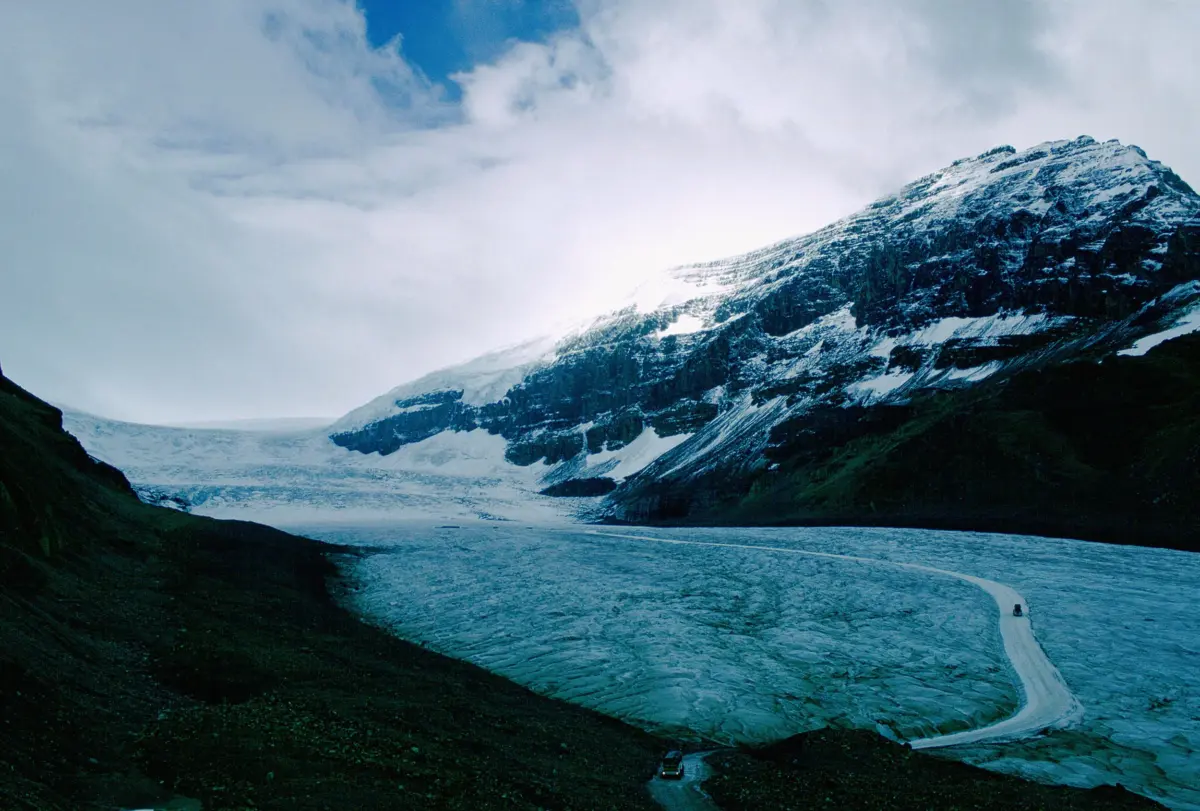
As global temperatures rose naturally at the end of the Pleistocene epoch, this massive sheet retreated toward the poles. Yet, it did not vanish entirely. A small fragment of that ancient sheet remained trapped in the high latitudes of Baffin Island: the Barnes Ice Cap. Spanning an area roughly the size of Delaware, this unique ice formation is frozen directly to the underlying bedrock rather than moving dynamically like a traditional valley glacier. This geographical quirk acts as a natural freezer, preserving the landscape and biological records underneath it.
The 3,600-Year Milestone and the Return of the Ice
To determine when the Barnes Ice Cap first stabilized at its modern size, lead author Nicolás Young and his team at Columbia University’s Lamont-Doherty Earth Observatory utilized an innovative exposure-dating technique.
By measuring concentrations of Beryllium-10—a rare isotope that accumulates on rock surfaces when exposed to cosmic rays—the researchers calculated when rocks surrounding the glacier were last exposed to the sky. Their findings revealed that the ice cap reached its current footprint approximately 3,600 years ago.
Following this stabilization, the ice cap began to creep outward once more. To trace this resurgence, the research team looked to the tundra’s most resilient inhabitants: mosses and lichens.
"After the ice cap retreated, mosses eventually colonized this newly exposed land," explains Young. "These mosses are living there, and things are normal—then, eventually, the ice cap starts to re-expand. The ice covers the moss, and kills it."
Trapped beneath the advancing ice, these dead moss specimens were preserved in pristine condition. Radiocarbon dating of these organic fragments allowed the scientific team to piece together a precise timeline. The data indicates that the Barnes Ice Cap began its modern expansion phase roughly 2,000 years ago—a milestone that many paleoclimatologists view as the harbinger of a new glaciation period.
The 1960s Turning Point
For two millennia, the ice cap continued its slow, persistent crawl across the Canadian tundra. But this multi-century trajectory suffered a violent disruption in the 1960s.
By cross-referencing historical aerial photographs with modern satellite telemetry, the researchers discovered that the ice cap abruptly reversed course. Instead of growing, it began to shrink at an unprecedented rate. Since the 1980s, the margins of the Barnes Ice Cap have retreated by an average of 4 meters per year. This sudden, dramatic reversal corresponds precisely with the exponential acceleration of human-induced carbon dioxide emissions, which have driven widespread glacial retreat across every continent on Earth.
Supporting Context & Metrics: Decoding the Science of Glaciation
The implications of the Science study stretch far beyond Baffin Island, touching on the fundamental mechanics of Earth’s climate system and addressing long-standing controversies in climate science.
The Milankovitch Cycles and Natural Rhythms
To contextualize the study’s findings, it is necessary to examine the natural drivers of planetary climate shifts. Milankovitch cycles describe the collective effects of changes in the Earth’s movements on its climate over thousands of years. These cycles encompass:
- Eccentricity: The shape of Earth’s orbit around the sun (roughly a 100,000-year cycle).
- Obliquity: The angle that Earth’s rotational axis is tilted relative to its orbital plane (a 41,000-year cycle).
- Precession: The direction of Earth’s axis of rotation (a 26,000-year cycle).
These astronomical variations dictate the amount of solar radiation reaching different parts of the planet during specific seasons. When high-latitude summers receive less solar energy, winter snowpacks fail to melt completely, accumulating year over year and eventually triggering the growth of continental ice sheets. Under natural conditions, the Earth was primed to enter another one of these cooling phases.
The 1970s "Ice Age Scare" Re-examined
The new findings also shed light on an episode frequently weaponized by climate change skeptics. In the early 1970s, as global temperatures experienced a temporary, localized cooling trend, a group of prominent scientists gathered at Brown University to discuss the looming possibility of a new ice age. Convinced by preliminary data that a glaciation period was imminent, the group took the extraordinary step of drafting a formal warning letter to President Richard Nixon.
For decades, climate deniers have pointed to this historical meeting—and the sensationalized media coverage surrounding it—as proof that the scientific community cannot be trusted, framing global warming as a manufactured hoax.
However, the new research from Young and his colleagues reframes this history entirely.
"I think this study actually helps show that scientists were right about a pending glaciation," Young notes.
The scientists of the 1970s were observing a natural planetary cycle that was genuinely underway. What they could not fully anticipate was the unprecedented, exponential spike in anthropogenic greenhouse gas emissions that would completely overpower these natural astronomical forces. Far from invalidating modern climate science, the 1970s ice age hypothesis—when viewed through the lens of this new data—demonstrates just how powerfully human industrial activity has overridden the planet’s natural operating system.
Official Statements and Expert Analysis
The study has drawn widespread acclaim from the broader scientific community, while prompting calls for further comparative research.
-
Andrew Wickert (University of Minnesota Twin Cities):
Commenting on the broader cultural and scientific weight of the research, environmental science professor Andrew Wickert noted, "A question that’s in the popular consciousness is, have we caused enough global warming to stop the next ice age from happening? Even as we were just starting to ramp up emissions, we’ve already done enough damage to cause the major North American ice sheet to already start retreating. That’s significant." -
Nicolás Young (Columbia University, Lead Author):
Reflecting on the sheer temporal magnitude of the modern thaw, Young emphasized the scale of the disruption: "Modern retreat of this glacier has reversed 2,000 years of net expansion—that’s a pretty decent chunk of time." -
Meredith Kelly (Dartmouth College):
Praising the empirical rigor of the study as "awesome" and citing its ability to display a "clear pattern of what the ice cap was doing," Earth sciences professor Meredith Kelly nevertheless urged caution regarding global generalizations. Kelly emphasized that future research must compare the Barnes Ice Cap data against sediment and ice cores from other high-latitude sites to fully map out how the entire Northern Hemisphere was transitioning into glaciation prior to industrial interference.
Future Outlook: A Planet Locked in an Artificial State
The revelation that human emissions have halted a natural ice age forces a profound philosophical and scientific reckoning. For millions of years, Earth’s climate has been governed by astronomical rhythms—slow, majestic cycles of freezing and thawing that dictated the rise and fall of ecosystems and species.
Today, humanity has effectively seized control of the planetary thermostat. By driving atmospheric carbon dioxide concentrations well past pre-industrial baselines, we have pushed the Earth into an artificial warm state. While avoiding the catastrophic encroachment of massive continental ice sheets might sound beneficial on the surface, the mechanism by which it was achieved—uncontrolled fossil fuel combustion—has unleashed a cascading series of planetary crises.
Rising sea levels, extreme weather events, ocean acidification, and the destabilization of vital climatic currents are the steep prices of our geological intervention. The Barnes Ice Cap stands not merely as a relic of the last ice age, but as a monument to the Anthropocene: a quiet, frozen witness to the moment humanity rewrote the future of the Earth.