Executive Overview
Amazon Web Services (AWS) has announced the public preview of the AWS Well-Architected Agent, an advanced, AI-powered service designed to radically transform how organizations evaluate, optimize, and maintain their cloud environments. Moving far beyond traditional, manual audits and static rule-based checklists, the Well-Architected Agent acts as an expert virtual cloud architect. It continuously reviews infrastructure, correlates complex utilization metrics, understands bespoke business goals, and delivers context-aware, highly targeted optimization recommendations complete with ready-to-implement remediation packages.
By synthesizing resource configurations, application topologies, and operational metrics across more than 65 AWS services, the new agent bridges the persistent gap between architectural best practices and execution velocity. It evaluates workloads through the established lenses of the AWS Well-Architected Framework—focusing on cost optimization, security, performance efficiency, and reliability—while proactively highlighting critical cross-pillar trade-offs.
Available initially across select AWS regions for customers enrolled in qualifying AWS Support plans, this launch marks a watershed moment in automated cloud management. This comprehensive report explores the architectural mechanics of the Well-Architected Agent, its core capabilities, its workflow integration via Infrastructure as Code (IaC) and the AWS Model Context Protocol (MCP) Server, and the broader industry implications for enterprise cloud operations.
Detailed Chronology and Core Architecture
Moving Beyond Static Checklists
For years, cloud engineers and enterprise architects have relied on the AWS Well-Architected Tool to conduct manual reviews of their environments. While immensely valuable for uncovering systemic risks, these traditional reviews require significant human capital, time, and cross-functional coordination. They often result in static lists of generic recommendations that lack the nuanced context of an organization’s specific runtime environment, application dependencies, and commercial constraints.
The AWS Well-Architected Agent was engineered to solve this operational bottleneck. Conceptualized and developed to emulate the diagnostic methodology of seasoned enterprise cloud architects, the agent operates autonomously yet under the strict governance of user-defined parameters. Instead of merely flagging an over-provisioned instance or an open security group, the agent evaluates the holistic ecosystem—correlating CPU, memory, and network utilization metrics against deployment configurations and actual application topologies.
The Inner Workings: From Data Ingestion to Remediation
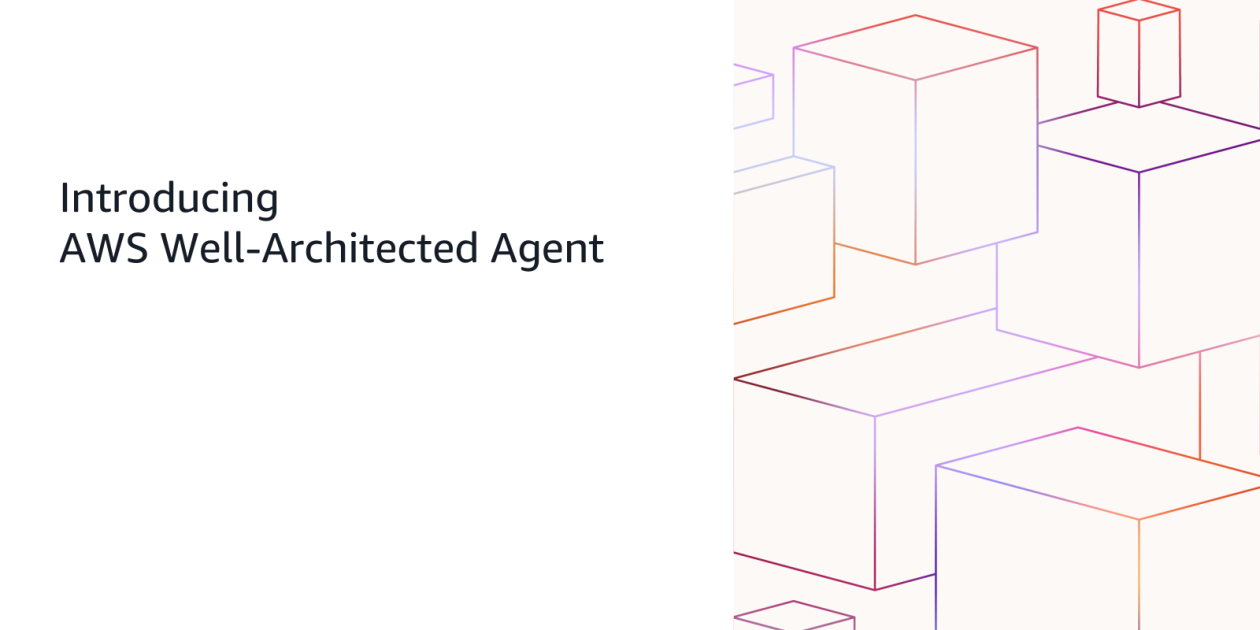
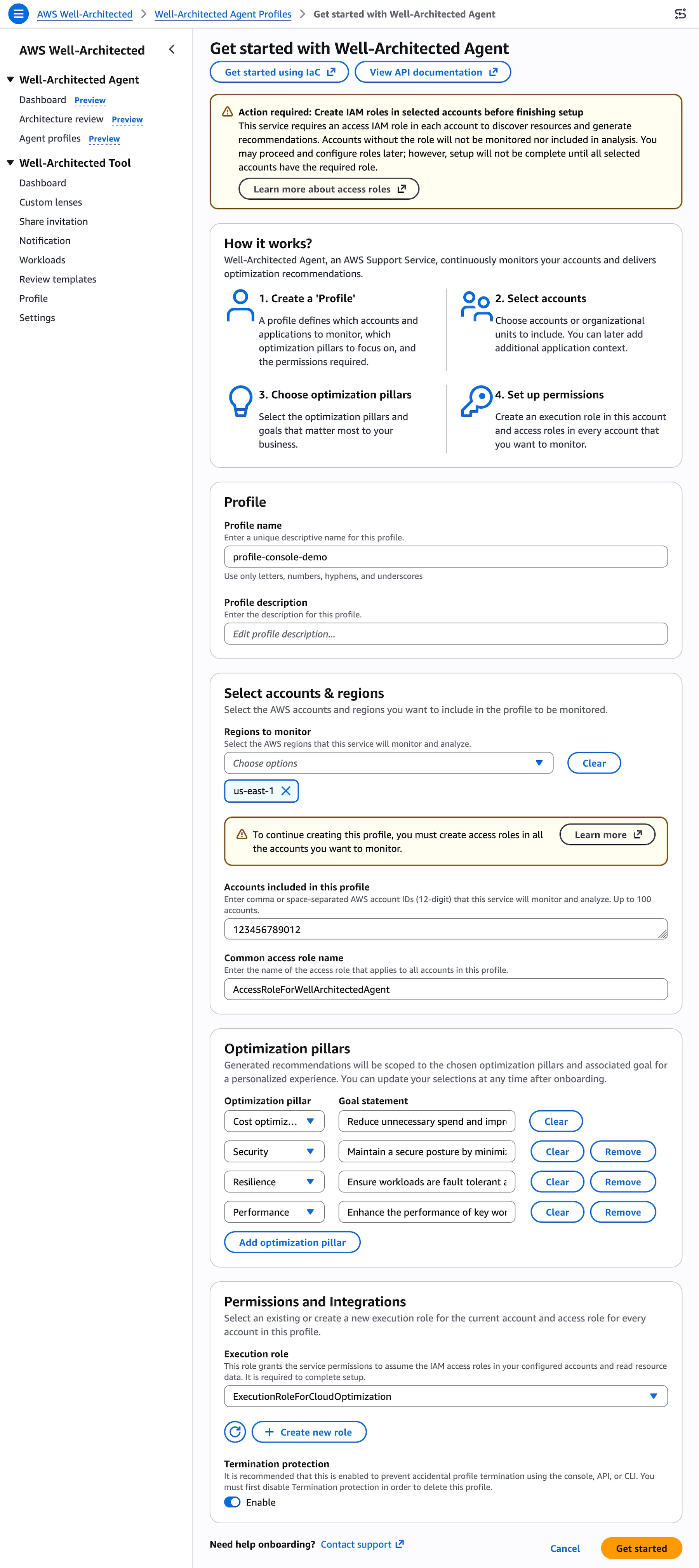
The operational lifecycle of the AWS Well-Architected Agent is divided into four distinct phases: scoping, ingestion and analysis, recommendation generation, and automated remediation.

- Scoping via Agent Profiles: Administrators begin by establishing an agent profile within the AWS Well-Architected console. This step defines the exact boundaries of the agent’s authority. Teams can specify which AWS accounts, regions, and optimization pillars (Cost Optimization, Performance Efficiency, Reliability, and Security) the agent should prioritize. Crucially, users can assign distinct business goals to each pillar, allowing the AI to tailor its evaluation metric weights—for instance, aggressively prioritizing latency-reduction trade-offs over cost minimization for mission-critical transactional workloads.
- Secure Access Provisioning: To evaluate the environment, the agent utilizes customer-managed IAM roles. These roles grant read-only access to resource configurations, telemetry, and topology data without exposing underlying application payloads.
- Deep Analysis and Cross-Pillar Correlation: Once initialized, the agent processes environment data against Well-Architected best practices spanning over 65 distinct AWS services. Within 24 hours of profile creation, it generates a ranked list of prioritized findings. Unlike traditional scanners, every finding includes a comprehensive impact analysis, an explanation of why the recommendation was made, and a clear breakdown of cross-pillar trade-offs (e.g., how an enhanced security posture might marginally increase operational cost or latency).
- Actionable Remediation Packages: The agent does not stop at diagnosis; it expedites resolution. Engineers can choose from multiple resolution types, including direct console actions, CLI commands, or updated Infrastructure as Code (IaC) templates ready for integration into existing continuous integration and continuous deployment (CI/CD) pipelines.
Supporting Context, Features, and Technical Workflows
To fully appreciate the utility of the AWS Well-Architected Agent, one must examine its core functional components and how they integrate into modern software development lifecycles.
[ AWS Environment / IaC Repository ]
               │
               ▼ (Customer-Managed IAM Roles)
   [ AWS Well-Architected Agent ]
               │
        ┌──────┴──────┐
        ▼             ▼
[ Live Analysis ]  [ Pre-Deployment IaC Review ]
        │             │
        └──────┬──────┘
               ▼
   [ Prioritized Recommendations ]
       (Cross-Pillar Trade-offs)
               │
        ┌──────┴──────┐
        ▼             ▼
[ Console Action ]  [ Updated IaC (Terraform/CDK) ]
1. Pre-Deployment Architecture Reviews
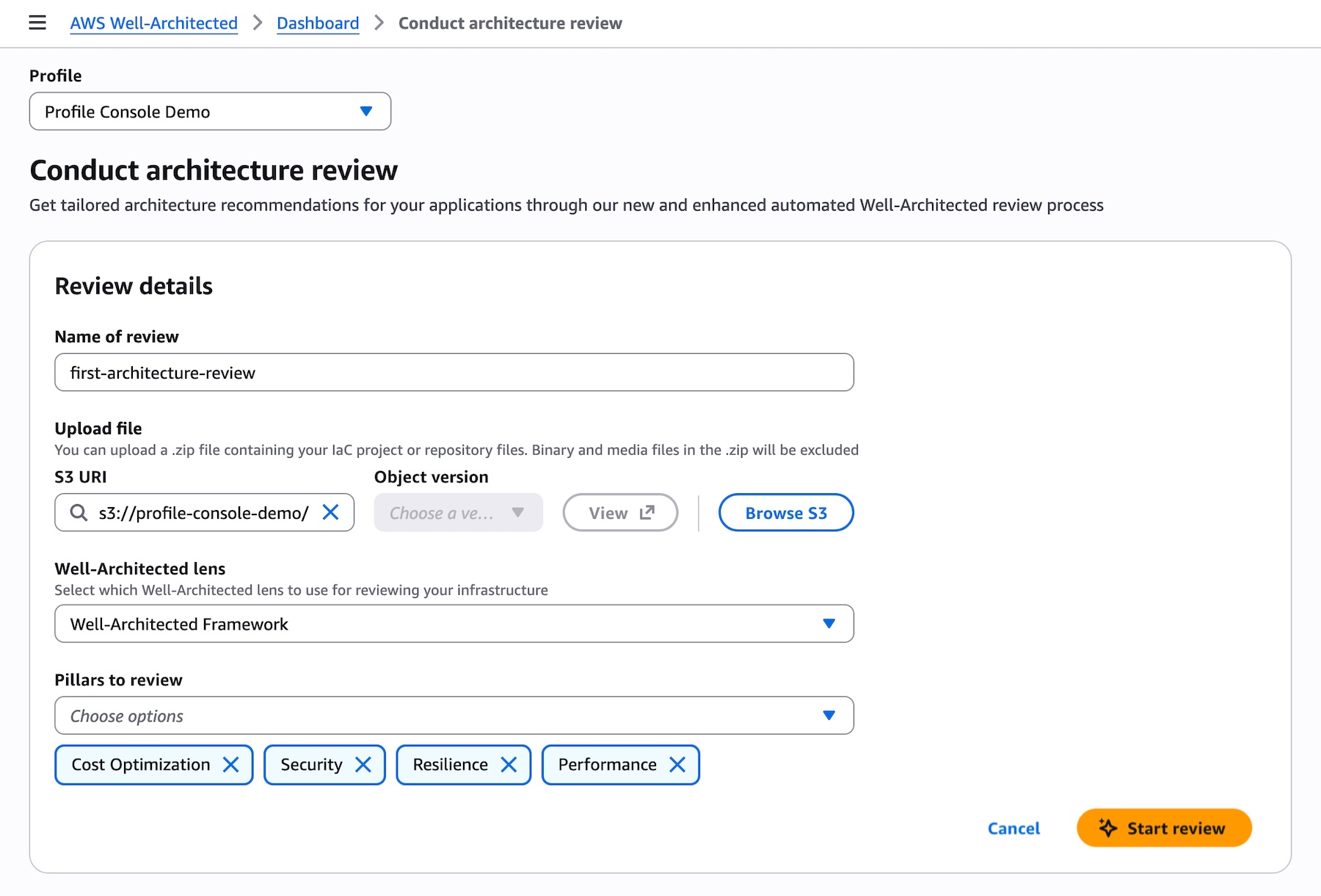
Cloud optimization has historically been reactive—fixing architectural flaws after they have been deployed to production. The Well-Architected Agent breaks this reactive cycle by introducing pre-deployment code analysis.
Development teams can upload an archive (.zip) containing their Infrastructure as Code projects—whether written in Terraform, AWS CloudFormation, or the AWS Cloud Development Kit (CDK)—directly into the console. The agent analyzes these templates against chosen Well-Architected lenses before a single resource is provisioned. This shift-left approach ensures that security misconfigurations, non-compliant resource types, and structural inefficiencies are caught and neutralized during the coding phase.
2. Contextual Application Boundaries
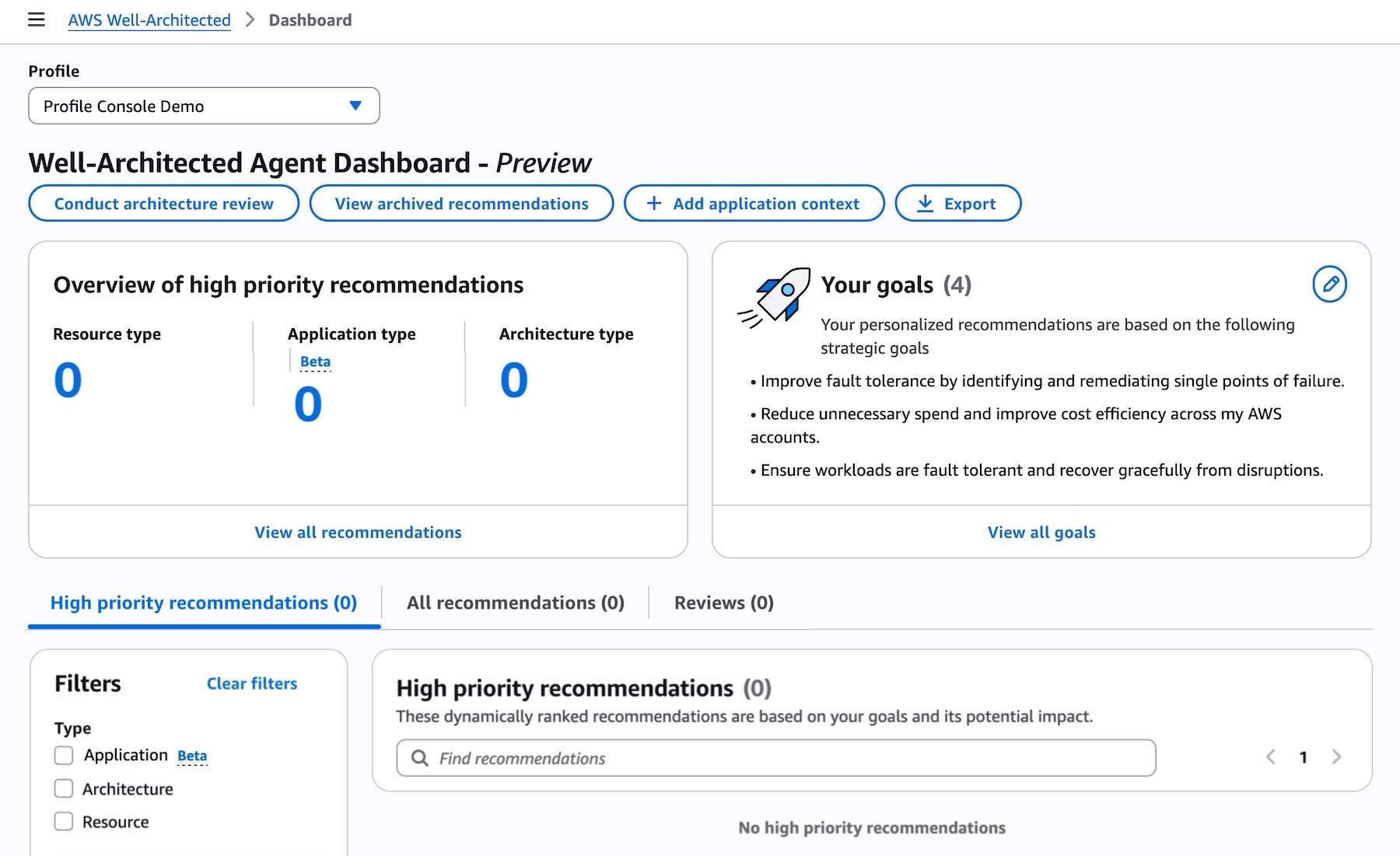
Generic alerts often plague operations teams with noise because automated tools lack application context. A database running at 90% CPU utilization might be interpreted as a performance bottleneck by a naive script, whereas an expert architect knows it is intentionally tuned for batch processing during off-peak hours.
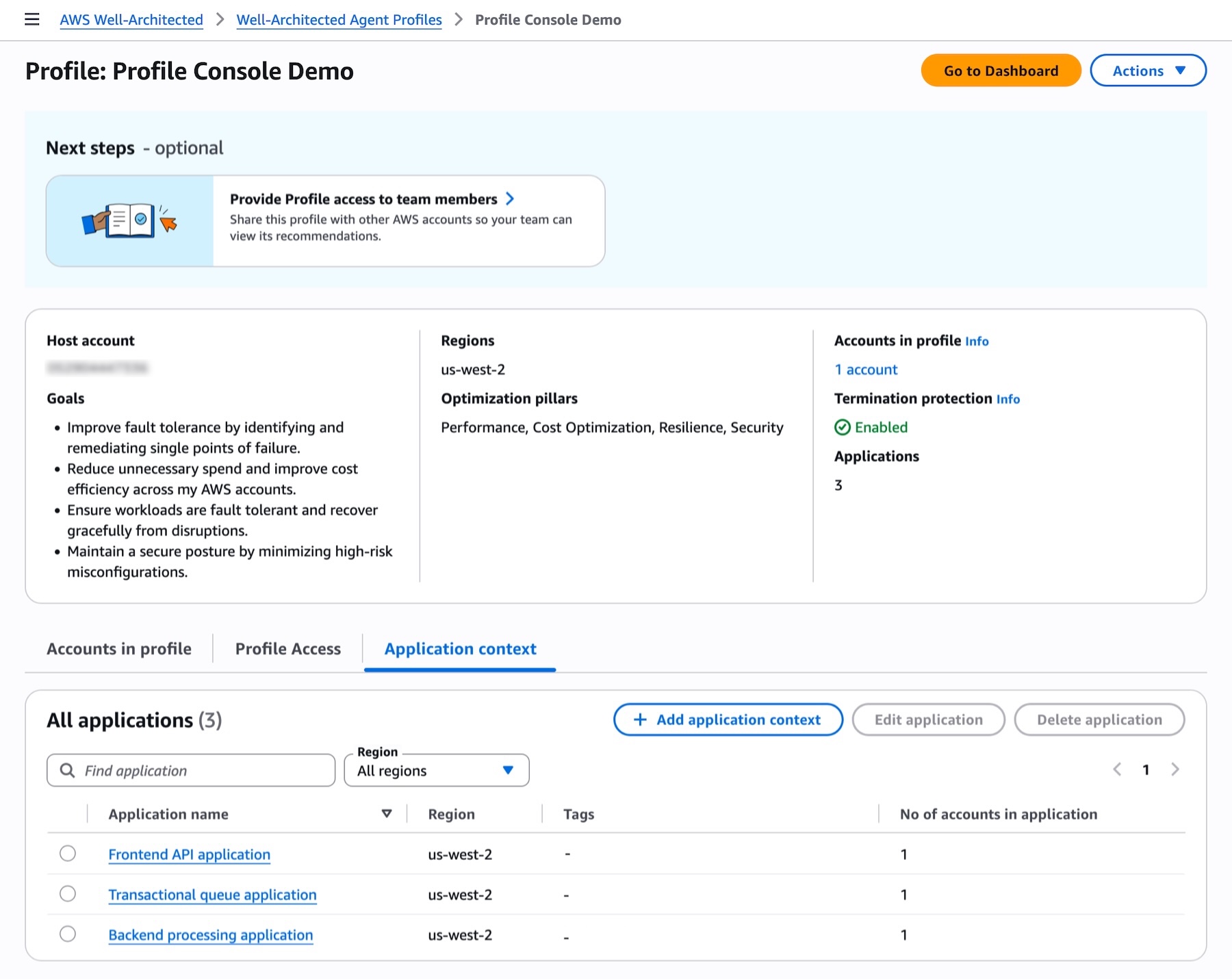
The Well-Architected Agent addresses this through Application Context Enrichment. By using the dashboard to define applications—mapping specific accounts, regions, services, and resource tags—engineers provide the AI with vital business context. This context refines recommendation relevancy, virtually eliminating false positives and ensuring that optimization insights align with the actual business intent of the workload.
3. Programmatic Integration via AWS MCP Server and Plugins
Modern cloud operations rely heavily on automation and developer tooling rather than manual console navigation. Recognizing this, AWS has built deep extensibility into the Well-Architected Agent.
Through the AWS Model Context Protocol (MCP) Server and associated plugins, development teams can interact with the agent programmatically. Engineers can query optimization documentation, search findings, and pull remediation advice directly within their preferred AI coding assistants and Integrated Development Environments (IDEs). When the agent generates a recommendation fix involving an updated CDK function or Terraform module, developers can copy the code directly into their active codebase without breaking their development flow.
Official Statements and Industry Impact
While specific executive quotes from the initial release announcement focus on the developer-centric rollout led by community advocates like Channy Yun, the strategic implications of the service are profound. Industry analysts and enterprise cloud architects have long anticipated generative AI moving from general-purpose chat interfaces to deeply integrated, domain-specific systems capable of autonomous infrastructure governance.
By embedding decades of AWS engineering best practices into an autonomous agent, Amazon is effectively democratizing enterprise-grade cloud architecture. Smaller engineering teams, which may lack dedicated cloud optimization specialists or enterprise support architects, can now continuously posture their environments against the gold standard of AWS design principles.
Furthermore, the introduction of cross-pillar trade-off analysis addresses a long-standing critique of automated optimizers. Too often, cost-optimization tools blindly suggest downsizing instances without factoring in the resulting degradation of system resilience or security posture. By explicitly surfacing these trade-offs, the Well-Architected Agent empowers technical leaders to make informed, balanced decisions that reflect their organization’s unique risk tolerance and financial strategy.
Future Outlook and Availability
Availability and Prerequisites
As of its public preview announcement, the AWS Well-Architected Agent is accessible in three primary regions:
- US East (N. Virginia)
- US East (Ohio)
- US West (Oregon)
Despite these regional service hosting locations, organizations can onboard and monitor workloads originating from any AWS commercial region. The service is delivered as part of AWS Support and is available to all customers subscribed to an eligible AWS Support plan.
The Road Ahead
As the public preview progresses, industry watchers expect AWS to expand the agent’s capabilities in several key directions:
- Broader Service Coverage: Extending analysis beyond the initial 65+ services to encompass emerging generative AI services, specialized database engines, and complex hybrid-cloud architectures.
- Autonomous Remediation Loops: While current workflows require human approval to apply fixes (via console, CLI, or IaC templates), future iterations may introduce policy-driven, automated self-healing for low-risk, high-confidence optimizations.
- Custom Enterprise Lenses: Integrating custom organizational best practices and compliance frameworks seamlessly into the agent’s reasoning engine, bridging internal governance policies with native AWS telemetry.
Conclusion
The release of the AWS Well-Architected Agent represents a fundamental evolution in cloud management. By fusing deep infrastructural telemetry with contextual AI reasoning, AWS has transformed the Well-Architected Framework from a static reference guide into an active, breathing participant in enterprise software engineering. For organizations striving to maintain secure, resilient, high-performing, and cost-effective cloud estates, the Well-Architected Agent promises to cut through operational noise and deliver actionable clarity at scale.
Developers and cloud architects are encouraged to explore the public preview today via the AWS Well-Architected console and provide feedback through standard AWS Support channels.