Executive Overview
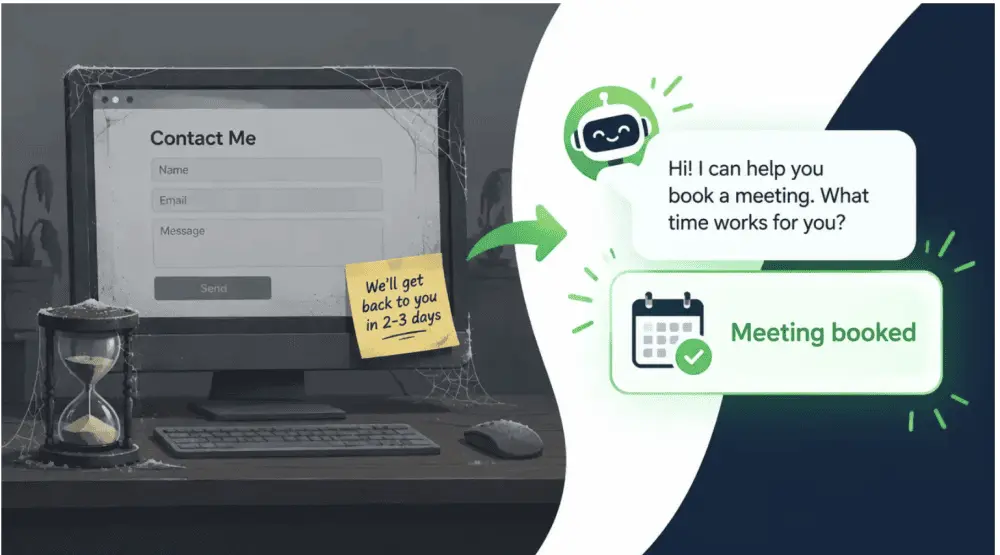
For decades, the B2B go-to-market playbook has followed a rigid, predictable—and often painfully slow—cadence. A prospective buyer visits a company’s website, navigates past layers of marketing copy, and arrives at the digital equivalent of a black hole: the "Contact Us" form. They submit their information, a silent digital clock begins to tick, and somewhere in an internal queue, a junior sales development representative (SDR) eventually reviews the submission.
By the time a human finally reaches out—frequently days later—the moment has passed. The buyer has moved on, cooled down, or found an alternative solution.
In 2026, this latency is no longer just inefficient; it is a structural liability. According to insights shared by SaaStr founder Jason Lemkin, a surprising number of modern B2B organizations—including AI-native startups that raised millions on futuristic agent narratives—are still operating their inbound funnels with legacy workflows: a static form, a manual routing queue, and an overwhelmed SDR.
SaaStr decided to upend this status quo. By replacing its traditional inbound workflow with an autonomous AI agent named "Amelia AI"—built on Qualified’s Piper architecture and modeled after SaaStr’s Chief AI Officer, Amelia Lerutte—the organization processed over two million website sessions, generated 614 targeted meetings, and secured upwards of $1 million in closed-won revenue. More importantly, the experiment revealed a seismic shift in pipeline efficiency: 71% of SaaStr’s closed-won sponsorship deals in a single month were sourced directly by the AI inbound agent, shattering historic inbound performance benchmarks.
This report examines how SaaStr transitioned away from manual lead routing, the operational mechanics behind deploying a high-performing inbound agent, and why the simplest page on your website—the contact form—is the most crucial frontier for enterprise artificial intelligence.
Detailed Chronology: From Squarespace Queues to Autonomous Inbound
To understand the magnitude of SaaStr’s AI transition, one must examine the legacy infrastructure that preceded it. For years, SaaStr managed its inbound traffic using a standard stack anchored by a Squarespace website.
The Friction of the Legacy Flow
Under the old operational model, the path from prospect interest to discovery call was fraught with friction points:
- Submission & Latency: A prospect filled out an inquiry form, which entered a digital queue.
- Manual Round-Robin: A human team member manually assigned the lead to an Account Executive (AE) via a round-robin rotation.
- The Waiting Game: The AE followed up asynchronously when their schedule permitted, introducing a mandatory two-to-three-day lag during a standard business week.
- Calendar Tag: Once the AE reached out, a tedious back-and-forth email exchange ensued to nail down a mutually agreeable meeting time.
- Redundant Discovery: Finally, a meeting was booked, but the first 10 minutes were invariably wasted on basic qualifying questions that could have been answered prior to the call.
The end-to-end timeline routinely stretched across 48 to 72 hours. While leadership considered this an operational baseline that "worked," a post-mortem audit following a major SaaStr Annual event exposed a devastating blind spot.
A meticulous review of Salesforce data uncovered approximately 1,000 high-intent prospects who had filled out the "I’m interested in sponsoring" form and received zero human follow-up. Ever. These were warm, high-intent buyers who had actively raised their hands and asked for an opportunity to exchange capital for partnership visibility, only to fall through the cracks of a neglected queue.
The Turning Point: Deploying Amelia AI
Recognizing that every handoff represents a point where a warm lead cools—and where potential revenue quietly evaporates—SaaStr pulled the plug on the legacy inbound queue. In its place, they deployed Amelia AI.
Designed to operate instantaneously, Amelia eliminates the traditional waiting period. When a user lands on high-value pages, such as sponsorship prospectuses or pricing matrices, the agent initiates an interactive, contextual dialogue within seconds. Rather than forcing a user to wait for a 21-year-old human to manually evaluate their company size and budget, the agent qualifies the prospect in real time, answers complex structural questions using up-to-date documentation, and drops a direct calendar booking link into the chat window.
Supporting Context & Metrics: The Hard Data Behind Autonomous Inbound
The financial and operational metrics generated by SaaStr’s deployment of Amelia AI challenge long-held assumptions about the limits of customer-facing automation.
Scale and Conversion Efficiency
During a single SaaStr AI Annual event cycle, the inbound agent’s performance figures highlighted the stark contrast between human-staffed queues and continuous AI execution:
- Total Sessions Handled: While a human team managing live chat might realistically field 100 to 200 sessions before burning out, the AI agent seamlessly navigated over 45,000 qualifying sessions.
- Meetings Generated: The agent successfully booked 614 targeted meetings.
- Deal Velocity and Value: With an average deal size hovering around $85,000 for top-tier sponsorships, the cumulative pipeline value touched tens of millions of dollars, culminating in over $1 million in closed-won revenue directly attributable to the agent.
- The Conversion Spike: Historically, inbound leads accounted for roughly 29% to 34% of SaaStr’s closed-won sponsorship deals. During the agent’s peak operating month, 71% of all closed-won sponsorship revenue originated from AI-qualified inbound leads.
Solving the Burnout Equation
Staffing an equivalent volume of inbound traffic manually would require a dedicated team of at least three full-time Business Development Representatives (BDRs). Beyond the prohibitive payroll costs, enterprise leadership notes a harsh operational reality: junior inbound SDRs frequently churn or burn out within three months of repetitive qualification duties.
An AI agent, by contrast, operates 24 hours a day, 7 days a week, across every global time zone, without experiencing fatigue, morale degradation, or administrative drift.
Official Statements & Core Philosophy: Why Inbound Agents Succeed Where Outbound Fails
According to Jason Lemkin, the primary reason inbound agents represent a high-ROI, low-friction deployment lies in the fundamental nature of intent.
"One of the simplest, highest ROI things to put an agent on? Your Contact Me form. No one should wait days to hear back from a 21-year-old human to qualify them." — Jason Lemkin, Founder of SaaStr
The Bounded Nature of Inbound
Most enterprise AI agent deployments struggle because the operational scope is "fuzzy"—the agent is asked to perform open-ended, unpredictable tasks across ambiguous domains. Inbound qualification, however, represents the precise inverse:
- High Intent: The buyer has already raised their hand and initiated contact. They want to talk.
- Bounded Responsibilities: The agent’s job description is strictly circumscribed: answer accurate questions, qualify the lead against predefined criteria, route the prospect to the appropriate AE, and secure a calendar booking.
- Clear Success Metrics: Success is binary and easily measurable—meetings booked and revenue closed.
- Asymmetric Risk Profile: The downside risk is effectively zero, because the alternative being replaced is a static form sitting neglected in a backend queue.
Outbound vs. Inbound: A Comparative Advantage
Many startups invest heavily in complex outbound agent stacks that require pristine data hygiene, sophisticated list-building, IP warm-ups, multi-channel sequencing, and exhaustive iteration before generating a response.
Inbound agents bypass these hurdles entirely. Because the traffic is already visiting your digital real estate, an inbound agent begins producing tangible, revenue-generating outputs within weeks of deployment.
Future Outlook: The Evolution of Intelligent Revenue Routing
SaaStr’s experience offers a roadmap for the future of B2B go-to-market strategies. As artificial intelligence matures, the competitive advantage will no longer belong to companies with the largest manual sales teams, but to those that leverage intelligent orchestration and deep contextual integration.
Beyond the Chat Window: Capturing Abandoned Intent
The chat interface is merely the surface layer of an advanced inbound agent. The true economic value is captured in what happens when prospects disengage.
SaaStr utilizes its agent infrastructure to monitor behavioral friction points:
- Abandoned Prospectus Pages: If a prospective sponsor browses a high-value partnership deck multiple times without filling out a form, the agent proactively engages or flags the behavior.
- VIP Ticket Recovery: Automated workflows step in when visitors hesitate at checkout or exit ticket purchase flows, offering contextual assistance or dynamic incentive codes.
CRM Context: The Difference Between a Chatbot and an SDR
An inbound agent operating in a vacuum—devoid of historical customer relationship management (CRM) data—is little more than an expensive, glorified FAQ bot. When Amelia AI interacts with a visitor, she instantly cross-references internal databases to determine:
- Whether the visitor’s company has attended past events.
- If a colleague has previously engaged with SaaStr sales teams.
- Historical sponsorship tiers and organizational size.
This deep context changes the dynamic entirely. Instead of a robotic interrogation, the conversation mirrors an ongoing business relationship. Furthermore, downstream handoffs are vastly streamlined; Account Executives receive a comprehensive dossier before the introductory call, allowing them to skip tedious discovery phases entirely.
Intelligent Routing vs. Blind Round-Robins
Traditional sales management relies on round-robin assignment to maintain fairness among sales representatives. However, fairness to reps rarely equates to optimization for revenue.
Modern AI architectures weight historical Salesforce data to route inbound opportunities dynamically. High-value accounts are directed specifically to the Account Executives who statistically close those deal types with the highest win rates, maximizing yield across the entire pipeline.
Conclusion
The modern buyer’s patience has vanished. In a hyper-competitive B2B landscape where deal cycles are lengthening and every closed-won contract requires immense effort, operational lag is where inbound revenue goes to die.
SaaStr’s transition from a neglected Squarespace form and a multi-day SDR queue to an autonomous, context-aware AI agent demonstrates a fundamental truth of 2026 go-to-market strategy: automation is no longer a peripheral experiment—it is the core engine of modern pipeline velocity. By letting artificial intelligence handle the routine friction of qualification and routing, organizations can transform their most boring website page into their most reliable revenue generator.