Executive Overview
The landscape of enterprise cloud computing and artificial intelligence is undergoing a profound paradigm shift. In a strategic expansion of its artificial intelligence ecosystem, Amazon Web Services (AWS) has announced the public preview of Amazon Bedrock Managed Agents powered by OpenAI. This development bridges two of the most influential entities in the modern technology sector. Built upon a customized iteration of OpenAI’s Agents API, this AWS-native integration allows developers and enterprise architects to design, deploy, and scale advanced autonomous agents optimized specifically for OpenAI models—all while operating entirely within the secure, highly governed boundaries of the AWS cloud infrastructure.
Simultaneously, AWS continues to refine its expansive global portfolio of cloud services through routine lifecycle management updates. As cloud-native architectures mature, optimizing resource allocation requires a delicate balance between driving cutting-edge innovation and gracefully phasing out legacy tools. This comprehensive report explores the architectural mechanics of the new Bedrock Managed Agents, analyzes the flexibility offered by dual execution environments, evaluates the broader implications of AWS’s latest model expansions, and details the structural lifecycle adjustments taking effect across the platform.
Detailed Chronology & Architectural Deep Dive
Bridging Ecosystems: Amazon Bedrock Managed Agents Powered by OpenAI
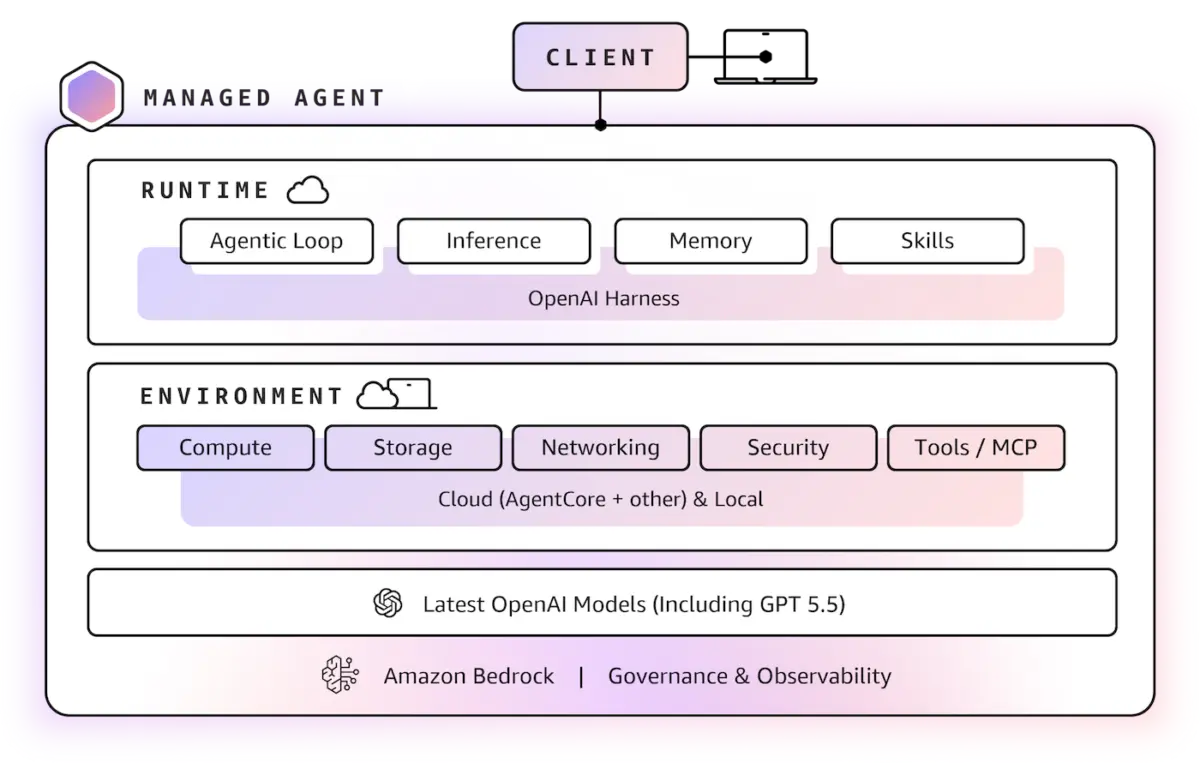
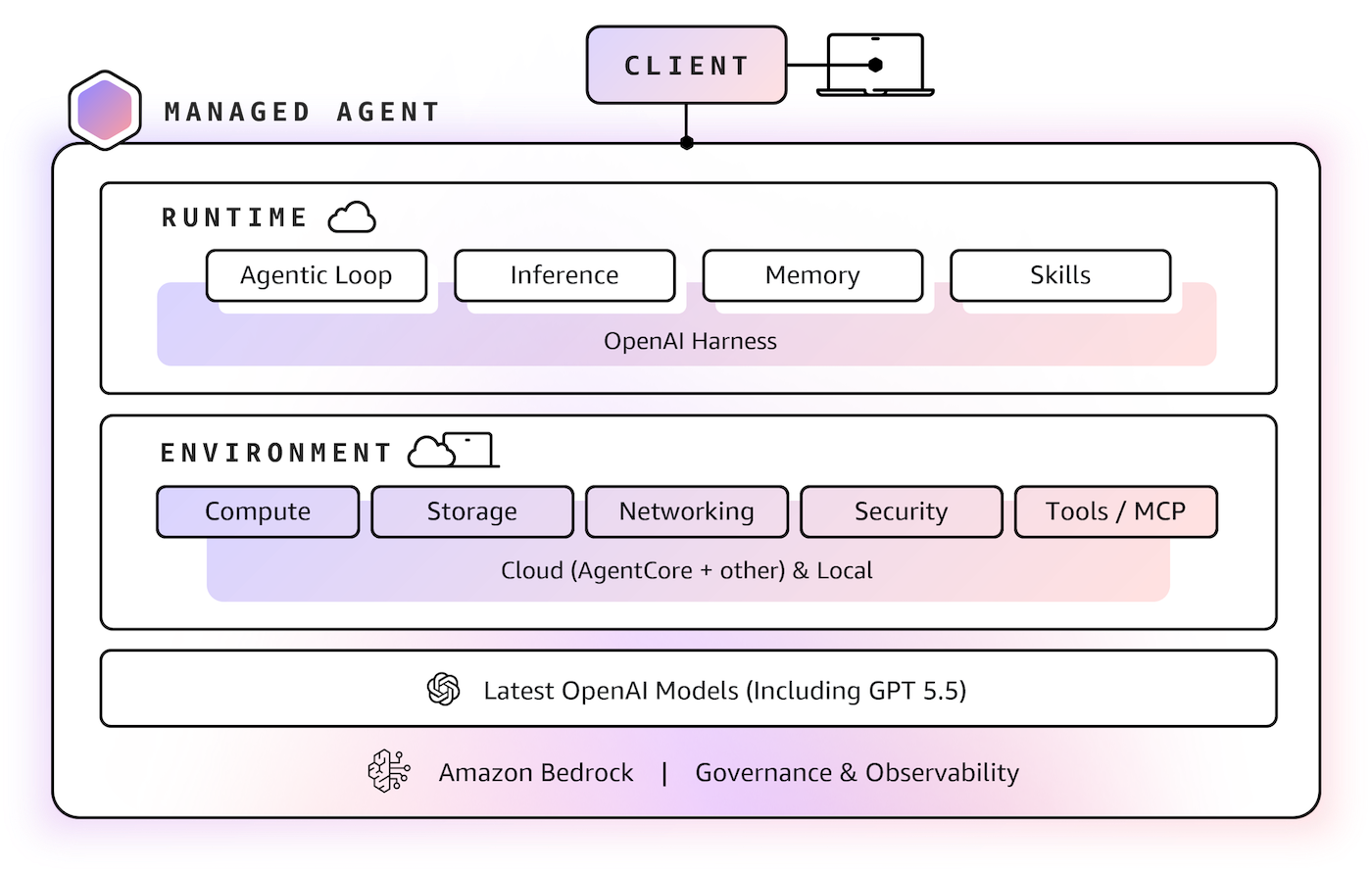
For years, enterprises operating within multi-cloud or hybrid environments have sought seamless interoperability between premier foundational models and robust cloud governance frameworks. The introduction of Amazon Bedrock Managed Agents addresses this demand head-on. By engineering an AWS-native adaptation of OpenAI’s Agents API, AWS enables organizations to harness the reasoning capabilities of OpenAI models directly alongside native AWS services such as Amazon DynamoDB, AWS Lambda, Amazon S3, and AWS Identity and Access Management (IAM).
[ Developer / Client Request ]
             │
             ▼
[ Amazon Bedrock Managed Agents (OpenAI-Powered) ]
             │
             ├──────► Option A: Self-Hosted Compute (EC2, Containers, Local Dev)
             │
             └──────► Option B: Amazon Bedrock AgentCore Runtime (Managed Sessions & Storage)
The core advantage of this integration lies in permission continuity. Traditionally, routing requests across disparate AI tooling frameworks required complex, custom-built API bridges that often introduced security vulnerabilities or compliance blind spots. With Bedrock Managed Agents, developers utilize the exact same AWS identities, fine-grained access permissions, and auditing controls already established within their organizational environments. This ensures that autonomous agents operate under strict compliance parameters, adhering to internal data governance and security postures without requiring a complete overhaul of existing cloud infrastructure.
Execution Environments: Flexibility for Modern Workloads
To accommodate diverse software development lifecycles and architectural requirements, AWS has structured the deployment of these agents around two distinct execution environments:
- Self-Hosted Compute: For development teams requiring deep customization, offline debugging, or integration with pre-existing containerized environments, self-hosted compute options are fully supported. Developers can run and test agent logic on local workstations, private data centers, or customized container clusters while still maintaining API compatibility with the Bedrock orchestration layer.
- Amazon Bedrock AgentCore Runtime: For organizations prioritizing fully managed operational overhead, the Bedrock AgentCore Runtime provides an elastic, highly scalable cloud environment. This managed runtime handles session orchestration, state management, and configurable data storage directly inside the user’s designated AWS account, minimizing infrastructure management burdens and allowing engineering teams to focus purely on business logic and agent behavior.
Expanding Frontier Model Choices
Beyond the integration of OpenAI-powered agents, AWS continues to fortify Amazon Bedrock as a multi-model hub. Enterprise clients are no longer tethered to a single proprietary artificial intelligence architecture. By continually incorporating new frontier models into the Amazon Bedrock ecosystem, AWS empowers organizations to perform rigorous comparative benchmarking—selecting models based on precise cost-to-performance ratios, latency thresholds, domain-specific accuracy, and multimodal capabilities.
Supporting Context & Strategic Metrics
The convergence of managed agent frameworks and multi-model availability reflects broader macroeconomic and technical trends in enterprise IT. According to recent cloud adoption metrics:
- Autonomous Agent Adoption: Industry analyses indicate that over 65% of enterprise cloud strategies now prioritize the integration of autonomous agents to automate complex, multi-step workflows, ranging from customer support triage to automated software deployment pipelines.
- Security and Compliance Priority: In enterprise procurement surveys, governance and identity management remain the primary bottlenecks for generative AI deployment. By tying OpenAI-powered agent execution directly to AWS IAM policies, AWS directly mitigates the risk of shadow AI and data exfiltration.
- Infrastructure Lifecycle Velocity: Hyperscale cloud providers retire or transition between 1% and 3% of their service portfolios annually to prevent technical debt accumulation, reallocate hardware resources to high-density GPU clusters, and streamline developer experience.
Official Statements and Industry Perspective
While specific executive quotes accompanying the initial rollout emphasize a commitment to customer choice, the overarching philosophy communicated by AWS leadership remains consistent: flexibility without compromise.

"Our customers want the freedom to choose the best foundational models for their unique workloads, but they refuse to compromise on enterprise security, data privacy, and governance," notes technical documentation from the Amazon Bedrock product team. "By bringing OpenAI-powered agents natively into Amazon Bedrock with robust execution environments like AgentCore Runtime, we are giving builders the best of both worlds: bleeding-edge AI reasoning combined with the enterprise-grade trust of AWS."
Industry analysts have similarly praised the move, noting that as generative AI moves past the experimental phase into mission-critical production environments, tightly integrated management planes will dictate market leadership. Organizations can no longer afford fragmented toolchains; they demand unified operational dashboards where traditional cloud resources and generative AI agents coexist harmoniously.
Future Outlook & Lifecycle Management
As cloud ecosystems evolve, architectural foresight requires understanding not only what is being introduced, but also what is being phased out. Alongside cutting-edge AI announcements, AWS maintains a rigorous product lifecycle schedule to guide enterprise architects through infrastructure modernization.
Navigating AWS Product Lifecycle Changes
Cloud service deprecation can introduce operational friction if not managed proactively. AWS provides structured transition paths through its Product Lifecycle Changes framework, categorizing shifts into three distinct phases:
- Maintenance Phase: Services entering this stage are closed to new customers starting October 29, 2026. Existing users retain access but are strongly encouraged to migrate workloads to recommended modern alternatives.
- Sunset Phase: Services in this category are on a definitive trajectory toward complete decommissioning, with AWS providing direct migration guides, architectural tooling, and technical support to ensure seamless cutovers.
- End of Support: Services reaching this final milestone no longer receive security patches, bug fixes, or technical assistance, underscoring the necessity for organizations to maintain rigorous asset inventories.
Preparing for the Road Ahead
For IT leaders and developers, the path forward involves a two-pronged strategy. On one hand, engineering teams should begin prototyping with the newly available Amazon Bedrock Managed Agents to evaluate how autonomous workflows can enhance operational efficiency. On the other hand, cloud administrators must review internal infrastructure audits against the latest AWS availability updates to ensure no lingering legacy dependencies face unexpected disruption.
As the industry converges on re:Invent and other upcoming builder-focused community events, the dialogue will undoubtedly center on how managed AI agents scale within enterprise environments. By marrying the innovative capabilities of frontier models with the unwavering reliability of cloud-native infrastructure, AWS is setting a definitive benchmark for the next generation of enterprise computing.