SAN FRANCISCO — In what is rapidly shaping up to be the most consequential financial event in the history of the technology sector, artificial intelligence pioneer Anthropic officially filed its S-1 prospectus with the U.S. Securities and Exchange Commission this morning. The company plans to list its Class A common stock on the Nasdaq Global Select Market under the ticker symbol “ANT.” While the precise share count and target price range have yet to be established, market analysts and institutional forecasters project an initial public valuation that could eclipse $100 billion, easily securing its position as the largest initial public offering in corporate history.
Surpassing historical milestones set by corporate giants like Saudi Aramco and Alibaba—and outpacing even high-profile contemporaneous offerings from space infrastructure titans like SpaceX—Anthropic’s public debut underscores the meteoric rise of generative artificial intelligence from an experimental academic pursuit into the foundational infrastructure of the global economy.
Yet, beneath the staggering top-line valuation and the $80 billion net loss reflecting aggressive, front-loaded investments in research, training, and infrastructure, the S-1 reveals a treasure trove of operational data. For startup founders, enterprise leaders, and venture capitalists, the filing offers a rare, granular look at the unit economics of operating a hyperscale frontier AI laboratory.
Executive Overview: The Numbers That Defy Precedent
To understand Anthropic’s ascent is to comprehend a hyper-growth trajectory without parallel in commercial history. According to the financial statements contained within the prospectus, the company’s revenue progression reads like a typographical error:
- FY 2023: $41 million
- FY 2024: $386 million
- FY 2025: $4,585 million ($4.585 billion)
- H1 2026: $16,286 million ($16.286 billion)
To contextualize the H1 2026 figure, revenue in the first six months of the current fiscal year was roughly fourteen times greater than the $1,163 million recorded during the corresponding period in 2025.
According to market intelligence from Renaissance Capital, this unprecedented scaling has positioned Anthropic at the pinnacle of historical deal sizes:
Largest IPOs in History, by Deal Size (Projected/Actual)
1. Anthropic (2026)        ~$100.0B
2. SpaceX (2026)               $75.0B
3. SK Hynix (2026)             $26.5B
4. Saudi Aramco (2019)   $25.6B
5. Alibaba (2014)                 $21.8B
*Anthropic estimate | Source: Renaissance Capital
While Wall Street will fixate on the sheer velocity of revenue generation and the magnitude of the net loss, operational experts are dissecting the foundational metrics that illuminate how Anthropic converts frontier research into durable, enterprise-grade revenue.
Detailed Chronology & Financial Evolution
The journey from a safety-focused research lab founded by former OpenAI researchers to a global enterprise powerhouse has been breathtakingly rapid. Anthropic’s commercial strategy evolved in distinct phases, moving from API-first developer experimentation to deep enterprise integration, and finally to ubiquitous workplace deployment.
Phase 1: The Research & API Foundation (2021–2023)
During its formative years, Anthropic focused heavily on Constitutional AI and alignment research. Monetization began quietly through API access for developers building custom wrappers and applications. With a modest revenue baseline of $41 million in 2023, the company operated much like a traditional deep-tech R&D organization, heavily subsidized by early venture capital and strategic cloud partnerships.
Phase 2: Model Scaling and Enterprise Penetration (2024–2025)
The introduction of increasingly sophisticated iterations of the Claude model family—culminating in the Claude 3 and Claude 3.5 architectures—unlocked massive enterprise demand. Revenue surged nearly tenfold from 2023 to 2024 ($386 million), and then exploded past $4.5 billion in 2025. This era was characterized by the establishment of "pay-for-intelligence" metered usage models, securing early multi-million-dollar commitments from Fortune 500 institutions.
Phase 3: The Multi-Billion-Dollar Hyper-Scale Era (2026)
The first half of 2026 cemented Anthropic’s status as an economic juggernaut. Generating over $16.2 billion in six months, the company transitioned from a high-burn startup into a dominant enterprise infrastructure provider. The simultaneous launch of specialized workflow tools like Claude Code and Claude Cowork captured white-collar knowledge work across engineering, finance, legal, and operations departments, driving retention rates and deal sizes to unprecedented heights.
Supporting Context: Five Critical Metrics Every Founder Must Analyze
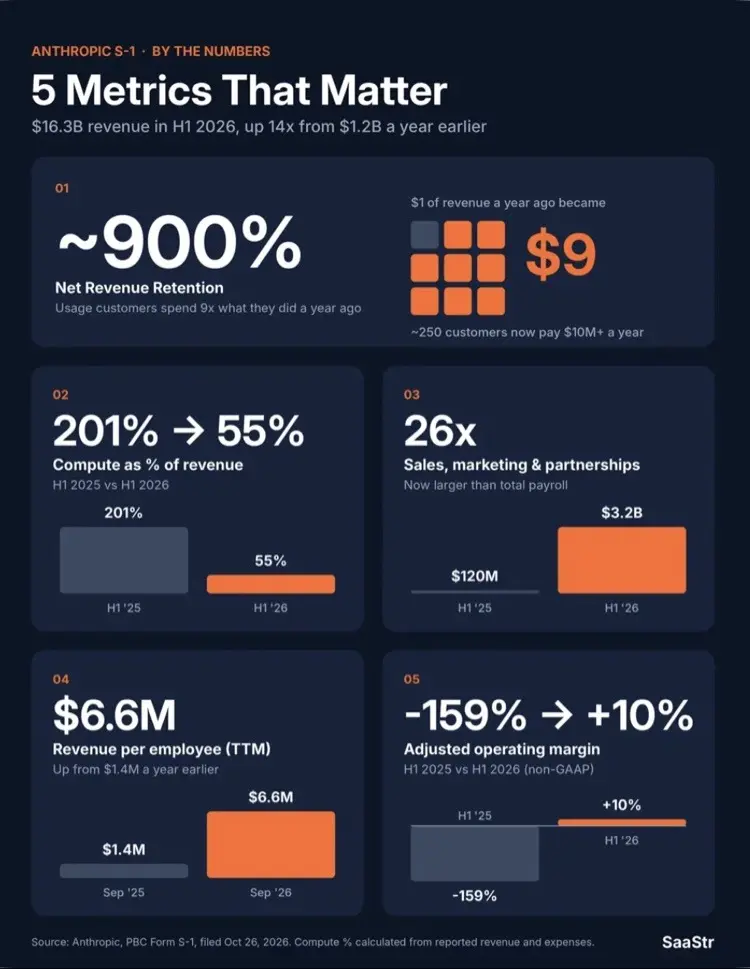
Beyond the headline valuation, five distinct metrics detailed in the S-1 reveal the mechanics of modern AI scaling:
1. Net Revenue Retention of ~900% and 250 Customers Paying $10M+
Anthropic reports a Net Revenue Retention (NRR) rate of approximately 900% as of September 30, 2026.
To understand this figure, one must look at the methodology: NRR is calculated as current-quarter revenue from qualified customers divided by the revenue generated by those exact same customers in the corresponding quarter of the previous year. Crucially, consumer subscriptions (Claude Pro and Max) are excluded because fixed-price tiers obscure true usage expansion and contraction. This means the core usage business expanded ninefold within its existing customer base over a 12-month window.
This expansion is concentrated at the top of the pyramid. As of September 30, 2026, Anthropic boasts:
- More than 11,900 customers generating over $100,000 in Trailing Twelve Months (TTM) revenue.
- More than 1,900 customers generating over $1 million in TTM revenue.
- Approximately 250 customers generating over $10 million annually.
By pricing on a usage model metered in tokens rather than static seats, Anthropic avoided the artificial revenue caps imposed by traditional SaaS seat-based pricing. As enterprise workflows became more complex, customer spend scaled naturally with productivity.
2. Compute Efficiency: Cost Per Task Down 40%, Compute Ratio Collapsing
A central debate surrounding AI businesses has been the sustainability of high infrastructure costs. Anthropic’s filing provides definitive evidence of rapid efficiency gains.

The rollout of Claude Opus 5.5 reduced customer costs per task by approximately 40% compared to its predecessor, Claude Opus. Crucially, falling task costs did not compress revenue; rather, lower friction spurred higher utilization volumes.
Simultaneously, compute and infrastructure expenses as a percentage of revenue plummeted:
- H1 2025: Compute costs stood at $2,334 million against revenue of $1,163 million—representing compute costs at 201% of revenue.
- H1 2026: Compute costs rose to $8,945 million against revenue of $16,286 million—representing compute costs at 55% of revenue.
For the quarter ended June 30, 2026, revenue surged 1,368% year-over-year, while compute and infrastructure expenditures grew by "only" 300%. Note for financial modelers: Anthropic books compute and infrastructure expenses under operating expenses rather than cost of revenue, meaning training, research, and serving costs are consolidated before standard gross margins.
3. Sales, Marketing, and Partnerships Scale to $3.2 Billion
While much of Claude’s initial distribution was organic—driven by word-of-mouth among software engineers—Anthropic aggressively scaled its go-to-market apparatus.
Sales, marketing, and partnerships expenses surged from $120 million in H1 2025 to $3,168 million in H1 2026 (a 26x year-over-year increase). This expense line now eclipses direct cash payroll.
The capital was deployed across several high-leverage vectors:
- Applied AI Teams: Forward-deployed software engineers who work on-site with major enterprise clients to build custom integrations into proprietary IT stacks.
- Strategic System Integrator (SI) Partnerships: Deep alliances with global consultancy giants including Accenture, Deloitte, KPMG, and PwC.
- Platform Ecosystems: Native integrations with major enterprise data and cloud platforms such as Salesforce and Snowflake.
- Mid-Market Expansion: The launch of Ode with Anthropic, a dedicated AI services subsidiary established in partnership with private equity firms to bring tailored AI solutions to mid-market companies.
4. $6.6 Million in Revenue Per Employee
Capital and operational efficiency are further highlighted by workforce metrics. Anthropic reported TTM revenue per employee exceeding $6.6 million as of September 30, 2026, up dramatically from $1.4 million a year earlier.
Total personnel expenses reached $3,152 million in H1 2026, though this figure includes $2.2 billion in stock-based compensation. Consequently, cash payroll remains remarkably lean relative to a business annualizing at over $32 billion in revenue. Revenue grew approximately 14-fold over the year, while headcount expanded at a fraction of that rate, demonstrating profound operational leverage.
5. Claude Code and the Rapid Ramp of Claude Cowork
Product innovation remains the ultimate engine of Anthropic’s growth. The filing highlights Claude Code as the vanguard of what Anthropic terms "Virtual Collaborators," noting that its enterprise impact rivaled the initial wave of conversational AI assistants.
Capitalizing on technical users acting as internal corporate champions, Anthropic subsequently packaged the same underlying agentic architecture into Claude Cowork, designed specifically for non-technical finance, marketing, and operational teams. According to the S-1, adoption rates for Claude Cowork significantly outpaced the trajectory of Claude Code at equivalent points in their respective lifecycles. By September 2026, Anthropic began consolidating Cowork and Claude.ai into a unified application interface.
Official Statements and Industry Reception
In the official letter to prospective shareholders accompanying the S-1 filing, Anthropic’s leadership emphasized the ethical and safety-first framework that has guided the company since its inception:
"Our mission has never been merely to build powerful technology, but to ensure that artificial intelligence develops in a manner that is safe, interpretable, and broadly beneficial to humanity. The metrics in this prospectus demonstrate that rigorous safety research and commercial enterprise scale are not mutually exclusive—they are deeply synergistic. As enterprises entrust their most critical operations to Claude, we bear a profound responsibility to maintain the highest standards of reliability, security, and alignment."
Industry analysts have greeted the filing with a mixture of awe and strategic recalibration. Venture capitalists are actively advising portfolio companies to re-examine their pricing models, noting that Anthropic’s success with usage-based token metering offers a masterclass in capturing the true economic value generated by software.
Future Outlook: Navigating the Public Markets
As Anthropic prepares for its roadshow and eventual listing on the Nasdaq Global Select Market under the ticker ANT, the company stands at the vanguard of a technological revolution.
The challenges ahead are non-trivial. Sustaining a 900% NRR as the customer base matures into the tens of thousands will require relentless product innovation. Managing multi-billion-dollar compute obligations while navigating global regulatory scrutiny over AI safety, copyright, and data privacy will test management’s operational resilience.
Yet, the S-1 filing paints an unmistakable portrait: Anthropic has successfully bridged the chasm between foundational research and commercial ubiquity. With $16.2 billion in half-year revenue, 250 enterprise clients contributing upwards of $10 million annually, and a rapidly expanding ecosystem of workflow agents, Anthropic’s public debut will serve as the definitive bellwether for the artificial intelligence economy for years to come.