Executive Overview
The modern go-to-market (GTM) playbook—defined by high-volume automated outbound, AI Sales Development Representatives (SDRs), and saturated digital channels—is hitting a wall. When sending a personalized email or LinkedIn message becomes functionally free, every inbox fills to the brim, conversion rates plummet, and noise drowns out signal.
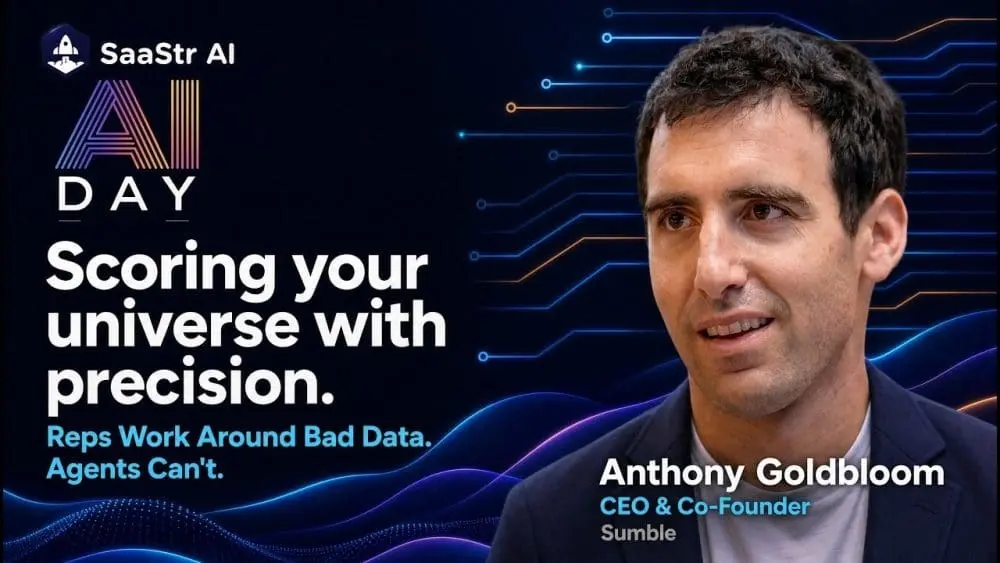
Enter Sumble. Led by Anthony Goldbloom—founder of the legendary machine learning community Kaggle, which Google acquired in 2017—Sumble is quietly carving out a reputation as the best B2B data company tech executives are whispering about. Its customer roster reads like a roll call of Silicon Valley’s elite, counting Snowflake, Databricks, Figma, Wiz, Baseten, Vercel, Modal, and CodeRabbit among its adopters.
Rather than building another tool designed to push more volume through the pipeline, Sumble approaches the GTM stack from the opposite direction. It leverages autonomous AI agents to build ultra-granular, highly accurate company and contact intelligence before a single message is sent. Recently featured in a deep-dive session hosted by SaaS media platform SaaStr—where the platform has been embedded directly into internal workflows for the past six to eight weeks—Sumble represents the vanguard of a massive operational shift: the transition from human-operated, dashboard-heavy data research to headless, agent-first execution.
Detailed Chronology & Operational Mechanics
From Kaggle to GTM: The Genesis of Sumble
Anthony Goldbloom’s career has long been intertwined with the evolution of data and machine learning. Having founded Kaggle and watched it scale into a premier global hub for data scientists under the Google/DeepMind umbrella, Goldbloom recognized a fundamental paradigm shift occurring across software businesses. The bottleneck in enterprise growth was no longer a lack of compute or basic contact data; it was the structural inability of traditional data vendors to keep pace with hyper-dynamic organizational changes.
Unlike traditional founders who matriculate through traditional sales or marketing leadership, Goldbloom approached Sumble’s architecture by embedding himself directly with enterprise GTM teams at high-growth companies. He asked a foundational question: What exact data does an agent-first sales motion actually need to function without human intervention?
The answer dictated Sumble’s engineering roadmap. Traditional databases rely on static firmographics—industry, revenue bands, and broad headcount ranges updated quarterly or annually. Sumble, by contrast, is built to ingest chaotic, real-time unstructured data—from job postings and engineering blogs to earnings call transcripts and financial filings—and synthesize it into actionable, daily-refreshed operational triggers.
How SaaStr Runs Sumble: Headless and Agent-Driven
During the joint showcase, SaaStr’s leadership detailed how the media and events giant utilizes Sumble within its proprietary internal agent, Prospector. Rather than requiring human operators to log into a web dashboard, query filters, and manually export CSVs, SaaStr’s agents interact with Sumble completely headlessly.
When an inbound lead arrives, or when an outbound, renewal, or account-enrichment workflow triggers, Prospector calls Sumble programmatically. The agent queries Sumble to instantly map organizational structures, identify precise reporting lines, and verify whether an inbound lead holds genuine decision-making authority.
For an enterprise events business, this depth of data is mission-critical. For instance, the sheer headcount of a sponsor’s go-to-market organization directly dictates how many team members they are likely to deploy to their exhibition booth at major industry gatherings like SaaStr AI. By chaining advanced tools—specifically combining Exa for web-scale discovery, Sumble for foundational account/contact verification, and Clay for orchestration—SaaStr has built custom Claude skills capable of sourcing and qualifying ideal customer profiles (ICPs) with unprecedented speed and accuracy.
Supporting Context & Metrics: Granularity vs. Accuracy
Granularity: Reading the Tea Leaves of a Single Job Post
To illustrate Sumble’s hyper-granularity, Goldbloom presented a compelling case study examining a single job posting published by retail giant Walmart. To the untrained eye, a job description is simply a hiring notice. To Sumble’s ingestion engine, that single document unlocks a treasure trove of strategic intelligence:
- Active Tech Migrations: Mentions of specific legacy or modern frameworks reveal underlying infrastructure shifts.
- Team Expansion Plans: Explicit reporting structures indicate which internal business units are scaling or contracting.
- Budget Allocation: Specific tooling requirements signal active software vendor evaluations.
When you multiply the insights extracted from that single Walmart job posting across the entirety of the company’s historical job listings, pair them with quarterly earnings transcripts, engineering blog posts, and executive podcast appearances, a living, breathing dossier emerges. GTM teams gain a granular, team-by-team view of what is happening inside an enterprise account long before a sales rep ever initiates outreach.
Accuracy: The Multiplicative Trap of Multi-Step Workflows
Granularity alone, however, is useless without high accuracy. A persistent complaint among revenue operations (RevOps) leaders is the decay rate of enterprise data. Historically, maintaining pristine data integrity required brute-force manual labor. Goldbloom noted that financial data giant Bloomberg historically employed roughly 9,000 workers across lower-cost global hubs dedicated entirely to manually validating and cleaning records. Today, specialized AI agents can automate this validation at a fraction of the cost.
Many enterprise workflows require sequential verification steps—such as identifying a company, filtering by department, isolating a specific job title, verifying active tenure, and locating a valid corporate email. If an organization relies on a waterfall data vendor where each individual step operates at an 80% accuracy threshold, errors compound geometrically:
$$textFinal Accuracy = 0.8 times 0.8 times 0.8 times 0.8 times 0.8 approx 33%$$
At a 33% end-to-end accuracy rate, two out of every three records are flawed, rendering automated outreach toxic to a brand’s reputation. Sumble’s architectural goal is to push individual verification steps to a 99% accuracy floor, which preserves an acceptable end-to-end reliability rate of roughly 95% across multi-step sequences.
Daily Account Scoring: A Case Study in OpenAI
To operationalize this data, Sumble advocates for two core practices: daily account scoring and granular contact scoring.
Unlike legacy platforms that score accounts once a year during territory planning based on static metrics, Sumble recalculates account scores daily using dynamic attributes. To demonstrate, Goldbloom highlighted OpenAI (ranked third on Sumble’s internal target tracking list), breaking its organizational health down into three analytical pillars:
- Size & Headcount Composition: Sumble tracks exact staffing levels across GTM engineers, sales reps, marketers, RevOps, and SDRs. It monitors technographic footprints—detecting whether OpenAI’s GTM teams utilize modern tooling like Clay, Cursor, Claude Code, or Codex—and maps internal adoption across tools like LinkedIn Sales Navigator.
- Growth Trajectory: Sumble’s data revealed that OpenAI’s sales headcount expanded by an astonishing 395% over a 12-month period, while its marketing organization grew by 269%.
- Concentration & Sales-Led Maturity: Despite massive headcount growth, sales reps accounted for only 5.4% of OpenAI’s total workforce. This metric highlights that OpenAI is not a traditional, heavily sales-led enterprise, tempering automated scoring priorities for sales tooling vendors.
Contact Scoring & Real-Time Slack Interception
Beyond macro account scoring, Sumble ranks individual contacts both within specific accounts and globally across all tracked companies, generating a prioritized list of the top 1,000 decision-makers worldwide.
This precision directly transforms operational urgency. In one internal example shared from Sumble’s own Slack channels, the head of revenue operations at a company ranked 102nd on Sumble’s target list initiated a product-led session. Because Sumble’s algorithms also ranked that specific individual as the sixth most influential person within their organization, automated alerts fired instantly to the assigned Account Executive.
The AE immediately recognized the high-value signal and engaged the lead in real-time. Had the platform relied on lagging indicators or generalized lead scoring, an opportunity of that magnitude might have sat dormant in a queue for days.
Official Statements & Real-World Impact
Enterprise adoption stories underscore the tangible ROI of shifting from volume-driven to precision-driven GTM motions.
- Nooks Doubles Enterprise AEs: Conversational AI platform Nooks initially deployed Sumble strictly for territory planning and segmentation. By leveraging Sumble’s precise SDR headcount metrics per company, Nooks surfaced 700 high-value target accounts that were entirely missing from their legacy CRM databases. This discovery alone provided the business case necessary to double its enterprise Account Executive team before accounting for any inbound conversion or paid advertising use cases.
- Contextualizing Inbound Leads at SaaStr: Demonstrating the platform’s utility on a live inbound lead from BambooHR, SaaStr’s workflow showcased how agent-first data enrichment refines deal execution. When BambooHR submitted an inbound inquiry, SaaStr’s internal agent (Prospector) cross-referenced historical sponsorship data, scraped recent announcements via Exa, and pulled Sumble’s deep organizational metrics—noting a sales headcount of 357 employees. Armed with this intelligence, SaaStr’s sales motion shifted from generic pitching to strategic advisory: guiding the sponsor to deploy senior GTM leadership and international account executives to their event booth rather than entry-level reps, thereby ensuring adequate coverage for European and Canadian attendees.
Future Outlook: The Autonomous Agent Era and the Death of "Good Enough" Data
As artificial intelligence agents transition from experimental novelties to autonomous operators running core business workflows, the tolerance for dirty data is rapidly evaporating.
Goldbloom offered a stark warning regarding legacy waterfall enrichment vendors: consider a scenario where a professional named Sam joins Anthropic. Standard waterfall enrichment tools queried blindly will frequently return [email protected] based on common naming conventions. However, if Anthropic employs 30 employees named Sam and the subject’s tenure began precisely one week ago, that email address almost certainly belongs to an established veteran, not the new hire.
A human sales rep reviewing the record manually will spot the discrepancy and hesitate; an autonomous AI agent, lacking human intuition, will execute the outreach and email the wrong person without blinking.
Sumble’s core thesis is that as automation scales, the micro-rules governing data accuracy matter exponentially more. By eliminating probabilistic guesses and prioritizing deterministic, agent-ready intelligence, platforms like Sumble are laying the foundational infrastructure for the next decade of B2B commerce. The future of enterprise sales does not belong to the company that sends the most emails; it belongs to the agent that targets the exact right person, with the exact right context, at the exact right moment.