Executive Overview
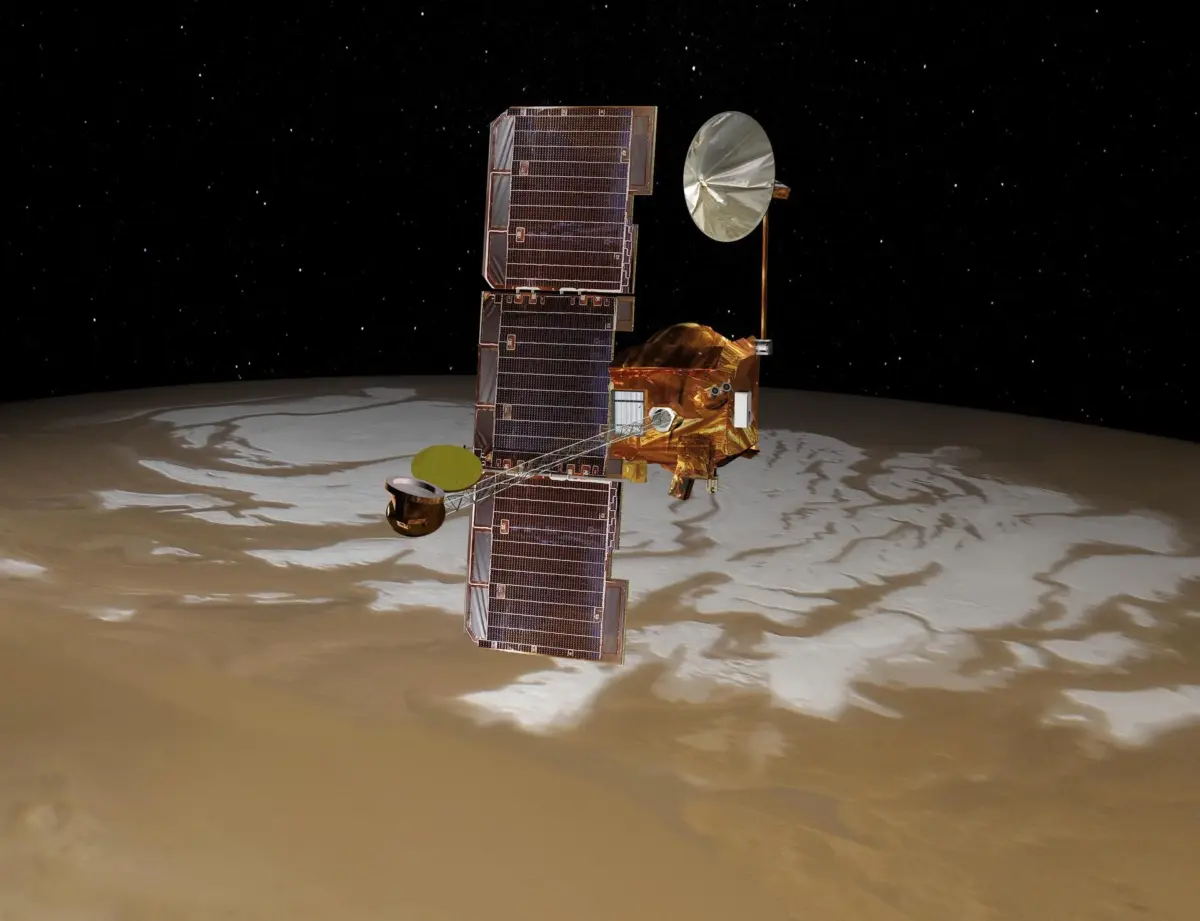
For over two decades, two remarkably resilient workhorses of deep-space exploration have silently circled the Red Planet, rewriting planetary textbooks while outliving their designed life expectancies by generations. NASA’s Mars Odyssey, which slipped into Martian orbit on October 24, 2001, and its slightly younger sibling, the Mars Reconnaissance Orbiter (MRO), have operated far longer than anyone monitoring their launches ever dared to dream.
Together, these veteran spacecraft have fundamentally transformed our understanding of Mars. They have cataloged the history of water, mapped subterranean ice sheets, observed shifting sand dunes, and served as vital telecommunications bridges for every successful surface rover that has phoned home to Earth. Yet, as these aging sentinels coast through the harsh vacuum of deep space, they are facing unprecedented existential challenges—from the slow, inevitable depletion of vital propellant to cosmic forces literally rewriting the stars.
More concerning than their advanced age, however, is the looming shadow over their future. Planetary scientists and aerospace engineers increasingly wonder whether Odyssey and MRO will be the final flagships of their kind to watch over the Red Planet. As NASA pivots toward a paradigm of "faster, cheaper, smaller" missions, the grand era of heavily engineered, multipurpose Martian science orbiters may be drawing to a close. This shift leaves the planetary science community grappling with a sobering question: Can humanity continue to unlock the secrets of Mars on a shoe-string budget, or are we drifting back toward the catastrophic engineering failures of the late 20th century?
Detailed Chronology: Two Decades of Martian Resilience
To understand the magnitude of the achievements of Mars Odyssey and the Mars Reconnaissance Orbiter, one must examine the timeline of human ambition, mechanical ingenuity, and near-miraculous survival.
2001: The Dawn of Odyssey
In the late summer of 2001, NASA was nursing a collective hangover from a string of devastating planetary mission losses. Into this cautious atmosphere stepped the 2001 Mars Odyssey spacecraft. Arriving at the Red Planet on October 24, 2001, its primary objective was straightforward: map the chemical composition of the Martian surface, search for abundant hydrogen (implying water ice), and establish a reliable relay network for forthcoming landers. Designed for a baseline mission lasting just a few Earth years, Odyssey immediately exceeded expectations, transforming into the longest-continuously-operating spacecraft in Mars orbit.
2005–2006: The Arrival of MRO
Building upon Odyssey’s early successes, NASA launched the Mars Reconnaissance Orbiter on August 12, 2005. Equipped with the most powerful cameras ever sent to another world—including the High Resolution Imaging Science Experiment (HiRISE)—MRO entered Martian orbit on March 10, 2006. Its mission was to study the history of water on Mars in hyper-detail, monitor daily weather, and identify safe landing sites for future missions. Like Odyssey, MRO was engineered with a conservative lifespan of roughly four to five years of primary science operations. Instead, it has spent nearly two decades capturing the hyper-resolution topography of a dynamic planet.
The Decades Between: Triumphs and Ingenuity
Over the ensuing twenty years, both spacecraft became the silent backbone of interplanetary research. They documented seasonal flows, tracked global dust storms, detected fresh impact craters in real-time, and served as the indispensable telecommunications lifeline for rovers like Spirit, Opportunity, Curiosity, and Perseverance. Because surface rovers lack the high-gain antennae necessary to beam large volumes of data directly to Earth, they route their scientific payloads and diagnostic logs through Odyssey and MRO high above.
Recent Crises: Stellar Shifts and Phantom Fuel
Operating a spacecraft for twenty years in the hostile radiative environment of Mars is an exercise in continuous improvisation. Last year, MRO faced a bizarre, existential dilemma brought on purely by its own longevity: the stars had moved. The orbiter relies on an onboard stellar atlas to orient itself and determine its exact spatial location. However, over nearly two decades of operation, the proper motion of stars across the galaxy had shifted their celestial coordinates just enough to confuse MRO’s star trackers. NASA engineers had to intervene, uploading a newly calibrated star map to keep the veteran orbiter pointed true.
Meanwhile, Mars Odyssey faces an entirely different adversary: the phantom drain of its propellant reserves. Odyssey does not feature a traditional mechanical fuel gauge. In the zero-gravity environment of orbital flight, liquid propellant sloshes freely without a predictable down-force, making volume measurement nearly impossible. With its fuel tanks slowly running dry, NASA flight controllers have had to completely reinvent how they manage the spacecraft’s thrusters, learning to execute attitude adjustments using microscopic bursts of fuel to stretch every remaining drop.
Supporting Context & Metrics: The Engineering "Margin"
How did NASA achieve this unprecedented longevity? The answer lies in a combination of traumatic historical lessons and a rigorous engineering philosophy known as "margin."

The Ghosts of 1999
To appreciate why Odyssey and MRO were built like titanium-clad tanks, one must look back at NASA’s infamous "faster, better, cheaper" era of the late 1990s. In 1999, the agency suffered back-to-back catastrophes at Mars. First, the Mars Climate Orbiter burned up in the atmosphere due to a notorious mix-up where one engineering team used imperial units while another utilized metric specifications. Just months later, the Mars Polar Lander slammed directly into the Martian surface because a software glitch went uncorrected during pre-flight testing.
These twin disasters seared themselves into the institutional memory of NASA’s Jet Propulsion Laboratory (JPL). When teams assembled to design Odyssey and MRO, the margin for error was reduced to zero.
The Power of Margin
"Those failures were very much on the mind of the team pulling together the Odyssey spacecraft," recalls Glen Havens, JPL project and mission manager for Mars Odyssey. Chastened by past losses, NASA poured significantly more resources into perfecting Odyssey and MRO prior to launch, designing every subsystem for maximum resilience, building in rigorous redundancy, and testing every component configuration to exhaustion.
This protective buffer is what engineers call "margin"—the spacecraft equivalent of packing extra rations for a wilderness trek. Nilton Renno, a spaceflight engineer at the University of Michigan, notes that unexpected anomalies are an absolute certainty in deep space. Spacecraft must be designed to absorb those hits and keep functioning. For instance, MRO launched carrying a larger battery and significantly more propellant than its nominal mission parameters strictly required. That generous design margin is the exact reason the mission is still operational today, with NASA eyeing yet another decade of service.
The Hazards of Isolation
Unlike Earth-orbiting satellites, which can be continuously monitored, adjusted, and patched by ground crews on an hourly basis, Mars spacecraft must be remarkably autonomous. As Rob Lillis, a planetary and space physicist at the University of California, Berkeley, points out, communication bandwidth to the Red Planet is severely restricted. Science spacecraft may only check in with Deep Space Network ground stations once or twice a week.
"A Mars craft has to be able to manage by itself," Lillis explains. When solar radiation storms hit, or when onboard computing systems experience single-event upsets from cosmic rays, automated fault-protection systems must kick in immediately to save the hardware from permanent bricking.
Official Statements and Industry Insights
The scientific community is deeply unified in its praise for Odyssey and MRO, while simultaneously expressing deep anxiety over the future architecture of Mars exploration.
"Both Odyssey and MRO are some of the most productive spacecraft that have ever existed. They have been critical to NASA’s overall Mars research program. They give us unprecedented insight into Mars as a vibrant planet rather than just a lump of rock."
— Briony Horgan, Planetary Scientist, Purdue University
The sentiment is echoed by mission engineers who spent decades nursing these machines through the cold dark of space. Paul Fieseler, chief engineer for MRO at JPL, highlights that the spacecraft’s durability is a testament to meticulous pre-flight testing and over-engineered subsystems. Yet, the margins are razor-thin, and the stakes for future missions are rising.

The vulnerabilities of orbiting Mars were brutally underscored just last year, when NASA abruptly lost contact with the Mars Atmosphere and Volatile Evolution (MAVEN) spacecraft. Despite being the agency’s youngest Red Planet orbiter at just 11 years old, MAVEN suffered an unexpected power failure while behind the planet, bringing a premature end to its mission. The loss served as a stark reminder that in planetary science, longevity can never be taken for granted.
Future Outlook: A Shifting Paradigm for Mars Exploration
As Odyssey and MRO march deeper into their twilight years, profound questions loom over NASA’s long-term strategy for Martian orbital architecture. The institutional appetite for building massive, multi-instrument flagship orbiters appears to be waning, replaced by a lean, specialized, and commercialized approach.
Commercial Relays and Minimalist Science
In an effort to modernize communications, NASA has contracted with Blue Origin to build a dedicated commercial communications satellite designed to beam massive streams of scientific data back to Earth for at least five years. However, unlike Odyssey and MRO—which began as rigorous science missions and subsequently evolved to double as communication relays—this new generation of commercial orbiters will serve strictly as signal repeaters.
Meanwhile, NASA’s upcoming science agenda for Mars features increasingly lean, targeted projects. Lillis is currently leading a dual-orbiter mission designed to study how the Martian upper atmosphere reacts to the constant stream of charged particles flowing off the sun. Even so, Lillis openly admits that the mission parameters are "right on the edge of being too small to do good science."
Compounding these concerns is the aggressive timeline for proposals like Skyfall, a planned trio of small helicopters intended to launch aboard a nuclear-propelled spacecraft within a remarkably tight two-year window. While technologically dazzling, such rapid-fire, low-cost missions offer minimal capability to answer the deep, complex geological and astrobiological questions that Odyssey and MRO spent decades tackling.
The Return of "Faster, Cheaper"?
To many veteran researchers, these modern initiatives evoke an uncomfortable déjà vu, threatening a return to the dangerous compromises of the late 1990s.
"Certainly they’re pushing for faster, cheaper," warns Briony Horgan. "It’s going to be a lot more challenging to do good science in that environment."
For now, high above the rust-colored dunes, Mars Odyssey and the Mars Reconnaissance Orbiter continue their eternal laps. They scan ice sheets, guide surface rovers, and faithfully relay humanity’s reach into the cosmos. But as their fuel reserves dwindle and their mechanical joints creak under the weight of decades in the void, the planetary science community is left wondering: When these legendary orbiters finally go silent, will NASA have the vision and the resources to replace them, or will the golden age of Martian cartography fade into history?