Executive Overview
In what is rapidly shaping up to be the largest initial public offering (IPO) in the history of the capital markets, artificial intelligence pioneer Anthropic has officially pulled back the curtain on its closely guarded financials. The company filed a massive 335-page S-1 registration statement with the U.S. Securities and Exchange Commission (SEC), offering the public its first comprehensive look inside the operational machinery of one of the world’s most dominant generative AI companies.
The filing confirms what Wall Street and Silicon Valley insiders have suspected for months: Anthropic is scaling at a velocity previously unseen in corporate history. For the first half of the fiscal year, the company reported a staggering $16.3 billion in revenue—a breathtaking 14-fold increase compared to the same period in 2025. Yet, this meteoric rise is mirrored by equally extraordinary financial figures on the other side of the ledger, including a net loss driven largely by accounting adjustments on convertible instruments and complex derivative liabilities.
Beyond the raw numbers, the S-1 provides a rare window into the internal governance, equity distribution, and existential anxieties of a frontier AI lab. Unusually, Anthropic’s seven co-founders share a remarkably egalitarian stake in the enterprise, defying the traditional Silicon Valley paradigm where a founding CEO commands an outsized majority of voting power and equity. Furthermore, the prospectus dedicates an unprecedented 93 pages exclusively to risk factors—ranging from standard macroeconomic and debt-servicing concerns to chilling admissions regarding the potential misuse of future frontier models by malicious actors seeking to synthesize chemical and biological weapons.
As institutional investors pore over the documentation ahead of an anticipated late-2026 debut, this filing serves as a defining moment not only for Anthropic, but for the entire commercial artificial intelligence sector. It highlights the immense capital requirements, structural volatilities, and societal stakes inherent in the race to build artificial general intelligence (AGI).
Detailed Chronology: The Road to the S-1 Filing
To understand the magnitude of Anthropic’s public market debut, it is necessary to examine the rapid evolutionary arc of the company. Founded in 2021 by a cadre of former high-ranking researchers and engineers who departed OpenAI over strategic and philosophical disagreements regarding safety and commercialization, Anthropic positioned itself as a research-first entity dedicated to building reliable, interpretable, and steerable AI systems.
The Incubation and Early Funding Phase (2021–2023)
In its infancy, Anthropic operated quietly, focusing heavily on safety research, constitutional AI, and the development of its flagship foundational models under the Claude family. As the generative AI boom caught fire following the late-2022 release of competing technologies, Anthropic transitioned from a research-centric public benefit corporation into a commercial powerhouse. To fund the immense compute infrastructure required to train next-generation models, the company secured monumental capital injections from tech giants including Amazon and Google, alongside traditional venture capital heavyweights.
The Scaling Era and Market Acceleration (2024–2025)
By 2024 and 2025, Anthropic had firmly established itself as a primary competitor to OpenAI, securing massive enterprise contracts and integrating its models deeply into cloud ecosystems. Revenue transitioned from experimental figures to multi-billion-dollar streams. As corporate adoption of Claude accelerated across legal, financial, and software development sectors, the company’s capital requirements scaled in tandem. Whispers of an eventual public offering began to circulate among financial analysts by mid-2025, culminating in the formal preparations for an IPO throughout the course of 2026.
The S-1 Drop and Pre-IPO Milestones (October 2026)
The release of the 335-page S-1 document marks the formal commencement of the IPO process. Preceding this filing, market speculation had already reached fever pitch, with financial analysts meeting executive leadership to gauge the company’s trajectory. Reports surfaced that Anthropic’s annualized revenue run rate could touch an astonishing $110 billion by the close of 2026, driven by an exceptional surge in third-quarter enterprise demand. Now, with the S-1 officially public, the regulatory review period begins, setting the stage for what financial pundits predict will shatter previous records for market capitalization and capital raised upon listing.
Supporting Context & Metrics: Breaking Down the Numbers
A close analysis of the financial tables embedded within Anthropic’s S-1 reveals a corporate profile defined by extreme contrasts: hyper-growth matched against immense capital expenditures, operational scaling, and complex liability structures.
Unprecedented Revenue Velocity
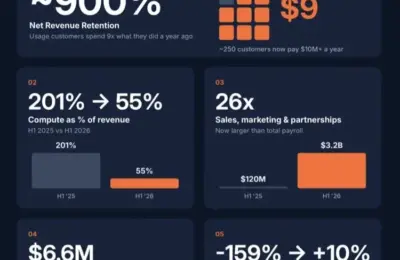
For the first half of the fiscal year, Anthropic logged $16.3 billion in revenue. To contextualize this figure, it represents a 14x multiple over the revenue reported during the corresponding period in 2025. This rate of expansion dwarfs the early historical growth rates of previous tech titans, including cloud computing pioneers and social media giants during their respective scaling phases.
Industry analysts tracking the S-1 note that this momentum shows no immediate signs of plateauing. While the official prospectus refrains from issuing forward-looking financial guidance for the second half of the year, external reports from financial institutions—such as those compiled by Reuters following executive briefings—indicate that Anthropic’s annualized revenue run rate (ARR) could approach $110 billion by the end of 2026. This trajectory is fueled by massive enterprise deployments, sticky API usage, and the widespread integration of Claude into mission-critical corporate workflows.
Operating and Net Losses: The Cost of Frontier AI
Despite surging top-line revenue, profitability remains elusive in the traditional sense, though operational efficiencies are beginning to materialize:
- Operating Income Loss: For the first half of 2026, Anthropic posted an operating loss of $693 million. Encouragingly for prospective investors, this figure represents a reduction of approximately two-thirds compared to the operating losses sustained during the same period in the previous year, signaling early operating leverage.
- Net Loss Realities: The net loss for the first half of the year was reported at a staggering $80 billion. However, financial analysts emphasize that this headline-grabbing number is heavily skewed by non-operating accounting factors. Approximately 90% of this net loss stems from a "change in fair value of convertible notes, derivative liabilities, and SAFEs" (Simple Agreements for Future Equity). As the company’s valuation skyrocketed ahead of the IPO, the accounting value of these early-stage financial instruments adjusted upward dramatically, resulting in a massive paper loss that does not directly reflect day-to-day cash burn.
An Egalitarian Cap Table: The Co-Founder Stakes
One of the most surprising structural revelations in the S-1 filing is the distribution of equity among Anthropic’s seven co-founders. In typical high-growth Silicon Valley startups, the founding Chief Executive Officer—in this case, Dario Amodei—frequently commands a dominant, disproportionate share of the equity and voting control, often leaving co-founders with significantly smaller tranches.
Anthropic’s prospectus reveals a striking departure from this norm. Each of the company’s seven co-founders—Dario Amodei, Daniela Amodei, Tom Brown, Jack Clark, Jared Kaplan, Sam McCandlish, and Christopher Olah—holds between 230,000 and 246,000 shares of Class A stock. This remarkable degree of parity underscores the collaborative research ethos from which the company was born and suggests a decentralized approach to internal governance that has persisted even as the company scaled into a corporate titan.
Official Statements and Institutional Perspectives
While the S-1 document itself serves as the primary authoritative record, reactions from the financial and technological communities have been swift and multifaceted.
Financial advisors managing the underwriting process have pointed to the sheer volume of institutional demand as validation of the generative AI thesis. "Anthropic is no longer an experimental bet on speculative technology; it is core infrastructure for the global economy," noted one institutional asset manager tracking the filing. "The revenue numbers validate that enterprise customers are willing to pay premium prices for frontier intelligence, regardless of the broader economic climate."
At the same time, governance experts have focused heavily on the unique risk disclosures and the unusual co-founder equity structure. Corporate governance advocates have praised the balanced distribution of shares among the founding team, arguing it minimizes key-person risk and aligns the long-term incentives of the technical and executive leadership. Conversely, credit analysts have flagged the company’s substantial debt obligations—incurred to build out state-of-the-art data centers and secure high-end accelerator chips—as a critical variable that will require disciplined capital management post-IPO.
Anthropic’s executive leadership has consistently emphasized in briefings that their primary mandate remains the safe, responsible scaling of AI capabilities. The S-1 explicitly frames this dual mission—balancing aggressive commercial expansion with rigorous safety guardrails—as both the company’s greatest competitive moat and its most profound operational challenge.
Future Outlook: Risks, Rewards, and the Horizon
As investors prepare to evaluate Anthropic’s shares on the public market, the company’s own disclosures provide a sobering roadmap of the challenges that lie ahead. Nothing encapsulates this better than the staggering 93 pages of risk factors embedded within the prospectus, stretching continuously from page 27 to page 120.
Conventional Business and Financial Risks
On the operational front, Anthropic’s risks are deeply intertwined with the hyper-competitive nature of the AI landscape. The company acknowledges that any deceleration in revenue growth could severely constrain its ability to fund the exorbitant research and development costs required to maintain a frontier position. Furthermore, retaining elite AI research talent in an aggressive bidding war waged against well-capitalized tech monopolies remains a persistent vulnerability. Having taken on significant debt to finance its infrastructure, Anthropic also notes the ongoing challenge of servicing those financial obligations while simultaneously covering day-to-day operating expenditures.
Existential and Technological Risks
Perhaps the most compelling sections of the S-1 are those addressing forward-looking technological risks that transcend standard corporate disclosures. In a stark and unusual acknowledgment for a public filing, Anthropic warns that future iterations of its models are expected to exhibit capabilities that could be weaponized by bad actors:
"Future models are expected to demonstrate capabilities that could provide meaningful assistance to malicious actors seeking to develop chemical, biological, or other dangerous weapons."
This inclusion underscores the unique regulatory and ethical tightrope Anthropic must walk. Unlike traditional software or industrial firms, an AI lab’s primary product possesses dual-use characteristics that carry profound geopolitical and public safety implications. The company openly details the possibility that heightened government regulation, international export controls, or catastrophic safety failures could materially impact its business model and intellectual property rights.
Conclusion
Anthropic’s S-1 filing is more than a precursor to a record-breaking financial transaction; it is a defining document for the modern technological age. It captures a company generating tens of billions of dollars in revenue at a blistering pace, yet grappling with the monumental financial, operational, and ethical responsibilities of steering artificial intelligence toward safe horizons. As Wall Street prepares for the opening bell, the ultimate verdict on Anthropic will rest on whether the market can successfully price the extraordinary potential—and the unprecedented risks—of building the intelligence of tomorrow.