Executive Overview
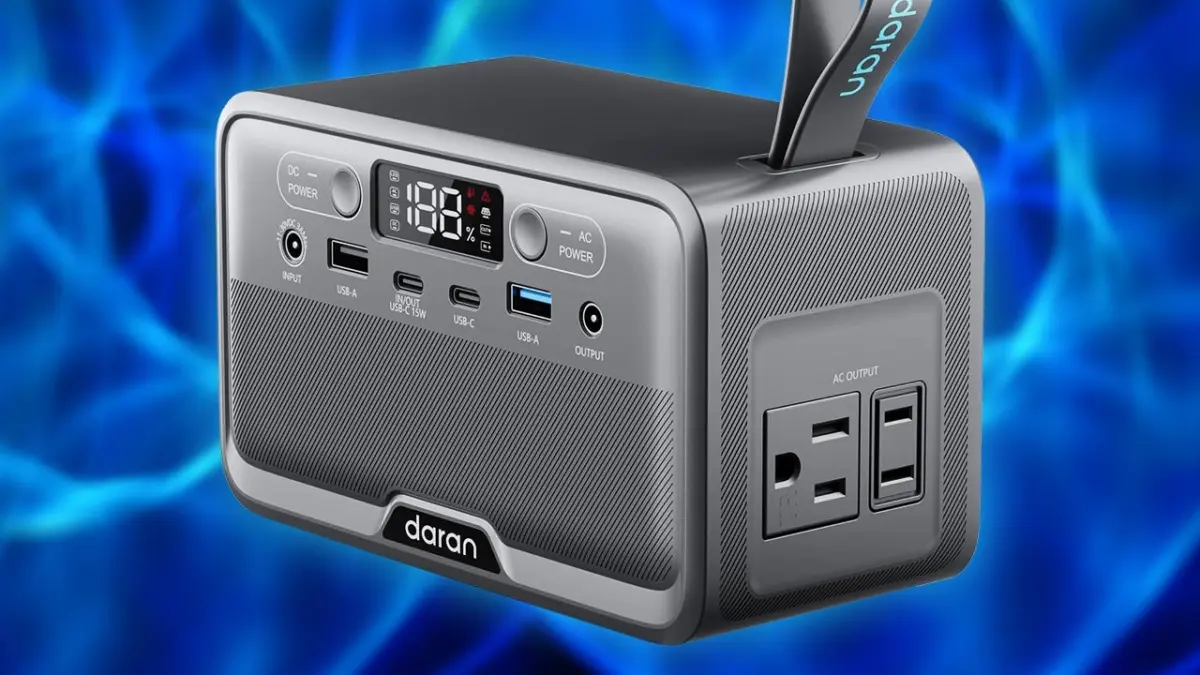
As the retail landscape gears up for the hyper-competitive holiday shopping season, early Black Friday promotions are moving beyond traditional categories like apparel and mainstream consumer electronics into the realm of hyper-portable, industrial-grade personal infrastructure. A prime example of this trend is a newly launched discount on the Daran 89.6Wh 100W LiFePO4 Power Station, currently marked down to an unprecedented $49.99 on Amazon through the application of a dedicated promotional checkout code ("DDDD4999").
At a 50% discount from its standard retail baseline, this promotional offering challenges long-standing assumptions about the cost-to-performance ratio of portable power. Historically, consumers seeking true alternating current (AC) output alongside direct current (DC) and USB connectivity were forced to choose between bulky, expensive generation units or chemically volatile traditional power banks. The Daran unit bridges this gap by marrying the diminutive form factor of a high-capacity airline-approved travel charger with the advanced, long-lasting safety chemistry of Lithium Iron Phosphate ($textLiFePO_4$) cells.
Crucially, this deal breaks from recent e-commerce trends by stripping away paywalls: unlike comparable holiday promotions that lock steep discounts behind paid memberships like Amazon Prime, this 50% price slash is universally accessible to all consumers. This structural analysis examines the engineering specifications, battery chemistry implications, market positioning, and broader consumer electronics trends contextualizing this early-season markdown.
Detailed Chronology of the Early Black Friday Power Market
The Shift Toward Modular, Personal Infrastructure
The trajectory of portable power supplies has undergone a radical transformation over the past five years. Prior to the widespread adoption of advanced battery chemistries, the market was sharply divided into two distinct categories:
- Traditional Power Banks: Lightweight, pocket-sized lithium-ion (NCM/NCA) devices limited exclusively to direct current (DC) outputs, typically restricted to USB-A and slow-charging micro-USB or early USB-C standards. These were incapable of driving devices requiring an AC wall socket.
- Heavy-Duty Solar Generators / Power Stations: Massive, multi-pound units boasting capacities exceeding 300Wh to upwards of 2,000Wh. While these featured traditional AC outlets, they were designed for emergency home backup, camping, or job-site applications—rendering them entirely impractical for daily urban commuting, remote work mobility, or air travel.
As hybrid work models solidified and reliance on mobile computing hardware (such as laptops, tablets, and handheld gaming PCs) accelerated, consumer demand shifted toward a "missing middle": ultra-portable power stations that could fit inside a standard backpack or briefcase while retaining genuine AC inversion capabilities.
The Arrival of the Daran 89.6Wh 100W Form Factor
Into this evolving marketplace stepped the Daran 89.6Wh 100W Power Station. Measuring a modest 6.5 inches by 3.3 inches by 4 inches and tipping the scales at just 2.5 pounds, the device was engineered from inception to defy traditional sizing metrics.
By scaling the architecture of a traditional generator down to the dimensions of a heavy-duty portable brick, manufacturers identified a critical sweet spot: an 89.6Wh capacity. This specific metric was not chosen at random. Under United States Transportation Security Administration (TSA) regulations, lithium-ion and lithium-iron-phosphate batteries with a capacity under 100 watt-hours (Wh) are universally permitted in carry-on baggage without requiring special airline clearance or prior administrative approval.
The Price Disruption Campaign
Ahead of the traditional Black Friday retail window, e-commerce platforms have experienced an influx of inventory clearinghouse strategies. Rather than waiting for the compressed frenzy of late November, manufacturers are utilizing targeted coupon codes to capture early-bird consumer traffic.
The introduction of the "DDDD4999" promotional code—dropping the price of the Daran unit to $49.99—represents a strategic inflection point. By bypassing the requirement for an Amazon Prime subscription, the promotion democratizes access to high-end battery infrastructure, signaling a broader market push to normalize $textLiFePO_4$ chemistry across all price tiers.
Supporting Context, Technical Metrics, and Specifications
To fully comprehend the engineering significance of the Daran 89.6Wh 100W Power Station at its current price point, one must dissect its internal architecture, port array, and thermodynamic properties.
Battery Chemistry: The Superiority of $textLiFePO_4$
The single most important technical differentiator of the Daran power station lies in its selection of Lithium Iron Phosphate ($textLiFePO_4$) battery cells, departing from the nickel-cobalt-manganese (NCM) or nickel-cobalt-aluminum (NCA) chemistries historically dominant in budget electronics.
+--------------------------+----------------------------+----------------------------+
| Metric                   | Standard NCM Chemistry     | Daran LiFePO4 Chemistry    |
+--------------------------+----------------------------+----------------------------+
| Cycle Life (to 80% Cap)  | 500 – 800 cycles           | 2,000 – 3,000+ cycles      |
| Thermal Stability        | Moderate (Prone to Runaway)| Exceptional (High Threshold)|
| Calendar Aging           | Rapid degradation over time| Slow, highly stable        |
| Environmental Impact     | Heavy use of Cobalt/Nickel | Cobalt-free, safer disposal|
+--------------------------+----------------------------+----------------------------+
As detailed in the comparison above, $textLiFePO_4$ cells provide a significantly enhanced lifecycle. While a standard budget power bank utilizing NCM cells might begin to degrade severely after 500 charge cycles, a $textLiFePO_4$ battery maintains structural integrity across thousands of cycles. Furthermore, the chemical bonds in iron-phosphate molecules are inherently more robust, rendering the cells vastly more resistant to thermal runaway—a critical safety factor for devices stored in enclosed backpacks, hot automobiles, or carried aboard commercial aircraft.
Power Capacity and Conversion Math
The unit boasts an 89.6Wh energy rating. For consumers accustomed to viewing power bank capacities in milliamp-hours (mAh), conversion requires accounting for the nominal voltage of the internal cells:
$$textWatt-hours (Wh) = fractextAmp-hours (Ah) times textVoltage (V)1$$

With an internal nominal voltage of approximately 3.2V per cell, an 89.6Wh capacity translates to roughly 28,000mAh. While a 28,000mAh rating is impressive for a pocket-sized device, the inclusion of a DC-to-AC inverter allows this energy to be channeled across a vastly superior array of output types compared to a standard USB power bank.
Comprehensive Port Array Analysis
The Daran unit features a diversified portfolio of seven distinct charging ports, engineered to handle legacy hardware alongside modern USB-C Power Delivery (PD) standards:
- Dual 120V AC Outlets: Capable of delivering a combined maximum of 100W. This enables the powering of traditional two-prong plugs—ideal for desk lamps, small medical devices, camera battery chargers, and vintage or specialized electronics that lack USB conversion cables.
- Dual USB-C Ports: Split configuration supporting up to 45W and 15W respectively. The 45W port is sufficient for fast-charging modern smartphones, tablets, and mid-tier USB-C powered ultrabooks (such as the MacBook Air or various Windows equivalents).
- Dual USB-A Ports: Offering 18W and 15W outputs, optimized for legacy accessories, smartwatches, wireless earbuds, and peripheral devices.
- DC5521 Port: A dedicated barrel-plug output capable of delivering up to 60W, serving specialized DC-powered routers, LED lighting rigs, and portable monitors.
Expert Perspectives and Industry Analysis
The democratization of advanced power infrastructure at sub-$50 price points has drawn commentary from retail analysts and hardware specialists tracking the intersection of consumer electronics and personal preparedness.
The Consumer Electronics Outlook
Industry observers note that the proliferation of low-cost, high-safety power stations reflects a broader maturation of the global supply chain. As manufacturing efficiencies for $textLiFePO_4$ cells have scaled to meet the massive demands of the electric vehicle and residential solar storage markets, excess production capacity has trickled down to micro-mobility and consumer peripheral manufacturers.
"We are witnessing the absolute commoditization of safe battery chemistry," notes an independent supply chain analyst specializing in lithium derivatives. "Five years ago, paying under fifty dollars meant buying a ticking time bomb of unstable NCM cells wrapped in cheap plastic. Today, engineering standards have risen to a point where consumers can demand—and receive—thermal stability, multi-port inversion, and rigorous TSA compliance without breaking the bank."
The Changing Nature of Mobile Productivity
With remote and hybrid work models remaining entrenched across corporate and creative sectors, the definition of an office has expanded indefinitely. Coffee shops, airports, regional transit systems, and outdoor workspaces demand a continuous supply of off-grid energy.
The availability of a 100W AC outlet in a 2.5-pound package changes the calculus for mobile professionals. Users are no longer tethered exclusively to wall sockets or forced to carry proprietary, single-purpose laptop power bricks that lack auxiliary device charging capabilities. The ability to simultaneously top off a smartphone via USB-C while running a productivity laptop off the primary AC inverter represents a fundamental shift in personal operational independence.
Future Outlook: The Road Ahead for Portable Energy
As we look past the immediate early Black Friday shopping window and toward the technological horizon of personal power generation, several key trends emerge from developments like the Daran 89.6Wh promotion:
1. The Death of the Traditional Power Bank
As $textLiFePO_4$ manufacturing costs continue their downward trajectory, single-function USB power banks lacking AC inversion capabilities face severe market pressure. Consumers are increasingly unlikely to invest in legacy lithium-ion bricks when micro-inverter technology allows for the simultaneous integration of AC sockets and high-wattage USB-C Power Delivery within virtually identical physical envelopes.
2. Regulatory Pressures and Safety Standards
With international transit authorities tightening scrutiny over lithium-based batteries in cargo and passenger holds, the strict adherence to sub-100Wh thresholds—coupled with inherently non-combustible $textLiFePO_4$ chemistry—will likely become the baseline regulatory expectation for consumer-grade portable power. Products failing to meet these safety benchmarks risk obsolescence as consumer awareness regarding thermal stability grows.
3. Solar Integration and Micro-Gradients
The next frontier for sub-100Wh power stations involves seamless, plug-and-play solar panel integration. While units like the Daran model currently rely primarily on wall adapters or car chargers for replenishment, future iterations at this price point are expected to feature standardized photovoltaic input controllers, enabling true off-grid micro-generation for hikers, campers, and emergency preparedness kits.
Conclusion: Evaluating the Early-Season Opportunity
For consumers evaluating the current retail landscape ahead of the holiday rush, promotional offerings like the Daran 89.6Wh 100W LiFePO4 Power Station—accessible via code DDDD4999 for $49.99—represent an unusually high-value intersection of safety, utility, and cost-efficiency. By removing the barrier of paid subscription memberships and delivering professional-grade battery chemistry in an ultra-portable, TSA-compliant chassis, this deal illustrates just how far personal energy infrastructure has advanced in a remarkably short span of time.