Executive Overview
In the fast-paced ecosystem of social media, internet phenomena often emerge from the unlikeliest of origins. Throughout October 2026, a peculiar and highly specific piece of athletic wear—the humble black skull cap—became the epicenter of one of TikTok’s most pervasive viral sensations. Known simply as the "Skull Cap Trend," this wave of comedic skits and before-and-after transformations captured the collective imagination of millions.
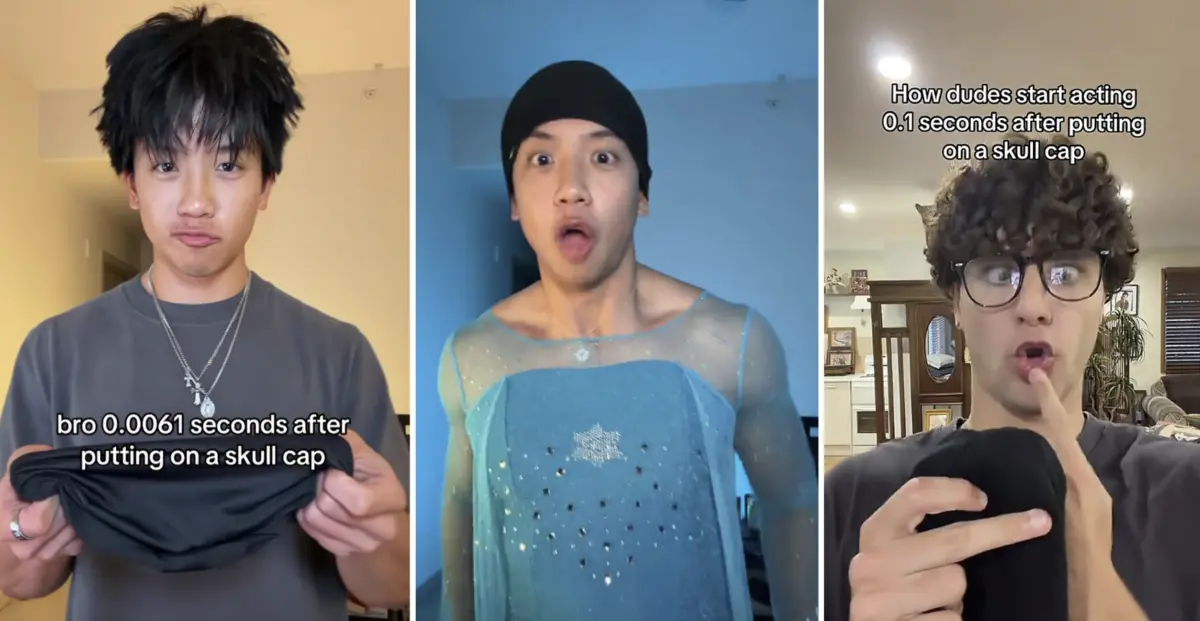
Characterized by a deliberate, deadpan juxtaposition between an intentionally awkward, plain persona and an exaggerated, hyper-confident "Chad-like" alter ego, the trend relies on the simple act of pulling a thin, breathable sports cap over the head. Perfectly synchronized to the distinct beat drop of Bryson Tiller’s verse from DJ Khaled’s hit track "Wild Thoughts" (featuring Rihanna), these videos transformed everyday content creators into overnight viral sensations.
This deep-dive investigation explores the meteoric rise of the Skull Cap Trend, dissecting its organic origins, tracking its explosive viral trajectory across multiple user demographics, analyzing the psychological appeal of modern "glow-up" satire, and forecasting the longevity of fashion-based internet memes in an increasingly saturated digital marketplace.
Detailed Chronology: The Genesis and Ascent of a Phenomenon
The narrative of the Skull Cap Trend is one of organic, decentralized growth. Unlike corporate-backed marketing campaigns or meticulously planned influencer activations, this trend bubbled up from the grassroots level of TikTok’s algorithm in mid-October 2026.
The Spark: Mid-October 2026
While no single user can definitively claim ownership as the sole inventor of the concept, the format crystallized rapidly around October 16, 2026. Creators noticed a humorous correlation between the sleek, athletic utility of black skull caps—typically designed to be worn snugly beneath sports helmets—and an instant, albeit satirical, elevation in physical attractiveness and personal confidence.
The formula was deceptively simple:
- The Setup: The video begins with the creator looking intentionally unkempt, plain, or nerdy, often wearing expressionless or confused postures.
- The Transition: The subject dons a black skull cap, pulling it tight across the head.
- The Payoff: Timed precisely to the beat drop of Bryson Tiller’s verse—"And you know I’ma slaughter like I’m Jason / Bust it, why you got it on safety?"—the creator strikes an intense, unblinking, hyper-masculine pose, embodying an exaggerated persona of absolute invincibility and swagger.
An early watershed moment occurred on October 16th, 2026, when TikTok user @big_bobby6929 uploaded a textbook execution of the format. The clip resonated instantly with the algorithm, pulling in an astonishing 7.4 million views and over 286,400 likes within a span of just 11 days. This initial proof-of-concept demonstrated that audiences were hungry for lighthearted, self-deprecating humor that subverted traditional, overly serious beauty standards on the platform.
The Viral Tipping Point: October 18–23, 2026
Following the early success of pioneers like @big_bobby6929, the trend experienced exponential, cross-demographic growth throughout the third week of October. The barrier to entry was remarkably low: anyone with a smartphone and a $5 athletic skull cap could participate, fueling a massive wave of user-generated content.
- October 18, 2026: Creator @antoniopieterss released a high-impact iteration of the trend. Capitalizing on the momentum, the video shattered previous engagement metrics, accumulating over 12.8 million views and 2.3 million likes in a mere nine days.
- October 21, 2026: The trend transcended standard creator demographics. User @grumpyleanneandmaitland injected family dynamics into the format, publishing a video featuring a mother participating in the exaggerated transformation. The playful video struck a chord, drawing 11.8 million views and 1.7 million likes in less than a week. Simultaneously, user @_mc_chicken_lover posted a version sporting the caption "okay trends over," ironically propelling the format even further into the mainstream consciousness with 11.3 million views and 2.8 million likes.
- October 23, 2026: As saturation approached, user @brodyjboling posted a fatigued response video titled "I did the trend now stop tagging me," capturing the cultural fatigue and comedic pressure felt by creators who felt obligated to join the movement. Despite the tongue-in-cheek exhaustion, the post pulled in an impressive 9.3 million views and 1.5 million likes in four days.
Supporting Context & Metrics: The Anatomy of a TikTok Glow-Up
To understand why the Skull Cap Trend achieved such widespread cultural resonance, one must examine the broader lineage of internet humor. The phenomenon builds directly upon established tropes like the "lockjaw trend," jawline-sharpening exercises, and exaggerated "glow-up" (glo-up) narratives that have dominated short-form video platforms for years.
The Psychology of Satire and Self-Deprecation
Traditional glow-up videos on TikTok historically functioned as genuine showcases of personal improvement—weight loss, skincare journeys, hair transformations, or fashion upgrades. However, Gen Z and Alpha digital culture has increasingly leaned into post-irony and absurdist humor.
The Skull Cap Trend weaponizes this fatigue. By taking a mundane, highly utilitarian item—a skull cap—and treating it like a magical artifact of supreme masculine confidence, creators mock the hyper-serious nature of internet fitness and "alpha male" coaching culture. The joke relies on the extreme contrast: a person slouching in a poorly lit bedroom instantly morphs into a stoic, intense model-esque figure simply by pulling fabric over their ears.
Audio Architecture: The Power of Bryson Tiller
No analysis of the Skull Cap Trend is complete without examining its auditory backbone. The inclusion of Bryson Tiller’s verse from DJ Khaled’s 2017 multi-platinum track "Wild Thoughts" was not accidental; it provided a masterclass in algorithmic sound utilization.
The lyrics—evoking themes of unpredictability and reckless abandon ("Cause you get wild, wild, wild")—paired with a crisp, heavy percussion drop, offered creators a foolproof editing cue. The split-second timing required to hit the beat drop created a Pavlovian satisfaction for viewers scrolling through their "For You" pages (FYP). Algorithms reward watch-time and completion rates; the anticipation of the impending transformation ensured that users rarely scrolled away before the beat hit.
Engagement Metrics at a Glance
| Date (2026) | Creator Handle | Views (Approx.) | Likes (Approx.) | Key Characteristic |
|---|---|---|---|---|
| Oct 16 | @big_bobby6929 |
7.4 Million | 286,400 | Early foundational template |
| Oct 18 | @antoniopieterss |
12.8 Million | 2.3 Million | High-impact execution |
| Oct 21 | @grumpyleanneandmaitland |
11.8 Million | 1.7 Million | Intergenerational/family angle |
| Oct 21 | @_mc_chicken_lover |
11.3 Million | 2.8 Million | Satirical self-awareness ("trend’s over") |
| Oct 23 | @brodyjboling |
9.3 Million | 1.5 Million | Creator peer-pressure response |
Official Statements and Industry Perspective
While social media trends rarely warrant formal press releases from major corporations, the cultural footprint of the Skull Cap Trend prompted commentary from branding experts, fashion analysts, and digital sociologists.
Dr. Elena Vance, a senior researcher in digital media cultures at the Global Institute of Internet Studies, noted the economic and cultural implications of platform-driven micro-trends:
"What we witnessed with the Skull Cap Trend in October 2026 is a fascinating example of democratic fashion consumption. A piece of athletic gear traditionally relegated to practicality—cycling under helmets, winter running, or football padding—was recontextualized as a badge of internet irony. Brands often spend millions trying to engineer viral moments, yet the internet spontaneously selected an unpretentious, inexpensive accessory to satirize modern standards of attractiveness. It proves that authenticity and shared communal laughter remain the highest currency on platforms like TikTok."
Furthermore, athletic apparel retailers noted minor, unexpected surges in online search queries and purchases for plain black compression skull caps during the peak of the trend, illustrating how digital humor can tangibly ripple into traditional retail sectors.
Future Outlook: The Lifecycle of Micro-Trends in the Algorithmic Age
As October 2026 drew to a close, signs of saturation began to emerge. Videos featuring captions like "okay trends over" and satirical parodies pushing the joke to absurd extremes—such as wearing multiple caps or substituting skull caps with entirely unrelated household objects—signaled that the trend was entering its twilight phase.
What Lies Ahead?
- The Irony Cycle: As with the "lockjaw" and various glow-up memes that preceded it, the Skull Cap Trend will likely undergo a brief phase of meta-commentary, where creators mock the trend itself before it is entirely replaced by a new seasonal meme.
- Permanent Lexicon Inclusion: While the daily flood of skull cap transition videos will decline, the visual shorthand of the "black skull cap stare" has successfully cemented itself into modern internet vernacular. It joins a long list of ephemeral visual gags that internet users can reference years down the line.
- The Evolution of Short-Form Satire: Platforms like TikTok will continue to seek out objects of everyday mundanity to elevate through irony. The ease of replication demonstrated by this trend guarantees that creators will actively hunt for the next ordinary clothing item or accessory ripe for satirical transformation.
Ultimately, the Skull Cap Trend stands as a testament to the creativity of online communities. By taking something as simple as a piece of athletic headwear and turning it into a canvas for collective humor, TikTok users once again proved that the most powerful viral moments require nothing more than a smartphone, a sense of shared timing, and a willingness not to take oneself too seriously.