Executive Overview
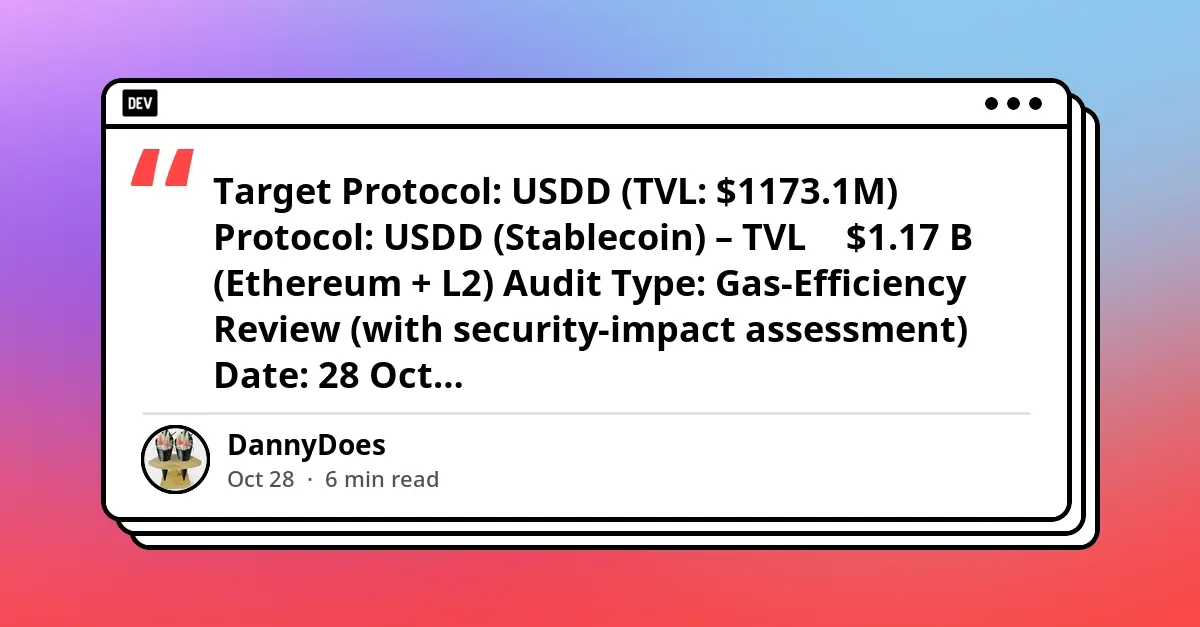
As decentralised finance (DeFi) matures, the metrics for protocol success stretch far beyond foundational smart contract security. While passing conventional, logic-based security audits is a critical initial milestone, the long-term viability of high-value algorithmic stablecoin protocols heavily depends on economic efficiency, gas optimization, and user experience (UX).
A comprehensive gas-efficiency review of the USDD protocol—a prominent algorithmic-backed stablecoin boasting a Total Value Locked (TVL) of approximately $1.17 billion across Ethereum and several Layer 2 (L2) roll-up networks including Optimism, Arbitrum, and Base—has revealed significant opportunities for architectural refinement.
Authored by senior decentralized finance security researchers, the October 2026 audit assessed USDD’s core contracts, which include the USDD token, USDDCore, Vault, Treasury, Minter, Redeemer, AccessControl, and Oracle. While these foundational components are battle-tested and structurally sound against standard monetary exploit vectors, the deep-dive review uncovered persistent gas inefficiencies. These inefficiencies primarily cluster around redundant storage reads, unoptimized loop patterns, and high-cost external calls executed during routine operations such as minting, burning, and protocol rebalancing.
The aggregate potential for gas savings across these core functions sits at an impressive 15% to 25%. For institutional and retail users operating on L2 environments—where gas pricing remains volatile—this optimization translates to material cost reductions of $0.30 to $0.70 saved per $10,000 transaction.
Crucially, the audit assigned the protocol an overall risk score of 3 out of 10. This rating reflects a low-to-medium economic risk profile with negligible direct security vulnerabilities. However, the identification of several gas-related economic attack surfaces—such as gas-griefing via unbounded loops and front-running vulnerabilities driven by high-cost state updates—underscores the urgent business value of implementing the recommended remediation roadmap.
Detailed Chronology and Technical Scope
The gas-optimization assessment of USDD was conducted throughout October 2026, targeting the protocol’s multi-chain deployment architecture. Given that USDD operates fluidly across Ethereum mainnet and multiple L2 scaling networks, the security engagement utilized static analysis tools, symbolic execution frameworks, and manual code inspections to trace execution paths under peak network load conditions.
The Anatomy of the Audit
The core objective of the engagement was to isolate and remediate code paths that consume unnecessary computational resources (gas) without contributing to protocol security or logical correctness. The review categorized findings into seven distinct vulnerability and optimization vectors:
- Storage-Layout & Variable Packing: Inefficient struct layouts leading to unnecessary storage slots and expensive
SSTORE/SLOADoperations. - Unchecked Arithmetic Operations: Redundant safety checks in loops and execution blocks where mathematical overflow is mathematically impossible.
- Redundant State Reads: Repeated external and storage reads within tight loops and frequent execution flows.
- External Call Patterns: Unbounded gas forwarding during cross-chain bridge interactions on L2 roll-ups.
- Event Emission Overhead: Over-indexed event topics inflating calldata size and transaction costs.
- Loop Inefficiencies: Unbounded $O(N)$ array iterations across administrative functions such as whitelist updates.
- ERC-20 Transfer Logic: Sub-optimal balance updates and string-based error handling that heavily inflate transaction overhead.
Rather than uncovering a single catastrophic flaw that could compromise the protocol’s monetary peg, the audit revealed a cumulative collection of micro-inefficiencies. Left unaddressed, these inefficiencies compound over millions of routine transactions, creating economic friction for users and introducing vectors for localized denial-of-service (DoS) and gas-griefing attacks.
Supporting Context & Metrics
To fully understand the implications of the USDD gas optimization audit, one must analyze the quantitative metrics governing the protocol’s operational efficiency. With a TVL hovering around $1.17 billion, USDD processes a massive volume of token transfers, minting operations, redemption requests, and treasury rebalancing events daily.
Comprehensive Findings Breakdown
| Category | Number of Findings | Overall Impact | Recommended Remediation Action |
|---|---|---|---|
| Storage-Layout & Packing | 7 | Medium (10–30% extra gas per mint/burn) | Reorder/pack variables; leverage immutable and constant keywords where applicable. |
| Unchecked Arithmetic | 5 | Low (5–10% extra gas per loop) | Replace legacy safe-math libraries with unchecked blocks where overflow is impossible. |
| Redundant State Reads | 9 | Medium (8–15% extra gas per external call) | Cache state variables in memory; implement view helpers. |
| External Call Patterns | 4 | High (20–40% extra gas on L2 bridges) | Enforce low-level call structures with explicit gas stipends; batch bridge payloads. |
| Event Emission | 3 | Low (2–5% extra gas per transaction) | Trim unnecessary indexed topics from event logs. |
| Loop Inefficiencies | 6 | High ($O(N)$ loops on large arrays like whitelists) | Transition from dynamic arrays to mappings and bit-map structures. |
| ERC-20 Transfer Logic | 2 | Medium (5–12% extra gas per transfer) | Adopt unchecked balance modifications and custom error structures. |
Economic Impact Analysis
The aggregate gas-saving potential of 15% to 25% on frequently triggered functions (such as mint, burn, and rebalance) carries profound implications for user retention. On Layer 2 networks—where execution gas fees are fundamentally tied to L1 data posting costs and L2 execution pricing—unoptimized state updates create sudden fee spikes.
By streamlining these interactions, institutional users executing large-scale stablecoin operations save roughly $0.30 to $0.70 per $10,000 transferred. While modest on an individual transaction basis, at scale, these savings equate to hundreds of thousands of dollars in retained capital for the protocol’s user base over a fiscal year.
Identified Attack Vectors (Gas-Related Economic Surfaces)
While USDD’s monetary and stabilization mechanisms remain robust, the audit highlighted five distinct gas-related economic attack vectors that could be leveraged by malicious actors to degrade protocol usability or disrupt administrative oversight.
1. Gas-Griefing via Unbounded Loops
Administrative functions—most notably updateWhitelist(address[] calldata accounts)—iterated over user- or administrator-provided arrays without implementing a hard length cap.
- The Vulnerability: An attacker or compromised administrative key could submit a transaction with an excessively large array, causing the execution context to exhaust available block gas and revert. This blocks legitimate updates and stalls governance workflows.
- Impact: Potential Denial of Service (DoS) for critical administrative operations.
2. Front-Running Driven by High-Cost State Updates
High gas consumption during minting and burning processes causes transaction fees to fluctuate wildly.
- The Vulnerability: On L2 roll-ups where mempool visibility and sequencer ordering can experience congestion spikes, high-cost transactions provide an attractive surface for MEV (Maximal Extractable Value) searchers. Front-runners can outbid users, causing legitimate transactions to fail or execute under highly unfavorable slippage parameters.
- Impact: Direct economic loss for retail and institutional users alongside degraded protocol reputation.
3. Re-Entrancy Amplification via Heavy External Calls
Although USDD’s contracts implement robust re-entrancy guards (such as OpenZeppelin’s nonReentrant modifier), the sheer computational weight and gas consumption of external calls—such as cross-chain bridge withdrawals—widen the temporal execution window.
- The Vulnerability: High gas execution increases the complexity of state transitions before guard variables are successfully updated, raising the theoretical complexity of downstream integrations.
- Impact: Elevated risk surface for complex multi-contract interactions, though direct fund loss remains unlikely.
4. Gas-Limit Manipulation on L2 Bridges
The protocol’s bridgeOut function historically forwarded the entirety of remaining transaction gas to downstream L2 bridge contracts.
- The Vulnerability: If a target bridge contract were to be compromised, maliciously upgraded, or experience unforeseen execution loops, it could intentionally consume 100% of the forwarded gas. This forces the outer transaction to revert, locking user assets in transit.
- Impact: Asset lock states and severe user frustration.
5. Event Spam and Calldata Bloat
Over-indexed events—such as Transfer(address indexed from, address indexed to, uint256 value, uint256 indexed epoch)—significantly increase calldata size and log storage overhead.
- The Vulnerability: Attackers can artificially inflate network congestion and historical query costs by spamming transactions that trigger heavily indexed log emissions, driving up infrastructure overhead for indexers and RPC nodes.
- Impact: Artificially inflated transaction fees and localized network congestion.
Prioritized Technical Recommendations
To neutralize these economic vectors and capture the projected efficiency gains, the audit outlines a tiered remediation strategy grouped by impact severity, complete with architectural implementation sketches.
High-Impact Optimizations
-
Cap and Batch Whitelist Updates (H1):
- Implementation: Replace unchecked dynamic arrays with capped structures. Enforce a strict upper limit via
require(accounts.length <= 100, "Array exceeds max length"), and transition membership validation to a bitmap (uint256 whitelistBitmap) for $O(1)$ complexity checks. - Estimated Saving: 20% to 30% reduction in admin transaction costs.
- Implementation: Replace unchecked dynamic arrays with capped structures. Enforce a strict upper limit via
-
Cache
msg.senderand Storage Reads (H2):- Implementation: Eliminate repeated
SLOADoperations inside loops. Cache state variables and immutable parameters in memory prior to executing iterative logic (e.g.,address sender = msg.sender;). - Estimated Saving: 8% to 12% per looped function call.
- Implementation: Eliminate repeated
-
Deploy
uncheckedArithmetic blocks (H3):- Implementation: Leverage Solidity’s native overflow protection ($ge$ version 0.8) intelligently. In functions like
mintandburn, once boundary conditions (totalSupply + amount <= MAX_SUPPLY) are safely validated, wrap increment logic inunchecked totalSupply += amount;. - Estimated Saving: 5% to 10% per mint/burn operation.
- Implementation: Leverage Solidity’s native overflow protection ($ge$ version 0.8) intelligently. In functions like
-
Migrate to Custom Errors (H4):
- Implementation: Strip out legacy string-based require statements (
require(isMinter[msg.sender], "Not a minter");), which cost roughly 30 gas per character. Replace them with gas-efficient custom errors:error Unauthorized(); if (!isMinter[msg.sender]) revert Unauthorized(); - Estimated Saving: 4% to 6% per conditional check.
- Implementation: Strip out legacy string-based require statements (
-
Batch Bridge Calls with Fixed Gas Stipends (H5):
- Implementation: Protect core contracts from malicious downstream consumption by enforcing explicit gas stipends on external calls:
(bool ok,) = L2Bridge.callgas: 150_000(abi.encodeWithSignature("deposit(address,uint256)", to, amount)); require(ok, "Bridge execution failed"); - Estimated Saving: 10% to 15% per cross-chain bridge transaction.
- Implementation: Protect core contracts from malicious downstream consumption by enforcing explicit gas stipends on external calls:
Risk Scoring and Assessment Summary
The formal risk evaluation framework applied to the USDD gas optimization audit divides risk across three distinct evaluation vectors:
| Evaluation Dimension | Assigned Score (1–10) | Analytical Rationale |
|---|---|---|
| Economic (Gas-Related) Risk | 3 | Inefficiencies elevate user operating costs and expose minor DoS vectors, but do not compromise underlying collateral or asset safety. |
| Security Impact of Identified Patterns | 2 | Absence of direct fund loss vectors; risks are strictly limited to potential griefing or gas-price front-running. |
| Overall Combined Risk Score | 3 | Low-to-medium urgency. Remediation paths are straightforward and yield immediate, tangible UX benefits. |
An overall risk score of 3/10 indicates that while the protocol faces zero immediate existential security threats, the implementation of the recommended optimizations represents an essential high-value business upgrade. Deploying these fixes reduces the combined risk score to $le 1$ (negligible).
Future Outlook & Conclusion
The gas-optimization review of the USDD protocol demonstrates that algorithmic stablecoin architecture must continuously evolve to meet the performance demands of multi-chain ecosystems. While USDD’s core monetary logic remains functionally secure and battle-tested, addressing economic inefficiencies is vital for sustaining long-term competitiveness.
By systematically applying the prioritized high- and medium-impact recommendations—capping administrative loops, caching storage reads, leveraging unchecked arithmetic blocks, adopting custom errors, and securing cross-chain bridge calls—USDD is positioned to achieve a 15% to 25% reduction in gas consumption across its most heavily utilized functions.
Ultimately, these engineering upgrades transcend mere cost-cutting. By hardening the protocol against gas-griefing and front-running vectors, USDD reinforces its standing as a resilient, highly efficient, and user-centric DeFi primitive capable of scaling seamlessly across Ethereum and its burgeoning Layer 2 roll-up layers.