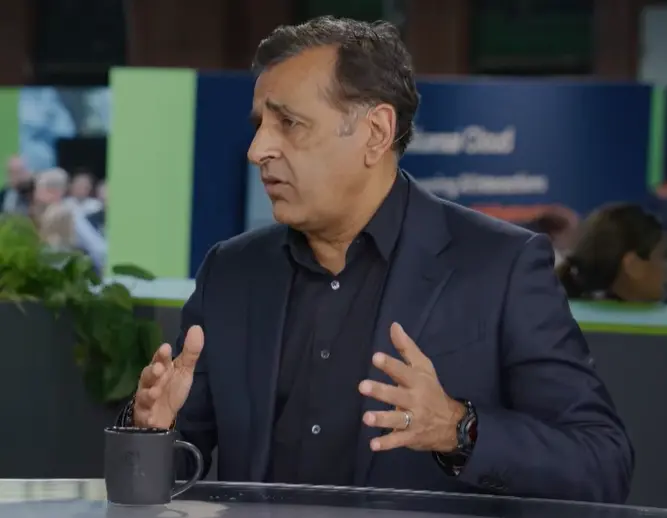
BERLIN — As the telecommunications industry hurtles toward a hyper-connected, intelligent tomorrow, the convergence of artificial intelligence and Radio Access Networks (RAN) has transitioned from a speculative research concept into an urgent commercial imperative. At NVIDIA GTC 2026 in Berlin, Capacity’s Saf Malik sat down with two of the sector’s most influential technology leaders: Ronnie Vasishta, Senior Vice President of Telecom at NVIDIA, and Pallavi Mahajan, Chief Technology and AI Officer at Nokia.
The high-level discussion offered a rare, comprehensive look beneath the hood of the AI-RAN alliance. Vasishta and Mahajan unpacked the rapid acceleration of AI-RAN technologies, detailing live customer trials, hard commercial timelines, remarkable spectral efficiency gains, and the strategic blueprint for transforming traditional telecom utilities into dynamic, revenue-generating AI platforms.
Executive Overview: The Paradigm Shift of AI-RAN
For decades, mobile networks have functioned primarily as high-capacity data pipes—efficient at moving bits from point A to point B, but largely agnostic to the intelligence running across them. However, the exponential rise of generative AI, the proliferation of edge computing, and the sheer complexity of managing modern 5G-Advanced and impending 6G architectures have rendered legacy infrastructure obsolete.
Enter the AI-RAN (Artificial Intelligence-Radio Access Network). By integrating accelerated computing directly into the RAN, operators are no longer just managing connectivity; they are deploying distributed supercomputing nodes at the network edge.
During their GTC 2026 panel, NVIDIA’s Ronnie Vasishta and Nokia’s Pallavi Mahajan emphasized that this is no longer a theoretical exercise. Armed with accelerated computing hardware from NVIDIA and Nokia’s carrier-grade network orchestration software, tier-one mobile operators worldwide are actively transitioning from lab environments to live, commercial-scale field trials. The collaboration marries Nokia’s deep-rooted telecommunications pedigree with NVIDIA’s unmatched prowess in parallel processing and AI infrastructure, setting a new benchmark for how mobile networks are designed, deployed, and monetized.
Detailed Chronology: From Concept to Commercialization
The journey toward a fully integrated AI-RAN ecosystem has accelerated dramatically over the past 24 months, marked by key technical milestones and strategic alignments between silicon vendors and network infrastructure giants.
The Foundation of Accelerated Computing in Telecom
The initial phase of the AI-RAN movement centered on proving that general-purpose processors (CPUs) alone could no longer efficiently handle the rigorous computational demands of heavy signal processing alongside concurrent AI workloads. As virtualization and Open RAN standards matured, Nokia and NVIDIA recognized an opportunity to co-design hardware-accelerated software defined radios. By offloading heavy baseband processing and AI inferencing tasks onto specialized GPUs, the companies demonstrated that RAN infrastructure could achieve unprecedented levels of efficiency.
Moving from Lab to Live Customer Trials
By late 2025 and into early 2026, the collaboration shifted from conceptual architecture to real-world validation. During the discussions in Berlin, Vasishta and Mahajan highlighted ongoing live customer trials with forward-thinking Tier-1 mobile network operators (MNOs). These trials are crucial: they test the resilience, latency, and power-handling capabilities of AI-RAN deployments under heavy, dynamic user loads in dense urban environments.
According to the executive briefing, these commercial trials are paving the way for broad, multi-market rollouts projected for late 2026 and 2027. Operators are no longer asking if they should adopt AI-RAN, but rather how quickly they can integrate accelerated computing into their capital expenditure roadmaps to avoid being left behind.
Supporting Context & Metrics: Efficiency, Economics, and Architecture
The commercial business case for AI-RAN rests on two foundational pillars: dramatic operational efficiency gains and the creation of entirely new revenue streams.
Spectral Efficiency and Network Optimization
Radio spectrum is arguably a mobile operator’s most expensive and constrained resource. Traditionally, optimizing spectral efficiency required complex, static mathematical models that struggled to adapt in real-time to unpredictable interference, weather conditions, or sudden surges in user density.
With AI-RAN, machine learning models running at the network edge can dynamically predict traffic patterns, optimize beamforming in milliseconds, and mitigate interference with surgical precision. Mahajan and Vasishta noted that early deployments are yielding unprecedented spectral efficiency gains. By leveraging AI-driven predictive resource allocation, operators can squeeze significantly more capacity out of their existing spectrum holdings, delaying or entirely avoiding the multi-billion-dollar cost of acquiring new frequency bands.
Redefining the Total Cost of Ownership (TCO)
A common critique of introducing heavy AI workloads into telecommunications infrastructure has been power consumption. Critics argue that data center-grade computing at cell sites could cause energy expenditures to skyrocket.

However, Nokia and NVIDIA have turned this narrative on its head. Through tight software-hardware integration, AI-RAN enables dynamic power management. Base stations can intelligently scale down compute power during low-traffic windows while remaining instantly responsive to sudden demand spikes. Furthermore, because a single AI-RAN node can simultaneously handle traditional RAN workloads and host third-party enterprise AI applications, operators save massive amounts of capital by consolidating infrastructure that would otherwise require separate, dedicated hardware footprints.
Transforming Networks into Edge Computing Platforms
Perhaps the most profound metric discussed at GTC 2026 is the expansion of the Total Addressable Market (TAM) for telecom operators. For years, Average Revenue Per User (ARPU) has remained largely flat or experienced slow decline. AI-RAN changes the equation by turning every cell tower into a localized micro-data center.
This distributed architecture allows operators to offer high-value, ultra-low-latency services—such as localized voice AI processing, autonomous robotics coordination (physical AI), industrial automation, and augmented reality—directly to enterprise clients. Instead of acting merely as a dumb pipe, the telecom operator becomes the foundational platform provider for the local digital economy.
Official Statements and Industry Perspectives
The convergence of telecommunications and accelerated computing represents a rare alignment of two massive, historically siloed industries.
Highlighting the urgency and momentum of the partnership, Ronnie Vasishta, Senior Vice President of Telecom at NVIDIA, underscored how hardware-accelerated RAN is reshaping the industry’s horizon:
"What we are seeing today is the realization of a shared vision. By bringing together NVIDIA’s accelerated computing platform and Nokia’s world-class network architecture, we are enabling operators to transcend traditional boundaries. AI-RAN isn’t just about making the network faster or more efficient—it is about turning the mobile network into a living, intelligent platform capable of supporting the next generation of global innovation."
Echoing these sentiments, Pallavi Mahajan, Chief Technology and AI Officer at Nokia, emphasized the strategic imperative for network operators looking toward the future:
"The demands placed on modern networks are scaling faster than humanly possible to manage manually. AI-native architecture is no longer a luxury; it is an absolute necessity. Our work with NVIDIA is proving that operators can radically enhance spectral efficiency, lower their total cost of ownership, and simultaneously unlock powerful new monetization avenues as we march steadily toward an AI-native 6G future."
Future Outlook: Paving the Road to an AI-Native 6G Era
As the telecommunications sector looks past the maturation phase of 5G-Advanced, attention is rapidly shifting toward the horizon of 6G. Industry consensus dictates that 6G will not merely be an incremental speed upgrade over 5G, but a fundamentally native AI architecture from its inception.
The work being done today by Nokia and NVIDIA serves as the vital bridge to that future. By embedding AI directly into the radio access network now, operators are building the operational muscle memory, software frameworks, and hardware foundations required for 6G.
In this upcoming era, the network will act as a unified, sentient nervous system. It will autonomously heal itself, dynamically reconfigure to defend against sophisticated cyber threats, and seamlessly provision computing resources on demand.
As demonstrated at NVIDIA GTC 2026, the partnership between Nokia and NVIDIA is no longer just a technical collaboration—it is the vanguard of a complete architectural reinvention. For mobile operators navigating a fiercely competitive global landscape, embracing the AI-RAN revolution is no longer a future-proofing strategy; it is the definitive key to survival and long-term prosperity in the intelligent age.