Executive Overview
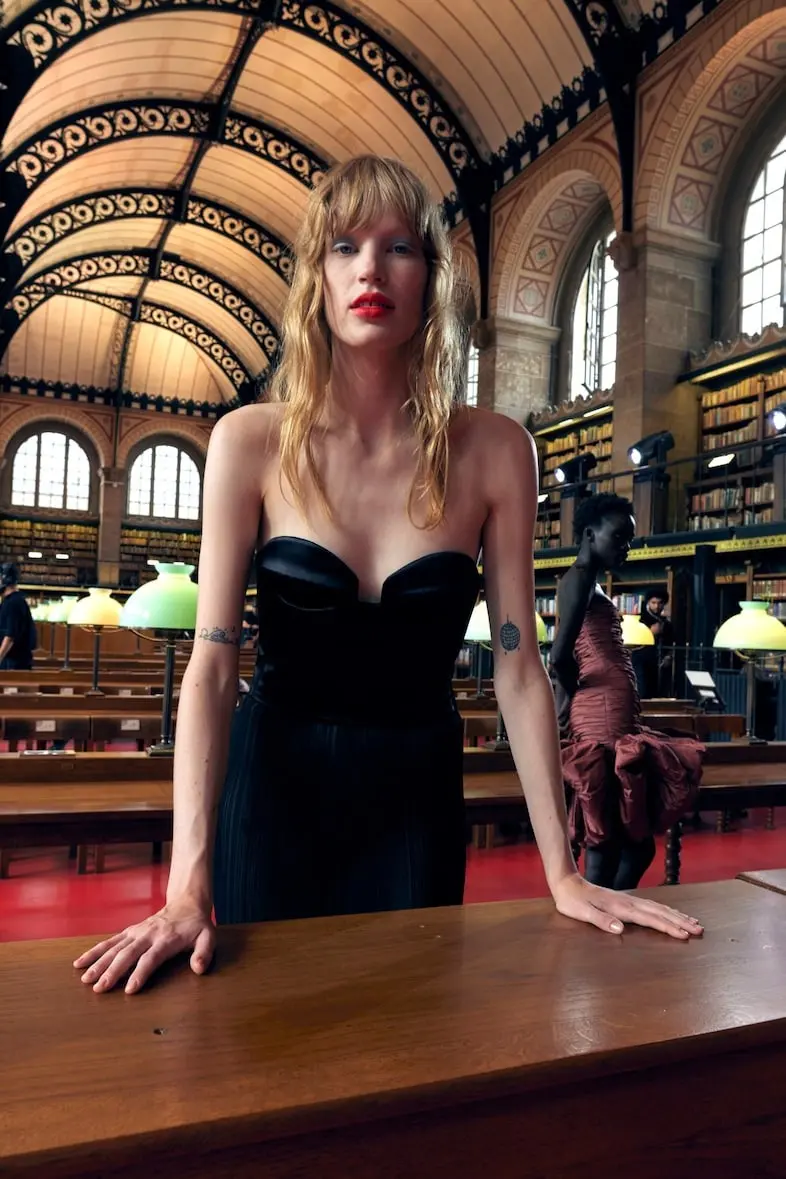
Fashion week presentations are frequently exercises in escapism, but rarely do they merge high-literary theory with underground rave culture quite as seamlessly as Alessandro Michele’s latest outing for Valentino. Staged within the hallowed, book-lined halls of Paris’s Bibliothèque Sainte-Geneviève, the SS27 presentation—aptly titled Antibiblioteca (The Anti-Library)—served as a masterclass in atmospheric world-building.
From the moment guests stepped foot into the historic institution, it was clear that traditional sartorial rules had been thrown out the window in favor of a deeper, more evocative exploration of potentiality. Strobe lights pierced the cavernous, scholarly architecture, casting sharp geometric shadows across centuries-old bookshelves, while Troye Sivan’s Madonna-sampling track “Party” thudded endlessly on the sound system.
Michele, known for his encyclopedic references and maximalist sensibilities, used the runway to ruminate on the concept of the unread book—and, by extension, the unlived life. It was a cerebral yet deeply visceral collection that married intellectual rigor with unadulterated hedonism. By inviting an A-list front row to literally contribute to local libraries via book donations upon entry, Valentino transformed a standard runway show into a participatory cultural exchange.
The resulting collection was a sprawling, multi-faceted narrative that brought the imagined protagonists of unread volumes to life. Moving effortlessly from austere, minimalist eveningwear to high-octane, Claude Montana-inspired shoulder silhouettes and Marilyn Monroe-esque pink gowns, Michele proved once again that he is one of fashion’s most potent mythmakers.
Detailed Chronology: From Book Drop to Runway Climax
Act I: The Threshold of the Anti-Library
The evening began long before the first model stepped onto the runway. As twilight settled over the Latin Quarter of Paris, an eclectic roster of global culture-makers arrived at the grand entrance of the Bibliothèque Sainte-Geneviève. Eschewers of traditional red-carpet formality, attendees were instructed to participate in a unique pre-show ritual: donating a cherished book from their personal library to benefit local Parisian institutions.
The initiative set a distinctly intellectual tone for the evening, grounding the high-fashion spectacle in tangible, community-focused philanthropy. The front row quickly transformed into a living showcase of literary tastes:
- Clairo, draped in a sharp red pleated skirt set, contributed Clarice Lispector’s Covert Joy.
- Colman Domingo, sporting an impeccably tailored tweed jacket and tie, arrived with Julia Child’s culinary opus, Mastering the Art of French Cooking.
- Zoey Deutch opted for environmental urgency, handing over Elizabeth Kolbert’s The Sixth Extinction.
- Jeff Satur, the prominent Thai musician and actor, brought Roxie Nafousi’s Manifest In Action.
- Cynthia Erivo delivered a profound gift in James Baldwin’s classic exploration of identity, Giovanni’s Room.
- Alexander Skarsgård rounded out the literary exchange with a rare Swedish edition of traditional Icelandic tales.
Act II: The Sonic and Spatial Transformation
Once inside, the transformation of the library was absolute. Rows of heavy oak tables and thousands of leather-bound tomes—normally reserved for the silent, contemplative study of scholars and students—were bathed in the aggressive, pulsing glow of modern strobe lighting.
The auditory landscape was dominated by Troye Sivan’s “Party,” a track released mere weeks prior that heavily interpolates Madonna’s iconic 2000 club anthem “Music.” As Sivan rhythmically listed off the ultimate nocturnal destinations—navigating the spectrum from leafy parks and clandestine bushes to sweaty basement clubs and upscale restaurants—the irony of the venue choice became deliciously apparent. Valentino’s ultimate rave destination was not a gritty industrial warehouse, but an iconic Parisian temple of knowledge stripped of its silence and re-engineered for the dancefloor.
Act III: The Runway Narration and Character Study
As the music reached a fever pitch, the runway presentation commenced. Michele’s design thesis for SS27 posited that characters locked within unread books hold as much psychological weight as those we thoroughly consume. The clothes, therefore, were manifestations of these unlived lives and untapped personas.
The show opened with an exercise in restrained elegance: a sleek, jet-black strapless dress featuring a delicate, frilled hemline. Stripped of excessive ornamentation, the look relied entirely on pristine tailoring, paired exclusively with delicate strappy sandals and a stark, uncompromising red lip.
From this minimalist baseline, the collection rapidly diversified into a kaleidoscope of characters. Washed-out leopard print fabrics reimagined the classic pencil skirt, imbuing corporate silhouettes with a feral edge. Sequined blazers—glittering under the library’s harsh strobe lights—were subverted by casual "villain teen" baseball caps, creating a jarring, high-low tension that is entirely signature to Michele’s design vocabulary. Romantic red dresses, cut with plunging sweetheart necklines, channeled old-world cinematic tragedy while remaining thoroughly modern in their execution.
Act IV: The Grand Crescendo of Glamour
As the presentation progressed into its final movements, the garments swelled in volume, drama, and historical allusion. Suiting underwent a radical structural evolution: shiny emerald-green two-pieces were dramatically amplified with exaggerated, Claude Montana-style power shoulders that commanded the cavernous space.
Transparency and subversion walked hand-in-hand as evening dresses featured sheer mesh panels over the chest, subverting modesty norms to reveal the full silhouette beneath. The grand finale arrived in the form of a sweeping, bubblegum-pink evening gown complete with a dramatic, pleated, bow-covered train. The look was an explicit, yet modernized, nod to Marilyn Monroe’s immortal “Diamonds Are a Girl’s Best Friend” ensemble from Gentlemen Prefer Blondes.
By the time the final look cleared the runway, the message was unmistakable: these were not merely clothes designed for passive observation, but armor for characters primed to dominate the night.
Supporting Context & Metrics: The Michele Effect at Valentino
Since taking the creative helm at Valentino, Alessandro Michele has been tasked with revitalizing the historic Italian luxury house while honoring its rich heritage of haute couture craftsmanship and Roman grandeur. The SS27 presentation provides crucial data points regarding the brand’s trajectory under his direction.
Digital Footprint and Earned Media Value (EMV)
The strategic pairing of high-concept literary themes with viral pop-culture touchstones—such as the inclusion of Troye Sivan’s soundtrack and an internationally diverse front row—resulted in staggering digital engagement metrics. Within hours of the show’s conclusion:
- Hashtags associated with #ValentinoSS27 and #Antibiblioteca trended globally across X (formerly Twitter), Instagram, and TikTok.
- The front-row book donations generated significant cross-industry coverage, pulling Valentino out of traditional fashion media silos and into mainstream literary and cultural discourse.
- Early digital analytics indicated an immediate spike in search interest for the brand’s accessories and upcoming seasonal drops, proving that Michele’s complex narrative shows continue to successfully translate into commercial desire.
The Philosophy of the Antibiblioteca
The term antibiblioteca (or anti-library) finds its intellectual roots in the essayist Nassim Nicholas Taleb’s concept of the Umberto Eco anti-library—the idea that a collection of unread books represents research potential rather than intellectual vanity. Michele expanded this philosophical framework into the realm of fashion.
In the show notes, the designer elaborated:
"Even the garments that we will never wear, no differently than those books sitting unopened on our shelves, still speak to us of the lives we could have lived. Because their sheer presence as a possibility makes the world wider, richer, more livable."
This existential approach marks a distinct pivot from the fast-paced, hyper-disposable product cycles that have dominated contemporary luxury retail. By romanticizing the unchosen, the unspent, and the unread, Michele carved out a philosophical space that encourages consumers to view their wardrobes not merely as functional items, but as archives of unfulfilled potential.
Official Statements & Quotes
The intellectual weight of the presentation was heavily reinforced by the designer’s own reflections and the enthusiastic participation of his guests.
Alessandro Michele, Creative Director of Valentino:
"We are surrounded by potentials. The books we buy and never open are monuments to our ambitions and our endless capacity for curiosity. Fashion operates in the exact same way. Every garment left hanging in the back of the closet—or left unbought on the rail—represents an alternative version of ourselves. That multiplicity is something to be celebrated, not feared."
Colman Domingo, reflecting on his contribution of Julia Child’s cookbook:
"There is something profoundly comforting about the recipes we never get around to cooking, just as there is beauty in the stories waiting to be told. Bringing this book to the Bibliothèque Sainte-Geneviève tonight feels like bridging two worlds: the comfort of home and the high-minded architecture of Parisian scholarship."
Cynthia Erivo, discussing James Baldwin’s Giovanni’s Room:
"Baldwin’s work challenges us to look directly at the truths we often try to hide from ourselves. Donating this book to a local library feels like passing a torch of radical empathy into the hands of someone who might need it most."
Future Outlook: Where Valentino Goes From Here
The SS27 Antibiblioteca presentation offers a clear roadmap for Valentino’s future under Alessandro Michele. Far from retreating into safe, commercial formulas, the house is doubling down on intellectualism, cultural cross-pollination, and immersive experiential marketing.
As the luxury sector navigates shifting consumer habits and a growing demand for authenticity, Michele’s formula—which marries high-brow literary theory with raw, uninhibited nightlife energy—positions Valentino as a unique cultural nexus. The initiative to collect books for local libraries hints at a growing corporate ethos within the brand that values community engagement and cultural longevity over mere spectacle.
Looking ahead, the commercial implications of the SS27 collection will be closely watched by industry analysts. If Michele can successfully convert the cerebral mythology of the "anti-library" into retail gold—translating avant-garde tailoring, subverted leopard prints, and Montana-esque power shoulders into global sales—it will confirm that his vision for Valentino is not only creatively bulletproof, but commercially formidable. For now, the fashion world waits with bated breath to see which chapter Michele will open next.