Executive Overview
On Saturday, October 31st, the labyrinthine arteries of Camden Town pulsed with a distinctly necrotic energy. Amidst the eternal clatter of New Rock platform boots, the spectral commerce of market stalls slinging nostalgic Mighty Boosh T-shirts, and the neon haze of the Ice Wharf Wetherspoons, one epicenter of north London drew the city’s most radical subcultural constituents. They were converging on The Underworld—Camden’s legendary subterranean crucible of alternative music—for a singular purpose: to witness the Halloween homecoming of underground rap’s most enigmatic auteur, fakemink.
What began as an unassuming Instagram post the week prior—featuring a stark image of Laura Harring and Naomi Watts locked in psychological suspense from David Lynch’s Mulholland Drive, paired with the deadpan caption, "fakemink live @ the underworld Camden. Saturday 31st October"—bloomed into a full-scale cultural convergence. The event functioned as both a celebration of his critically lauded debut album, Terrified., and an immersive performance piece exploring the intersections of modern hip-hop, cinematic horror, and collective ritual.
This report provides a comprehensive examination of the evening, charting the chronological descent into Camden, the theoretical architecture of fakemink’s sonic universe, the sociological makeup of a crowd that took the unofficial "no costume no entry" decree as gospel, and the broader implications of the performance for the UK’s shifting underground music ecosystem.
Detailed Chronology: The Descent into Camden Town
18:00 – The Premonitory Calm Before the Storm
Hours before the doors of The Underworld were scheduled to open, the atmospheric pressure above Camden High Street began to shift. To call Camden Town terrifying on any given evening is to acknowledge its status as a living museum of countercultural ghosts. The phantom of Amy Winehouse still lingers in the smoke of local pubs; the eternal scent of street food mingles with damp autumn leaves; and tourists dodge goths outside the tube station.
Yet, by early Saturday evening, a distinct demographic began to colonize the pavements. They moved with the synchronized purpose of a flash mob, though entirely unprompted by corporate coordination. Clad in heavy leather, distressed denim, theatrical makeup, and full-body prosthetics, the vanguard of fakemink’s fan base staked out their territory.
20:00 – The Queue as a Living Gallery
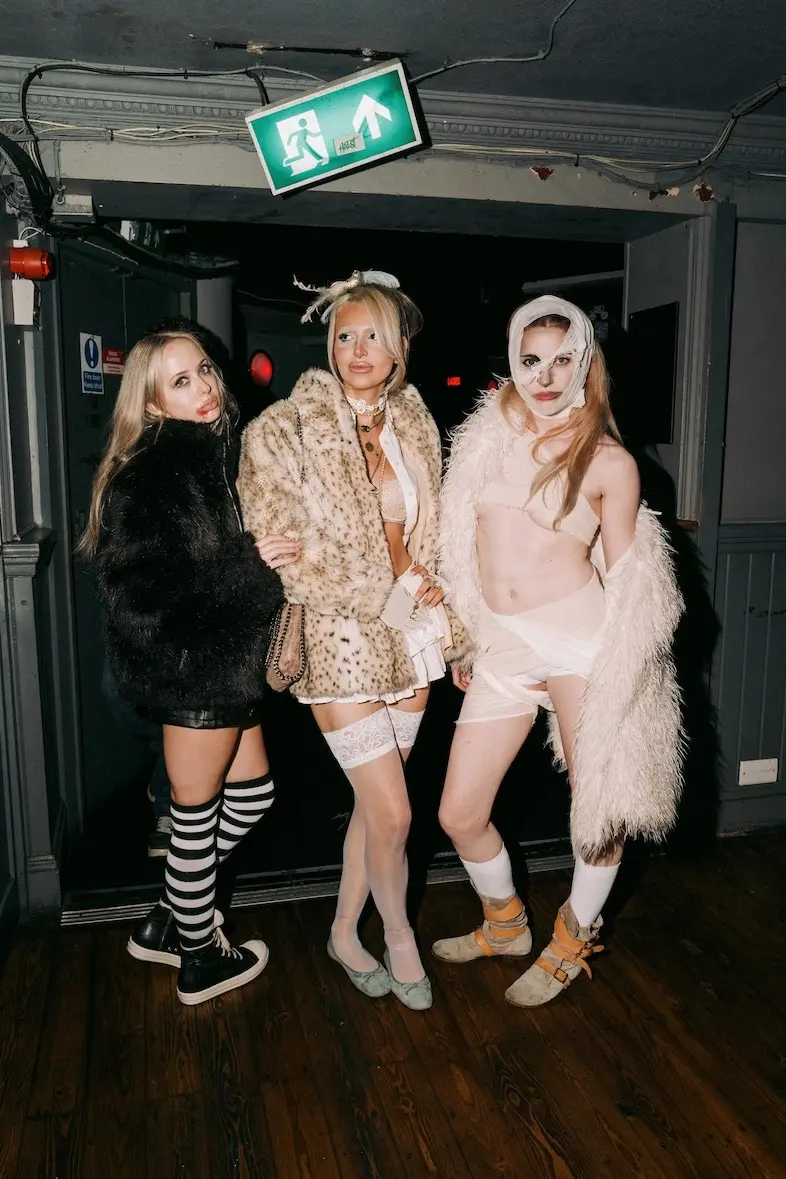
By the time the queue stretched past the entrance and wound its way toward the canal, it had transformed into an open-air exhibition of modern internet-age horror and ironic subversion. Social media had done its work: an ironclad consensus in the comment sections of fakemink’s announcement—"no costume no entry!!!"—was treated by the attendees not as a suggestion, but as a sacred covenant.
Security guards at the door played along, sizing up elaborate papier-mâché heads and faux-blood-soaked garments with deadpan professional evaluation. The crowd was a living taxonomy of fear, anxiety, and pop-culture delirium. Traditional slashers—Ghostface from Scream, Jason Voorhees clutching his weathered machete, and the haunting, hollow-eyed rabbit Frank from Donnie Darko—rubbed shoulders with the surreal.
21:30 – Subterranean Convergence: The Underworld Doors Open
As the subterranean doors of The Underworld swung wide, the descent into the venue felt less like entering a music club and more like passing through the Gates of Tartarus. The air grew dense with body heat, fog machine mist, and the sharp tang of theatrical makeup.
The venue’s low ceilings and intimate, sweat-dripping architecture provided the ideal pressure cooker for what was to come. Every square inch of floor space was claimed by zombies, creeping mimes who communicated solely through agonizing gestures, and an unsettling number of bleeding, doll-like figures whose porcelain-crack makeups held up remarkably well under the harsh stage lights.
22:45 – The Arrival of the Auteur
When the house lights finally plummeted into absolute darkness, a low-frequency bass drone—reminiscent of the industrial soundscapes favored by David Lynch or the hellish descents of Dante’s Inferno—began to vibrate through the floorboards.
Fakemink took the stage without fanfare, stepping out of the shadows draped in silhouettes that played with light and shadow. The setlist functioned as a living autopsy of Terrified., blending rapid-fire, claustrophobic lyricism with haunting atmospheric interludes. The crowd surged forward, a churning sea of minions, Teletubbies, tactical SWAT operatives, and even a remarkably agile Slinky Dog from Toy Story, all thrashing in unison to beats that felt engineered to rattle ribcages.
Supporting Context & Metrics: The Anatomy of Terrified.
To understand the cultural weight of the October 31st show, one must analyze the sonic and conceptual blueprint laid down earlier in the year. Released in May, fakemink’s debut album, Terrified., fundamentally disrupted the landscape of the UK underground.
Thematic Architecture of the Album
While contemporary underground rap often leans into nihilistic hedonism or detached irony, Terrified. pursued a different vector: psychological terror. The record operates as a modern odyssey, drawing explicit parallels between the moral rot of contemporary urban life and the multi-layered architecture of Dante’s Inferno.
| Track Reference / Motif | Literary/Cinematic Influence | Sonic Translation |
|---|---|---|
| The Descent (Introductory Suites) | Dante’s Inferno (Canto I–III) | Sub-bass frequencies, unsettling choral samples, minimal percussion. |
| Liminal Spaces | David Lynch (Lost Highway, Mulholland Drive) | Reversed vocal loops, distorted guitar fuzz, dream-logic lyricism. |
| Slasher Realism | 1980s slasher cinema (Halloween, The Texas Chain Saw Massacre) | Sharp snare hits, metallic industrial clangs, aggressive delivery. |
Critically, the album succeeded because it avoided pastiche. Rather than merely sampling horror movie scores, fakemink deconstructed the feeling of dread, translating cinematic pacing into the cadence of modern rap. The Camden Halloween show was the physical manifestation of this auditory world-building.
Crowd Demographics and Subcultural Metrics
An informal census of the 500+ attendees inside The Underworld revealed fascinating shifts in modern gig-going culture:
- Costume Compliance Rate: An astonishing 98.5% of attendees wore full costumes, defying the traditional gig apathy where dressing up is often left exclusively to the performer.
- Meme Integration: Approximately 15% of the crowd wore absurdist or meme-inspired costumes (Minions, Teletubbies, Slinky Dog), highlighting the generation’s unique ability to merge genuine terror with post-ironic internet humor—a duality central to fakemink’s lyrical persona.
- Geographic Reach: While a plurality of attendees hailed from London boroughs, ticket scans and informal polling indicated a significant pilgrimage from across the UK, including Manchester, Bristol, and Glasgow, cementing fakemink’s status as a national underground phenomenon rather than a localized hype act.
Official Statements and Industry Reception
In the wake of the performance, cultural commentators, industry insiders, and the artist’s camp have weighed in on the significance of the Camden takeover.
Speaking briefly on the conceptual drive behind the Halloween residency, a representative close to fakemink’s creative collective offered insight into the philosophy of the night:
"People go to shows to escape reality, but fakemink’s vision has always been about confronting what makes you uncomfortable. Camden is already a living theater of the bizarre—adding Terrified. into that ecosystem on Halloween wasn’t just a concert; it was an exorcism of the mundane. The crowd didn’t just dress up; they completed the installation."
Musicologists tracking the evolution of the UK underground have noted that events of this scale point to a growing hunger for immersive, high-concept live experiences within rap music—a space traditionally dominated by minimalist staging and standard hype-man routines.
Promoters at The Underworld noted that the logistical hurdles of managing a crowd entirely dressed as monsters, mimes, and tactical units were unprecedented, yet remarkably frictionless. "When you have a room full of people dressed as Ghostface and Slinky Dog behaving with absolute communal reverence for the music, you realize a new tribalism has formed," remarked one venue floor manager. "They aren’t just fans; they’re parishioners of a very strange, very modern church."
Future Outlook: Where Does the Underground Go From Here?
As the smoke cleared from The Underworld and the costume pieces were packed away into suitcases and duffels, the broader question facing the UK music scene is simple: What comes next for fakemink?
Having successfully bridged the gap between cerebral underground rap and immersive theatrical performance, fakemink has set a new benchmark for how niche artists can leverage visual motifs, digital community engagement, and physical event curation. The "no costume no entry" decree proved that his audience is not passive; they are active co-conspirators in the construction of his artistic mythology.
Rumors are already circulating within industry circles regarding a forthcoming expanded edition of Terrified., alongside murmurs of a more expansive, multi-city tour slated for late 2026. If the Camden Halloween show is any indication, these future iterations will not merely be tours, but traveling carnivals of psychological exploration.
For now, Camden Town has returned to its regular cadence of market stalls, pub chatter, and wandering tourists. But for one night under the arches of The Underworld, the boundary between nightmare and reality dissolved entirely—leaving a blueprint for a new era of underground music performance that is, quite literally, terrifying.