Executive Overview
As artificial intelligence shifts from a theoretical productivity enhancer to the operational backbone of modern enterprise, few organizations have leaned into the transition as aggressively as Anthropic. In a newly published internal workforce report, the AI research and product company has pulled back the curtain on how its own operations have transformed under the weight of widespread AI agent deployment.
Synthesizing internal headcount data, agent session telemetry, calendar analytics, Slack interaction patterns, hiring scorecards, and qualitative insights from 17 employee interviews, the report offers the most granular look to date at a mature, AI-first organization. Because Anthropic has restructured its internal workflows around autonomous agents more thoroughly than almost any other B2B entity, its findings serve as a bellwether for the rest of the technology sector—and the broader global economy.
The data reveals a stark transformation. While Anthropic’s overall headcount has tripled over the past year, the structural composition of its workforce, its hiring criteria, and its day-to-day operational rhythms have been fundamentally re-engineered. Most notably, the data highlights a steep decline in entry-level technical recruitment, a massive explosion in agent-driven productivity that simultaneously creates severe human-side bottlenecks, and a significant pivot toward "meta-work"—the management and orchestration of AI systems by human operators.
For founders, executives, and enterprise leaders navigating the next decade of organizational design, Anthropic’s internal experiment provides critical lessons on the opportunities and profound friction points of an agentic workforce.
Detailed Chronology: The Evolution of Anthropic’s AI Workforce
To understand how Anthropic reached its current operational state, it is necessary to examine the timeline of agent integration that accelerated rapidly throughout 2025 and 2026.
Phase 1: The Code and Bug-Fixing Shift (Early to Late 2025)
The structural shift began in earnest during the early months of 2025. Initially, agent adoption was concentrated within technical departments where software engineering tasks—specifically code generation, testing, and debugging—were prime candidates for automation. As Claude models grew increasingly capable, engineering and research teams began noticing a dramatic lift in performance engineer output.
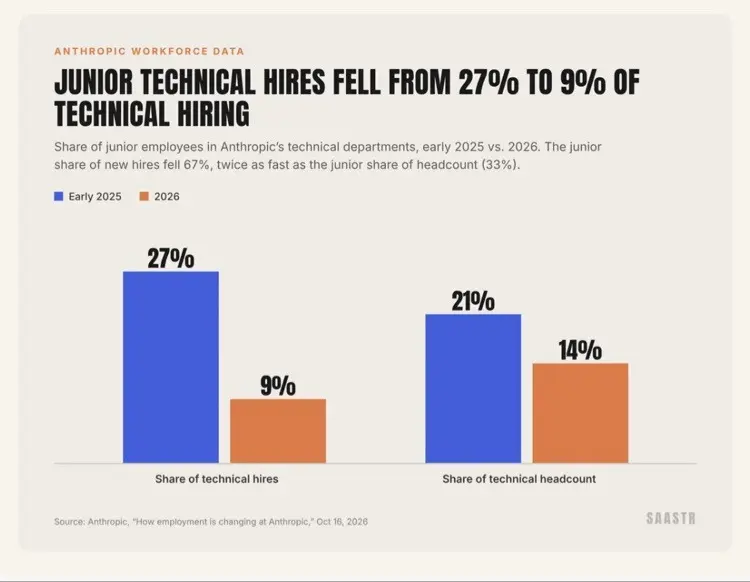
By late 2025, written standing instructions for agents—the foundational guardrails and prompt frameworks that dictate how autonomous systems operate—jumped from a few hundred to several thousand. During this period, the proportion of junior technical hires began a downward trajectory, sliding from 27% of all technical hires down toward historical lows as core coding tasks were successfully offloaded to models.
Phase 2: The Operational Re-Architecture (January – April 2026)
By January 2026, the integration of AI agents moved beyond isolated technical tasks into broader organizational workflows. Sales and go-to-market teams underwent radical restructuring. Recognizing that human recruitment could not scale rapidly enough to meet surging market demand—some leaders noted the impossibility of absorbing a 3x to 5x increase in sales headcount efficiently—Anthropic rebuilt its sales architecture. By April 2026, more than half of all new enterprise logos were coming through self-serve channels, driven by automated triage, personalized outreach, and agent-assisted closing mechanisms.
Simultaneously, engineering teams formalized their reliance on autonomous agents. In March 2026, total agent work hours surpassed human work hours for the first time in the company’s history. By August 2026, agents directed by employees were logging six times as many hours as their human supervisors. This period also marked the peak of administrative automation; routine clerical work, scheduling, and email triage were almost entirely absorbed by custom agent assistants, pushing executive assistants and operational staff into higher-level chief-of-staff roles.
Phase 3: The Bottleneck and Meta-Work Era (Mid-to-Late 2026)
As autonomous agents scaled to outpace human hours by a factor of six, the organization hit a new operational equilibrium characterized by intense "meta-work." By mid-2026, interactive Claude sessions revealed that roughly 80% of agent runtime was spent idle, waiting for human intervention, review, or strategic direction.
The volume of agent-generated output created a massive reading and review burden for human teams. In response, hiring managers permanently altered their assessment matrices, sidelining traditional domain expertise in favor of metrics measuring autonomy, judgment, and the candidate’s proven track record of orchestrating AI tools.
Supporting Context & Metrics: The Numbers Behind the Transformation
Anthropic’s internal metrics quantify the massive scale of operational leverage unlocked by agentic workflows, while also underscoring the friction points that emerge when software systems operate at superhuman speeds.
1. The Collapse of Junior Technical Hiring
The most alarming statistic in the report centers on early-career employment. Since early 2025, the share of junior employees across Anthropic’s technical departments fell from 21% to 14%. Even more striking, the share of new technical hires who were classified as junior plummeted from 27% to 9%. Job postings targeting junior engineers dropped off a cliff beginning in December 2025.
Teams that relied most heavily on Claude for code writing and debugging saw their entry-level pipelines dry up first. By April 2026, roughly a third of machine learning managers and one-fifth of software engineering managers explicitly stated they were hiring fewer people because AI agents were handling the baseline coding and testing load. Anthropic’s report notes an uncomfortable truth: while internal redeployment and worker protection programs help retain existing staff, they offer no solutions for the junior engineer who fails to secure an initial entry-level offer in an automated labor market.
2. Hyper-Growth and Unprecedented Revenue Efficiency
Despite—or perhaps because of—its heavy reliance on AI, Anthropic tripled its overall headcount over the preceding twelve months. However, the internal mix of talent shifted away from purely technical roles. Technical departments dropped from 61% to 56% of total headcount as non-technical functions, including sales, finance, and recruiting, scaled rapidly to manage the company’s hyper-growth.
Adjusted to 2025 constant dollars, Anthropic’s revenue per employee at five years old is estimated to be two to four times higher than what tech giants like Google and Meta achieved at the exact same stage in their corporate lifecycles. Administrative headcount, meanwhile, remained virtually flat, proving that AI assistants can absorb clerical expansion even as enterprise output multiplies.
3. The 80% Human Bottleneck
By August 2026, agents were logging six times the operational hours of their human handlers. Code commits per engineer surged to five times their baseline from six months prior, and parallel gains were recorded in legal contract processing and accounts payable. Crucially, tracking data showed that agent-written code was deleted or reverted at the exact same frequency as code written entirely by hand, indicating that raw output quality did not suffer under automation.
However, a massive systemic bottleneck emerged: interactive agent sessions spent 80% of their time idle, waiting for human input. The sheer volume of material generated by agents created a severe cognitive load. For technical teams, reading agent output consumed hours of the workweek; for non-technical teams, reviewing everything produced by their agents would consume more than half of a standard working week. Human review speed had officially become the ultimate limiting factor for corporate productivity.
4. The Rise of Meta-Work and Standing Instructions
Managing this agentic workforce required a new category of labor: meta-work. Written standing instructions given to agents exploded from a few hundred in July 2025 to 8,500 a year later. Meta-work consumed 22% of the average employee’s interactive Claude sessions by the spring of 2026, up from 10% the previous fall.
This meta-work primarily involved writing multi-agent specs, setting up peer-review loops between different models, and monitoring automated pipelines. Because agents cannot parse unrecorded hallway conversations or private direct messages, the company was forced to mandate open documentation and transparent Slack threads so that autonomous systems could access up-to-date institutional context. Consequently, median meeting times rose by 20% as humans convened to make cross-functional decisions that could subsequently be translated into agent-readable frameworks.
Official Perspectives and Industry Insights
The insights from Anthropic’s internal report were further contextualized by executive commentary at major industry gatherings, such as the SaaStr AI conference, where company leaders detailed how these structural changes manifest on the ground.
Kelly Loftus, who scaled Anthropic’s startup sales organization from under 10 people to over 150 in just 18 months—while overall company headcount grew from 250 to 1,300—noted that traditional sales management paradigms no longer apply. Loftus’s team operates largely without traditional sales quotas, relying instead on fluid "shadow targets" driven by automated lead processing and real-time data feeds.
Similarly, Eleanor Dorfman discussed the operational impossibility of traditional scaling. Realizing that the company could not onboard human sales reps fast enough to keep pace with hyper-growth, Dorfman restructured the go-to-market organization to prioritize automated self-serve funnels. Within four months of this pivot, 54% of new enterprise logos were acquired through automated, self-serve workflows—though executives caution that this figure is an extreme outlier born of unprecedented market demand and should not be treated as a universal B2B benchmark.
On the internal employee side, qualitative interviews revealed a psychological shift in job function. Executive assistants reported that routine scheduling and email management had vanished, replaced by high-level chief-of-staff responsibilities. Software engineers described their roles shifting from direct line-by-line coders to systems architects who spend their days reviewing pull requests generated by autonomous background models.
To mitigate the disruptive effects of this rapid restructuring, Anthropic implemented two key structural cushions:
- Broad-Based Equity Alignment: Employees are granted significant financial stakes in the company, ensuring they share directly in the productivity dividends generated by the agents they manage—modeled loosely on the productivity-for-equity bargains of mid-20th-century industrial labor pacts.
- An AI Early Warning System: The company utilizes internal data analytics to monitor role demand and forecast which job functions are vulnerable to automation. By tracking these shifts proactively, Anthropic facilitates internal redeployment and upskilling, resulting in a 50% increase in internal lateral moves as employees transition into newly minted roles before their legacy tasks disappear.
Future Outlook: What the Anthropic Model Means for Enterprise Strategy
Anthropic’s workforce report offers a sobering glimpse into the realities of the AI-first enterprise. The narrative that AI will simply "assist" human workers without altering organizational structures is definitively debunked by the data. Instead, AI agents are actively displacing baseline execution tasks, shrinking the entry-level hiring funnel, and forcing a complete re-evaluation of what human talent is paid to do.
For executives and founders, several strategic takeaways emerge from Anthropic’s trajectory:
- The Death of the Traditional Entry-Level Runway: As autonomous systems absorb foundational coding, drafting, and analytical tasks, companies must figure out how to cultivate senior talent when entry-level execution roles are automated away. Relying entirely on external hiring for senior talent is unsustainable if the junior pipeline ceases to exist.
- Human Review as the Ultimate Bottleneck: Buying or building more agents will not solve productivity challenges if human review capacity remains constrained. Organizations must invest heavily in automated verification, assertion testing, and structured decision-making frameworks to prevent human review queues from stalling enterprise momentum.
- The Pivot to Meta-Management: The future value of an employee lies less in their raw domain execution and more in their ability to orchestrate, prompt, audit, and direct autonomous agents. Hiring scorecards must evolve to screen for high-level judgment, systems-level thinking, and cross-functional autonomy.
- Radical Transparency for Machine Consumption: Institutional knowledge can no longer live in silos, unrecorded meetings, or DMs. For agents to function effectively, corporate culture must shift toward radical documentation, ensuring that every strategic decision is rendered in a format that AI systems can read, ingest, and act upon.
Ultimately, Anthropic’s internal experiment proves that while AI can multiply corporate revenue per employee and scale output by factors of five or six, it demands an equally radical transformation of corporate culture, talent acquisition, and workflow design. Organizations that fail to prepare for the agentic shift risk finding themselves bottlenecked not by their technology, but by their own human processes.