Executive Overview
London has never been a city to whisper its style; it prefers to scream it from the front row, the cobblestones, and the makeshift barricades outside every major venue. As the fashion pack descended upon the British capital for the Spring/Summer 2027 (SS27) showcases, London Fashion Week (LFW) once again cemented its reputation as the global epicenter of sartorial defiance. While Milan trades in polished elegance and Paris in bourgeois heritage, London remains the undisputed laboratory of youth culture, historical subversion, and unbridled creative anarchy.
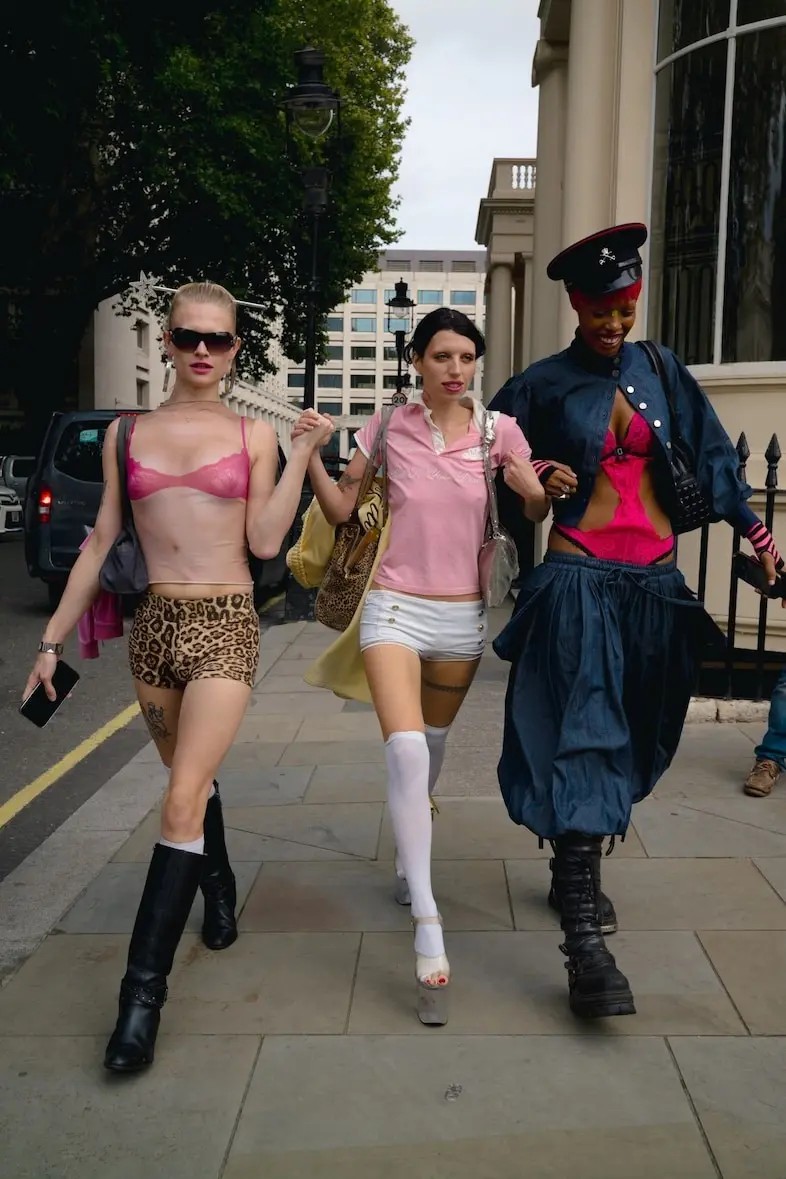
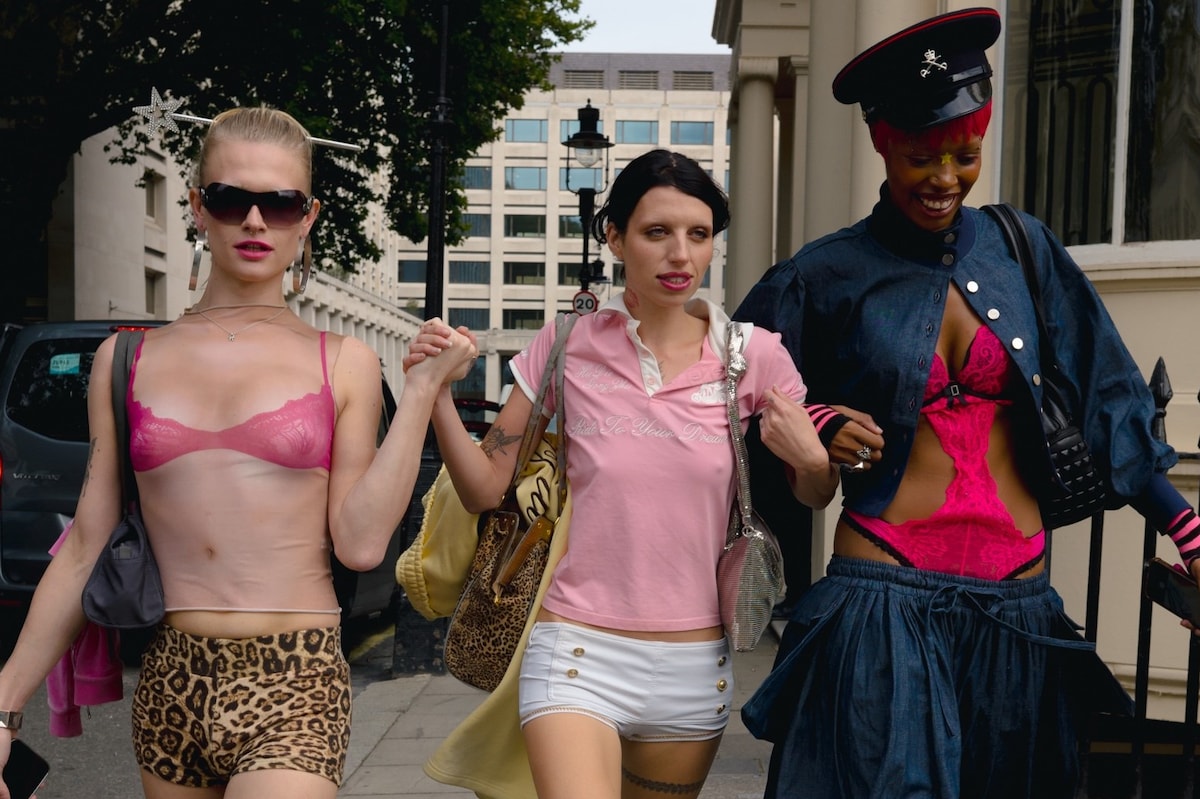
This season’s street style offered a panoramic, highly eclectic feast for the eyes, proving that the hordes of photographers lining the pavements outside each show venue are entirely justified. Beyond mere aesthetic coordination, the attendees transformed the streets into an interactive, socio-political, and deeply ironic canvas. Slogan tees bore provocative mandates ranging from fiscal rebellion to pop-cultural nostalgia, while unexpected accessories—from luxury vintage archival pieces to repurposed consumer electronics—redefined the parameters of modern styling. On the runways, emergent talents like Kai Ghattaura, Chopova Lowena, and Liza Keane tore up the rulebook; off the runways, the front-row guests and show-goers matched that rebellious energy garment for garment.
Detailed Chronology: The SS27 Street Style Narrative
Day One: The Manifesto on Pavement
The tone of SS27 was established within the first twenty-four hours outside the opening shows. London’s historic affinity for the slogan tee returned with a vengeance, evolving from a political tool of the 1970s punk era into a postmodern collage of irony, internet culture, and direct provocation.
Photographers scrambled to capture garments emblazoned with stark, blunt declarations. A striking number of show-goers sported minimalist white cotton tees bearing the deadpan directive: “EVADE TAXES.” Others leaned into linguistic subversion with words like “Cuntry” stamped across distressed knitwear. Perhaps the most viral sartorial statement of the opening day, however, was a masterclass in noughties millennial nostalgia: a graphic tee featuring the iconic 2006 paparazzi photograph of Lindsay Lohan, Britney Spears, and Paris Hilton squeezed together in the backseat of a car, superimposed above the rallying cry, “Make America Great Again.”
The blurring line between high art, performance, and everyday dress was further emphasized by artist Harry Freegard, who turned up sporting a literal portrait of Princess Diana emblazoned across his chest. This opening salvo set a clear precedent: for SS27, quiet luxury was persona non grata. Londoners were speaking directly to the lens, treating their bodies as billboards for cultural commentary.
Day Two: Animalistic Textures and Archival Flexes
As the week progressed, the visual vocabulary shifted from text-heavy declarations to heavy-hitting textures and stealth luxury flexes. Animal print—specifically aggressive, unapologetic leopard print—dominated the asphalt. Echoing the sultry, high-octane energy of Adriana La Cerva from The Sopranos (a cultural touchstone that manifested directly on the runway during Natasha Zinko’s presentation, where the character’s aesthetic ghost loomed large), attendees draped themselves in faux-fur coats, trousers, and accessories spotted with feline spots.
Yet, the true masterclass of Day Two lay in the realm of accessories, specifically the subversion of everyday tech. Nothing headphones were ubiquitous across the pavements, but purists and minimalists look away: not a single person wore them in their ears. Instead, the transparent-cased earbuds were repurposed as avant-garde bag charms, braided into hair, or strung together as industrial-chic necklaces.
Footwear and bags also underwent intense scrutiny from the street style chroniclers. Amidst a sea of contemporary labels, the undisputed holy grail handbag of the season was unmasked: a remarkably rare, ice-cream-print variant of the classic Balenciaga Le City bag. Retailing upwards of a thousand pounds on secondary archival markets and practically impossible to track down in this specific colorway, the appearance of multiple Le City iterations proved that London’s vintage connoisseurs are playing a high-stakes treasure hunt.
Day Three and Beyond: The Synthesis of Runway and Reality
By the final stretches of LFW SS27, the dichotomy between what was shown on the catwalk and what was worn on the street dissolved entirely. The anarchic spirit pulsing through the collections of off-schedule and NEWGEN designers bled directly into the street style corpus.
Runway highlights such as Kai Ghattaura’s structural deconstruction, Chopova Lowena’s coven-meets-bowling-alley pastiche, and Liza Keane’s visionary textiles found their spiritual mirrors in the crowds outside. Attendees layered contradictory historical periods—Victorian lace paired with motocross leather, heavy British punk hardware juxtaposed against delicate silk slips. The streets of London proved once again that style here is not a seasonal trend report; it is an enduring, living archive of subcultural rebellion.
Supporting Context & Metrics: The Economics and Sociology of LFW Street Style
To understand London Fashion Week street style is to understand the socio-economic and cultural pressures currently shaping the British capital. Unlike New York, Milan, or Paris—where fashion weeks are heavily bankrolled by corporate luxury conglomerates and institutional tourist boards—London Fashion Week operates under a uniquely scrappy, entrepreneurial, and fiercely independent umbrella, spearheaded by the British Fashion Council (BFC).
| Metric Category | LFW SS27 Observations & Industry Estimates | Historical Comparison (Pre-Pandemic vs. Current) |
|---|---|---|
| Primary Street Style Demographics | 65% Gen Z / Younger Millennial, 25% Established Creatives, 10% Press/Buyers | Shift from traditional editors to digital creators and independent stylists |
| Dominant Aesthetic Drivers | Post-ironic sloganism, archival luxury, subcultural mashups | Evolution from minimalist streetwear to hyper-individualized vintage layering |
| Accessory Innovation Index | High utilization of repurposed tech (Nothing earbuds as jewelry/charms) | Growth of non-traditional object styling over traditional luxury branding |
| Secondary Market Impact | High demand for rare archival pieces (e.g., Balenciaga Le City Ice Cream print) | Surge in peer-to-peer resale platforms driving street style composition |
The economic realities of the UK—marked by cost-of-living pressures, high tax burdens, and shifting creative funding models—manifested literally in the fashion choices of the attendees. Slogans like “EVADE TAXES” are not merely provocative graphic choices; they act as dark, satirical mirrors to the political malaise gripping modern Britain. Similarly, the obsession with deep archival finds—such as the elusive Balenciaga Le City bags—points to a broader rejection of fast-fashion saturation in favor of hyper-curated, high-value investment pieces sourced through secondary markets, Depop, and specialized vintage dealers.
Official Statements and Industry Perspectives
The cultural resonance of London’s street style ecosystem continues to draw commentary from designers, critics, and sociologists alike.
Reflecting on the unique energy of the British capital, a prominent London-based independent designer noted off-schedule:
"You can’t manufacture what happens outside a London show space. In Paris, people dress to be approved by the house; in London, people dress to challenge the house, the government, and the algorithm. There is an inherent punk DNA here that corporate dollars cannot buy out."
Meanwhile, street style photographers who spend their seasons tracking fashion weeks across the globe frequently cite London as their most fertile territory. Yu Fujiwara, whose lens captured the definitive imagery of the LFW SS27 season, remarked on the spontaneity of the crowds:
"In other fashion capitals, you wait for the person carrying the predictable ‘It-bag’ of the season. In London, someone will walk past you wearing a rare archival piece with a pair of earphones dangling off their belt loop like a talisman. You have to keep your eyes open every second because the narrative changes the moment the doors open."
Cultural commentators have also highlighted how the intersection of internet memes and physical garments—such as the viral Lindsay Lohan/Britney Spears/Paris Hilton MAGA-punned tee—signals a new era of digital native street style. The outfit is no longer just designed to look good in person; it is optimized for instant algorithmic capture, serving as a physical manifestation of online discourse brought directly into the physical realm.
Future Outlook: Where Goes London Style?
As the dust settles on London Fashion Week SS27, the ripples of its street style dominance will undoubtedly be felt across global retail and trend forecasting agencies for months to come. The season has signaled several critical trajectories for the future of fashion:
- The Death of Monolithic Trends: The days of a single, uniform silhouette dominating a fashion week are officially over. London’s street style demonstrated that hyper-individualism, characterized by jarring juxtapositions of eras, textures, and political statements, is the only prevailing rule.
- Archival Obsession and Circular Fashion: The prominence of rare pieces like the Balenciaga Le City print highlights a growing consumer fatigue with current-season commercial output. The future of status dressing lies in provenance, rarity, and the secondary market.
- Wearable Irony: As socio-political and economic tensions persist, fashion will continue to double down on humor, dark satire, and direct messaging. The slogan tee has been revitalized not as a billboard for corporate brand loyalty, but as a vehicle for individual critique and internet-era absurdism.
Ultimately, London Fashion Week SS27 proved that regardless of economic headwinds or shifting global fashion calendars, the city’s streets remain the most exciting, unpredictable, and fearless runway in the world. Escape the algorithm? On the pavements of London, the algorithm was beaten at its own game.