Executive Overview
As generative artificial intelligence transitions from an esoteric academic pursuit to a ubiquitous, consumer-grade technology, the boundary between objective reality and synthetic fabrication has dissolved. Today, anyone with a browser and a prompt can conjure hyper-realistic photographs of events that never happened, people who do not exist, and public figures in compromising or entirely fictitious scenarios.
This technological leap—powered by advanced diffusion models like Midjourney, Stable Diffusion, and DALL-E—has triggered a systemic crisis of visual trust. The implications extend far beyond viral hoaxes; they strike at the foundational integrity of public discourse, journalistic credibility, and democratic governance.
[ Generative AI Models ] ---> ( Rapid Proliferation ) ---> [ Synthetic Visuals ]
                                                                  |
       +----------------------------------------------------------+
       |
       v
[ Undermining Trust ] ---> [ Manipulating Public Opinion ] ---> [ Threatening Democracy ]
"It has become increasingly challenging for the average human eye to distinguish between AI-generated and real photos," warns Andrey Doronichev, CEO and co-founder of Optic.xyz, a leading digital forensics platform designed to detect synthetic imagery. "This has the potential to manipulate public opinion, undermine the credibility of news sources, and ultimately threaten the democratic process by promoting disinformation."
In the wake of this synthetic media deluge, a reactive ecosystem of detection algorithms, platform policies, and verification startups has emerged. Yet, these countermeasures are locked in a perpetual game of catch-up against rapidly evolving generative architectures. Compounding the crisis is a parallel institutional failure: major social media platforms, depleted of trust and gutted by corporate restructuring, are profoundly ill-equipped to police the rising tide of synthetic disinformation.
This report provides a comprehensive examination of the generative AI crisis, evaluating the technical arms race between detection and generation, the systemic vulnerabilities of social media moderation, and the severe implications for global security and democratic stability.
Detailed Chronology: From Academic Curiosities to the Mainstream Synthetic Flood
To understand the current crisis of visual verification, it is necessary to trace the rapid evolution of generative adversarial networks (GANs) and diffusion models from isolated research papers to mass-market applications.
-
2014–2018: The Genesis of Deepfakes and GANs
The foundational architecture for modern image synthesis began with Ian Goodfellow’s introduction of Generative Adversarial Networks in 2014. Initially, these systems produced low-resolution, highly distorted images—often featuring nightmarish facial distortions and uncanny artifacts. By 2017 and 2018, open-source communities began weaponizing these tools to swap faces in videos (popularizing the term "deepfakes") and generate rudimentary synthetic faces via pioneering sites like ThisPersonDoesNotExist.com. While alarming to cybersecurity experts, these early iterations were easily flagged by casual observers due to obvious structural flaws. -
2021–2022: The Diffusion Revolution
The paradigm shifted dramatically with the commercialization of text-to-image diffusion models. Unlike GANs, which struggled with complex compositions and fine details, diffusion models—such as OpenAI’s DALL-E 2, Stability AI’s Stable Diffusion, and Midjourney—learned to synthesize stunningly complex imagery from natural language prompts. By late 2022, these tools were released to the public. Millions of users began generating everything from whimsical digital art to photorealistic fabrications of real-world events within seconds. -
Early 2023: The Inflection Point of Viral Fabrication
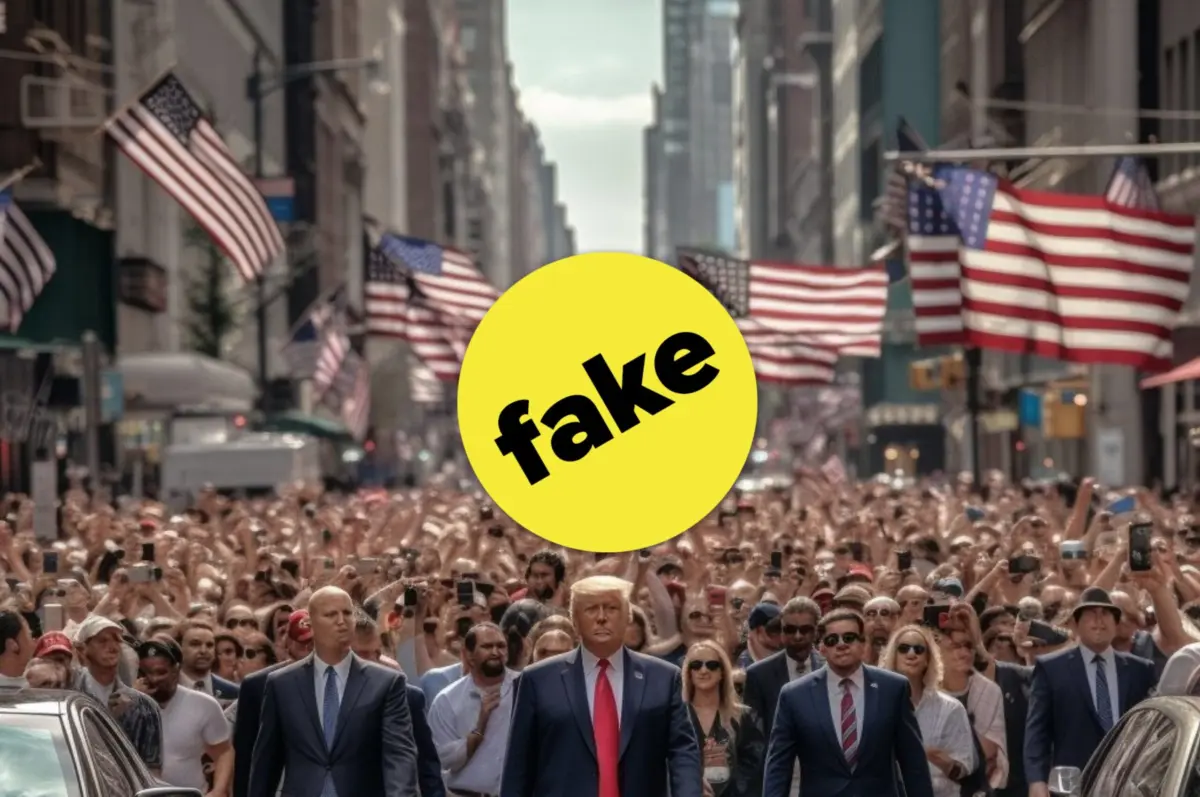
The friction between generative capability and public gullibility culminated in early 2023 with a series of viral synthetic images. Fabricated photos of former U.S. President Donald Trump being violently arrested by police spread rapidly across Twitter, Facebook, and TikTok, tricking not only casual internet users but also verified accounts and foreign media outlets. Simultaneously, hyper-realistic images of Pope Francis wearing a luxury Balenciaga puffer jacket demonstrated that synthetic media could effortlessly merge high-fashion absurdity with documentary-style realism, catching the public entirely off guard. -
Late 2023–Present: The Industrialization of Disinformation
Today, generative AI is no longer confined to hobbyists or viral pranksters. State-sponsored actors, political campaigns, and malicious syndicates utilize commercial-grade APIs to automate the production of localized, highly targeted disinformation campaigns. The speed of generation has outstripped the capacity of traditional forensic validation, transforming the internet into a high-trust-deficit ecosystem.
Supporting Context & Metrics: The Arms Race of Detection and Verification
The proliferation of synthetic media has catalyzed a technological counter-movement: the birth of AI detection utilities. Platforms like Optic.xyz, Hugging Face detectors, and proprietary corporate tools analyze pixel-level anomalies, metadata signatures, and frequency domains to determine whether an image originated from a human camera lens or a machine-learning latent space.
However, none of these tools are infallible. As generative models are retrained on cleaner datasets and fine-tuned with advanced rendering algorithms, the digital fingerprints left by AI generation are growing fainter.
The Low-Tech Forensic Toolkit
While algorithms struggle to maintain parity with generative updates, human analysts continue to rely on heuristic inspection. Historically, AI generators have struggled with rendering anatomically complex structures. Analysts routinely examine:
- Anatomical Inconsistencies: Malformed hands, extra or missing fingers, asymmetrical teeth, and impossible joint articulations.
- Environmental Disjointedness: Illogical shadow angles, warped background geometry, inconsistent text rendering on signs, and mismatched reflections in mirrors or eyes.
- The "Too Good to Be True" Rule: In the era of digital saturation, visually arresting, perfectly composed dramatic photos that align too cleanly with a specific political narrative demand rigorous skepticism.
+-----------------------------------------------------------------+
|                    IMAGE VERIFICATION LAYERS                    |
+-----------------------------------------------------------------+
|  Layer 1: Heuristic Inspection (Hands, Text, Lighting, Shadows) |
+-----------------------------------------------------------------+
|  Layer 2: Algorithmic Detection (Optic.xyz, Forensic Scanners)  |
+-----------------------------------------------------------------+
|  Layer 3: Primary Source Validation (Legacy Newsroom Cross-Check) |
+-----------------------------------------------------------------+
Despite these investigative frameworks, the sheer volume of daily uploads makes manual verification mathematically impossible. The forensic battleground is asymmetric: generation takes seconds, while verification requires deep cross-referencing, metadata auditing, and contextual investigation.
Official Statements: Regulatory Blind Spots and Platform Failure
As synthetic media spills across digital borders, experts warn that the institutional infrastructure designed to protect public information is fracturing. Platform policy enforcement—once considered the last line of defense against viral manipulation—has degraded significantly.
Kayla Gogarty, deputy research director at Media Matters for America, a prominent nonprofit media watchdog, articulated the gravity of this institutional vulnerability in an interview with BuzzFeed News:
"As there has been a recent rise of AI-generated media, it has become clear that platforms are unprepared for this moment in which fake images and misinformation could lead to real-world harm. Particularly concerning is Twitter, as Elon Musk has abandoned much of the platform’s content moderation and it has become difficult to determine account credibility under the new checkmark policy."
Gogarty’s assessment highlights a systemic governance vacuum. While major tech conglomerates formally maintain "manipulated media" policies prohibiting deceptive synthetic content, the practical reality of enforcement tells a different story.
Following massive workforce reductions, trust-and-safety teams across social media giants have been decimated. Compounded by changes to verification systems—where legacy badges denoting institutional credibility have been replaced by pay-for-play subscription models—consumers can no longer rely on platform infrastructure to separate verified journalism from synthetic fabrication.
Independent researchers point out that algorithmic amplification models actively reward emotional engagement, making sensationalized AI imagery an ideal vehicle for viral distribution. Because outrage and shock drive platform metrics, synthetic fabrications frequently out-perform boring, nuanced reality before human moderators can intervene.
Future Outlook: Navigating the Post-Truth Horizon
As we look toward upcoming global elections, corporate earnings cycles, and geopolitical flashpoints, the trajectory of generative AI points toward deeper integration and greater realism.
- The Death of Photographic Proof: The legal and journalistic standard that "seeing is believing" is permanently defunct. In judicial proceedings, investigative journalism, and historical record-keeping, photographic evidence will increasingly require cryptographic provenance—such as the Coalition for Content Provenance and Authenticity (C2PA) standards—to trace an image from its capture on a physical sensor to its final publication.
- Multimodal Manipulation: The convergence of text, image, audio, and video generation into unified multimodal models means that future disinformation will not be limited to still photos. Real-time synthetic video streaming and voice cloning will enable sophisticated phishing attacks, deepfake political assassinations of character, and instantaneous financial market manipulation.
- The Resurgence of Institutional Journalism: Paradoxically, the degradation of open social media spaces may drive a renaissance for verified, legacy news institutions. When the open web becomes a chaotic wasteland of algorithmic hallucinations and deepfakes, the value proposition of trusted, vetted editorial processes will skyrocket.
[ Open Web: Synthetic Chaos ] ---> [ Loss of Visual Trust ] ---> [ Value Shift to Verified Journalism ]Conclusion
The rise of generative AI imagery is not merely a technological hurdle; it is an existential stress test for human cognition and democratic stability. As Andrey Doronichev and Kayla Gogarty underscore, the tools to fabricate reality have outpaced our societal mechanisms to govern them.
Navigating this perilous post-truth horizon requires a multi-pronged defense: robust cryptographic watermarking standards, continuous investment in forensic detection tools, aggressive regulatory oversight of platform accountability, and, above all, a collective return to rigorous media literacy. Until society adapts to this synthetic reality, every stunning image encountered online must be met with a foundational question: Is this real, or is this an illusion engineered to deceive us?