By Saf Malik
Senior Content and Insights Manager
Executive Overview
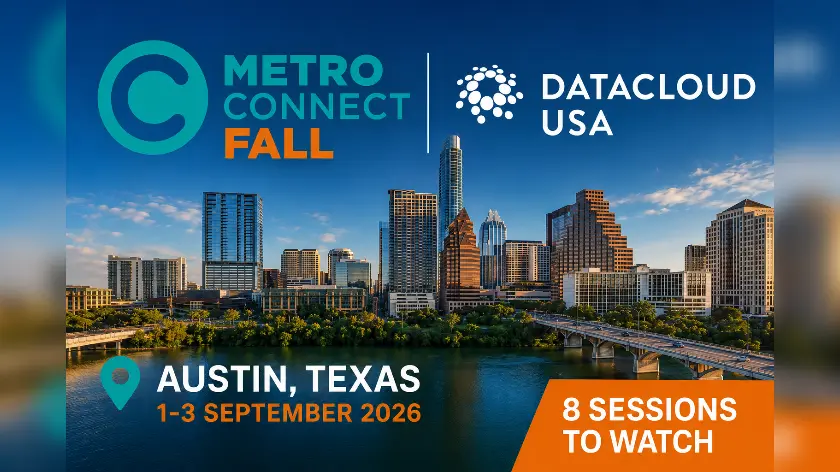
As the United States digital infrastructure market enters the final stretch of the year, industry leaders, investors, and technologists are preparing to converge in Austin, Texas. From September 1–3, Metro Connect Fall will return to the Texas capital, co-located alongside Datacloud USA and the Investment and Finance Forum.
With the official event agenda now finalized, the upcoming summit promises to serve as a critical crucible for the data center, fiber, and telecommunications tower sectors. Coming on the heels of a dynamic spring edition—which underscored the six foundational trends reshaping modern digital infrastructure—the fall gathering arrives at a definitive inflection point. The overarching narrative is no longer just about managing growth; it is about confronting the structural bottlenecks threatening to stall the artificial intelligence (AI) revolution.
From the escalating strain of inference-driven traffic patterns on legacy network architectures to the complex realities of powering next-generation facilities with nuclear energy, Metro Connect Fall 2026 tackles the industry’s most urgent questions head-on. This comprehensive preview explores the core sessions, strategic debates, and economic forces set to dictate the market’s trajectory heading into Q4 and beyond.
Detailed Chronology: Key Sessions Set to Define the Agenda
The three-day conference in Austin is packed with high-stakes panels, fireside chats, and town halls designed to dissect the intersection of digital infrastructure, capital markets, and energy policy. Below is a detailed look at the core thematic sessions that will set the tone for the event.
Day 1: Network Architecture and the AI Traffic Tsunami
The conference opens with a high-profile keynote panel addressing one of the most pressing technical questions of our time: Can existing network architecture handle inference-driven traffic patterns?
Bringing together industry luminaries Dave Schaeffer (CEO of Cogent Communications), Dan Davis (CEO of Arcadian Infracom), and Maneesh Gauba (Oracle), this session establishes a recurring theme for the entire event—infrastructure built for a completely different era of demand. While much of the public discourse focuses on data center compute power, this panel shifts the spotlight to the underlying transport networks. As AI workloads pivot from training to real-time inference, data movement is skyrocketing, exposing the vulnerabilities of legacy fiber routes and backhaul architectures.
This discussion directly builds on insights from earlier in the year, notably the Spring 2026 CEO panel, which argued that strict fiber discipline will ultimately define the winners and losers of the AI era, and Marc Ganzi’s keynote asserting that AI monetization hinges entirely on industrialization.
M&A and Consolidation Pressures in the Fiber Sector
Later in the week, the capital markets take center stage with a dedicated Mergers & Acquisitions (M&A) panel featuring heavyweights from Searchlight Capital, Safanad, and Novacap.
Consolidation has been the shadow hanging over the fiber sector throughout 2026. With macroeconomic pressures, shifting interest rates, and high capital expenditure requirements testing balance sheets, this session will dive deep into current deal pricing, shifting buyer appetites, and the viability of smaller regional operators holding out against relentless consolidation. Investors will be listening closely for signals on whether valuations have bottomed out or if further corrections are on the horizon.
Powering the Future: Nuclear Energy vs. Regulatory Realities
Few topics have dominated infrastructure conversations quite like power generation. A keynote panel featuring Brian Gitt (Oklo) and Bob Kinscherf (Constellation) confronts the widening gap between nuclear power’s theoretical promise for AI data centers and the messy commercial and regulatory realities of actually getting small modular reactors (SMRs) and traditional nuclear plants connected to the grid.
While nuclear energy is frequently heralded as the ultimate zero-carbon baseload solution for energy-hungry AI clusters, developers face immense hurdles regarding permitting, safety oversight, and transmission interconnections. This panel serves as a reality check, testing the nuclear narrative against hard logistical facts.
Community Friction: The Social License to Build
Acknowledging that local opposition can derail a project faster than a zoning board, a dedicated Town Hall—chaired by Ilissa Miller with representatives from EnergiAcres, Flypower, and QTS—brings community pushback against data center development to the forefront.

Rather than treating local friction as background noise, this session gives voice to community concerns regarding land use, noise pollution, and resource consumption. This discussion holds particular relevance for Central Texas coverage, especially in light of recent projections indicating that data centers could consume up to 2.7% of Texas’s water supply by 2030. Operators attending this session will need to evaluate how they frame trust, transparency, and corporate stewardship to secure their social license to operate.
Supporting Context & Metrics: Speed, Design, and Alternative Financing
Beyond the headline-grabbing energy and M&A panels, Metro Connect Fall will also tackle the operational mechanics of building and funding the next generation of digital infrastructure.
The Great Tension: Speed vs. Design Discipline
Two contrasting panels will examine the operational tightrope operators must walk to meet hyperscale demand:
- The Design-First Argument: Featuring speakers from EdgeConneX, Nvidia, and Edged Data Centers, this session posits that the majority of a facility’s scalability and efficiency is determined long before ground is ever broken. It is a plea for architectural rigor and future-proofing.
- The Fast-Build Reality: Conversely, speakers from Crusoe, AMD, and STACK Infrastructure examine how operators are compressing construction timelines to feed insatiable hyperscale demand.
Read side-by-side, these two panels frame the industry’s central operational tension: the race to deploy capacity quickly versus the imperative to maintain engineering and operational discipline.
Innovative Financing: Asset-Backed Securitization (ABS)
While equity and traditional debt deals dominate the trade press, alternative financing mechanisms are quietly transforming how capital-intensive projects are funded. Chaired by Kirkland & Ellis, a panel featuring DataBank and Moelis & Company explores how asset-backed securitization (ABS) is being leveraged to finance infrastructure at unprecedented scale. As traditional bank lending tightens, ABS offers a compelling route for mature operators looking to unlock liquidity from existing asset portfolios.
Speculative Horizons: Orbital Data Centers
Pushing into the outer edges of technological possibility, a fireside chat with Rob DeMillo of Sophia Space explores the concept of orbital data centers. While still speculative, the session aligns with the broader Non-Terrestrial Network (NTN) and satellite connectivity spaces that industry analysts have increasingly brought into the fold, hinting at a long-term future where compute infrastructure moves beyond the Earth’s atmosphere.
Official Statements and Industry Perspectives
The convergence of Datacloud USA, the Investment and Finance Forum, and Metro Connect Fall in Austin highlights a broader structural maturation within the digital infrastructure ecosystem.
Industry analysts and event organizers note that the conversations in Austin will move past speculative hype and into execution mode. As capital becomes more discerning and resource constraints—particularly around power and water—intensify, operators can no longer rely on cheap capital and lax regulatory environments to fuel expansion.
"The digital infrastructure market has crossed a threshold," notes Saf Malik, Senior Content and Insights Manager. "We are no longer simply asking how much capacity we can build, but how we can sustain it across energy constraints, community resistance, and shifting financial models. Austin will be where these hard answers begin to take shape."
Future Outlook: Looking Toward Q4 and Beyond
As Metro Connect Fall 2026 gets underway from September 1–3, the outcomes of its panel discussions and networking sessions will reverberate throughout the final quarter of the year and into 2027.
The digital infrastructure landscape stands at a crossroads. The pressures of the AI boom have accelerated timelines, forced technological innovation, and strained global power grids. How industry leaders respond to these challenges in Austin—whether through disciplined fiber deployment, realistic energy strategies, innovative securitization, or proactive community engagement—will set the blueprint for the next decade of digital growth.
For those tracking the intersection of technology, finance, and real estate, Metro Connect Fall is not just a conference to attend; it is a barometer for the entire global economy’s digital foundation.
To view the full agenda and register for the event, visit the official Metro Connect Fall Agenda.