Executive Overview
In a major milestone for enterprise data engineering, Amazon Web Services (AWS) has announced the general availability of AWS Glue 6.0. This release represents one of the most substantial architectural leaps in the history of the fully serverless data integration and extract, transform, and load (ETL) service.
AWS Glue 6.0 introduces a massive 30% price reduction compared to previous generations, fundamentally altering the economics of large-scale data processing in the cloud. Beyond cost savings, the new version is built upon a fully modernized runtime stack anchored by Apache Spark 4.1, Python 3.12, and Scala 2.13, delivering profound performance enhancements across analytical and transactional workloads.
At the core of this release is the industry’s most complete implementation of Apache Iceberg v3 (built on Iceberg 1.11.0) on a serverless managed Spark service. By introducing native support for features like the VARIANT data type with advanced shredding capabilities, AWS Glue 6.0 eliminates historical bottlenecks associated with processing semi-structured data—such as nested JSON, application logs, and high-frequency event streams.
Engineers and data architects can now build, scale, and optimize data lakes with unprecedented efficiency, zero infrastructure management, and single-digit millisecond latency for real-time streaming pipelines. This comprehensive briefing explores the architectural underpinnings, cost dynamics, operational upgrades, and strategic implications of AWS Glue 6.0.
Detailed Chronology and Technical Evolution
The journey toward AWS Glue 6.0 reflects a multi-year effort by AWS to align its serverless data ecosystem with the rapidly evolving standards of modern open-source lakehouse architectures.
The Evolution of Managed Spark on AWS
Since its inception, AWS Glue has sought to abstract away the operational overhead of provisioning, tuning, and scaling Apache Spark clusters. However, as data volumes have scaled into petabyte and exabyte territories, enterprise customers demanded tighter integration with open table formats like Apache Iceberg, Delta Lake, and Hudi.

- The Spark Transition: Earlier iterations of AWS Glue laid the groundwork for managed ETL, but users frequently encountered friction when migrating legacy codebases or attempting to process complex, nested semi-structured data without incurring heavy computational penalties.
- The Apache Iceberg Revolution: Over the past two years, Apache Iceberg emerged as the definitive standard for open table formats, offering ACID transactions, time travel, and hidden partitioning. Recognizing this shift, AWS steadily increased its support for Iceberg, culminating in the comprehensive v3 specification implementation found in Glue 6.0.
- Modernizing the Runtime (Spark 4.1, Python 3.12, Scala 2.13): Glue 6.0 marks a complete overhaul of the underlying execution engine. By jumping to Apache Spark 4.1, AWS provides users with cutting-edge query optimization, enhanced memory management, and improved execution plans. Simultaneously, the inclusion of Python 3.12 and Scala 2.13 ensures that data science and engineering teams can leverage the latest language features, security patches, and library ecosystems without compatibility drag.
Supporting Context & Deep-Dive Metrics
To fully appreciate the impact of AWS Glue 6.0, one must examine the specific technical pillars that drive its performance and economic value proposition.
1. Radical Cost Optimization: 30% Price Reduction
Cloud data warehouse and data lake expenditures have long been a focal point of enterprise FinOps strategies. With AWS Glue 6.0, AWS has engineered efficiencies into its underlying serverless infrastructure, passing the savings directly to customers.
- The Economics: A flat 30% reduction in hourly rates for crawlers and ETL jobs fundamentally changes the total cost of ownership (TCO) for large-scale data transformations.
- Granular Billing: Retaining the second-by-second billing model ensures that organizations only pay for the exact compute resources consumed down to the second, avoiding the idle costs associated with traditional cluster management.
- Data Catalog Pricing: The AWS Glue Data Catalog maintains its predictable, consumption-based model—providing the first one million objects stored and the first one million accesses completely free each month, with nominal fees thereafter.
2. Native Apache Iceberg v3 and the VARIANT Data Type
Semi-structured data sources—such as web clickstreams, IoT telemetry, application debug logs, and JSON payloads—have traditionally been notoriously difficult to query efficiently in data lakes. Developers historically faced a painful dichotomy: either flatten schemas (leading to massive data bloat and pipeline breakage when schemas evolved) or store data as raw strings (resulting in abysmal query performance and exorbitant compute costs due to repeated parsing).
AWS Glue 6.0 solves this dilemma by introducing full support for the Apache Iceberg v3 specification, highlighted by the VARIANT data type with shredding support.
- How
VARIANTShredding Works: Instead of treating semi-structured payloads as opaque string blobs or forcing rigid schemas, theVARIANTdata type intelligently "shreds" internal fields into columnar structures under the hood. - Query Acceleration: Queries targeting specific attributes within JSON or log data execute with read performance speeds comparable to native, statically-typed numeric or string columns.
- Resilience to Schema Drift: When upstream applications alter their JSON schemas (e.g., adding new fields or changing nested structures), Glue 6.0 pipelines continue to function without crashing or requiring manual code rewrites. This completely eliminates custom parsing logic and duplicate data copies.
3. Spark 4.1 Engine Enhancements
As the powerhouse engine driving Glue 6.0, Apache Spark 4.1 introduces foundational improvements:
- Enhanced PySpark Performance: Optimized execution paths reduce serialization overhead between Python and the underlying JVM, resulting in faster data frame transformations and machine learning feature engineering workflows.
- Real-Time Streaming Capabilities: Coupled with advanced optimizations, Glue 6.0 achieves single-digit millisecond latency for streaming ingestion pipelines, bridging the gap between batch analytics and real-time operational monitoring.
- Simplified ETL Authoring: Reduced boilerplate code requirements allow data engineers to write cleaner, more maintainable PySpark and Scala scripts.
Official Statements and Industry Perspective
While AWS engineering leadership has framed Glue 6.0 as a generational leap for lakehouse architectures, industry analysts and early enterprise adopters have similarly weighed in on its strategic significance.

"With AWS Glue 6.0, we wanted to remove the historical compromises data engineers faced," notes technical documentation and release commentary from AWS. "Organizations should not have to choose between cost-efficiency, modern open table formats, and high-performance semi-structured querying. By coupling a 30% price reduction with a fully modernized Spark 4.1 runtime and complete Iceberg v3 support, we are delivering the most capable serverless ETL platform on the market."
Data architects across financial services, retail, and digital media have echoed these sentiments, emphasizing that the elimination of manual JSON parsing via VARIANT shredding alone will save hundreds of engineering hours annually. Furthermore, the seamless upgrade path—requiring zero API changes beyond updating the --glue-version parameter—has lowered the barrier to adoption significantly.
Future Outlook: The Serverless Lakehouse Horizon
The launch of AWS Glue 6.0 signals a clear trajectory for cloud-native data management. As organizations increasingly adopt decentralized data mesh architectures and open table formats like Apache Iceberg, the boundary between data lakes and traditional data warehouses continues to dissolve.
What Lies Ahead for AWS Glue Users:
- Deeper AI and LLM Integration: With Python 3.12 support and optimized runtime performance, AWS Glue 6.0 is uniquely positioned to serve as the foundational ETL backbone for generative AI applications, preparing, cleaning, and vectorizing massive datasets for downstream Large Language Models (LLMs) hosted on Amazon SageMaker or Amazon Bedrock.
- Autonomous Optimization: Future iterations are expected to lean further into AI-driven auto-tuning, where Glue will dynamically adjust partition strategies, memory allocations, and compaction routines without human intervention.
- Ecosystem Expansion: As the AWS MCP (Model Context Protocol) Server and associated AI agent plugins gain broader adoption, developers will increasingly interact with AWS Glue jobs, monitor error logs, and execute migrations entirely through conversational AI interfaces integrated into their preferred IDEs.
Getting Started and Migration Guide
Transitioning to AWS Glue 6.0 is designed to be frictionless for existing customers. No core API modifications are required.
Step-by-Step Adoption Path:
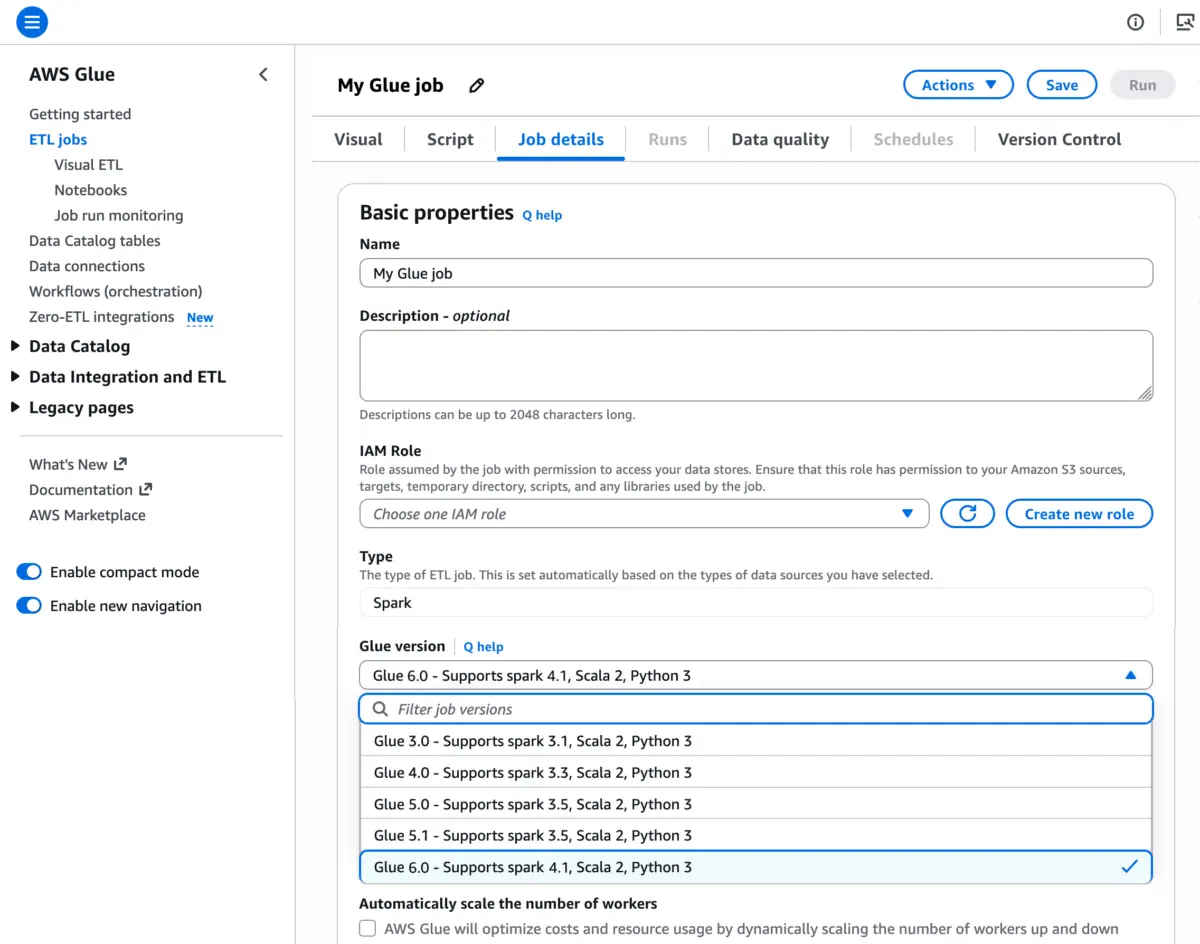
- Creating New Jobs: In the AWS Glue Studio console, navigate to the Job Details tab and select Glue 6.0 – Supports Spark 4.1, Scala 2, Python 3 from the version dropdown menu. Alternatively, specify the parameter
--glue-version 6.0when executing thecreate-joborupdate-jobAPIs via the AWS CLI or AWS SDKs. - Interactive Notebooks: For data scientists utilizing AWS Glue Studio notebooks or Jupyter interactive sessions, simply set
6.0in the%glue_versionmagic command. - Upgrading Existing Jobs: To migrate legacy pipelines, engineers can deploy the automated Spark upgrade agent available directly within AWS Glue Studio, or enable the auto-upgrade feature to seamlessly transition workloads to the new runtime.
AWS Glue 6.0 is generally available today across all commercial AWS Regions where AWS Glue operates. Organizations are encouraged to consult the official AWS Capabilities by Region documentation to verify local feature parity and review the comprehensive migration guides to begin capturing the 30% cost savings and performance benefits immediately.