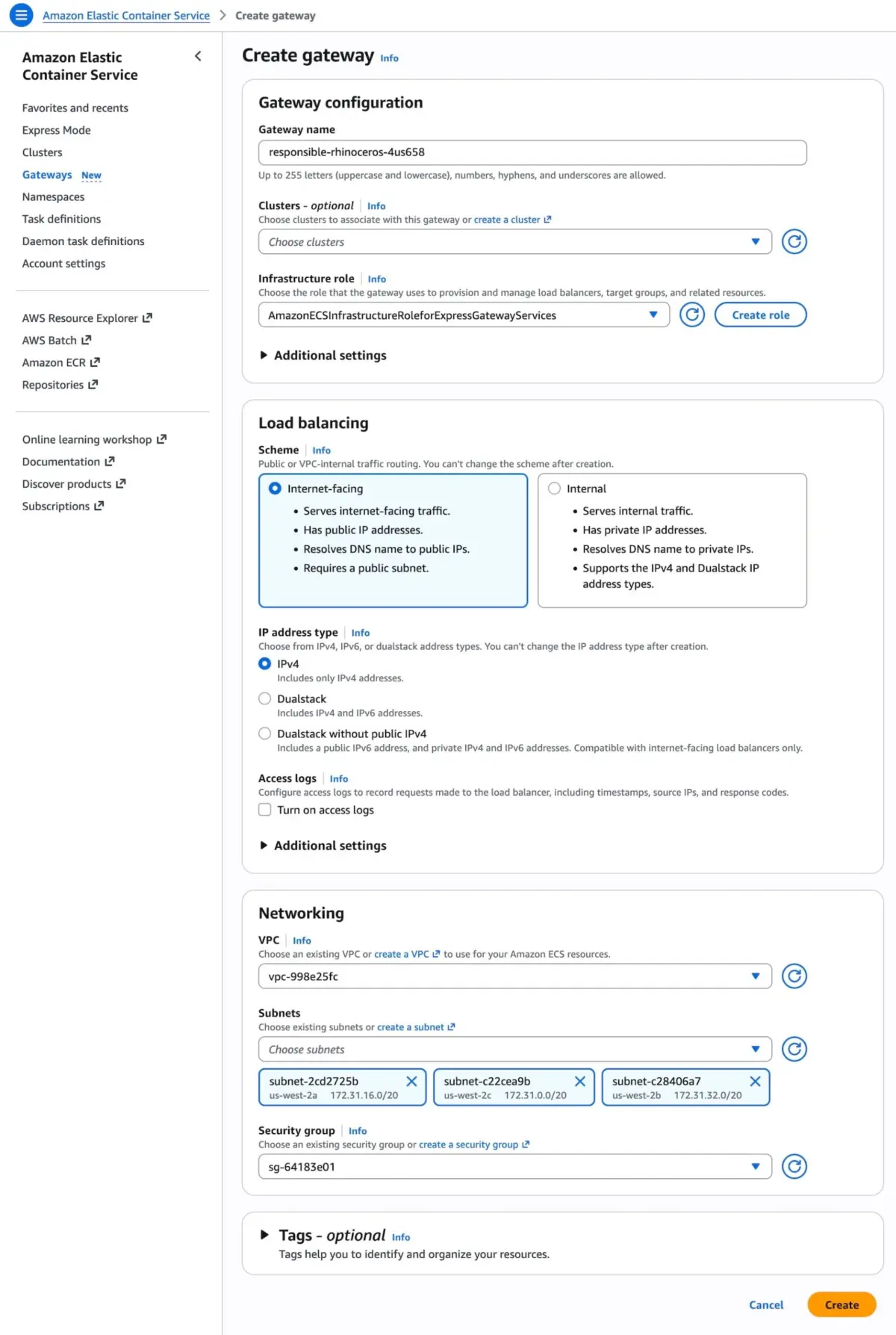
Managing containerized applications at cloud scale has long presented infrastructure architects and platform engineering teams with a persistent operational friction point: ingress networking configuration. Historically, whenever a new microservice or containerized workload was deployed on Amazon Elastic Container Service (Amazon ECS), operators were forced to manually provision, wire, and maintain a sprawling web of supporting infrastructure. This ritual typically involved setting up Application Load Balancers (ALBs), generating and validating AWS Certificate Manager (ACM) certificates, configuring AWS WAF web ACLs, tuning security groups, and binding target groups.
Compounding this complexity, platform teams had to continuously synchronize these foundational resources as applications scaled out, underwent rolling deployments, or changed parameters. This per-service operational overhead slowed down deployment velocity, introduced bottlenecks that frustrated development pipelines, and significantly increased the risk of configuration drift across large enterprise cloud estates.
To eliminate this friction, Amazon Web Services (AWS) has announced the general availability of Amazon ECS Gateway, a powerful new account-level resource that fundamentally reimagines ingress networking for containerized workloads. Amazon ECS Gateway introduces an automated, highly scalable mechanism that dynamically provisions and manages the necessary infrastructure on behalf of platform teams, all while keeping resources safely created and isolated directly within the customer’s AWS account.
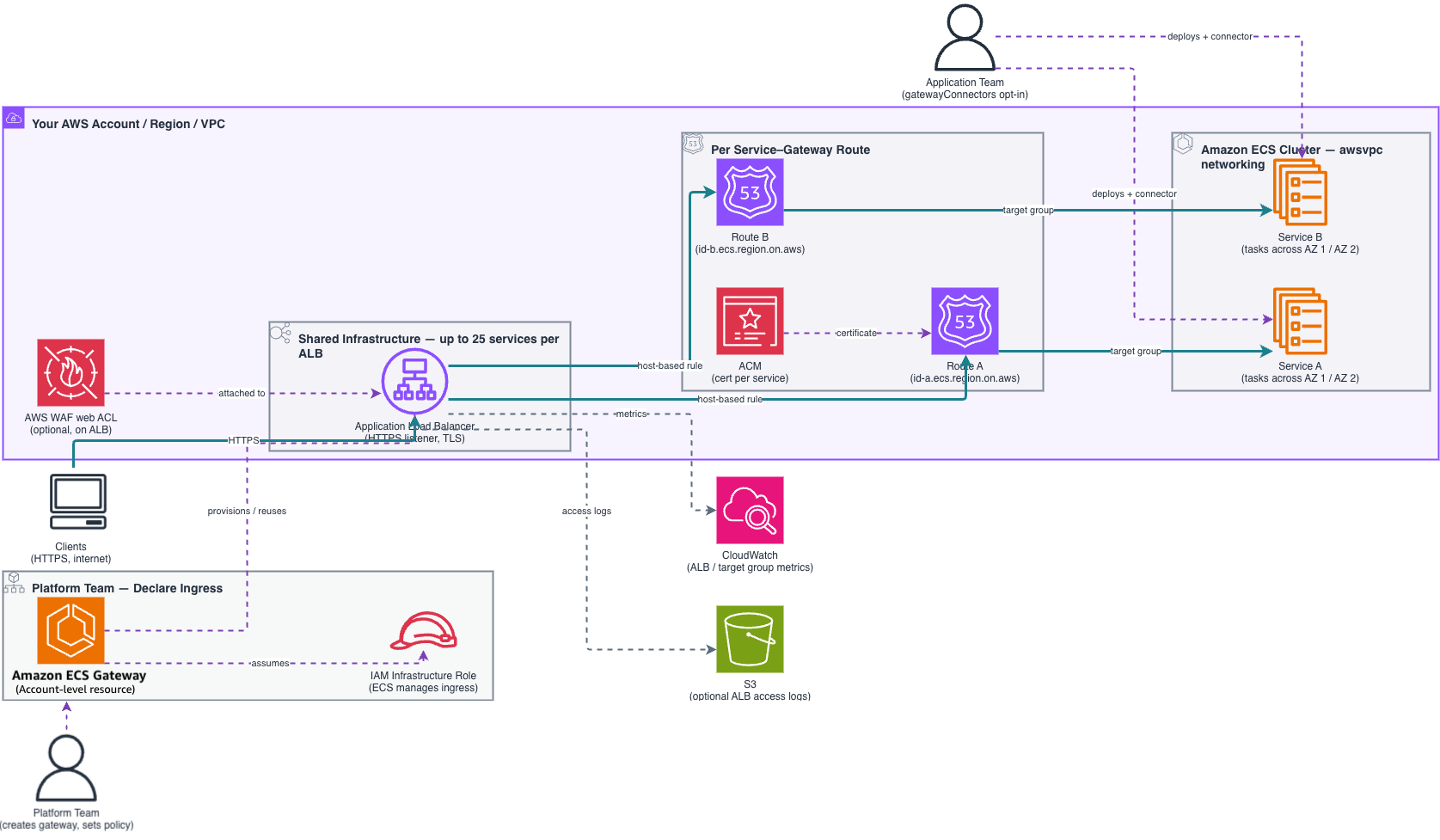
By leveraging host-based routing and allowing up to 25 disparate services to share a single Application Load Balancer, the feature drastically cuts infrastructure costs and rationalizes the resource footprint. ECS handles the complete, end-to-end lifecycle of the underlying infrastructure: automatically spinning up the initial load balancer upon the connection of a first service, scaling out additional ALBs as capacity thresholds are hit, and tearing them down when they are no longer required. Each service is provisioned with a unique, ready-to-use DNS hostname the moment setup completes, empowering development teams to ship applications faster and with far greater confidence.

Detailed Chronology
The journey toward the release of Amazon ECS Gateway stems from years of direct customer feedback concerning the operational overhead of container ingress management. For years, as organizations accelerated their containerization strategies, scaling architectures meant writing increasingly complex Infrastructure as Code (IaC) modules or custom control loops just to keep load balancers aligned with ECS tasks.
Phase 1: Identifying the Ingress Bottleneck
In the early days of container adoption, organizations typically paired every single ECS service with its own dedicated Application Load Balancer or mapped them through complex reverse-proxy meshes. While this approach provided workload isolation, it introduced severe cost inefficiencies. Enterprises operating hundreds or thousands of microservices watched their cloud bills swell purely from idle or underutilized load balancer hourly charges. Furthermore, platform engineering teams found themselves bottlenecked by repetitive change-control tickets every time an application team needed a new public-facing endpoint configured with proper TLS certificates and WAF rules.
Phase 2: Architecting a Native Solution
Recognizing that ingress management should be a platform-level capability rather than a per-service chore, AWS engineers designed ECS Gateway to abstract away the undifferentiated heavy lifting of load balancing and DNS assignment. The development focused on achieving a strict separation of responsibilities:
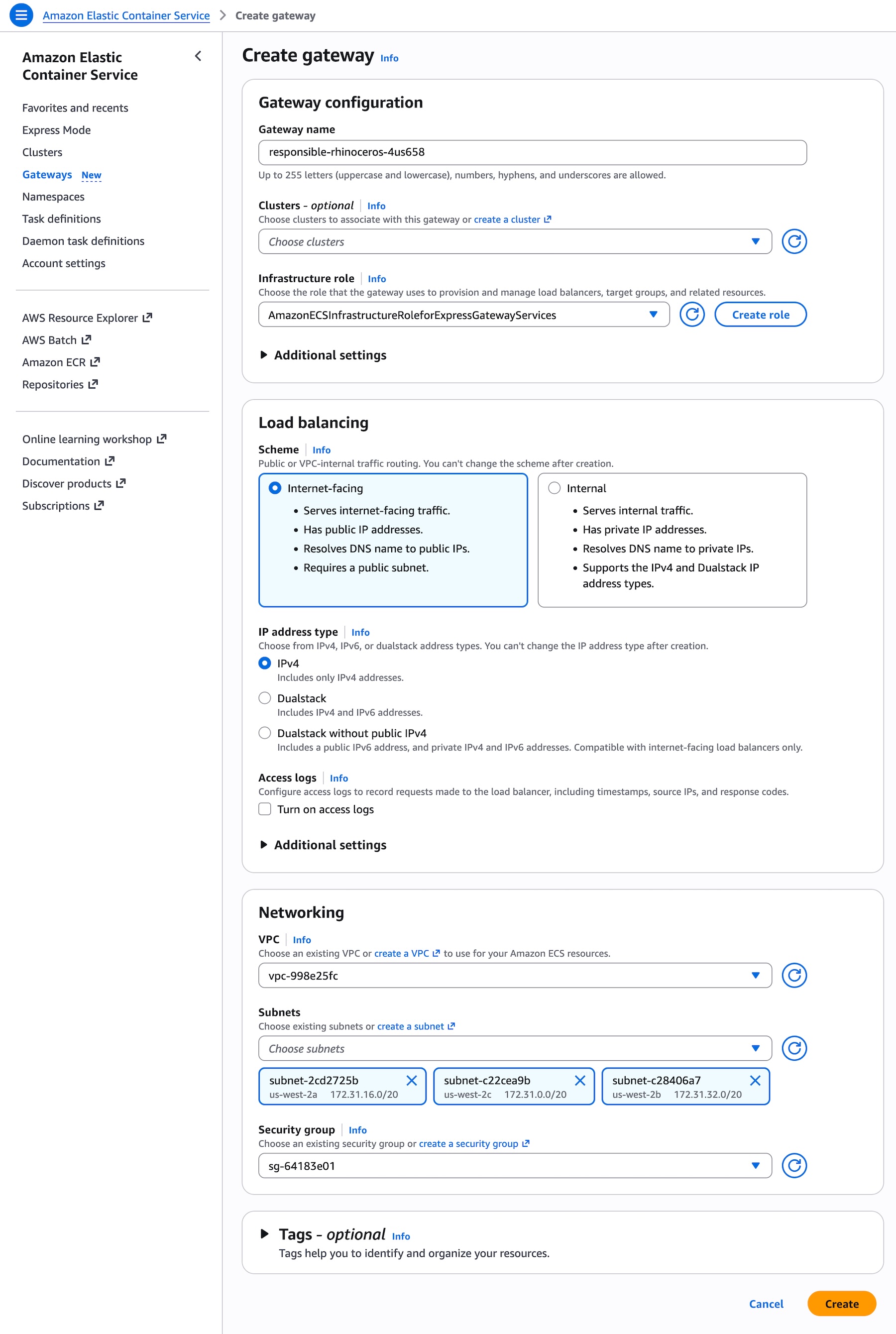
- Platform Teams maintain global governance, defining account-level gateways, establishing IAM infrastructure roles, selecting VPC subnets, and setting security guardrails like WAF web ACLs and maximum load balancer limits (
maxAlbCount). - Application Teams simply attach lightweight "gateway connectors" to their service definitions. They do not need to concern themselves with target groups, listener rules, or certificate mapping.
Phase 3: General Availability and Ecosystem Integration
Released for immediate availability across all commercial AWS Regions where Amazon ECS is supported, ECS Gateway debuts with deep integration into existing AWS management tools. Beyond standard AWS Management Console workflows and AWS CLI commands, AWS has ensured that platform engineers can create, manage, and query ECS Gateway architectures programmatically. This includes native support within the AWS MCP Server and associated plugins, allowing developers to interact with ECS Gateway via advanced AI coding tools and agents.

Supporting Context & Metrics
To fully appreciate the architectural impact of Amazon ECS Gateway, it is vital to examine the scale, topology, and economic dynamics of modern enterprise container environments.
Many-to-Many Topology and Scaling Limits
ECS Gateway is built upon a flexible, many-to-many association model designed to fit everything from small-scale staging environments to massive multi-tenant enterprise production clusters:
- Cluster Associations: A single ECS Gateway can be associated with up to 10,000 distinct clusters, enabling centralized management across an entire organization.
- Gateway Density: Conversely, a single ECS cluster can support up to 5 gateway associations. This allows platform teams to assign multiple gateways—such as distinct public-facing and VPC-internal gateways—to the exact same cluster based on traffic routing requirements.
- Resource Sharing Efficiency: By utilizing host-based routing, ECS Gateway allows up to 25 individual services to share a single Application Load Balancer. This density directly targets and mitigates the ALB cost explosion that organizations historically experienced when provisioning isolated load balancers for microservices architectures.
Behind the Scenes: The Provisioning Lifecycle
When an application team adds a gateway connector to an ECS service definition via CreateService or UpdateService, a sophisticated orchestration pipeline executes automatically:
- Compatibility Evaluation: Amazon ECS evaluates the gateways associated with the target cluster. A gateway is deemed compatible if its access type (e.g., public or internal) matches the service’s connector filter, if it resides in the same Virtual Private Cloud (VPC), and if it spans all Availability Zones utilized by the service’s configured subnets.
- Resource Allocation: For each matched connection, ECS assigns the service to an ALB with available headroom. If existing ALBs are at capacity, a new ALB is automatically provisioned (bounded by the user-defined
maxAlbCountquota). - Per-Service Artifact Generation: ECS automatically provisions an ACM certificate, generates a unique DNS hostname, establishes a listener rule to direct traffic for that hostname to the correct target group, and configures a dedicated service security group that permits inbound traffic strictly from the corresponding ALB security group.
- Activation: Once these actions complete, the gateway route transitions to an
ACTIVEstate, rendering the service endpoint immediately ready to receive live production traffic.
Migration and Adoption Flexibility
For organizations with existing architectures, ripping and replacing legacy load balancer configurations can introduce unnecessary deployment risk. ECS Gateway addresses this by supporting incremental adoption. Existing ECS services that currently utilize dedicated load balancers can transition to ECS Gateway smoothly by calling UpdateService to inject a gateway connector. Because both ingress paths remain operational simultaneously, teams can thoroughly validate the new gateway connection before safely deprecating and removing the legacy load balancer configuration.
Official Statements
While direct quotes from leadership underscore the strategic intent behind the launch, the architectural philosophy shared by AWS product engineering emphasizes user empowerment and operational simplification:
"When platform teams manage containerized applications at scale on Amazon ECS, configuring ingress networking for every single service has historically acted as a major velocity bottleneck. With Amazon ECS Gateway, we are shifting the paradigm from manual, per-service wiring to an automated, account-level platform capability. We are giving platform teams the governance controls they need while freeing developers to focus purely on business logic."
— AWS ECS Product Engineering Team
Industry analysts and early preview participants have similarly highlighted the dramatic reduction in operational toil. By automating the lifecycle of ACM certificates, target groups, listener rules, and DNS records, organizations report an estimated reduction of up to 70% in the time required to onboard new containerized microservices into secure, production-ready staging environments.
Future Outlook
The launch of Amazon ECS Gateway marks a foundational milestone in how AWS customers will architect cloud-native networking over the coming years. As container fleets continue to grow in density and complexity, the boundary between application code and infrastructure must remain fluid yet strictly governed.
Looking ahead, we can anticipate several evolutionary paths for the ECS Gateway architecture:
- Advanced Traffic Management: Future iterations are expected to introduce more granular traffic-shaping capabilities directly at the gateway layer, including native support for canary deployments, blue-green traffic splitting, and advanced rate-limiting policies without requiring heavy service mesh overhead.
- Deeper AI and Agentic Integration: With the immediate day-one inclusion of AWS MCP Server support, AWS is signaling a strong commitment to agent-driven infrastructure management. We will likely see platform engineers increasingly relying on AI assistants to autonomously spin up gateways, diagnose routing anomalies, and optimize ALB sharing ratios via natural language prompts.
- Multi-Region and Global Mesh Harmonization: As enterprise workloads expand across global footprints, extending the gateway abstraction model to coordinate multi-region ingress routing natively within ECS remains a logical frontier for reducing cross-region networking complexity.
Ultimately, Amazon ECS Gateway transforms ingress networking from a tedious, error-prone hurdle into a seamless, automated utility. By harmonizing cost efficiency, automated infrastructure lifecycles, and strict security segmentation, AWS has provided platform teams with the definitive toolkit needed to scale containerized applications smoothly into the next decade.