Executive Overview
The landscape of personal knowledge management (PKM) has experienced a seismic shift over the past half-decade. Tools that prioritize local-first architectures, markdown formatting, and interconnected web-like thinking have transitioned from niche productivity hobbies into mainstream powerhouses for developers, researchers, writers, and students alike. Chief among these applications is Obsidian, a proprietary titan that has captured the loyalty of millions with its blazing speed, extensible plugin ecosystem, and absolute ownership of user data via local markdown files.
However, despite its massive adoption, Obsidian occupies a complex space in the open-source community. While users maintain sovereign control over their files on local hard drives, the core application itself remains proprietary and closed-source. For developers and privacy purists who demand total transparency down to the binary level—and who crave deeply integrated artificial intelligence capabilities built natively into the foundation rather than layered on via third-party plugins—a gap has long persisted.
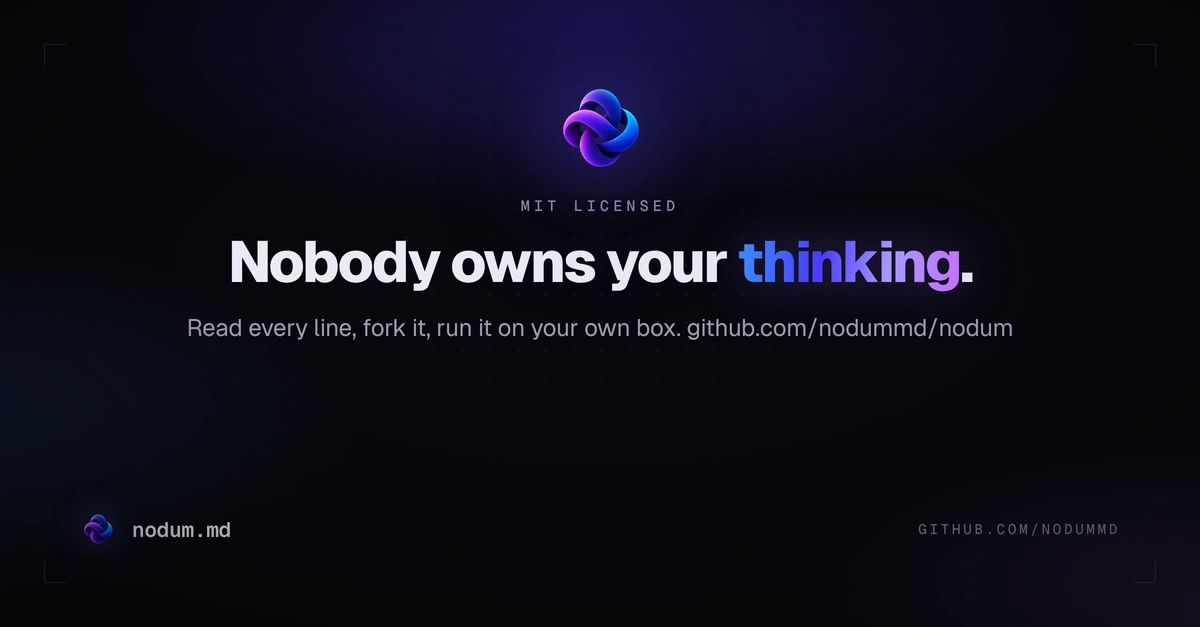
Enter Nodum.md, a bold new open-source contender designed to challenge the status quo. Spearheaded by developer Maqbool Thoufeeq T, Nodum positions itself as a modern, markdown-first, AI-native alternative to Obsidian. Built from the ground up to address the evolving demands of digital note-takers, Nodum merges the familiar local-first philosophy of traditional PKM tools with cutting-edge artificial intelligence. As the project enters its early developmental phase, it invites the global developer community to test, critique, and co-create an extensible knowledge-management ecosystem that remains entirely open, transparent, and user-owned.
Detailed Chronology: The Genesis of Nodum.md
The Search for a Truly Open-Source Knowledge Base
The journey toward Nodum.md began with a familiar frustration common among software engineers and knowledge workers. While applications like Obsidian provided a stellar framework for linking thoughts, organizing projects, and maintaining markdown files locally, the closed-source nature of the core client software left a subset of developers wanting more. The desire for a tool where both the data and the application logic are fully open-source—free from corporate roadmaps, proprietary licensing constraints, and fragmented AI integrations—set the stage for a new project.
Maqbool Thoufeeq T initiated development on Nodum to bridge this divide. Recognizing that modern knowledge management requires more than just static text formatting and manual backlinking, Thoufeeq envisioned a platform where artificial intelligence acts as an organic extension of the user’s thought process. Rather than treating AI as an afterthought or an awkward plugin requiring external API keys and complex configuration, Nodum was conceived with intelligence baked directly into its architectural core.
Reaching the Public Stage
On August 18, 2026, the project stepped out of stealth development and into the public eye with an official announcement on developer platforms. Accompanied by early code repositories and a dedicated web portal (nodum.md), the launch marked the beginning of Nodum’s public iteration cycle.
The initial release focused heavily on establishing core pillars:

- Markdown-First Architecture: Ensuring that users never experience vendor lock-in and that every note remains a standard, human-readable text file stored locally.
- Native AI Integration: Designing the framework to natively leverage machine learning models for summarization, synthesis, and semantic search.
- Open-Source Collaboration: Opening the source code via GitHub (
https://github.com/nodummd/nodum) to invite contributions, bug reports, and feature requests from the global tech community.
Though still in its infancy, the project’s rapid public deployment signals an aggressive timeline aimed at capturing the attention of power users who have been searching for an open-source alternative to established proprietary giants.
Supporting Context & Metrics: The PKM Wars and the AI Imperative
To understand the strategic significance of Nodum.md, one must examine the broader trends shaping the personal knowledge management market.
The Rise of Local-First Software
For years, cloud-based note-taking applications like Evernote and Notion dominated the market. While powerful, these platforms suffered from critical vulnerabilities: recurring subscription fatigue, reliance on third-party servers, privacy concerns regarding data scanning, and susceptibility to internet outages.
The counter-movement—championed by tools like Logseq, Obsidian, and various Emacs-based workflows—embraced "local-first" software principles. By storing notes as plain text markdown files directly on a user’s machine, these applications guaranteed data longevity, blazing-fast search speeds, and absolute privacy. Users realized that plain text would outlive any proprietary database format.
The Open-Source Dilemma
While Logseq proved that a powerful local-first PKM tool could be open-source, the market still lacked a direct conceptual peer to Obsidian’s sleek user interface, graph view capabilities, and rapid performance that also happened to be 100% open-source. Obsidian’s freemium model and proprietary core meant that advanced features, deep-level customizations, and auditability were restricted by corporate decisions.
The AI Transformation
Simultaneously, the artificial intelligence boom of 2023–2026 transformed user expectations. Note-taking is no longer just about storing information; it is about synthesizing it. Knowledge workers are drowning in data, making semantic search, automated tagging, contextual summaries, and conversational querying of personal notes essential features.
While existing tools have attempted to bridge this gap through community plugins (such as various OpenAI and local LLM integrations for Obsidian), these solutions often feel disjointed. They can suffer from breaking API changes, security concerns regarding third-party plugin code execution, and inconsistent UX design. Nodum.md enters this landscape with a distinct advantage: designing for AI from day one, ensuring that machine learning features feel native rather than bolted on.

Official Statements and Developer Vision
In its introductory documentation and community briefs, the core team behind Nodum.md has emphasized a philosophy rooted in user sovereignty and collaborative engineering.
A representative snippet from the project’s public announcements outlines its fundamental ethos:
"Markdown-first. AI-powered. Open source. Yours."
This four-part mantra serves as the guiding light for Nodum’s development roadmap:
- Markdown-First: Your thoughts belong to you. No proprietary databases, no hidden encryption keys, and no forced cloud syncs. Your notes remain transparent text files that you can read, edit, and back up using any tool you choose.
- AI-Powered: Transforming static text into a dynamic thinking partner. By embedding AI capabilities deeply into the application structure, Nodum aims to help users discover hidden connections across disparate notes, generate contextual summaries, and accelerate the creative writing process.
- Open Source: Complete transparency. Every line of core code is open for inspection, modification, and auditing by the community. Users are never at the mercy of a single company’s pricing changes or sudden pivot in product direction.
- Yours: Absolute data ownership and customization freedom. The software adapts to the user’s workflow, rather than forcing the user into a rigid corporate ecosystem.
Maqbool Thoufeeq T has repeatedly stressed that the project is currently in its early, formative stages. Rather than presenting a finished, monolithic product, the team has chosen an open-development approach—releasing early to gather feedback from real-world power users, developers, and knowledge management enthusiasts who can help steer the project’s architecture and feature priorities.
Future Outlook: Challenges and Opportunities for Nodum.md
As Nodum.md embarks on its journey, it faces a landscape rich with opportunity but fraught with technical and competitive challenges.
Overcoming the Network Effect
The greatest hurdle facing any new note-taking application is the entrenched loyalty and robust ecosystem of established tools. Obsidian, for instance, boasts thousands of community-built plugins, themes, and robust mobile applications built over years of iteration. To convince power users to migrate, Nodum must not only match core functionalities—such as bidirectional linking, graph visualizations, and canvas boards—but offer a demonstrably superior experience, particularly in its native AI implementation and open-source flexibility.

Scaling AI Integration Responsibly
Integrating artificial intelligence into a local-first PKM tool presents unique architectural challenges. Users deeply invested in privacy-focused, local-first software are often fiercely protective of their data. For Nodum’s AI features to succeed, the platform will likely need to support a hybrid approach: seamlessly integrating with cloud-based frontier models for heavy lifting while offering robust, out-of-the-box support for local Large Language Models (LLMs) running via tools like Ollama or Llama. Ensuring that personal notes never leave the user’s machine unless explicitly authorized will be a crucial trust-building metric.
Building a Vibrant Community
An open-source project is only as strong as its community. By launching publicly on platforms like GitHub and professional networks, Nodum has taken the vital first step toward cultivating a contributor base. The future of the platform depends on attracting core maintainers, plugin developers, UI/UX designers, and enthusiastic testers who can transform an ambitious prototype into a world-class productivity suite.
Conclusion
Nodum.md represents a compelling vision for the future of personal knowledge management. By fusing the timeless durability of local markdown files with the dynamic analytical power of modern artificial intelligence—all wrapped in a transparent, open-source package—it addresses the unfulfilled desires of privacy-conscious developers and knowledge workers everywhere. While the road ahead requires overcoming significant competitive momentum, Nodum’s early commitment to community-driven development ensures that its evolution will be one of the most closely watched open-source projects in the productivity space.
For those interested in shaping the future of note-taking, the repositories are open, the codebase is waiting, and the invitation to contribute is live.