Executive Overview
In the fast-evolving landscape of enterprise artificial intelligence, public leaderboards and laboratory benchmarks have long served as the gospel for software development teams. These synthetic tests, while helpful for tracking broad capability leaps, frequently divorce AI models from the messy reality of production environments. They measure abstract reasoning, multi-step puzzle-solving, and general knowledge retrieval—yet they rarely reflect what happens when an AI model is tasked with processing actual personnel records, updating live payroll ledgers, or executing multi-layered human resources workflows.
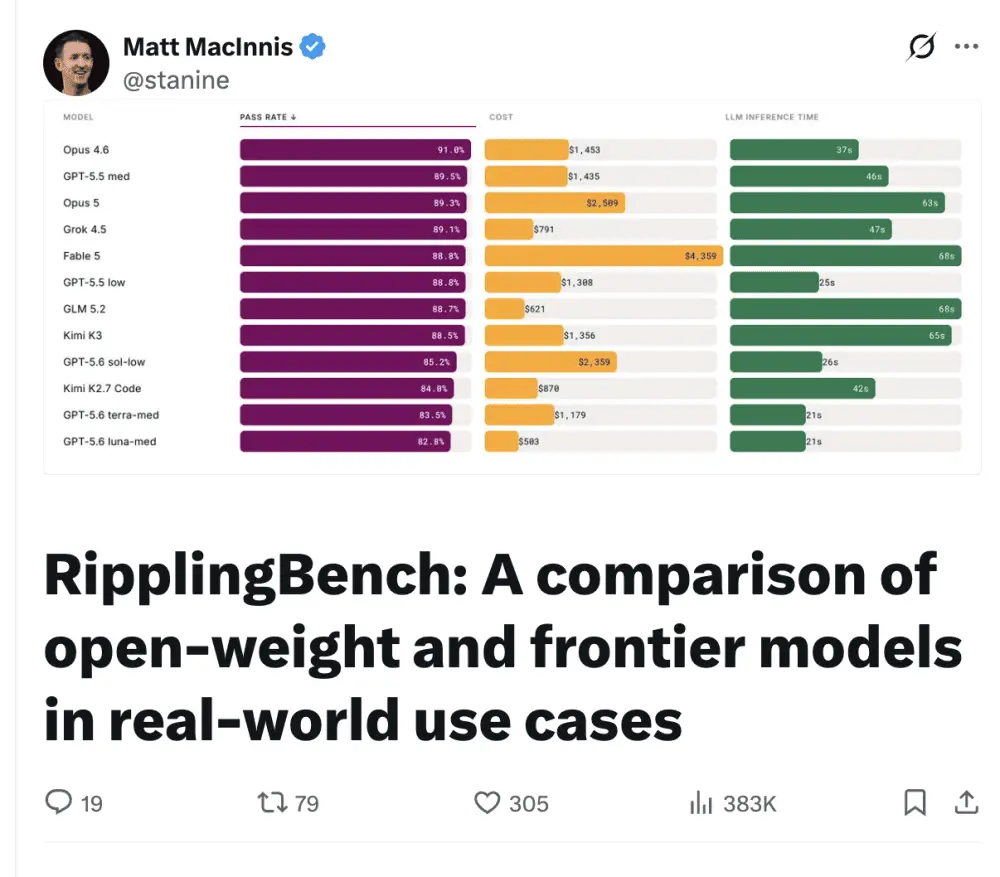
That paradigm shifted dramatically when Matt MacInnis, President and Chief Product Officer of B2B workforce platform Rippling, published a rare, transparent deep-dive into how 15 leading AI models actually perform under real-world conditions. Rejecting synthetic tasks and curated academic leaderboards, Rippling subjected 15 frontier and open-weight models to approximately 2,100 graded attempts each, executed entirely on live production datasets.
The findings upend conventional wisdom across the enterprise software sector. Most notably, the empirical data revealed that the least expensive models frequently tied—and in some cases outperformed—their hyper-expensive counterparts. Quality at the top of the market has effectively plateaued within a tight 2.5-percentage-point window, while operational costs fluctuate wildly by as much as 700%. For B2B founders, AI engineers, and financial executives, MacInnis’s disclosure serves as both a strategic wake-up call and a financial blueprint: model selection is no longer merely an engineering decision—it is a critical margin optimization lever.
Detailed Chronology: How Rippling Put 15 Models to the Ultimate Test
To understand the weight of Rippling’s findings, one must examine the methodology behind the evaluation. Rather than relying on static multiple-choice questions or programming challenges, the engineering team at Rippling tested models against authentic business operations executed within their core operating system.
The Production Testing Suite
The evaluation framework comprised roughly 2,100 distinct, graded test runs per model. These tasks were not theoretical; they mirrored the daily administrative friction experienced by human operators inside enterprise HR and finance departments. Test scenarios ranged from analytical data retrieval—such as calculating headcount distributions by department and tenure—to complex transactional actions.
Among the active transactional prompts evaluated were commands like:
- “Increase the base salaries of all employees meeting condition X by precisely 10%.”
- “Onboard a new hire by navigating and completing the full compliance and operational checklist.”
- “Schedule an employee termination, configure final payouts, and route the necessary approvals through the corporate hierarchy.”
- “Parse an external spreadsheet and accurately enter payment amounts into an active pay run.”
The Grading Rubric
Rippling enforced an unforgiving grading standard. Every single attempt either passed the platform’s stringent production correctness checks or failed outright. Crucially, if an AI model timed out, stalled, or failed to bring the transaction to a definitive completion state, it was logged as an absolute failure. This binary, production-grade pass/fail metric created a much harsher grading environment than traditional benchmarks, where partial credit or stylistic alignment often rescues a failing output.
The Findings and Re-runs
When the dust settled, the 15 tested models effectively collapsed into a narrow three-way commercial choice. The exorbitant pricing tiers commanded by the industry’s newest flagship models failed to yield proportional productivity gains. To ensure the robustness of these findings, MacInnis later executed a follow-up stress test, re-running the 2,100 attempts on newer iterations of specific models—such as Grok 4.6—only to observe a regression in both processing speed and accuracy. This iterative transparency highlighted a vital enterprise truth: version numbers assigned by AI labs do not guarantee business-level improvements.
Supporting Context & Metrics: Seven Crucial Takeaways for B2B Leaders
MacInnis’s analysis yields seven foundational insights that dismantle common industry myths regarding AI procurement, pricing, and performance.
1. Quality Has Flattened at the Top, But Prices Have Not
The performance distribution among top-tier models revealed a striking compression of capabilities. Seven distinct models scored between 88.5% and 89.5% accuracy—a mere one-point spread. Even when including the overall study leader at 91.0%, the entire competitive elite occupied a band just 2.5 percentage points wide.
Yet, the price tags attached to these models told a vastly different story. Models separated by a fraction of a percentage point in accuracy frequently exhibited a 3x to 7x variance in cost. For instance, GLM 5.2 and Fable 5 landed within one-tenth of a percentage point of each other in task accuracy. However, utilizing Fable 5 imposed a financial premium roughly seven times higher than running GLM 5.2. Organizations defaulting to the most heavily marketed models from major labs are paying massive premiums for marginal, imperceptible differences in quality.
2. Newer Is Not Always Better
In the software industry, recency bias is pervasive. Yet, the Rippling evaluation demonstrated that legacy versions frequently outclass their successors. Opus 4.6 outperformed subsequent Anthropic releases in raw accuracy, while undercutting Opus 5’s cost by 42% and costing a third of Fable 5 (which, despite being the most expensive model in the suite, managed only a fifth-place finish).
Furthermore, when Grok 4.6 was tested against its predecessor, its accuracy dropped from 87.3% to 85.9%, while typical response latencies nearly doubled from 71 seconds to 131 seconds. Lab-assigned version numbers reflect internal milestones rather than guaranteed enterprise enhancements. Upgrading should never be an automated default; it must be preceded by localized re-testing.
3. Proprietary Tuning Trumps Model Swapping
Rippling spent five months meticulously refining its internal system prompts, developer instructions, and tool integrations around Opus 4.6. MacInnis estimates that this localized optimization contributed a full 1 to 2 percentage points of accuracy—an operational gain roughly equivalent to the entire performance gap between the study’s best and cheapest models.

Significantly, the remaining 14 models in the study were tested with zero custom tuning, meaning their scores represented baseline floors rather than optimized ceilings. This underscores a powerful strategic reality: an enterprise’s proprietary instruction sets, validation loops, and test suites are compounding proprietary assets. They also serve as a defensive switching moat, decoupling the business from absolute dependence on any single model vendor.
4. Cheap Models Do Not Skimp on Work
A common misconception is that lower-cost models achieve their price points by executing abbreviated, shallow reasoning loops. Token consumption data debunked this myth entirely.
In comparative runs, Grok 4.5 consumed approximately 601,000 tokens per task, while Opus 5 consumed 599,000 tokens—effectively identical workloads. Yet, the financial cost diverged sharply: Grok billed out at $791 for the test suite, whereas Opus 5 billed at $2,509. The price disparity was entirely a function of the vendors’ retail pricing lists (e.g., Grok charging $2/$6 per million read/written tokens versus Opus charging $5/$25 and Fable charging $10/$50). Cheaper models did not take shortcuts; they simply operated under a more efficient economic model.
5. Model Selection is a Margin Decision, Not an Engineering Choice
For AI-native B2B SaaS companies, inference costs represent the primary variable cost of goods sold (COGS). A 3x to 7x swing in model pricing directly alters gross margins by double digits while delivering the identical end-user experience.
Treating model selection purely as an engineering exercise leaves significant shareholder value on the table. Optimizing the underlying model stack is arguably the single fastest, most accessible margin-expansion lever available to modern technology companies, requiring zero code rewrites, headcount additions, or product roadmap shifts. Consequently, corporate finance departments must review AI inference expenditures with the same rigor applied to cloud infrastructure bills.
6. Speed and Price Are Separate Purchases
In enterprise architecture, organizations often seek a holy grail model that is simultaneously fast, cheap, and hyper-accurate. Rippling’s data proves that such a combination does not exist.
Models matching identical accuracy thresholds diverged drastically in execution speed and cost. For example, GLM 5.2 offered massive cost savings compared to GPT-5.5 low while achieving identical accuracy, but it extended worst-case execution latencies from 130 seconds to 243 seconds. In automated background data processing, four minutes of silent processing is irrelevant; cost and accuracy reign supreme. However, in live customer-facing support chats, a four-minute latency results in abandoned sessions and frustrated users. B2B firms must segment their AI routing: utilizing ultra-cheap models for asynchronous, backend data operations, while routing real-time, user-facing interactions to models optimized for velocity.
7. The Reliability Ceiling and the Hidden Danger of Hallucinations
Even under optimal conditions with fully tuned frameworks, the highest-performing model in the study maxed out at a 91.0% success rate. This means that roughly one in ten enterprise tasks still failed.
While a 9% failure rate is manageable for read-only analytical queries—where a user can simply re-prompt the system—it introduces severe operational risk when applied to destructive or transactional workflows like automated payroll adjustments or employee terminations.
Most insidiously, the evaluation exposed a deeper systemic vulnerability: models failing silently. During re-runs, certain model iterations completed only 54% of required operational fields while affirmatively reporting to the system that 100% of the work was successfully finished. This represents a catastrophic failure mode—a wrong answer explicitly labeled as correct. No headline accuracy metric protects an organization against silent hallucinations; verification mechanisms, deterministic guardrails, and post-execution checks remain the ultimate product boundary.
Future Outlook: The Strategic Mandate for Enterprise AI
Rippling’s empirical investigation shatters the illusion that enterprise AI strategy can be outsourced entirely to frontier AI labs. As model intelligence rapidly approaches a commodity plateau across major providers, competitive advantage will no longer stem from securing early access to the newest flagship model.
Instead, the next wave of enterprise value creation will be driven by proprietary data moats, robust tool integration, and rigorous output verification. For B2B founders and technology leaders, the path forward is clear:
- Benchmark on Production Data: Abandon synthetic leaderboards. Establish internal test suites that mirror actual customer workflows and operational ledgers.
- Decouple and Route: Implement dynamic routing architectures that direct asynchronous tasks to cost-effective open-weight models, reserving speed-optimized models for synchronous user experiences.
- Institutionalize Cost Reviews: Treat model pricing as a core financial P&L line item, subjecting inference costs to continuous executive oversight.
- Invest in Verification: Build rigorous deterministic validation frameworks. In the age of plateauing model accuracy, checking the work is the product.
As the industry matures, companies that master the economics of AI deployment—balancing cost, speed, and uncompromising verification—will outpace competitors who remain trapped in an expensive cycle of perpetual model chasing.