Executive Overview
In a landmark collaborative operation involving global tech giant Google, specialized threat intelligence startups, and international law enforcement agencies, security investigators have successfully dismantled the XCPE botnet—a sprawling, deeply entrenched criminal infrastructure that silently weaponized more than 1.3 million Android TV set-top boxes worldwide.
Disclosed in a comprehensive report by the Google Threat Intelligence Group (GTIG), the botnet relied on a severe breach of consumer trust: hardware-level supply chain subversion. Devices manufactured by China-based Videostrong Technology Co. arrived at consumers’ doorsteps pre-infected with malicious software.
Without the users’ knowledge or consent, these streaming boxes—alongside other compromised Internet of Things (IoT) products such as telehealth hardware, digital signage systems, and karaoke machines—had their internet connections secretly leased out to strangers. These connections were exploited to facilitate residential proxy traffic, advertising fraud, mass content scraping for AI training models, and large-scale digital extortion.
While the primary takedown severed access to 1.3 million directly infected Android set-top boxes, security experts warn that the true scope of the infrastructure is far more expansive. According to startup threat tracking firm Synthient, the action is projected to sever the botnet’s secondary access conduits to more than 10 million additional compromised peripheral systems lurking inside local home and enterprise networks.
By neutralizing the command-and-control (C2) servers and targeting the commercial residential proxy networks that monetized the backdoors, the coordinated takedown represents one of the most severe blows ever dealt to the gray-market streaming box ecosystem.
Detailed Chronology: Unraveling the Supply Chain Subversion
The collapse of the XCPE botnet is the culmination of years of escalating research into consumer-grade Android hardware, illuminating a shadowy underground economy where cheap smart-home devices are subsidized by cybercrime.
The Foundation of Compromise: Factory-Level Backdoors
Google mandates strict compatibility and security certifications for all original equipment manufacturers (OEMs) utilizing the Android operating system. These safeguards are designed to prevent malicious code from executing at the kernel or system level. However, GTIG investigators discovered that Videostrong Technology Co. bypassed these defenses by injecting malicious code that executed instantaneously during the device’s initial boot sequence—long before the user had a chance to connect to the internet or review privacy terms.
Once activated, the malware established a persistent backdoor, enrolling the device into the XCPE botnet (named after a core code component). Videostrong monetized this covert access by operating as a wholesale supplier of criminal infrastructure. The firm rented the bandwidth of infected boxes to third-party criminal affiliates, who pushed downstream malware modules, click-fraud scripts, and proxy software directly onto the consumer hardware.
From Social Media Hype to Malware Delivery
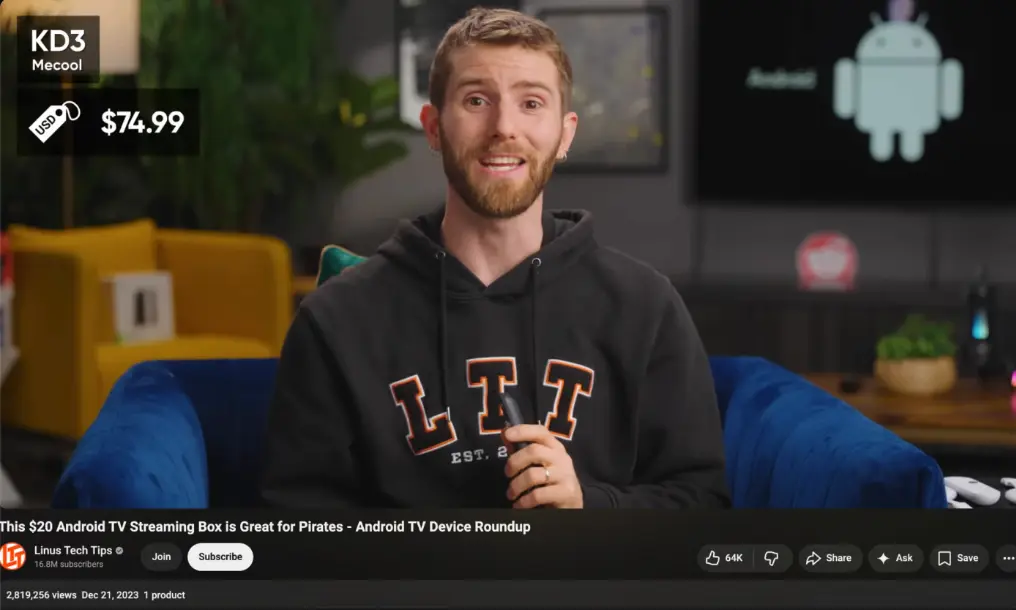
The distribution of these compromised devices relied heavily on influencer marketing and digital word-of-mouth. Throughout 2023 and subsequent years, popular consumer tech channels—such as the massive YouTube channel Linus Tech Tips, boasting nearly 17 million subscribers—showcased affordable, high-performance streaming boxes like those manufactured under the MECOOL brand (produced by publicly traded Chinese firm Skyworth Technology).

These boxes gained viral traction by offering hundreds of pay-TV channels and streaming services for a single, low, upfront fee—a hallmark of pirated media distribution. Unknowing consumers, trusting the recommendations of online reviewers, purchased the hardware in droves.
(Note: Following the disclosures, Linus Tech Tips updated its historical videos to explicitly characterize the devices as security scams and removed all associated commercial affiliate links.)
Research Convergence and the Synthient Breakthrough
The investigation accelerated in January 2026 when startup research firm Synthient published landmark findings regarding the Kimwolf botnet, which had been blanketing global internet service providers with record-breaking distributed denial-of-service (DDoS) attacks. Synthient demonstrated how Kimwolf rapidly infected millions of Android set-top boxes overnight, leveraging vulnerabilities within residential proxy software to jump across local area networks (LANs) and compromise secondary devices.
The findings forced several residential proxy providers to patch their networks, fracturing Kimwolf into smaller, more manageable clusters. This public exposure caught the attention of the Motion Picture Association (MPA), which partnered with Synthient to purchase, teardown, and analyze dozens of popular Android TV boxes.
Subsequent investigations by Synthient, Plume Security Labs, and Black Lotus Labs confirmed that MECOOL and other white-label brands were deeply intertwined with Videostrong’s malware ecosystem, bundling the XCPE core alongside commercial proxy software development kits (SDKs).
The Takedown Operation
Faced with overwhelming evidence of supply chain corruption, Google took decisive legal and technical action. Google severed all official corporate and licensing ties with Videostrong Technology Co., revoked compromised digital certificates, and initiated legal actions to seize domain names and C2 servers utilized to manage the botnet. Working in lockstep with global network operators and security infrastructure partners, Google’s coalition effectively severed the core communication pathways of the 1.3 million active XCPE nodes.
Supporting Context & Metrics: The Residential Proxy Economy
To understand why the XCPE botnet was constructed, one must examine the lucrative and legally ambiguous residential proxy market.
Residential proxies are services that allow external clients—ranging from legitimate market research firms to malicious threat actors—to route their internet traffic through real consumer IP addresses. By masquerading as standard home internet users, traffic from these proxies can bypass geographic blocks, evade fraud detection systems, and mask malicious activity.
The GTIG report and allied threat analyses identified numerous residential proxy providers whose SDKs were routinely bundled into the XCPE malware payload. Key players highlighted in the investigation include:

- AppSalt / Honeygain: Operated by Vilnius, Lithuania-based Oxylabs. In October 2026, Oxylabs rebranded as Source following a staggering $130 million funding round led by private equity firm Warburg Pincus, which valued the enterprise at $3.6 billion. Oxylabs did not respond to media requests for comment regarding its software’s appearance on backdoored devices.
- NetNut: Operated by publicly traded Israeli firm Alarum Technologies. NetNut was previously targeted in July 2026, when the FBI and international partners seized hundreds of domains linked to its infrastructure over its operation of a separate TV box proxy botnet named Popa.
- Other Ecosystem Participants: The GTIG report cataloged several additional proxy platforms integrated into the infection chain, including EarnFM, Traffmonetizer, Jaguar, LINKFOG, BMW/IPWeb, GaGaNode, and the Grass proxy network (though Grass representatives have previously denied intentional affiliation with streaming box manufacturers).
Scale of the Threat
While GTIG’s conservative metrics estimate the direct impact at 1.3 million active Android TV set-top boxes, industry analysts emphasize that this figure only scratches the surface.
Ben Brundage, founder of Synthient, noted in interviews that the 1.3 million metric is "highly conservative." Because infected TV boxes act as internal relays within home and office Wi-Fi networks, they expose connected laptops, smartphones, smart home appliances, and enterprise gear to secondary exploitation. Experts estimate the operation has successfully severed criminal access to upwards of 10 million auxiliary systems.
Official Statements and Industry Reactions
The exposure of systemic manufacturing backdoors has sent shockwaves through the consumer electronics and cybersecurity sectors.
Google pulled no punches in its official GTIG disclosures regarding Videostrong’s conduct:
"A device manufacturer intentionally infecting their users with malware is an unacceptable breach of trust, and represents a serious risk to those users. Without users’ knowledge or consent, infected devices were offered as a distribution mechanism for a wide array of criminal actors."
Synthient’s Ben Brundage underscored the unprecedented scale of the hardware-level compromise, stating:
"The scale of affected devices is likely way higher… This is probably the largest operation against backdoored TV boxes that we’ve seen."
Cybersecurity analysts emphasize that this enforcement action marks a critical turning point. Historically, botnet disruptions have focused on software vulnerabilities discovered after deployment. The XCPE takedown, by contrast, directly confronts the burgeoning threat of pre-installed, hardware-level supply chain subversion, where consumer hardware is designed from the factory floor to act as an adversary within the user’s home network.
Future Outlook & Recommendations
While Operation XCPE has successfully disabled a major pillar of the global proxy botnet infrastructure, security experts warn that the underlying economic incentives remain intact. As long as gray-market streaming boxes can be subsidized by monetizing consumer bandwidth and user data, malicious manufacturers will seek out novel ways to evade automated vetting procedures.
Recommendations for Consumers and Network Operators:
- Audit Streaming Hardware: Consumers are strongly advised to avoid unverified, deeply discounted streaming boxes promoted via social media influencers offering "unlocked" or free premium TV channels. Stick to trusted brands (such as Google TV, Apple TV, Amazon Fire TV, and Roku) that maintain strict software integrity and verified update channels.
- Network Segmentation: Smart home devices, particularly unverified IoT hardware and media streamers, should be isolated on a separate "guest" or IoT VLAN (Virtual Local Area Network) to prevent compromised units from pivoting to personal computers, network-attached storage (NAS), and sensitive work devices.
- Monitor Outbound Traffic: Advanced home router configurations and modern firewall solutions should be configured to monitor for anomalous outbound connection requests, particularly high-volume residential proxy traffic or unexpected peer-to-peer data streams.
- Stay Informed: Organizations like Synthient, Plume Security Labs, and Google Threat Intelligence Group continue to publish updated indicators of compromise (IoCs) and lists of affected hardware model numbers (such as Synthient’s public GitHub repository tracking Videostrong hardware). Users should cross-reference their hardware inventories against these verified safety advisories.