Executive Overview
In a dramatic escalation of an ongoing international manhunt, federal law enforcement has arrested a prominent Canadian cybersecurity executive in connection with the notorious ShinyHunters hacking syndicate. The federal dragnet closed around Edward Dubrovsky—a veteran incident responder, author, and security firm executive—who was taken into custody by Federal Bureau of Investigation (FBI) agents while visiting Pennsylvania for a high-profile cyber insurance conference.
The arrest marks a major turning point in a high-stakes federal investigation that has deeply embarrassed the U.S. intelligence and law enforcement apparatus. ShinyHunters recently breached the Bureau’s own digital defenses, siphoning sensitive personnel files, unit assignments, and psychiatric records belonging to thousands of federal agents. The syndicate’s operations have triggered an intense, cross-border response involving European law enforcement, multiple FBI field offices, and specialized digital forensic teams.
According to federal court records and investigative sources, Dubrovsky faces severe charges including cyber extortion and conspiracy. The case highlights a troubling, shadowy intersection within the modern cybersecurity landscape: the thin line between advisory firms specializing in ransomware negotiations and the illicit operations of the extortionists themselves. As investigators pore over seized devices, analyze international financial trails, and unravel encrypted communications, the fallout from this case threatens to send shockwaves through the multibillion-dollar cyber insurance and incident response industry.
Detailed Chronology: From Philadelphia Conference to Federal Custody
The sequence of events leading to Edward Dubrovsky’s apprehension unfolds like a modern cyber-thriller, moving rapidly from academic panels and industry networking events to the austere confines of a federal detention center.
The Cyber Risk Summit and the Trap
Between October 5 and October 7, the NetDiligence Cyber Risk Summit convened at the Loews Philadelphia Hotel. The annual conference draws elite figures from the cyber insurance, risk mitigation, and incident response sectors. Among the premier sponsors of the 2026 Philadelphia summit was Cypfer, a prominent Canadian security firm.
Dubrovsky, who had maintained a long association with Cypfer before transitioning to another Canadian security startup and summit sponsor, CyberSteward, traveled to Pennsylvania to participate in panel discussions. In a LinkedIn post published roughly a month prior to the conference, Dubrovsky enthusiastically expressed his plans to attend the summit alongside his CyberSteward colleagues to discuss global strategies for handling coercive extortion events and ransomware settlements.
Unknown to conference attendees, federal investigators were already tracking Dubrovsky’s movements. On October 8, just a day after the summit concluded, FBI agents intercepted and arrested him.
Legal Filings and Judicial Transfer
Federal court dockets reveal that an individual named Edward Dobrovsky—with a minor typographical error in the surname matching the suspect’s identity—was booked on federal charges of "conspiracy to threaten to impair the confidentiality of information with the intent to extort money" and "interference with commerce by threats."

While the core criminal complaint and several key evidentiary documents remain strictly sealed, partial records indexed via CourtListener.com outline the gravity of the accusations. As of October 10, the 54-year-old executive was being housed at a federal detention facility in Philadelphia according to the U.S. Bureau of Prisons inmate locator.
However, legal maneuvers initiated on October 9 indicate that the case has been rapidly transferred to the U.S. District Court for the Eastern District of Texas. Sources close to the investigation confirm that control of the broader ShinyHunters probe has been centralized within an FBI field office in Texas, signaling that the local Pennsylvania arrest is merely a tactical node in a much larger, multi-jurisdictional conspiracy investigation.
Corporate Distance and Defense
In the wake of the arrest, corporate entities rushed to distance themselves from the accused executive. Cypfer issued a clarifying public statement noting that contrary to claims on his professional profiles, Dubrovsky was never a founder or co-founder of the firm, but rather served as a managing director prior to his resignation in December 2025. Meanwhile, representatives for CyberSteward have remained largely silent, and court records indicate that Dubrovsky has not yet retained private legal counsel or been assigned a public defender.
Supporting Context & Metrics: The Anatomy of the ShinyHunters Threat
To fully understand the gravity of Dubrovsky’s arrest, one must examine the sprawling criminal enterprise of ShinyHunters and the devastating operational footprint they have left across the global digital economy.
Modus Operandi of a Cyber Syndicate
ShinyHunters has long operated as one of the most destructive and brazen cyber extortion rings in the threat landscape. The group typically leverages targeted phishing campaigns, credential harvesting, and security lapses at Software-as-a-Service (SaaS) providers to infiltrate corporate environments. Once inside, they exfiltrate massive troves of proprietary data, intellectual property, and customer records, threatening to leak the information publicly on dark web forums unless exorbitant cryptocurrency ransoms are paid.
The financial toll of their operations is staggering. According to intelligence compiled by the FBI, ShinyHunters has successfully extorted more than $70 million from corporate and institutional victims globally over the course of the year.
The FBI Breach and the Rise of "Rey"
The urgency behind the FBI’s pursuit intensified exponentially following a series of catastrophic security breaches that struck the Bureau itself.
- The Dutch Connection: Last month, international cooperation bore fruit when Dutch police apprehended Pepijn van der Stap, a reformed hacker turned cybercriminal suspected of playing a foundational role in the ShinyHunters operation. Forensic specialists immediately began extracting data from hardware devices seized during Van der Stap’s arrest.
- The New Leadership: In the wake of Van der Stap’s detention, a shadowy hacker operating under the online moniker "Rey" assumed operational command of ShinyHunters. Seeking to assert dominance and mock law enforcement, Rey and his associates targeted the FBI’s own online recruitment portal.
- Compromised Sensitive Data: The resulting data breach relieved the Bureau of sensitive files concerning thousands of active and prospective agents. The stolen trove included detailed unit assignments, operational specializations, and highly confidential medical and psychiatric records.
- The Downfall of Rey: The cyber-taunts did not last. Investigative reporting by Reuters revealed that "Rey" was, in fact, a teenager named Saif Al-din Khader. Khader was subsequently detained by authorities and has reportedly been cooperating with federal investigators. On October 7, intelligence reports linked Khader’s apprehension to a desperate attempt by the group to extort a navigation and digital aviation unit that had been divested by aerospace giant Boeing in late 2025.
The Paradox of Ransomware Negotiation
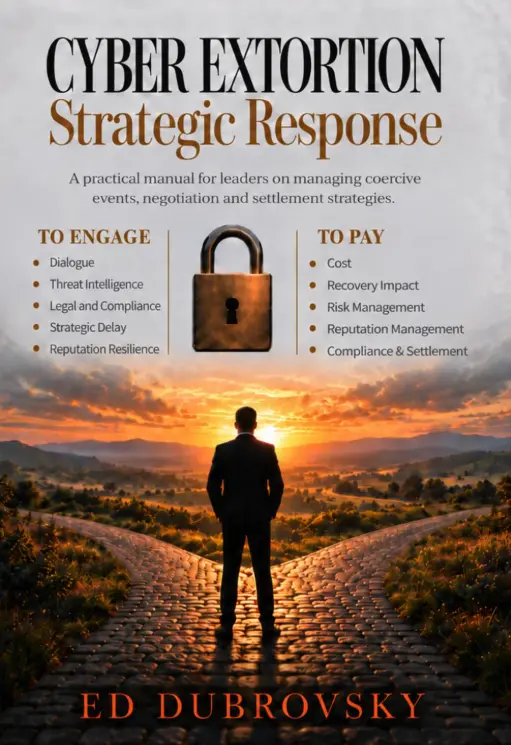
The arrest of a prominent cyber extortion author and advisor like Dubrovsky underscores a deep systemic vulnerability within the cybersecurity advisory ecosystem. Dubrovsky literally wrote the book on the subject—publishing a 252-page guide titled Cyber Extortion Strategic Response, which purports to navigate the ethical, legal, and operational nuances of ransomware interactions.

In promotional excerpts for his book, Dubrovsky emphasized a critical distinction: "Communicating with a criminal is not the same as negotiating a payment, and negotiating is not a commitment to pay." He argued that engagement could serve tactical objectives, such as testing threat actor claims, stalling for time, and evaluating corporate exposure. However, federal prosecutors now allege that the accused crossed the line from advisory negotiation into active criminal conspiracy and extortion—a development that threatens to cast a pall of suspicion over legitimate incident response firms worldwide.
Official Statements and Industry Reactions
The federal government has maintained a tight-lipped posture regarding the specifics of the ongoing conspiracy case.
In a brief statement published on X (formerly Twitter), FBI Director Kash Patel acknowledged the general thrust of the law enforcement actions against the ShinyHunters network but refrained from commenting on individual suspects or ongoing judicial transfers. Representatives for the FBI field office in Texas and the Department of Justice have similarly declined to provide granular commentary, citing the active, sealed nature of the court dockets and the likelihood of impending superseding indictments.
Meanwhile, the cybersecurity and cyber insurance industries are reeling from the news. Professional forums, risk management Slack channels, and executive circles are buzzing with speculation. The arrest of a leading voice in ransomware mediation has ignited fierce internal debates regarding the vetting of incident response consultants, the regulatory compliance of extortion payouts, and whether other executives within the ransomware negotiation ecosystem may soon find themselves in the crosshairs of federal prosecutors.
Future Outlook: What Lies Ahead
As this fast-moving legal and investigative saga continues to unfold, several critical developments are anticipated in the coming weeks:
- Unsealing of Court Documents: Legal transparency advocates and defense attorneys expect further details of the federal complaint to emerge as Dubrovsky is formally arraigned and transferred to the jurisdiction of the Eastern District of Texas. The initial hearings will likely shed light on the specific evidentiary basis connecting a cybersecurity executive to the ShinyHunters hierarchy.
- Additional Arrests Imminent: Sources close to the investigation have signaled to security researchers that the arrest of Edward Dubrovsky is unlikely to be an isolated incident. Law enforcement agencies are actively evaluating digital forensics recovered from European raids and cooperating informants, with rumors mounting that charges against principals at other ransomware negotiation and incident response firms could be forthcoming.
- Policy and Regulatory Fallout: The convergence of cyber extortionists and professional advisory firms is expected to attract intense scrutiny from legislative committees and regulatory bodies. Lawmakers may push for tighter oversight, mandatory reporting frameworks, and stricter licensing requirements for companies that interface directly with threat actors on behalf of corporate victims.
The takedown of key players in the ShinyHunters syndicate—spanning from teenage dark web leaders in Europe to seasoned executives in North America—demonstrates the global reach of modern cyber law enforcement. Yet, it also lays bare the grim reality that the digital underground has deeply infiltrated the very institutions built to defend against it. As the investigation deepens in Texas, the global cybersecurity community watches with bated breath to see who else might fall in the Bureau’s sweeping net.