Executive Overview
Released on August 26, Toxic: A Fairy Tale for Grown-Ups arrives in cinemas bearing the immense weight of stratospheric expectations. Positioned as one of the most financially lavish and technically ambitious projects in the history of Indian cinema, the gangland action saga spans five tumultuous decades. It attempts a narrative feat increasingly rare in the contemporary South Indian blockbuster landscape: it delivers a complete, self-contained story rather than artificially fracturing its plot into a serialized "Part 1."
Headlined by the bearded A-lister Yash—universally known as the "Rocking Star" following his monumental success in the KGF duology—the 194-minute epic plunges audiences into a heavily stylized underworld. Yet, despite commanding a staggering budget that places it among the highest-expenditure productions out of India, Toxic struggles profoundly under the weight of its own ambitions.
Directed by Geetu Mohandas, whose critically acclaimed Malayalam-language feature Moothon showcased a masterful command of intimate, subversive drama, this latest venture feels pulled in conflicting directions. On one hand, it boasts an evocative visual aesthetic, transforming the former Portuguese enclave of Goa into a moody, rain-soaked western coast hybrid of 1920s Chicago. On the other hand, the film is edited with a hyperactive, impressionistic velocity that renders spatial geography and character dynamics nearly incomprehensible.
While Yash turns in a compelling dual performance as both the ruthless mafioso Raya and his vengeful son, Rumi (affectionately and ominously nicknamed "Ticket"), the surrounding film operates as a sensory gauntlet. Plagued by an ungrounded soundscape, derivative musical cues, and an over-reliance on aggressive, abrasive pacing, Toxic emerges as an exhausting cinematic paradox: a visually stunning canvas that ultimately collapses under the crushing weight of its own chaotic execution.
Detailed Chronology and Narrative Structure
The sprawling narrative of Toxic covers a monumental canvas, stretching from the 1920s through India’s independence in 1947 and pushing decades beyond to chart the evolution of Goa’s illicit drug trade. The film opens in medias res inside a dusty, atmospheric circus tent. Here, a young boy with his face painted like a sad clown—bearing the moniker "Ticket"—is forcibly handed over by his frantic, manic acrobat mother, Nadia (Kiara Advani), to his estranged and vengeful father, Raya (Yash).
This angst-laden opening sequence immediately establishes an aura of foreboding. It hints at deep-seated psychological wounds and historic betrayals that have shaped the lives of its central figures. However, rather than allowing this tension to simmer, the screenplay accelerates at breakneck speed to fill in the missing narrative pieces.
Flashbacks and expository dialogue reveal a complex web of historical power plays. Decades prior, the Goa drug trade was managed by Raya’s unseen father alongside a syndicate of Portuguese gangsters, each burdened by their own convoluted family entanglements. As the decades turn, Raya and his steely, unyielding older sister, Ganga (Nayanthara), ascend to the upper echelons of this criminal empire through a continuous series of crisscrossing betrayals and cold-blooded maneuvers.
As the timeline shifts toward the mid-20th century and beyond, the narrative tracks Raya’s reign of vice, philandering, and violent dominance. The introduction of the film’s final act brings forward the adult Ticket—distinguished from his father by a thin goatee and digital de-aging. Ticket’s return triggers the ultimate reckoning, culminating in an over-explained yet emotionally resonant finale that attempts to tie together generations of inherited trauma. Unfortunately, the three-hour stretch bridging the opening circus and the closing confrontation unfolds as a blur of repetitive shootouts, leaving the audience to piece together a fragmented puzzle long after the emotional stakes have flatlined.
Supporting Context & Metrics: Production Scale and Aesthetic Identity
To understand Toxic, one must contextualize its unprecedented financial footprint. Sitting comfortably near the top of the most expensive Indian films ever produced, its financial heft is surpassed only by elite tentpoles like S.S. Rajamouli’s Varanasi and the mythological epic Ramayana: Part 1 (which also features Yash).
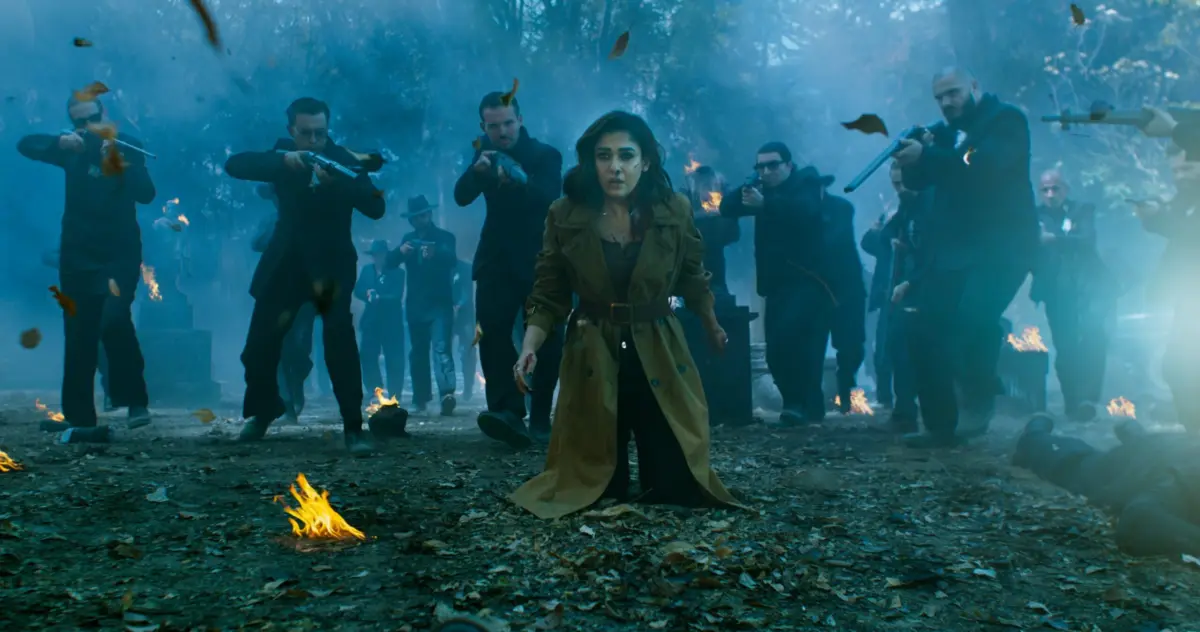
The production design by the art and costume departments is nothing short of miraculous on paper. The recreation of historical Goa is awash in slick suits, fedoras, tommy guns, and lavish speakeasies that evoke an exoticized, transnational noir aesthetic. Mohandas’s directorial gaze deliberately subverts the traditional male-centric lens of Indian mass media. Instead of lingering on the hyper-sexualized, oily washboard abs typical of the genre, the camera focuses on textured details like hairy chests, rolled-up sleeves, and characters navigating snowy, rainy microclimates with distinct physicalities.
Yet, this aesthetic triumph is severely undermined by post-production choices. Shot simultaneously in Kannada and English to cater to multiple global markets, the English-language version leans heavily into flowery, pseudo-poetic dialogue. Instead of enhancing the "fairy tale for grown-ups" conceit, the script forces characters to articulate subtext aloud, transforming every line into a lofty proclamation or a forced quip. Over a 194-minute runtime, this stylistic choice numbs the viewer, rendering memorable dialogue virtually nonexistent.
Furthermore, the film’s auditory architecture feels curiously dated. Drawing heavy inspiration from early-to-mid-2000s international cinematic touchstones—evoking sonic memories of In the Mood for Love, Donnie Darko, Requiem for a Dream, and The Dark Knight—the sound design lacks an original, cohesive identity. The result is a sonic landscape that feels derivative rather than homage-paying, compounding the overall sense of disorientation.
Official Statements and Industry Reception
As Toxic makes its theatrical debut, the reactions from critics and trade analysts alike highlight a widening chasm between technical scale and narrative coherence. Industry stakeholders have long praised Yash’s star power and his commitment to expanding the geographical and thematic boundaries of "pan-Indian" cinema.
Insiders note that the film’s simultaneous multilingual release strategy reflects a growing studio appetite to capture international audiences without compromising regional roots. However, behind-the-scenes whispers and critical analyses point toward friction between auteur-driven filmmaking and studio-mandated commercial tropes.
Critics have pointedly questioned the extent of Geetu Mohandas’s creative autonomy in the final cut. Given her track record of handling delicate, deeply human narratives in films like Moothon, the presence of aggressive, gratuitous violence targeting minor or tertiary characters in Toxic feels discordant. While the violence is ostensibly deployed to underscore the grim thematic reality of generational trauma, its execution frequently veers into chauvinistic bloodlust, suggesting compromises made to satisfy traditional male-hero worship expectations.
Studio representatives and production houses have defended the film’s brisk editing style as a deliberate artistic choice meant to mirror the fever-dream state of its protagonists. Nonetheless, the prevailing consensus across major journalistic outlets remains stark: the machinery of modern blockbuster filmmaking has swallowed a uniquely talented director’s vision whole.
Future Outlook
The commercial and cultural legacy of Toxic: A Fairy Tale for Grown-Ups will likely cast a long shadow over the future trajectory of Indian blockbuster cinema. On one hand, the film proves that studios are increasingly willing to finance dark, period-specific genre pieces that break away from standard contemporary urban or rural settings. The willingness to experiment with visual texture, historical pastiche, and non-linear character studies demonstrates a maturing industry eager to push artistic envelopes.
However, Toxic also serves as a cautionary tale regarding the perils of over-editing and narrative obfuscation. As Indian cinema increasingly targets global streaming and theatrical markets, audiences are demonstrating a low tolerance for style-over-substance filmmaking that prioritizes trailer-ready jump-cuts at the expense of basic geographical and emotional clarity.
For star Yash, the film cements his status as a magnetic performer capable of elevating even the most erratic material through sheer screen presence and physical dedication. His portrayal of Ticket—marked by parkour-inspired agility and raw, feral energy—points toward exciting avenues for his upcoming projects, notably Ramayana: Part 1.
Ultimately, Toxic will be remembered as a magnificent misfire: a project fueled by boundless ambition, staggering financial investment, and immense star power that ultimately lost its soul in the editing room. Whether future releases in the pan-Indian landscape learn from its structural pitfalls will determine if studios can balance high-concept visual splendor with the narrative discipline required to sustain an audience’s engagement over three hours.