Executive Overview
In a significant leap forward for cloud computing management and infrastructure governance, Amazon Web Services (AWS) has announced the public preview of the AWS Well-Architected Agent. This groundbreaking, AI-powered service is designed to fundamentally transform how organizations evaluate, optimize, and secure their cloud environments. Moving far beyond traditional, labor-intensive manual audits and generic, one-size-fits-all checklists, the Well-Architected Agent operates with the nuance and contextual understanding of an elite, seasoned cloud architect.
By autonomously correlating deep utilization metrics, intricate resource configurations, and complex application topologies against time-tested Well-Architected best practices across more than 65 AWS services, the agent delivers highly targeted, business-aligned optimization insights. Crucially, the service does not merely identify architectural bottlenecks or vulnerabilities; it formulates ready-to-implement remediation packages. Whether through updated Infrastructure as Code (IaC) templates, automated console instructions, or precise CLI commands, the AWS Well-Architected Agent bridges the critical gap between architectural discovery and hands-on execution.
Available initially via the AWS Well-Architected console for workloads across commercial regions—with processing hubs located in US East (N. Virginia), US East (Ohio), and US West (Oregon)—this advanced service is delivered through AWS Support. It is accessible to customers equipped with an eligible AWS Support plan, signaling AWS’s ongoing commitment to pairing cutting-edge artificial intelligence with enterprise-grade operational reliability.
Detailed Chronology: How the Well-Architected Agent Works
The deployment and utilization of the AWS Well-Architected Agent have been engineered to streamline complex cloud reviews into a coherent, step-by-step lifecycle. Understanding the chronological workflow helps organizations seamlessly integrate this powerful tool into their existing DevOps and cloud governance frameworks.
Step 1: Establishing the Agent Profile and Security Prerequisites
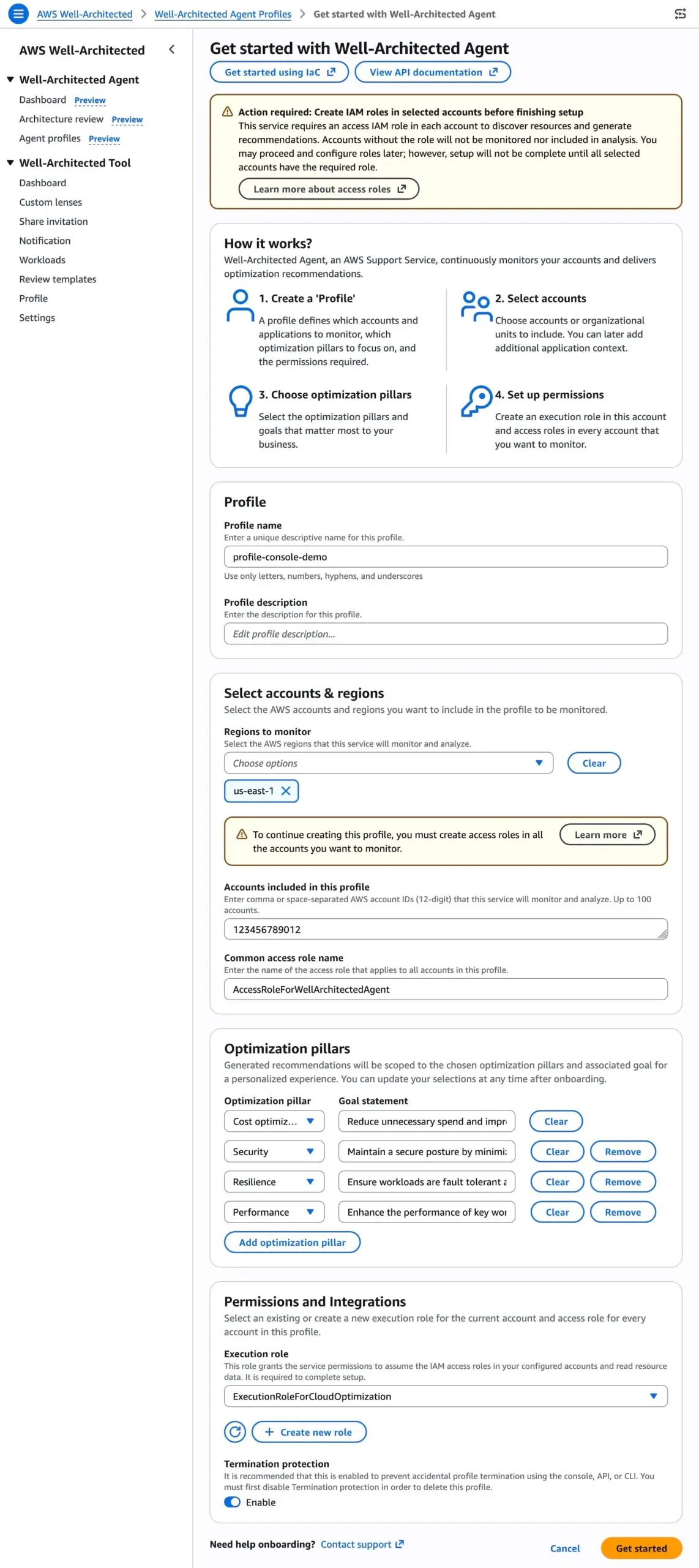
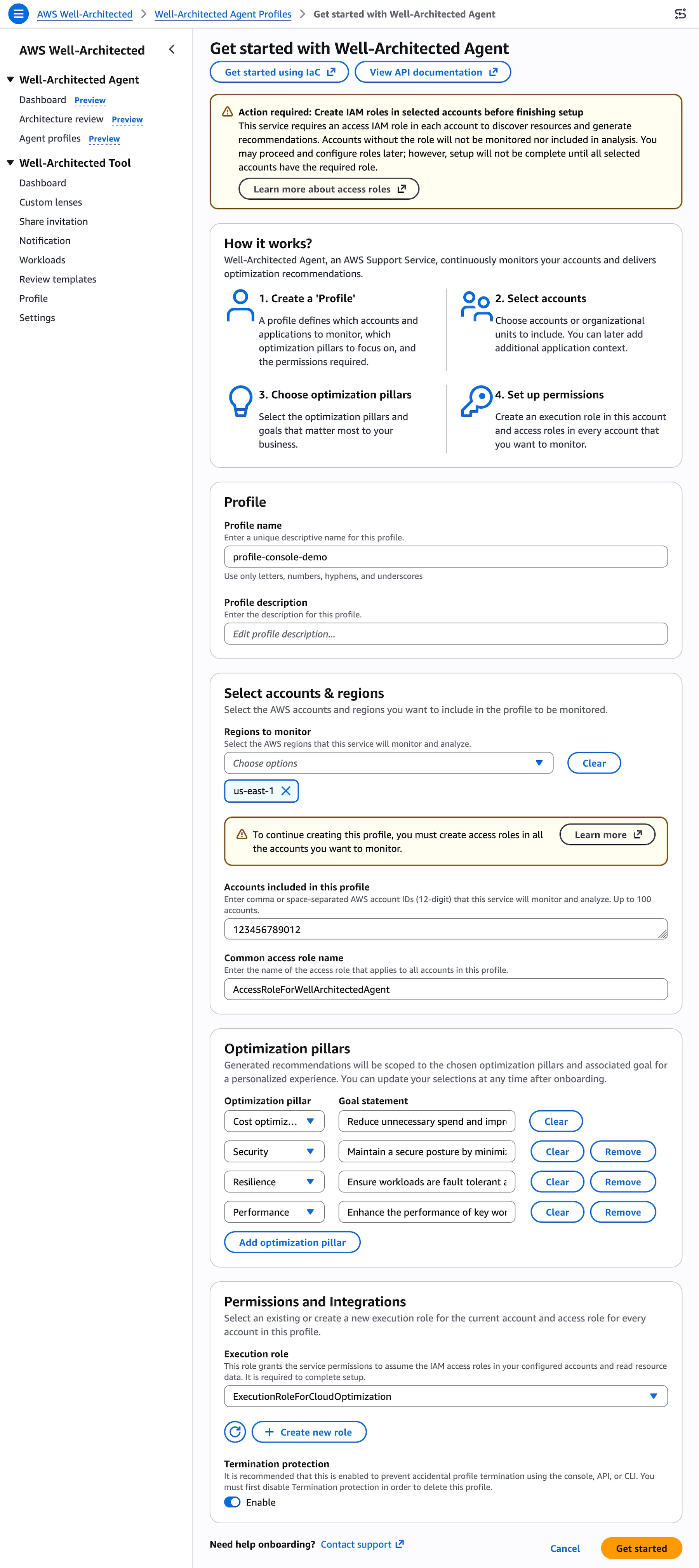
The journey begins within the AWS Well-Architected console, where administrators initiate the service by selecting Get started with Well-Architected Agent. During this phase, users define the precise scope of the agent’s mandate by creating an agent profile. This involves:
- Selecting specific AWS accounts and AWS Regions to monitor.
- Designating optimization pillars—such as cost optimization, performance efficiency, reliability, security, and operational excellence—that align most closely with the organization’s strategic initiatives.
- Establishing distinct business goals for each chosen pillar to ensure the resulting recommendations are weighted appropriately against corporate priorities.
To ensure strict adherence to the principle of least privilege, users must provision customer-managed AWS Identity and Access Management (IAM) roles. These roles grant the agent secure, read-only access to resource configurations, utilization metrics, and application topologies without exposing sensitive underlying data. Once configured, the agent initializes, and initial comprehensive resource and application recommendations are generated within 24 hours.

Step 2: Contextualizing Workloads and Pre-Deployment Analysis
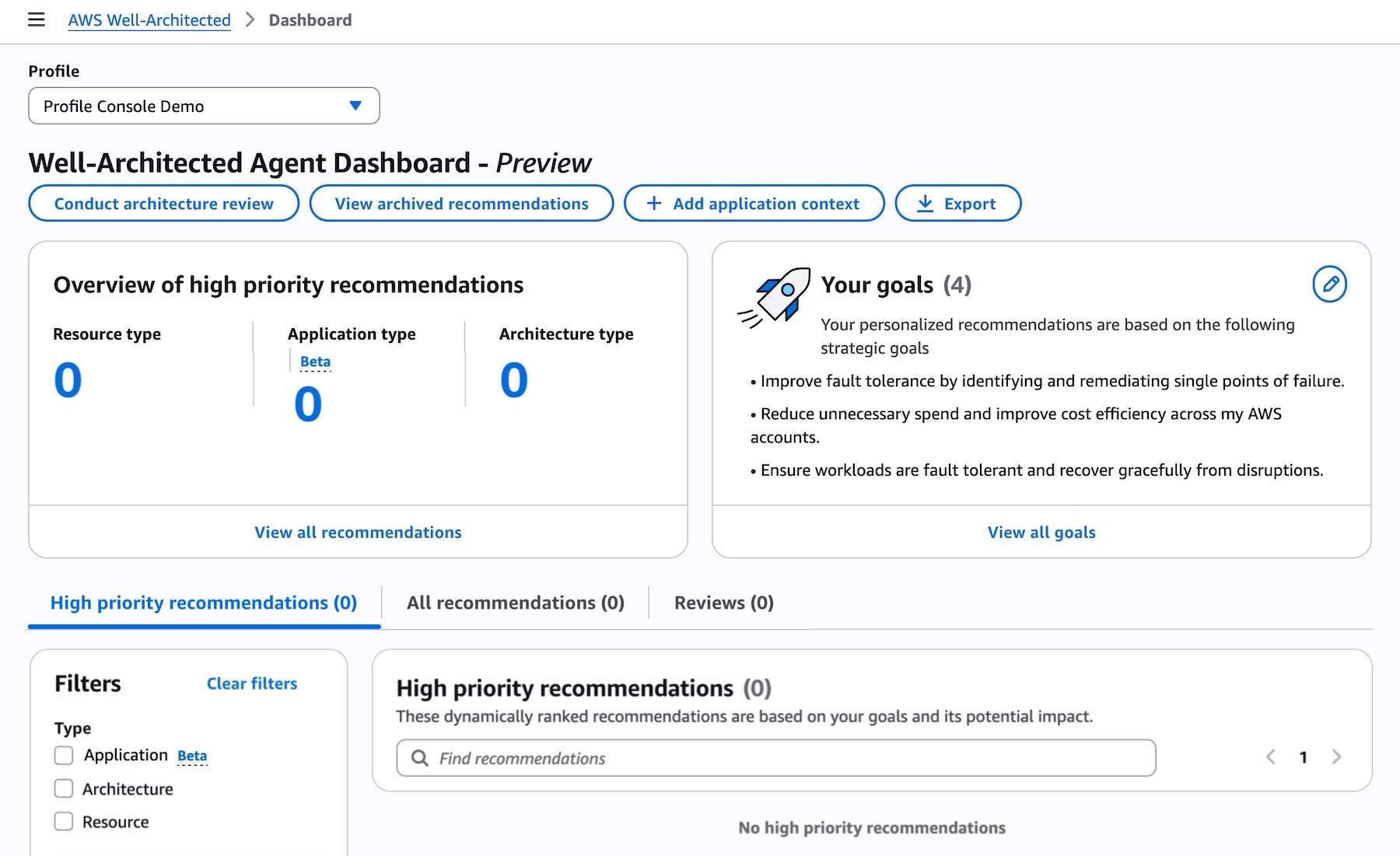
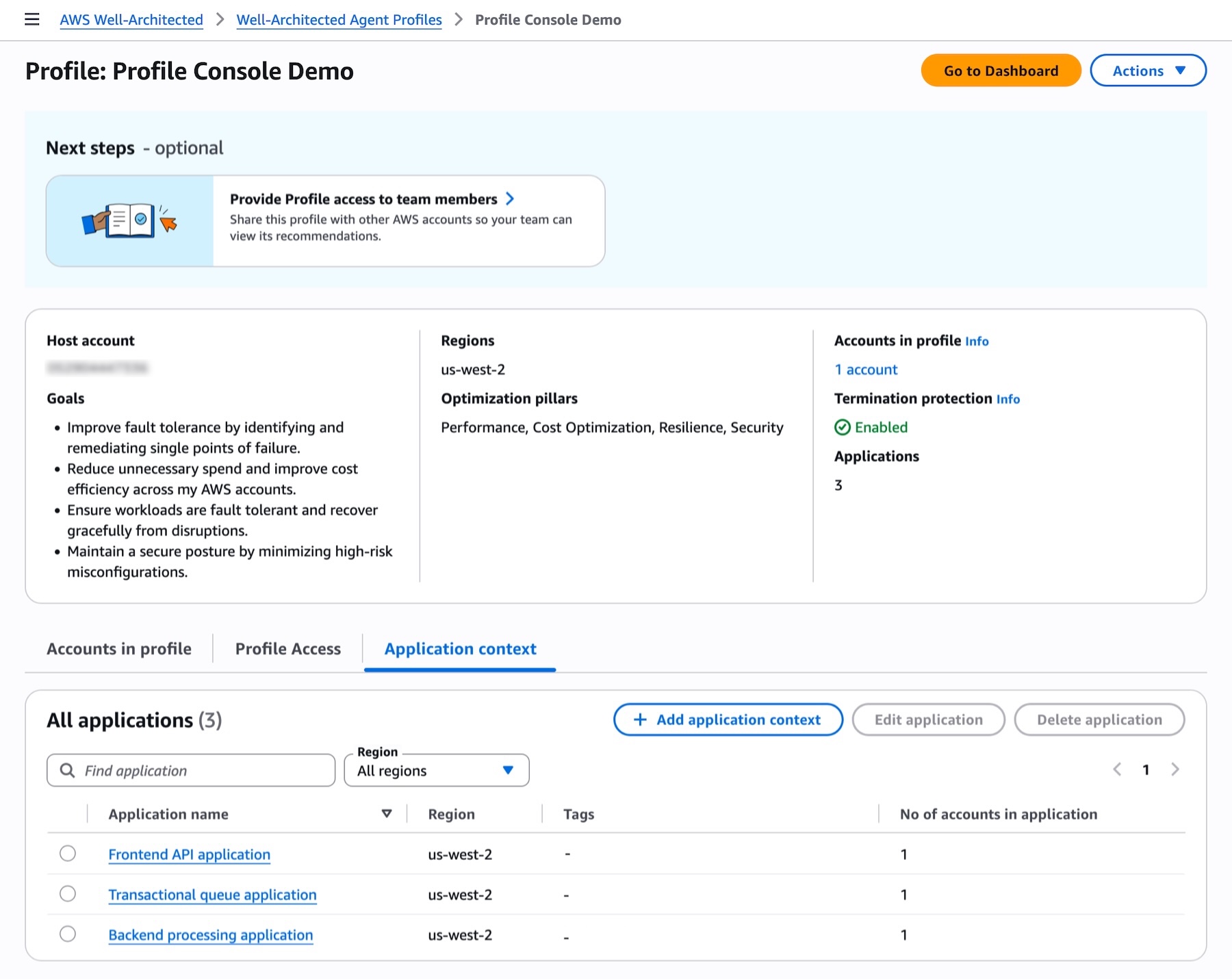
To maximize the relevance of its findings, the AWS Well-Architected Agent allows engineers to inject rich application context. By navigating the dashboard and selecting Add application context, teams can associate specific AWS accounts, regions, services, and resource-identifying tags with their designated applications. This narrows the operational scope and filters out architectural noise.
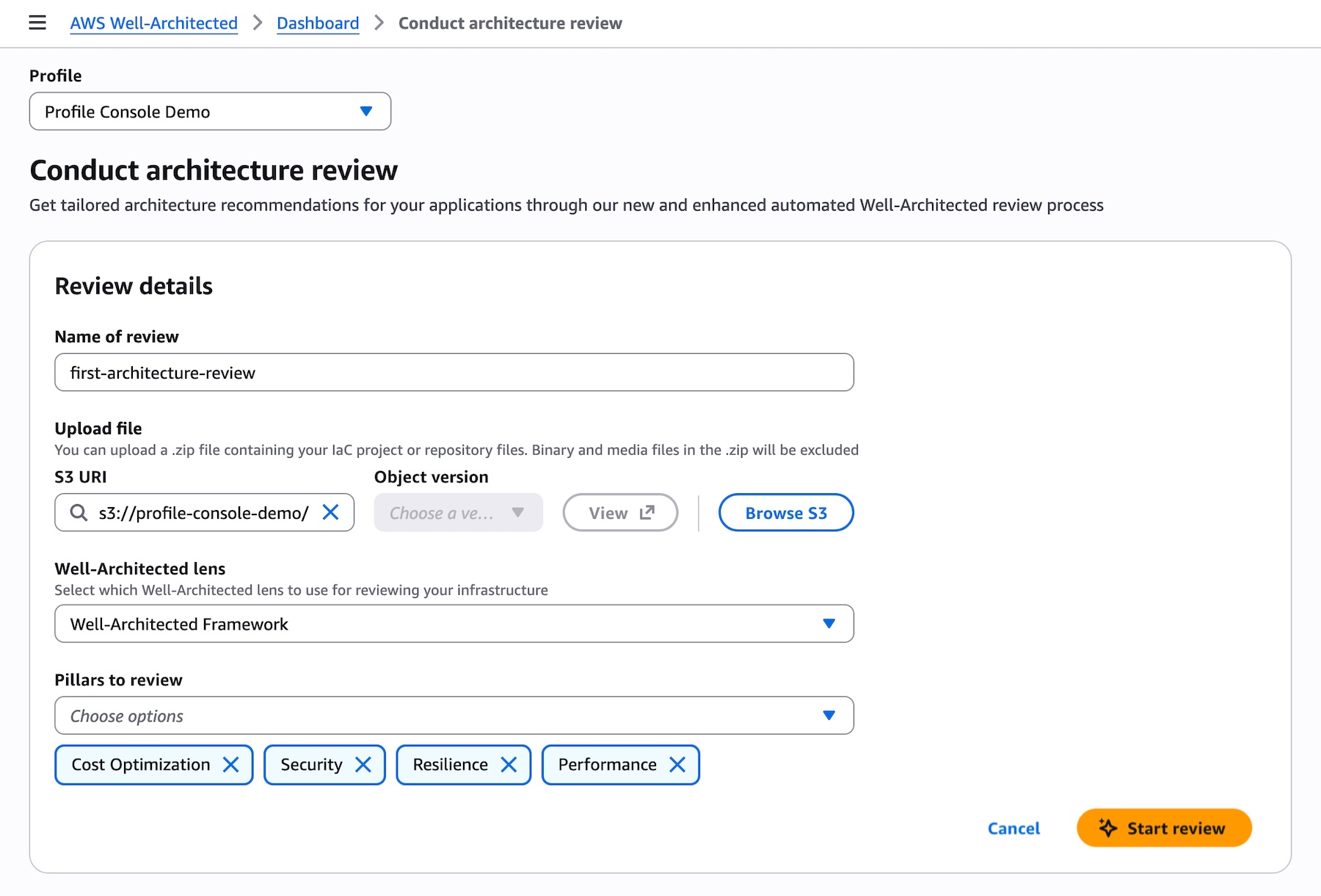
Furthermore, the agent extends its analytical capabilities beyond running production environments into the pre-deployment phase. Development teams can conduct proactive architecture reviews by uploading Infrastructure as Code (IaC) projects packaged as .zip files. Supporting popular frameworks such as Terraform, AWS CloudFormation, and the AWS Cloud Development Kit (CDK), the agent evaluates proposed architectures against chosen Well-Architected lenses before a single resource is provisioned in the cloud.
Step 3: Prioritized Triage and Intelligent Trade-Off Analysis
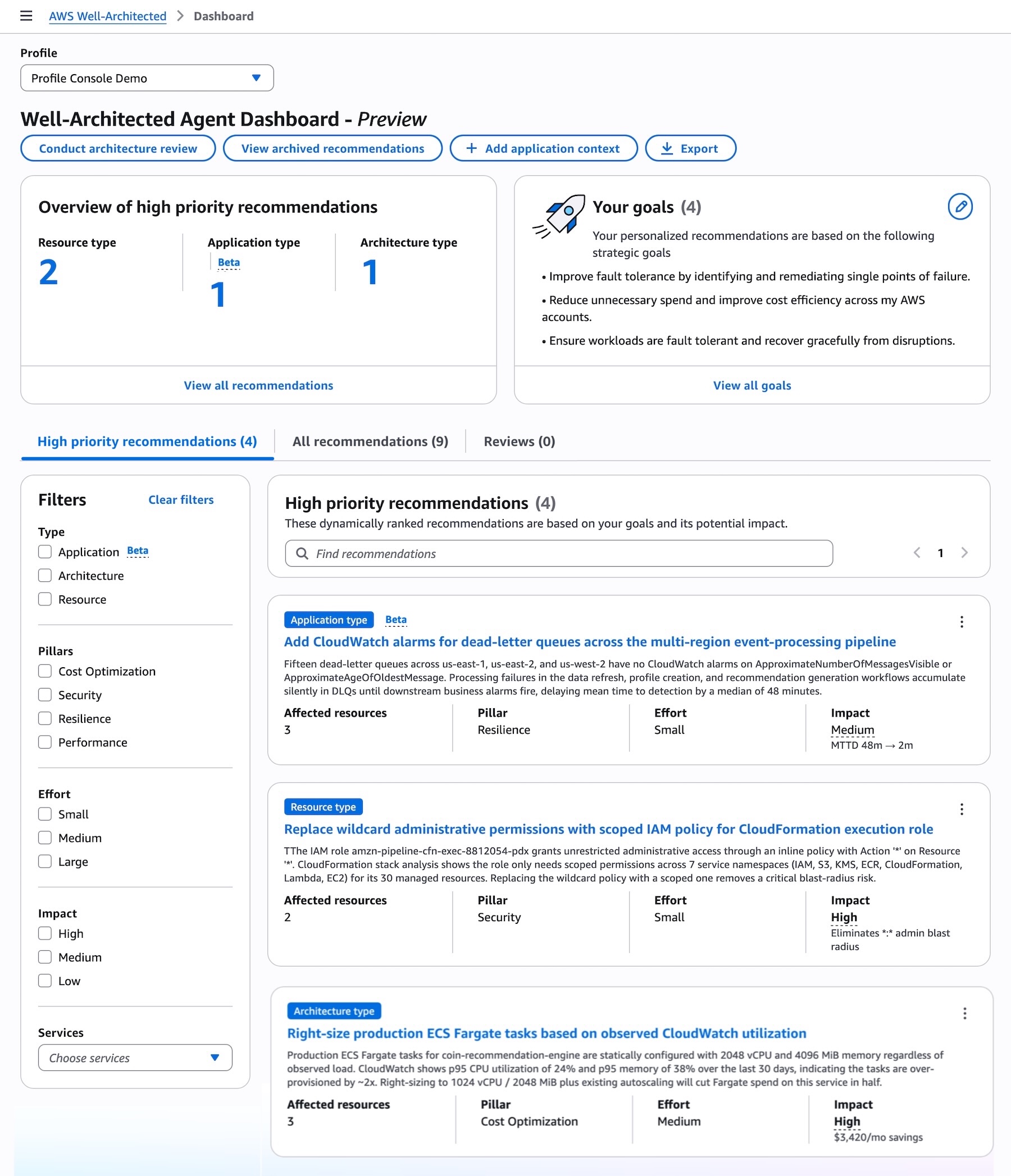
Once the agent completes its continuous evaluation, administrators are presented with a prioritized dashboard of recommendations. These findings are ranked not by raw technical severity alone, but against the organization’s explicitly declared business goals and selected optimization pillars.
Selecting an individual recommendation reveals deep diagnostic insights, including:
- The core reasoning and root-cause analysis driving the agent’s suggestion.
- The anticipated impact on the broader cloud ecosystem.
- Complex cross-pillar trade-offs—for instance, highlighting how a performance-enhancing modification might marginally impact cost, allowing decision-makers to make fully informed architectural compromises.
Step 4: Seamless Remediation and Workflow Integration
The true differentiator of the AWS Well-Architected Agent lies in its execution phase. By clicking Start remediation, engineers are presented with actionable resolution pathways categorized by resolution type. These include step-by-step console directions, CLI commands, and—most powerfully—updated IaC templates.
When choosing the updated IaC template option, the agent automatically generates the exact code modifications required for frameworks like the AWS CDK or Terraform. Engineers can copy these snippets directly into their source code repositories. Additionally, through the integration of the AWS MCP Server and developer plugins, teams can query the agent programmatically, searching documentation and integrating recommendations straight into their preferred AI coding tools and daily development workflows.
Supporting Context & Metrics: The Evolution of Cloud Governance
The introduction of the AWS Well-Architected Agent arrives at a critical juncture in the evolution of enterprise cloud computing. As organizations scale their digital infrastructure to unprecedented sizes, the complexity of managing multi-account, multi-region environments has grown exponentially.
Historically, cloud optimization relied on two primary methodologies: periodic, manual Well-Architected reviews conducted via questionnaires, or the deployment of static monitoring tools that generated high volumes of low-context alerts. Both approaches suffer from significant limitations:
- The Manual Review Bottleneck: Traditional reviews are episodic, often occurring annually or semi-annually. In fast-paced modern engineering organizations, infrastructure shifts daily, rendering static reviews obsolete almost as soon as they are documented.
- Alert Fatigue: Generic rules engines frequently flood DevOps and security teams with thousands of generic recommendations. Without business context or cross-pillar trade-off analysis, engineers struggle to prioritize fixes that genuinely move the needle for the business.
The AWS Well-Architected Agent directly addresses these systemic challenges by shifting cloud governance from a reactive, manual audit model to an active, autonomous, and context-aware partnership. By synthesizing utilization data across more than 65 foundational AWS services, the agent mirrors the cognitive process of a senior cloud architect. It evaluates resource utilization trends against modern architectural paradigms, ensuring that technical debt is systematically identified and addressed before it impacts system stability, operational budgets, or security posture.
Official Statements and Industry Perspective
While the cloud industry has seen a proliferation of general-purpose generative AI assistants, the AWS Well-Architected Agent represents a specialized, deeply integrated operational paradigm shift.
Industry analysts and early cloud architects evaluating the public preview have emphasized the importance of context-aware remediation. In traditional DevOps pipelines, discovering a misconfiguration or a suboptimal resource allocation is only half the battle; writing the remediation code, testing it, and ensuring it does not break downstream dependencies requires substantial engineering hours. By auto-generating precise, framework-specific code adjustments—such as updated AWS CDK snippets and Terraform configurations—AWS has markedly reduced the "time-to-remediate" metric.
Furthermore, the integration of the agent into the broader ecosystem of AWS Support ensures that enterprises adopting the tool have a direct line to expert guidance. This positions the Well-Architected Agent not merely as a software utility, but as a force multiplier for cloud engineering teams operating under tightening efficiency mandates.
Future Outlook: The Autonomous Cloud Operations Horizon
The launch of the AWS Well-Architected Agent points toward a clear trajectory for the future of cloud computing: the advent of truly autonomous, self-optimizing cloud environments.
As artificial intelligence models become increasingly sophisticated at reasoning over complex infrastructure graphs, tools like the Well-Architected Agent will likely transition from advisory entities to autonomous orchestrators. While the current public preview focuses on delivering contextual insights and empowering engineers with ready-to-implement remediation packages, the foundational architecture paves the way for automated, policy-driven self-healing cloud estates.
For enterprise IT leaders, Chief Technology Officers, and Cloud Center of Excellence (CCoE) teams, adopting the AWS Well-Architected Agent during its public preview phase offers a strategic advantage. It allows organizations to establish baseline governance profiles, train internal development teams on AI-assisted remediation workflows, and dramatically streamline their path toward bulletproof cloud architectures.
Organizations eager to evaluate the service can access the public preview today directly through the AWS Well-Architected console, with workloads able to be onboarded from any commercial AWS Region. Feedback and insights gathered during this preview period will undoubtedly shape the future iterations of this transformative tool, cementing its role as an indispensable asset in the modern cloud architect’s toolkit.