Executive Overview
In the fast-evolving landscape of B2B sales, traditional pipelines characterized by long contact forms, round-robin assignments, and 24-hour response lags are increasingly becoming relics of the past. Nowhere is this transition more visible—or more aggressively optimized—than at SaaStr. In a recent, deeply revealing breakdown on the latest episode of The Agents, Amelia outlined a complete, step-by-step masterclass on how SaaStr rebuilt its inbound sales funnel utilizing a suite of custom-built AI agents.
The results speak for themselves: over the last 12 months, SaaStr’s inbound AI agent has managed 17,000 live conversations with prospective clients, successfully securing approximately 600 qualified meetings for SaaStr AI Annual 2026. Looking ahead to 2027, the pipeline is tracking at nearly double the volume of the previous year.
Combined with a newly deployed self-serve agent working in tandem with the primary inbound infrastructure, these automated systems have driven a staggering 60% increase in new business. Even more remarkable? The entire operation is managed and maintained by just three human team members.
This article explores the step-by-step architecture of SaaStr’s AI-powered sales engine, detailing what was replaced, how the agents were constructed, the metrics that matter, and the strategic blueprints other tech-centric organizations can leverage to replicate this success.
Detailed Chronology: From Slow, Soul-Crushing Forms to Real-Time AI Engagement
What Was Replaced: The Legacy Funnel
Thirteen months ago, SaaStr’s inbound motion relied on a standard, highly friction-heavy playbook:
- A prospective sponsor navigated to the sponsorship page and encountered a long, tedious contact form.
- Upon submission, the lead routed directly to Amelia, who manually distributed it via a round-robin mechanism to herself or David.
- A human sales representative would respond roughly 24 hours later.
The typical response was almost universally generic: "Hey [Company], you look like a great fit for SaaStr AI, let’s book a time," accompanied by a Calendly link. Amelia candidly labels this "the worst email on planet Earth." A prospect actively reaches out, expressing high intent, only to be met with a slow, mechanical form letter.
Recognizing that the bar for customer experience in inbound sales was exceptionally low, SaaStr realized that almost any immediate, personalized interaction would radically outperform the legacy model. Thus began the journey toward total automation.
Part 1: Deploying the Inbound Agent on the Website
Step 1: Target Your Highest-Intent Page First
Rather than deploying an AI chatbot on the homepage where traffic is broad and unfocused, SaaStr placed its inbound agent—affectionately named Amelia AI and powered by Qualified—directly on the SaaStr AI Annual sponsor page. This is the precise digital real estate where prospective buyers evaluate multi-thousand-dollar commitments (such as ~$90K sponsorships). The golden rule here is simple: start on the one page where a fast answer translates directly into the highest financial value.
Step 2: Assign a Real Qualification Job
The agent does not merely act as a passive FAQ box; its core mandate is active qualification. However, this is not done through the frustrating, administrative checklist method often deployed by entry-level human reps. Instead, the agent engages in real-time, dynamic dialogue that delivers immediate value back to the prospect, answering questions instantly while collecting vital telemetry that makes subsequent human conversations deeply informed.
Step 3: Instantaneous Meeting Booking
By removing the gap between "submitting a form" and "receiving a helpful reply," the agent allows prospects to book meetings on the spot. There is no handoff delay, no waiting for a rep to draft an email, and consequently, zero drop-off in the critical window of peak buyer interest.
Step 4: Seamless Human Handoff
When the prospect transitions to a human-led call, the conversation picks up precisely where the AI left off. For instance, a human rep might open a call by saying: "You mentioned to Amelia that you were interested in coffee and newsletters. Coffee packages are sold out, but let me walk you through newsletters and our other available assets." The prospect is spared the agony of repeating themselves, and the first ten minutes of discovery are bypassed entirely, allowing sales reps to focus purely on value delivery and closing.
Step 5: Prioritizing Funnel Metrics Over Chat Counts
While the agent handled 17,000 conversations over the past 12 months—including plenty of playful or casual chats that the agent handled effortlessly—SaaStr focused strictly on the macro metrics: booked meetings and closed deals. This path successfully onboarded tier-one logos, including major industry players like OpenRouter.
Step 6: Knowing the Ideal Buyer Profile
This hyper-automated model thrives because SaaStr’s sponsors and customers are tech-centric, AI-native buyers who prefer conducting independent discovery, chatting with an AI agent, and booking meetings frictionlessly. For these buyers, encountering an advanced AI sales agent validates SaaStr’s positioning as a premier AI media and event property. Conversely, organizations selling to non-tech buyers who prefer traditional, protracted sales cycles must carefully evaluate whether their audience matches this behavior.
Step 7: Preserving the Self-Serve Door
Recognizing that a significant portion of buyers may feel intimidated by or uninterested in talking to an AI avatar—preferring instead to review pricing and packages independently—SaaStr chose not to eliminate the self-serve path. This crucial decision directly laid the groundwork for Part 2 of their automation strategy.
Part 2: Building and Integrating the Newest Self-Serve Agents
For over a year, SaaStr’s self-serve path was a static download link leading to a Google Slides prospectus. It converted poorly. The solution emerged organically when their renewal agent suggested to Amelia that she leverage her existing infrastructure to overhaul inbound self-serve leads. Because inbound prospects carry far less initial data than renewing customers, the new architecture was designed to extract maximum intelligence from minimal inputs.

Step 1: Replacing PDFs with Tokenized, Hosted Pages
Static PDFs offer zero visibility once downloaded. SaaStr replaced them with custom, tokenized web pages built on Replit. Upon submitting a brief form, prospects receive a dynamic, company-specific URL hosted directly on SaaStr’s domain, allowing the team to track engagement continuously.
Step 2: Integrating Advanced Heat Mapping
Via 10K (their AI VP of Revenue), SaaStr integrated Microsoft Clarity to analyze user behavior. For instance, analyzing a lead from Base44 revealed that the visitor spent minimal time on the general package overview, moderate time on Super Gold, extensive time on Gold, and lingered on the contact form. This heat map data perfectly corroborated what the prospect had self-reported in their initial form submission.
Step 3: Implementing a 10-Minute Observation Window
Because most self-serve visitors abandon a page within 5 to 7 minutes, SaaStr configured a deliberate 10-minute delay before the agent initiates any automated outreach. This ensures the user session is fully completed and heat-mapping data is comprehensively rendered.
Step 4: First-Party Signal Execution
Before consulting external data sources, the agent evaluates proprietary first-party signals in strict sequence:
- Historical brand engagement (e.g., discovering that Base44’s CEO had previously attended SaaStr AI Annual).
- Competitor analysis (the second-biggest buying signal).
- Third-party data enrichment (utilized only as a secondary layer).
This proprietary first-party layer provides deep contextual intelligence that off-the-shelf vendor databases simply cannot supply.
Step 5: Multi-Channel Routing
Upon lead arrival, the agent immediately broadcasts telemetry across internal systems: updating CRM records, notifying Slack channels, and—crucially—replacing manual, quarterly CSV spreadsheet uploads with instant data synchronization.
Step 6: AI-Drafted Pitches with Human Approval
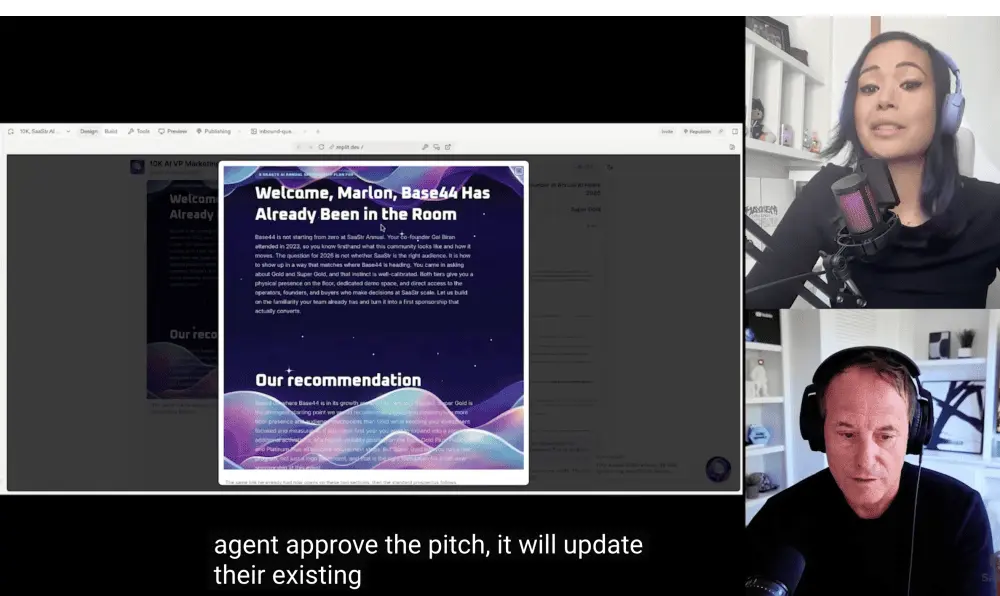
Within 30 to 60 seconds, the agent synthesizes a tailored pitch detailing why the target company should sponsor SaaStr AI, which of their direct competitors attended previous events, and recommended package tiers. The agent strictly utilizes public or anonymized data (e.g., referencing Replit’s public status as a top-tier sponsor). Amelia reviews, refines, and approves the pitch, which is then dispatched directly from her personal inbox rather than a generic marketing alias.
Step 7: Dynamic In-Place URL Updating
Perhaps the most innovative tactical element to replicate: the prospect’s original download link dynamically updates. Once the pitch is approved, returning to the exact same URL now greets the user with a personalized header: "Marlin, here’s why Base44 should be at SaaStr," complete with customized competitor matrices and package pricing. It evolves into a living document throughout the sales cycle.
Step 8: Custom-Built Meeting Booking Infrastructure
Dissatisfied with standard calendar tools like Calendly or Read AI that lacked unified system integration, SaaStr had their AI agent build a bespoke booking system in just 20 minutes. The resulting calendar interface dynamically displays the prospect’s company name, links directly to their personalized prospectus, tracks whether they opened the link without booking, and automatically drafts follow-up cadences if a prospect bounces.
Step 9: Context-Aware Account Routing
Leads are intelligently routed based on account ownership history. For instance, Base44 was routed to Amelia rather than David because Amelia managed similar accounts like Replit and Lovable. The agent weighs portfolio familiarity heavily to ensure leads land with the rep best equipped to handle that specific vertical.
Supporting Context & Metrics
The quantitative impact of this AI-driven overhaul is undeniable. Key operational metrics include:
- Conversations Handled: 17,000 inbound chats over a 12-month period.
- Meetings Booked: ~600 targeted meetings secured for SaaStr AI Annual.
- Pipeline Growth: 2027 inbound tracking at nearly double the prior 12-month pace.
- Overall Business Impact: A direct 60% increase in new business revenue.
- Team Efficiency: Maintained entirely by a lean team of three operators.
Core Tech Stack
SaaStr’s sophisticated automation ecosystem runs on a lean, modern stack:
- Qualified: Powers the primary real-time website conversational agent (Amelia AI).
- Replit: Used for building custom tokenized web applications and dynamic prospect pages.
- Microsoft Clarity: Powers behavioral heat-mapping and session analytics.
- Custom AI Models (including Fable 5.1): Provide strategic architectural advice and system optimization insights.
Pitfalls to Avoid: Lessons Learned
Building an advanced AI sales engine is not without its challenges. SaaStr’s leadership encountered several hurdles that organizations looking to copy this model should proactively avoid:
- Trying to Build Everything at Once: Adoption must be stair-stepped. SaaStr ran their foundational on-site chat agent successfully for nearly a full year before attempting to introduce self-serve generative agents.
- Backend Bloat: At one point, the internal AI coordinator (10K) experienced a drop in performance due to API overload and excessive data ingestion. Modularizing the architecture and leveraging advanced models restored peak performance.
- Internal Team Discrepancies: While Amelia worked seamlessly via direct backend agent interfaces, co-founder David initially lacked equivalent access, leading to reliance on legacy CRM tools. Ensuring uniform agent tooling across the entire sales team is vital.
- Assuming a Monolithic Buyer Journey: Maintaining both conversational and self-serve entry points in parallel is crucial until technology successfully unifies both experiences into a single, seamless hybrid path.
Recommended Build Order for Implementation
For organizations eager to replicate SaaStr’s success, leadership recommends the following phased build order:
- Deploy the Inbound Chat Agent First: Place it strictly on your highest-intent, high-value landing page. Let it run, qualify, and book meetings for at least 6 to 12 months to stabilize the primary flow.
- Upgrade the Self-Serve Path: Replace static PDFs with tokenized, hosted dynamic web pages.
- Integrate Behavioral Analytics: Implement heat mapping (such as Microsoft Clarity) to track actual prospect engagement.
- Automate First-Party Data Enrichment: Build routines that check internal historical signals and competitor activity before leaning on third-party databases.
- Develop Bespoke Booking and Routing Logic: Create custom booking interfaces and context-aware lead distribution systems to close the final tracking gaps.
Future Outlook
As B2B buyers become increasingly digital-first and AI-native, the traditional, human-bottlenecked sales funnel is rapidly losing its competitive edge. SaaStr’s experiment demonstrates that the future of enterprise sales does not lie in throwing more entry-level SDRs at a slow lead-routing process. Instead, it lies in deploying hyper-personalized, context-aware AI agents that respect the buyer’s time, deliver immediate value, and empower a lean team of human experts to focus exclusively on closing transformative deals. As agentic AI capabilities continue to evolve, the gap between companies utilizing automated sales infrastructure and those clinging to legacy forms will only continue to widen.