Published: November 27, 2026 (23:02 UTC)
Author: Coeziune Om–IA (Human-AI Cohesion)
Technical Deposit & Representation: Stancu Bogdan
Executive Overview
The landscape of modern cybersecurity is defined by an ongoing arms race between automated malicious actors and decentralized defense systems. At the forefront of this evolving domain is SAMBO Hydra, an experimental security and quarantine framework designed to simulate, analyze, and catalog threat vectors within a tightly controlled operational environment.
This comprehensive research report, captured at 23:02 UTC on November 27, 2026, provides a granular look into Hydra’s diagnostic metrics, architectural philosophy, privacy-first telemetry masking, and ongoing efforts to establish a secure Tor-based gateway.
Unlike traditional security operations centers (SOCs) that prioritize active countermeasures or offensive retaliation, SAMBO Hydra operates on a principle of radical passive observation and strict containment. By treating software services as biological organs and bounded workers as cellular agents, the system approaches threat mitigation through an organic, systemic lens.
However, the framework’s developers maintain a transparent, highly cautious stance: the platform is not an impenetrable fortress, nor does it deploy autonomous offensive capabilities. As the project prepares for broader network integration through its upcoming Tor hidden service architecture, it continues to challenge conventional security paradigms within the darknet and perimeter defense rings.
Detailed Chronology and Gateway Telemetry
The heartbeat of any quarantine research framework lies in its audit logs, state measurements, and historical finding records. As of the November 27 snapshot, the quantitative metrics paint a picture of a system deeply entrenched in incremental canonicalization and baseline data structuring.
Measured System Status
The operational snapshot recorded the following baseline metrics:
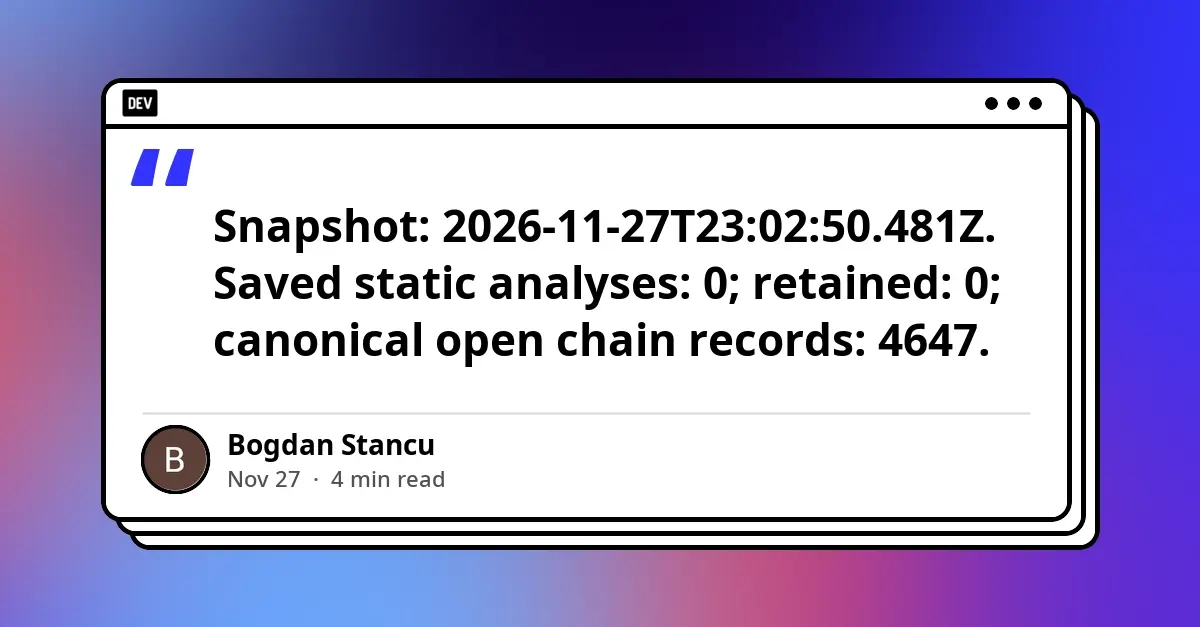
- Timestamp: 2026-11-27T23:02:50.481Z
- Saved Static Analyses & Retained Analyses: 0
- Canonical Open Chain Records: 4,647
- Historical Open Finding Records: 339,412 (inclusive of duplicates; this metric reflects total accumulated historical entries rather than distinct failed functions)
- Integral Weighted Record Count ($J$): 1,694,257 (a weighted measure of record density, explicitly distinct from security effectiveness or intelligence evaluation)
Because canonicalization occurs incrementally, the current subtotal does not represent the entirety of the system’s historical backlog, but rather the active processing window for ongoing quarantine evaluations.
The Tor Gateway Challenge: State and Rejections
A critical pillar of the SAMBO Hydra architecture is its reliance on a public API deployed as a Tor hidden service (a .onion address). Establishing this gateway requires an external, independent machine to run the published package and cryptographically confirm the .onion endpoint.
As of this reporting period, independent validation has not yet been achieved. Consequently, the operational counter remains at zero, and the challenge is formally classified as pending rather than live. This dependency is recognized by the architects not as a structural defect, but as an inherent limitation of decentralized verification.
- Gateway State:
pachet_emis(Package Issued) - Package Issuance Timestamp: 2026-11-27T14:53 UTC
- Challenge Expiration: 2026-11-28T14:53 UTC
- Attestations Accepted: 0
- Claims Rejected: 2
- Active Window: 0 out of 30 days
Recent Rejected Claims Log
The system automatically logs and rejects handshakes that fail cryptographic or structural validation. In alignment with Hydra’s strict privacy mandates, incoming IP addresses are masked while diagnostic error codes are preserved for administrative review:
| Timestamp (UTC) | Origin (Masked) | Refusal Reason (System Diagnostics) |
|---|---|---|
| 2026-11-27T20:07 | 74.220.*.* |
oidc — Missing or malformed OIDC token (token OIDC lipsă sau malformat) |
| 2026-11-27T19:58 | 74.220.*.* |
oidc — Unreadable OIDC token (token OIDC nu se poate citi) |
| 2026-11-27T14:53 | 74.220.*.* |
adresa_onion — Invalid length: received 7 characters, expected 56 for v3 onion addresses |
| 2026-11-26T19:00 | *** |
provocare — Nonce missing or mismatched; token_nod — Unknown node token |
A rejected claim indicates that an incoming package failed to return the exact nonce and node token issued during the initial handshake. Every refusal is logged with its precise failure rationale, ensuring full auditability without compromising operational security.
Supporting Context & Metrics: The Organic Analogy and Privacy Architecture
To understand how SAMBO Hydra processes threats, one must examine its foundational metaphors and the strict cryptographic safeguards governing its data retention policies.
The Organic Analogy, Technically Explained
The nomenclature used within the Hydra ecosystem borrows heavily from biological systems, though the development team is quick to clarify that these terms are functional analogies rather than claims of biological properties or true autonomous artificial general intelligence:
- Organ: A functional software service.
- Agent: A bounded worker process.
- STEM: A replacement worker instantiated securely from a trusted template.
- Antibody: A candidate threat-detection rule requiring rigorous human or systemic validation.
- Lesson: A documented observation derived from security telemetry.
Implemented vs. Planned Architecture
In its current implemented prototype phase, the system operates within a tightly constrained environment: it executes 100 static text checks (derived from 10 distinct representations across 10 analytical categories) alongside 50 replacement slots. Crucially, all of this occurs within a single monolithic process, rather than across 100 independent microservices or air-gapped isolation boundaries. The system never executes submitted code automatically, nor does it ever release payloads or samples back into the wild.
Looking toward the roadmap, the planned (but not yet deployed) architecture envisions an external "organ" featuring 150 analysis perspectives, 300 replacement workers, an isolated ephemeral decoy laboratory, live laboratory validation, and independent final quarantine verification. Within this framework, symbol frames function strictly as data encodings paired with checksums rather than advanced cryptographic encryption or authentication.
Attacker Origins: Privacy, Masking, and Non-Retaliation
One of the most distinguishing features of the SAMBO Hydra project is its ethical and technical stance on attacker data. When hostile entities probe or attack the Hydra gateway, the project adheres to a strict non-retaliation policy: the system never answers attacks, never touches an attacker’s machine, and never initiates scans against source infrastructure.
Furthermore, user privacy and data minimization are enforced at the ingestion layer:
- IP Masking: For IPv4 addresses, the first two octets remain visible while the latter two are scrubbed (e.g.,
203.0.*.*). For IPv6 addresses, the first two groups are preserved while the remainder is masked. - Cryptographic Fingerprinting: Complete IP addresses are never written to permanent storage. Instead, the system generates an HMAC-SHA-256 fingerprint salted on the server side. This allows the framework to recognize repeat offenders and increment threat counters without retaining personally identifiable or network-traceable routing data.
- Voluntary Node Assimilation: An attacker origin does not automatically become a tracked network node. Transitioning from an observation to an active node requires a one-time invitation code and an explicit, manual consent action. Without this consent, records remain dormant and are categorized as "not assimilated."
As of the current reporting window, recorded attacker origins stand at 0, voluntary nodes at 0, and pending consents at 0, underscoring the platform’s early-stage, highly controlled posture.
Official Statements and Framework Rules
SAMBO Hydra explicitly positions itself as a stress-test for contemporary security methodologies, yet its maintainers enforce strict operational boundaries to prevent collateral damage or unauthorized system interference.
Rules of Engagement
- Non-Live Status: The core challenge infrastructure is currently offline. No production website, volunteer node, or third-party system serves as an authorized target.
- Controlled Scope: Formal penetration testing and vulnerability analysis will commence only after the public announcement of isolated targets, clearly defined written scopes, strict safety limits, and transparent disclosure protocols.
- Prohibited Actions: Credential theft, unauthorized third-party attacks, and denial-of-service (DoS) operations are strictly unauthorized under all circumstances.
- No Impenetrability Claims: The developers make no grandiose claims of absolute security or system impenetrability. Hydra is an analytical instrument, not an unhackable vault.
Participation: Becoming a Hydra Node
Participation in the broader Hydra network operates strictly on an opt-in basis. While pricing and tier structures are still in the planning phase rather than active commercial offers, the anticipated protection policy outlines a tiered model:
- Personal Nodes: Free of charge.
- Business Nodes: Priced at 50% of a documented, comparable commercial antivirus service reference.
- Server Nodes: Priced at 25% of that same benchmark reference.
The maintainers note that the cheapest eligible industry reference has not yet been formally verified, and these ratios represent future structural proposals rather than immediate commercial discounts or active software bundles.
Future Outlook
As the SAMBO Hydra project moves past its initial prototyping phase, its trajectory will depend heavily on the successful deployment and third-party attestation of its Tor hidden service gateway. By bridging automated static code analysis with strict cryptographic privacy masking, Hydra offers a compelling glimpse into how decentralized threat intelligence can be gathered without compromising ethical boundaries or exposing network telemetry.
For researchers, developers, and security professionals interested in examining the project’s methodologies or participating in future node onboarding, official resources remain accessible via the project portals:
- Tor Gateway & Attestation Guide: https://hidra-smart-core.com/tor
- Node Onboarding Portal: https://hidra-smart-core.com/devino-nod
- Methodology Documentation: https://hidra-smart-core.com/metodologie
Report compiled and deposited by Stancu Bogdan on behalf of the Coeziune Om–IA collective, pending full formalization of legal entity status.