Executive Overview
For modern e-commerce entrepreneurs and digital marketers, the digital advertising landscape has increasingly become a theater of diminishing returns. Countless brands find themselves trapped in a frustrating cycle: generating high volumes of superficial clicks, accumulating empty metrics, and burning through advertising budgets on misaligned audiences at precisely the wrong moments. The traditional playbooks of hyper-targeting and chasing high Return on Ad Spend (ROAS)—once reliable shortcuts to profitability—now routinely leave brands stuck, plateaued, and over-engineered.
Enter Sam Piliero, an industry veteran and growth strategist who has witnessed firsthand the operational hurdles that choke scaling brands. Co-creating a foundational masterclass alongside Michael Stelzner, Piliero dismantles conventional media-buying wisdom. Instead of focusing on vanity metrics, Piliero presents the M4 Method: a comprehensive, four-stage architectural system designed to help e-commerce brands build ad accounts capable of generating consistent profits and predictable scaling.
Through meticulous examination of account structure, creative asset iteration, granular data deep dives, and deliberate scaling mechanics, this system has transformed modest storefronts into multi-million-dollar powerhouses. This investigative report breaks down the mechanics of the M4 Method, offering an authoritative, step-by-step roadmap for media buyers ready to transition from guesswork to mathematical predictability.
Detailed Chronology: Deconstructing the Pitfalls and the Four-Stage M4 Framework
To understand how to successfully scale an e-commerce business using Facebook ads, one must first recognize the structural traps that routinely derail campaigns. Piliero identifies two primary inhibitors that keep most advertisers trapped in mediocrity: an obsession with surface-level efficiency metrics and a fundamental misunderstanding of control.
The Two Major Roadblocks to Scale
-
The Efficiency Metric Trap: Too many media buyers obsess over ROAS and Cost Per Acquisition (CPA) as holy grails. While these metrics provide useful guardrails, they do not accurately measure real-world profitability. The ultimate objective of any enterprise is contribution margin—the actual cash retained in the business.
A healthy e-commerce brand typically targets a 10% to 20% net profit margin on revenue. For instance, a brand generating $1,000 in revenue while retaining $100 to $200 in profit is fundamentally healthy. Conversely, chasing an unsustainable 10x ROAS often forces an account to throttle its spend so severely that it limits total market share. A modest 2.2 ROAS, by contrast, can allow a business to aggressively acquire customers, build long-term lifetime value (LTV), and leverage compounding word-of-mouth growth to construct a much larger enterprise.
-
The Control Illusion: Advertisers frequently fall into one of two damaging extremes. They either over-engineer their accounts with dozens of competing campaigns pulling in opposite directions, or they throw their hands up, hand total control to the Meta algorithm, and pray for the best. Sustainable scaling requires finding the precise sweet spot between human strategic oversight and algorithmic optimization.
When brands commit to this balanced framework, the upside can be staggering. Piliero highlights that among his agency’s current roster, five distinct client businesses arrived roughly a year apart, spending under $30,000 per month on ads and pulling in less than $100,000 in monthly revenue. Within a short window, all five scaled into the $50 million-plus annual revenue bracket. While these figures represent exceptional outcomes, they illustrate the transformative power of pairing creative investment with a rigid adherence to customer lifetime value over short-term efficiency.

The M4 Method: Step-by-Step Architecture
To achieve these results, Piliero developed the M4 Method, a proprietary framework built around four sequential stages: Account Structure, Creative, Deep Dives, and Scale. Each stage builds upon the last, and skipping steps or altering the order fundamentally compromises the system’s structural integrity.
Stage 1: Account Structure (The Foundation)
Just as a luxury home built on a weak foundation will ultimately collapse, a disorganized ad account will squander even the most compelling product offerings and creative assets. Structure is what transforms raw creative inputs into sustainable, scalable output.
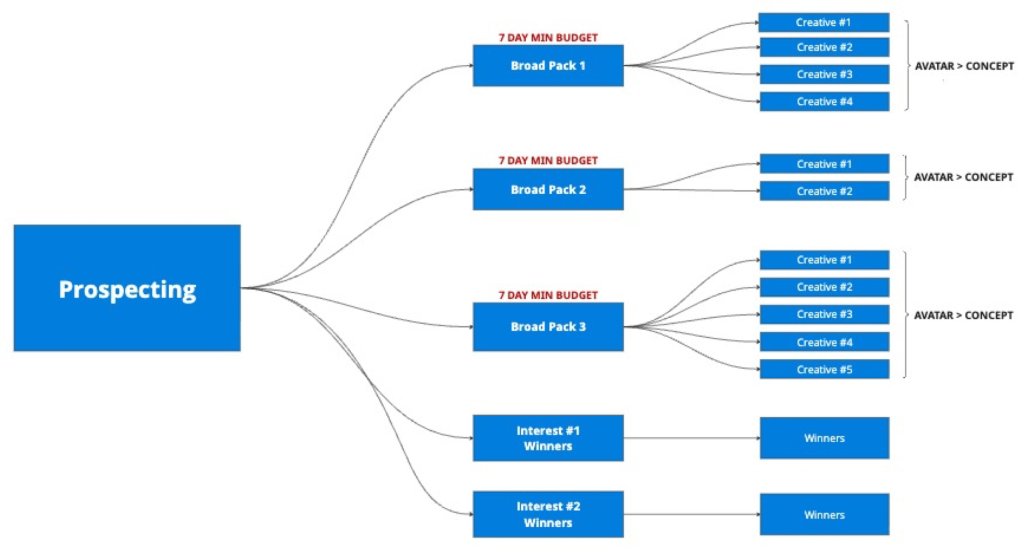
- Prospecting Campaign (CBO): The core of the M4 framework is a single prospecting campaign driven by Campaign Budget Optimization (CBO). Inside this campaign, advertisers house multiple ad sets known as "packs," where each new batch of creative gets its own dedicated container. The CBO setting allows the algorithm to fluidly distribute capital across packs, directing spend toward whichever asset is proving most effective at any given moment.
- Retention Campaign: Running parallel to the prospecting CBO is a dedicated retention campaign targeting existing customers. This separation ensures clarity: as ad spend scales, leadership can definitively see where capital is going—whether to new customer acquisition, mid-funnel retargeting, or existing buyers.
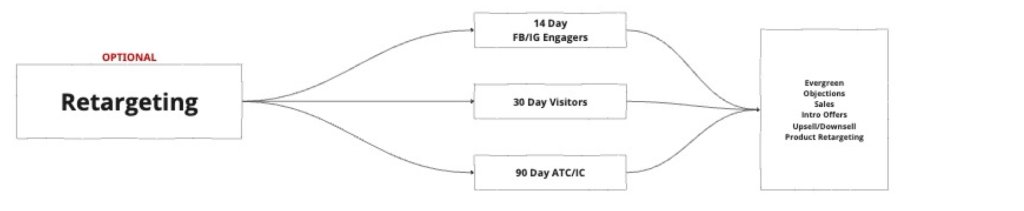
- Optional Campaigns: Two secondary campaigns round out the ecosystem: a retargeting campaign for warm prospects who have engaged but not yet purchased, and a scaling campaign designed to force spend exclusively against the top three to five proven ads in the account.
Stage 2: Creative (The Engine)
With a solid account structure established, creative becomes the single most influential performance variable. Following Meta’s algorithmic updates (such as the Andromeda shift), audience targeting choices no longer do the heavy lifting. Instead, the content of the ad itself signals to the algorithm who should see it.
Generic, broad creative routinely underperforms. Winning ads are hyper-specific, identifying a precise customer avatar, speaking directly to their unique pain point, and positioning the product as the exact solution.
To systematically manufacture winning ads ("hits" defined as assets that exceed ROAS targets while capturing 10%+ of total spend), marketers must embrace three core practices:
- Competitive Inspiration: Use tools like the Facebook Ads Library and MagicBrief to identify competitor ads that have run the longest and accumulated the highest impression counts. Longevity serves as a reliable proxy for profitability.
- Format Matching: Deploy video for top-of-funnel prospecting, while utilizing a blend of high-performing images and video for mid- and bottom-funnel touchpoints. Semi-professional User Generated Content (UGC)—sourced from micro-influencers with 1,000 to 20,000 followers—frequently outperforms polished studio commercials because it blends natively into social feeds.
- Iterative Variation: Rather than reinventing the wheel with every new test, build minor iterations of existing winners. Change the hook while keeping the body, swap out the opening visual, or utilize a different creator to deliver the same proven script.
Stage 3: Deep Dive Analysis (Unlocking Hidden Margins)
Most media buyers maintain flat daily budgets throughout the week, missing out on massive behavioral patterns. Piliero draws on his experience scaling BarkBox, where he noticed that ad performance routinely spiked every weekend. It took months to realize this wasn’t random; consumer behavior naturally shifted when people spent time at home with their pets.
Every e-commerce vertical exhibits unique conversion rhythms. Pet brands surge on weekends; gift items often peak early in the week. By pulling 90 to 180 days of baseline data (excluding seasonal anomalies like Black Friday), marketers can audit performance by day of week, placement, age, gender, and geography.
When a 20% to 30% variance in efficiency appears, the correct response is not to pause the underperforming days (which can break the compounding funnel), but rather to lean aggressively into high-performing segments by increasing budgets on peak days while trimming spend on slower ones.

Stage 4: Scale (The Compounding Engine)
Scaling should never be treated as a brute-force mechanism to fix a broken account; it is designed exclusively to amplify existing momentum. The M4 Method outlines three distinct scaling approaches:
- Vertical Scaling: Incrementally increasing budgets on existing campaigns by 10% to 30% every two to three days, allowing the algorithm to adjust without triggering a disruptive learning phase reset.
- Horizontal Scaling: Deploying separate, short-term campaigns (lasting 3 to 10 days) specifically for promotions, flash sales, or limited-time product drops.
- The Twin Engine Approach: Combining vertical and horizontal mechanics by identifying a winning ad in the prospecting CBO, generating iterative variations of that ad, feeding those variations back into the primary CBO, and simultaneously raising the overall campaign budget. This compounds growth without fragmenting data.
Supporting Context & Metrics: The Philosophy of the "King Goal"
To maintain clarity amidst a sea of moving variables, Piliero advocates for a foundational mental model borrowed from his corporate tenure: The King Goal.
Every e-commerce enterprise must establish one definitive North Star metric that supersedes all others. At BarkBox, the mantra was simple: "CAC is King." If customer acquisition costs remained within target parameters, secondary metrics—such as shifting cost-per-click rates or fluctuating CPMs—were treated as mere noise.
Adhering strictly to the King Goal prevents marketers from making panicked adjustments based on proxy metrics. When the primary profit target is met, the correct strategic decision is always to ignore short-term fluctuations and let the growth engine run.
Future Outlook: Navigating the Intersection of Creative Scale and Supply Chains
As e-commerce advertising continues to evolve into an ecosystem dominated by automated algorithms and machine learning, the competitive advantage will no longer belong to those who master technical account button-pushing. Instead, success will belong to brands that treat creative iteration as an industrial supply chain.
However, growth strategists must exercise caution. As Piliero notes, aggressive scaling requires careful operational alignment. Brands facing supply chain constraints or inventory bottlenecks must intentionally suppress scaling efforts. For these companies, the objective shifts away from raw customer acquisition toward maximizing efficiency per order, ensuring that marketing spend never outpaces fulfillment capacity.
Looking ahead, brands that successfully integrate the M4 Method—pairing disciplined account architecture with rapid creative iteration, deep behavioral data analysis, and a laser focus on customer lifetime value—will be uniquely positioned to build resilient, eight- and nine-figure enterprises capable of withstanding any platform update or macroeconomic shift.