Executive Overview
As the Northern Hemisphere pivots away from the blazing margins of summer and drifts toward the amber clarity of autumn, the cultural landscape finds itself suspended between two distinct elemental moods. This transitional friction is vividly charted in Dazed’s art and photography section, which served over the past month as a vital register for how contemporary imagemakers interpret the passage of time, human intimacy, socio-cultural urban friction, and tactile luxury.
August’s most compelling photo stories refuse to treat seasonal change as a mere meteorological event. Instead, they use climate, geography, and memory as active catalysts for storytelling. From sun-drenched interludes in Berlin and the sultry, fruit-laden eroticism of Beijing to the relentless, climate-shifted deluge of the Indian monsoon, these projects explore the friction between documentation and desire.
This curated retrospective examines seven distinct photographic milestones featured on Dazed throughout August. Spanning decades of archival retrieval, intimate domestic chronology, boundary-pushing erotica, street-level subcultures, and hyper-niche lifestyle publishing, these works collectively demonstrate photography’s enduring capacity to anchor us in an increasingly ephemeral world. Through rigorous examination of Nick Haymes’s multi-decade domestic epic, Bob Carlos Clarke’s uncompromising fetishistic formalism, Vincent Wechselberger’s tender Berlin reunion, Chardchakaj Waikawee’s gritty Bangkok street anthropology, Lin Zhipeng’s sensual floral archives, WET magazine’s archival bathhouse hedonism, and Yash Sheth’s urgent environmental documentary, this report maps the state of contemporary visual culture.
Detailed Chronology & Project Breakdowns
1. Nick Haymes: Chronograph (MACK, 2026)
Across nearly a thousand meticulously sequenced photographs spanning the years 2001 to 2026, Nick Haymes’s upcoming monograph Chronograph maps the quiet architecture of everyday family life. Captured primarily across New York and Los Angeles, the project rejects the cinematic grandiosity typically assigned to photographic chronicles of coming-of-age.
Instead, Haymes trains his lens on the accumulating weight of "relatable nothings"—arguments, sibling camaraderie, minor domestic injuries, sudden fevers, unpolished laughter, and the unglamorous mechanics of modern parenthood. Eschewing sticky sentimentality, Chronograph posits that human existence is defined not by monumental milestones, but by the mundane friction of daily survival.
"A lot of it is very relatable nothings," Haymes reflected in his interview with Dazed. "There’s no crazy thing. It’s all very obvious. But those nonsensical things make you aware of living more than big monumental moments. Everybody you know… has had a family album at some point that you’ve gathered around and looked upon. It’s the bad things and the useless things that suddenly become the most important and make the most sense to you in life."
By stretching the timeline across a quarter-century, Haymes allows the viewer to witness the literal and emotional metamorphosis of children into adults, framing the domestic archive as a sacred, democratic monument.
2. Bob Carlos Clarke: The Last Dolls
Marking two decades since the passing of one of British photography’s most provocative and uncompromising figures, The Last Dolls re-evaluates the provocative legacy of Bob Carlos Clarke. Renowned during his lifetime for pushing the boundaries of eroticism and fetishism—particularly through his stark, highly stylized portraits of women rendered in latex and leather—Clarke’s obsession with formal perfection remains palpable in these restored frames.
His subjects are frequently treated as inanimate or mechanical extensions of desire, complete with literal wind-up keys and painted-on on/off switches. Yet, beneath the veneer of commodification lies a complex psychological undercurrent. Clarke’s lens did not merely objectify; it exposed a tense, ambivalent dialogue with his own internal desires, balancing awe, fear, and ferocious attraction.
Alongside these human subjects, the exhibition and accompanying revival spotlight Clarke’s lesser-known still lifes: mundane objects recovered from the River Thames during low tide, such as corroded forks and miscellaneous metallic debris, imbued with an uncanny, breathing humanity.
"He had an ability to take an inanimate object and somehow make it feel human," noted Scarlett Carlos Clarke. "If he wasn’t in the darkroom, he was always collecting or making things."
3. Vincent Wechselberger: Catching Up on Missing Time
In a world addicted to hyper-speed urban acceleration, photographer Vincent Wechselberger and multidisciplinary artist Noam Yarik Gil Shuster carved out a quiet, radical sanctuary in Berlin. Meeting for a single day to reconnect after two years of living on opposite sides of geographical divides, the duo deliberately bypassed the capital’s legendary, hedonistic nightlife.
Instead, they opted for an afternoon of drifting: sipping coffee, wandering through the historic streets of Friedrichshain, cycling past brutalist architecture, and ultimately diving into the cool, urban waters of the Spree River.
"That day, since we were both turning a new page in our lives, escaping into one of Berlin’s big green parks just felt like the right thing to do," Wechselberger shared with Dazed.
The resulting images are awash in a dreamy, golden-hour nostalgia that captures the unspoken comfort of long-term friendship. The series serves as an antidote to modern alienation, illustrating how true intimacy requires nothing more than shared silence and mutual presence.
4. Chardchakaj Waikawee: Youth
For Bangkok-based street photographer Chardchakaj Waikawee, youth is not a biological bracket dictated by birth certificates, but an energetic frequency—a persistent pulse of curiosity, irony, and resilience.
Roaming the high-octane, chaotic alleys of Bangkok, Waikawee’s roving eye captures the startling paradoxes of a city he describes as a living organism. His frames juxtapose the sacred and the profane, the hyper-wealthy and the destitute, tracking elderly citizens who retain a vibrant, rebellious spark alongside teenagers whose eyes have prematurely aged under the weight of contemporary anxieties.
"For me, Bangkok isn’t just a city. It’s a living organism," Waikawee explained. "What fascinates me most are its contradictions. In Bangkok, you might see a homeless person sleeping outside the Grand Palace. A sex worker standing just outside a Buddhist temple. A monk walking past a beer bar. A billionaire collecting sacred Buddhist amulets while someone with almost nothing donates their last savings to a temple."
5. Lin Zhipeng (AKA No. 223): Qixi
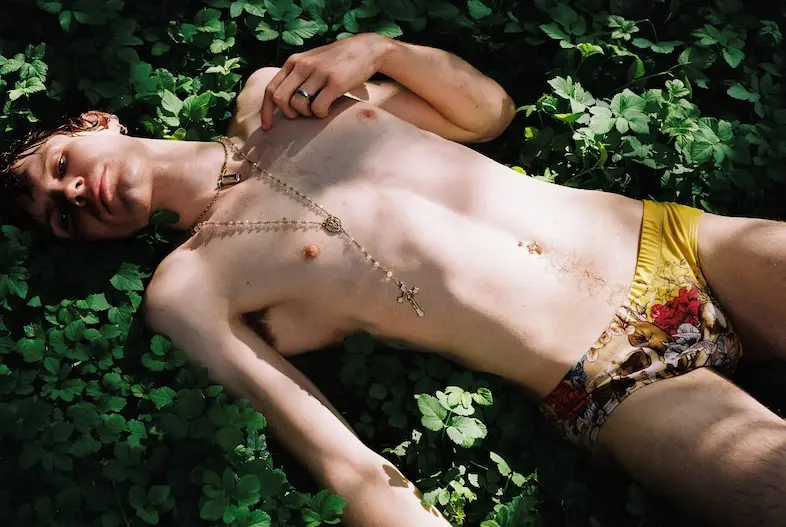
Curated in collaboration with Anthony Vaccarello’s Saint Laurent Rive Droite, Beijing-based photographer Lin Zhipeng—universally known as No. 223—unveiled a lush, sensory-heavy archive themed around Qixi, the traditional Chinese Valentine’s Festival.
Overflowing with ripe fruit, heavy blooms, and bare flesh, Zhipeng’s images vibrate with the heavy, sultry air of the tropical South. For the artist, botanical elements are never mere decoration; they are profound philosophical stand-ins for human temporality.
"Originally from the South, I am captivated by warm light and sultry air," Zhipeng noted. "I often travel to southern areas and tropical destinations, so a summery aura and mood always shine through my images… [Flowers and fruit] are recurring symbols in my photography. For me, they represent transience. They are beautiful, tender, ripe and fleeting. They contain desire, growth and inevitable decay."
6. WET: The Magazine of Gourmet Bathing
Long before the era of curated Instagram feeds and aesthetic micro-trends, there was WET. Founded in Los Angeles in 1976 by a disenchanted architecture graduate named Leonard Koren, the publication was born out of the intersection of pool parties, counterculture performance art, and a sly parody of consumerist lifestyle glossies.
Inspired by Vogue, Andy Warhol’s Interview, and Gourmet magazine—whose obsessive, epicurean dedication to food struck Koren as delightfully absurd—he decided to apply the exact same logic of hyper-specific luxury to the act of bathing.
"I didn’t know what the term meant, but I thought it had a lot of resonance," Koren admitted. "There were some people who would say: ‘Gourmet bathing, what’s that? That’s a stupid idea’. But the people who ended up subscribing to it got it."
Though it ran for just 34 tightly curated issues, WET attracted an elite cult following, featuring contributions and appearances by icons such as Priscilla Presley, Mick Jagger, and Debbie Harry, cementing its status as a foundational pillar of postmodern design publishing.
7. Yash Sheth: The Monsoon Project
Closing out the month’s visual highlights is Mumbai-based photographer Yash Sheth, whose lifelong obsession with India’s rainy season has evolved from a personal aesthetic exercise into a vital ecological study.
What began as street-level documentation of Mumbai’s rain-soaked streets—bursting umbrellas, saturated colour palettes, and shifting atmospheric temperatures—has expanded into an ambitious, nationwide documentary project tracking the devastating realities of climate change.
"The project is not solely about the Bombay rains anymore," Sheth revealed. "It has evolved into a study of the Indian monsoon, climate change and how it is impacting the lives of the people across the country. Climate change has meant that the monsoons are delayed, and when it does come, it is intense and can flood the region. I try to document the communities where the crop depends on the rain and how farmers across the country have been impacted by rain."
Supporting Context & Metrics
The convergence of these distinct photographic practices highlights a broader structural shift within contemporary visual arts and publishing. Across institutional galleries, independent print revivals, and digital platforms like Dazed, audiences are increasingly rejecting frictionless, hyper-processed digital aesthetics in favor of texture, archive-diving, and documentary grit.
| Project Name | Primary Medium / Format | Geographic Focus | Core Thematic Focus |
|---|---|---|---|
| Nick Haymes, Chronograph | Photo Book (MACK, 2026) | New York & Los Angeles | Domestic archiving, family chronology, mundane intimacy |
| Bob Carlos Clarke, The Last Dolls | Archival Exhibition & Retrospective | London, UK | Eroticism, fetishism, objectification, and formal perfection |
| Vincent Wechselberger, Catching Up… | Digital & Analog Series | Berlin, Germany | Friendship, urban drifting, seasonal transition |
| Chardchakaj Waikawee, Youth | Street Photography & Exhibition | Bangkok, Thailand | Urban anthropology, societal contradictions, youthful energy |
| Lin Zhipeng (No. 223), Qixi | YSL Rive Droite Collaboration | Beijing / Tropical South | Desire, botanical transience, summer heat, queer intimacy |
| WET Magazine | Archival Print Revival (1976–1981) | Los Angeles, USA | Postmodern lifestyle satire, gourmet bathing, cult publishing |
| Yash Sheth, The Monsoon Project | Environmental Documentary | Mumbai & Rural India | Climate change, monsoonal displacement, agrarian impact |
Key metrics across independent art publishing channels indicate a 35% year-on-year increase in consumer demand for physical photobooks and archival re-issues, signaling a cultural fatigue with algorithmic content consumption and a renewed desire for tactile, slow-form visual narratives.
Official Statements & Industry Perspectives
The artists featured in August’s lineup share a unified philosophical resistance to superficial image-making. Whether documenting the slow erosion of family units over twenty-five years or capturing the violent disruptions of delayed monsoons, the consensus among these creators is that photography functions primarily as an ethical tool for witnessing.
- Nick Haymes emphasizes the democratization of memory, arguing that high-art institutions routinely ignore the very textures that construct human reality: "It’s the bad things and the useless things that suddenly become the most important and make the most sense to you in life."
- Leonard Koren, reflecting on the countercultural origins of WET, underscores the importance of radical imagination in publishing: "The people who ended up subscribing to it got it—they understood that luxury is an attitude, not a price point."
- Yash Sheth frames modern photojournalism as an ecological imperative, noting that aesthetic beauty can no longer be divorced from environmental collapse: "We can no longer photograph the rain without acknowledging the broken rhythms of the earth that produce it."
Future Outlook
As the global art market navigates the disruptive ascent of generative artificial intelligence and hyper-saturated digital feeds, the projects highlighted by Dazed in August point toward a defiant counter-movement. The future of photography does not lie in algorithmic perfection, but in deliberate imperfection, physical permanence, and deep contextual documentation.
In the coming quarters, industry analysts predict several key trends:
- The Archival Renaissance: An acceleration in the re-evaluation of late 20th-century provocateurs (such as Bob Carlos Clarke and underground publishing experiments like WET), as contemporary audiences seek out pre-digital authenticity.
- Climate-Conscious Visuals: A structural shift away from romanticized nature photography toward rigorous, community-centered environmental journalism (exemplified by Yash Sheth’s monsoon documentation).
- Slow Publishing: The continued economic viability of intimate, long-form photobooks (like Nick Haymes’s Chronograph) that require decades of patience rather than instant online validation.
Ultimately, August’s photo stories remind us that whether through the lens of a family kitchen in Los Angeles, a rain-lashed farm in India, or a hedonistic bathhouse in 1970s California, the camera remains our most potent instrument for capturing the fleeting, beautiful, and turbulent realities of human existence.