Executive Overview
In a major development bridging the gap between frontend developer experience and enterprise-grade cloud infrastructure, Vercel and Amazon Web Services (AWS) have announced a deep native integration. Developers building web applications and artificial intelligence (AI) systems on Vercel can now provision and manage Amazon Simple Storage Service (Amazon S3) resources directly from the Vercel Marketplace and the generative UI tool, v0.
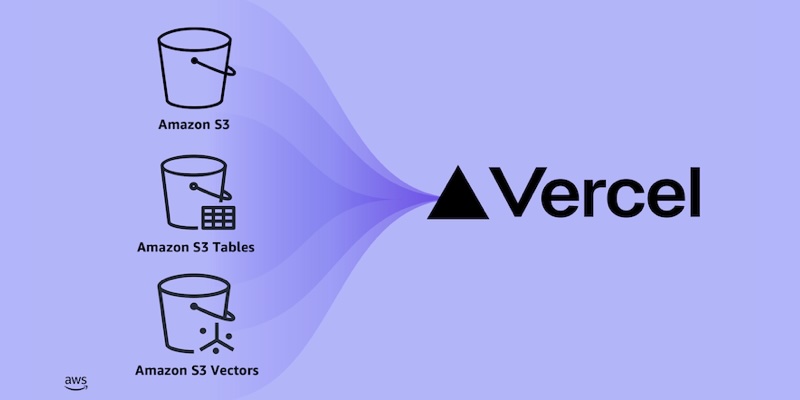
This architectural leap combines the unmatched durability, massive scalability, and granular performance of S3 with the streamlined, zero-friction provisioning workflows that have made Vercel a dominant platform for modern web development. Starting today, Amazon S3—encompassing standard object storage, specialized analytics via Amazon S3 Tables, and high-performance AI vector search via Amazon S3 Vectors—is natively accessible.
By eliminating the traditional overhead of navigating the AWS Management Console, configuring complex security policies, and manually generating static access keys, this integration addresses a persistent friction point in cloud development. Furthermore, it rounds out Vercel’s existing suite of AWS integrations, which already includes Amazon Aurora, Amazon DynamoDB, and Amazon OpenSearch Serverless. Developers can now orchestrate an end-to-end application stack—spanning relational databases, NoSQL datastores, object storage, open data tables, and vector indexes—all managed from a single Vercel dashboard, billed to a single AWS account, and secured through modern cryptographic standards.
Detailed Chronology: Bridging the Vercel and AWS Ecosystems
The journey toward this unified developer experience has evolved incrementally over several years, driven by the explosive growth of full-stack JavaScript frameworks like Next.js and the sudden, sweeping demand for production-grade AI infrastructure.
The Pre-Integration Era: Configuration Friction
Historically, building a modern web application on Vercel while leveraging AWS for persistent storage required a context-switching workflow. Developers would spin up high-performance frontend applications on Vercel, but whenever an application required file uploads, asset management, data lake analytics, or Retrieval-Augmented Generation (RAG) pipelines, the workflow stalled.
Engineers had to:
- Log into the AWS Management Console.
- Manually provision S3 buckets, configure Cross-Origin Resource Sharing (CORS) rules, and adjust public access block settings.
- Generate and secure Long-Term AWS IAM (Identity and Access Management) credentials (Access Key IDs and Secret Access Keys).
- Manually copy these sensitive secrets and paste them into Vercel’s environment variable configuration panels.
This process introduced severe security vulnerabilities—chiefly the risk of leaked static credentials—alongside cognitive overhead and administrative drag.
The Incremental Expansion of AWS on Vercel
Vercel began alleviating this friction by introducing managed database integrations. The onboarding of Amazon Aurora, Amazon DynamoDB, and Amazon OpenSearch Serverless demonstrated that developers wanted the scale of AWS without the bureaucratic provisioning steps. However, object storage—the lifeblood of media-heavy web applications and AI training/inference pipelines—remained a missing link. Developers still had to handle S3 infrastructure out-of-band.
The Native S3 Marketplace Launch
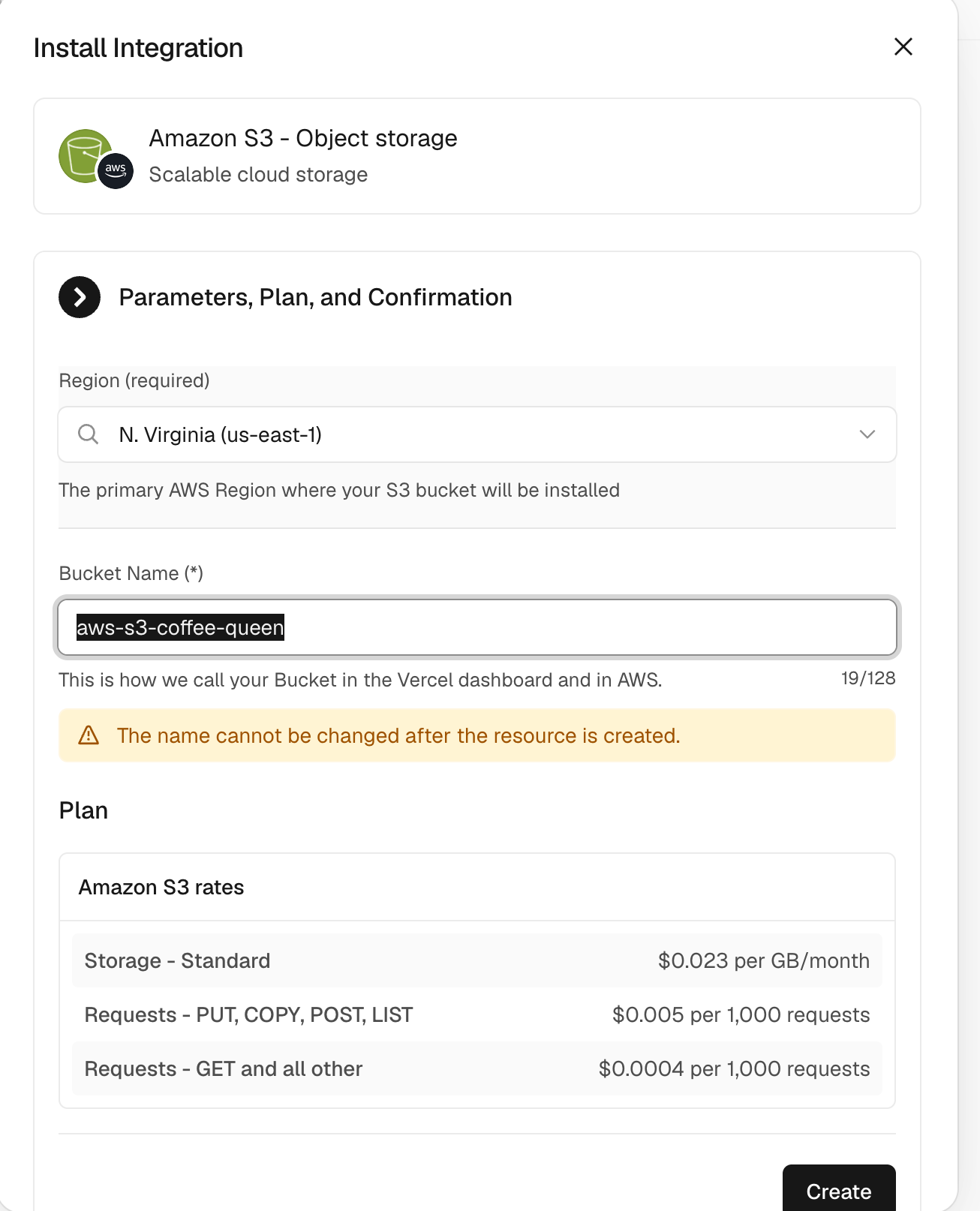
The release changes the paradigm entirely. By embedding Amazon S3 directly into the Vercel Marketplace and v0, the platforms have unified the storage layer with the deployment layer. Developers can now instantiate general-purpose object storage, S3 Tables, and S3 Vectors with a few clicks or a simple natural language prompt, entirely abstracting the underlying infrastructure choreography while maintaining strict enterprise compliance and security standards.
Architecture and Implementation: Three Workloads, One Unified Platform
The integration targets three distinct modern workloads: everyday object storage, high-volume analytics, and AI semantic search. Each utilizes a specialized tier of Amazon S3, accessible via uniform provisioning patterns and secured using OpenID Connect (OIDC) token exchange.

1. Security via OpenID Connect (OIDC)
Crucially, this integration eschews insecure static IAM credentials. When an S3 resource is provisioned and linked to a Vercel project, the integration automatically injects environment variables including AWS_REGION, AWS_ROLE_ARN, AWS_RESOURCE_ARN, and resource-specific bucket identifiers.
At runtime, Vercel’s serverless functions utilize the awsCredentialsProvider function from @vercel/functions/oidc. This module securely exchanges a short-lived OIDC token with the AWS Security Token Service (AWS STS) to generate temporary, highly scoped IAM credentials on the fly. No permanent keys are stored on disk or exposed to risk.
import  S3Client, PutObjectCommand  from "@aws-sdk/client-s3";
import  awsCredentialsProvider  from "@vercel/functions/oidc";

const s3 = new S3Client(
  region: process.env.AWS_REGION,
  credentials: awsCredentialsProvider(
    roleArn: process.env.AWS_ROLE_ARN,
  ),
);

export async function POST(request)
  const formData = await request.formData();
  const file = formData.get("file");

  await s3.send(new PutObjectCommand(
    Bucket: process.env.S3_BUCKET_NAME,
    Key: file.name,
    Body: Buffer.from(await file.arrayBuffer()),
    ContentType: file.type,
  ));

  return Response.json( success: true );
2. Everyday Object Storage
For traditional use cases—such as user-generated media, document management, and static asset distribution—developers can provision a general-purpose Amazon S3 bucket directly from the Vercel Storage tab in seconds. Using the standard AWS SDK for JavaScript, developers can seamlessly execute PutObject, GetObject, and ListObjectsV2 commands within their Next.js API routes or server actions.
3. High-Performance Analytics with S3 Tables
Modern data-driven applications frequently require analytical processing over massive datasets without the cost and complexity of managing dedicated data warehouse clusters. Amazon S3 Tables provide native S3 storage purpose-built for analytics, offering fully managed Apache Iceberg tables featuring automated table maintenance, compaction, and optimization as data volumes scale.
Through the Vercel integration, developers can combine S3 Tables with lightweight query engines like DuckDB running directly inside Vercel Serverless Functions. By attaching the table bucket via its ARN and passing temporary OIDC-derived credentials, developers can execute complex analytical queries at the edge:
import  DuckDBInstance  from "@duckdb/node-api";
import  awsCredentialsProvider  from "@vercel/functions/oidc";

const creds = await awsCredentialsProvider(
  roleArn: process.env.AWS_ROLE_ARN,
)();

const db = await DuckDBInstance.create();
const conn = await db.connect();

await conn.run("INSTALL aws; LOAD aws; INSTALL httpfs; LOAD httpfs; INSTALL iceberg; LOAD iceberg;");

await conn.run(`
  CREATE SECRET s3cred (
    TYPE s3,
    KEY_ID '$creds.accessKeyId',
    SECRET '$creds.secretAccessKey',
    SESSION_TOKEN '$creds.sessionToken',
    REGION '$process.env.AWS_REGION'
  );
`);

await conn.run(`
  ATTACH '$process.env.AWS_RESOURCE_ARN' AS s3tables (
    TYPE iceberg,
    ENDPOINT_TYPE s3_tables
  );
`);

const rows = await (await conn.run(`
  SELECT town_city, AVG(median_price) AS avg_price
  FROM s3tables."$process.env.S3_TABLES_NAMESPACE".town_monthly
  GROUP BY town_city
  ORDER BY avg_price DESC
  LIMIT 10
`)).getRowObjects();
(Note: When deploying DuckDB within Next.js, developers must configure @duckdb/node-api inside serverExternalPackages within next.config.mjs to ensure native bindings are handled correctly.)
4. Vector Search with S3 Vectors
As artificial intelligence applications and RAG architectures become ubiquitous, vector databases have become a critical system component. Amazon S3 Vectors deliver purpose-built, cost-optimized vector storage natively integrated into S3, eliminating the necessity of maintaining a separate, costly specialized vector database infrastructure.
While S3 Vectors do not generate embeddings themselves—leaving developers free to use their preferred AI models—they provide exceptionally fast similarity search capabilities over content stored directly within Amazon S3. Querying the index is achieved via the @aws-sdk/client-s3vectors client library:
import  S3VectorsClient, QueryVectorsCommand  from "@aws-sdk/client-s3vectors";
import  awsCredentialsProvider  from "@vercel/functions/oidc";

const vectors = new S3VectorsClient(
  region: process.env.AWS_REGION,
  credentials: awsCredentialsProvider(
    roleArn: process.env.AWS_ROLE_ARN,
  ),
);

export async function POST(request)
  const  embedding  = await request.json();

  const result = await vectors.send(new QueryVectorsCommand(
    vectorBucketName: process.env.S3_VECTOR_BUCKET_NAME,
    indexName: "documents",
    queryVector:  float32: embedding ,
    topK: 5,
    returnMetadata: true,
  ));

  return Response.json( matches: result.vectors );
Generative Infrastructure: Building with v0 by Vercel
Perhaps the most futuristic aspect of this announcement is the integration with v0 by Vercel, the company’s generative UI and application development tool. Rather than manually configuring storage buckets, developers can now use natural language prompts inside v0 to design, provision, and wire up complete functional applications.
For instance:
- Prompting v0 for "a photo gallery where users upload images using AWS" automatically provisions a general-purpose S3 bucket, configures the necessary environment variables, and generates the frontend and backend code for image uploads.
- Asking for "a support bot that answers questions from my PDFs" instructs v0 to provision an Amazon S3 Vectors resource, wire up semantic search, and generate the corresponding RAG chatbot interface.
- Requesting "an analytics dashboard for my clickstream data" triggers the provisioning of S3 Tables alongside the code required to query the underlying Apache Iceberg datasets.
This capability represents a fundamental shift from manual infrastructure-as-code (IaC) scripting to conversational, intent-driven cloud architecture.
Supporting Context & Metrics: Unifying the Modern Stack
The consolidation of database, analytical, object, and vector storage onto a single AWS account managed via Vercel delivers significant architectural advantages:
- Unified Billing & Governance: All S3 resources live directly within the developer’s designated AWS account. Enterprises retain full ownership, compliance auditing, and cost-allocation visibility via AWS-native tooling, while viewing billing through a consolidated operational lens.
- Reduced Latency and Complexity: By pairing Vercel’s globally distributed edge functions with AWS data infrastructure situated in optimal commercial regions, data transfer latency between the compute layer and the persistence layer is minimized.
- Account Flexibility: Teams can opt to create a brand-new AWS account directly through the Vercel integration workflow—which includes promotional incentives—or securely link an existing corporate AWS account to preserve enterprise agreements and legacy billing structures.
Pricing, Availability, and Getting Started
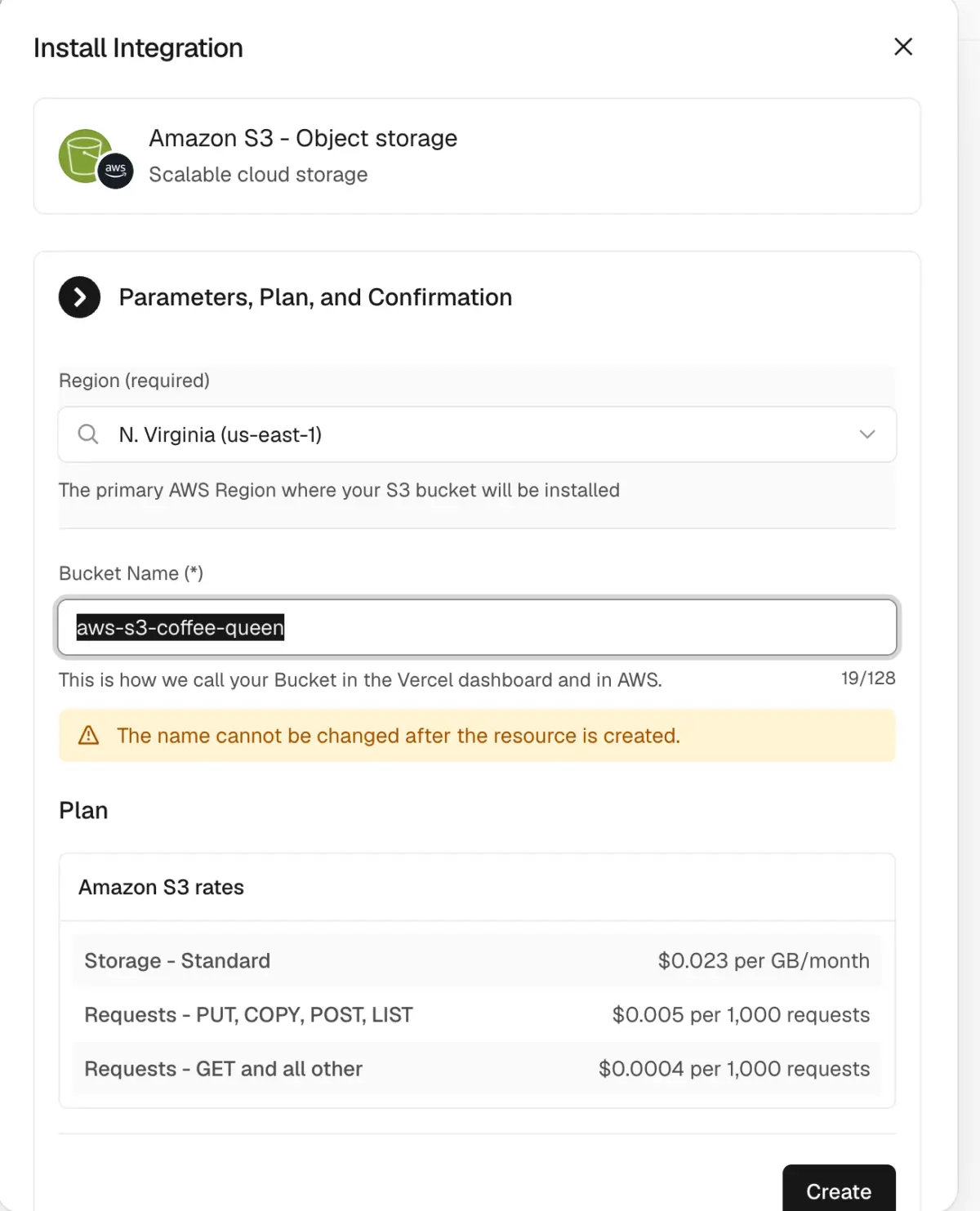
The Amazon S3 integration—including S3 Tables and S3 Vectors—incurs no additional markup or management charges from Vercel. Developers pay strictly for their standard, underlying Amazon S3 consumption pricing according to standard AWS rate cards.
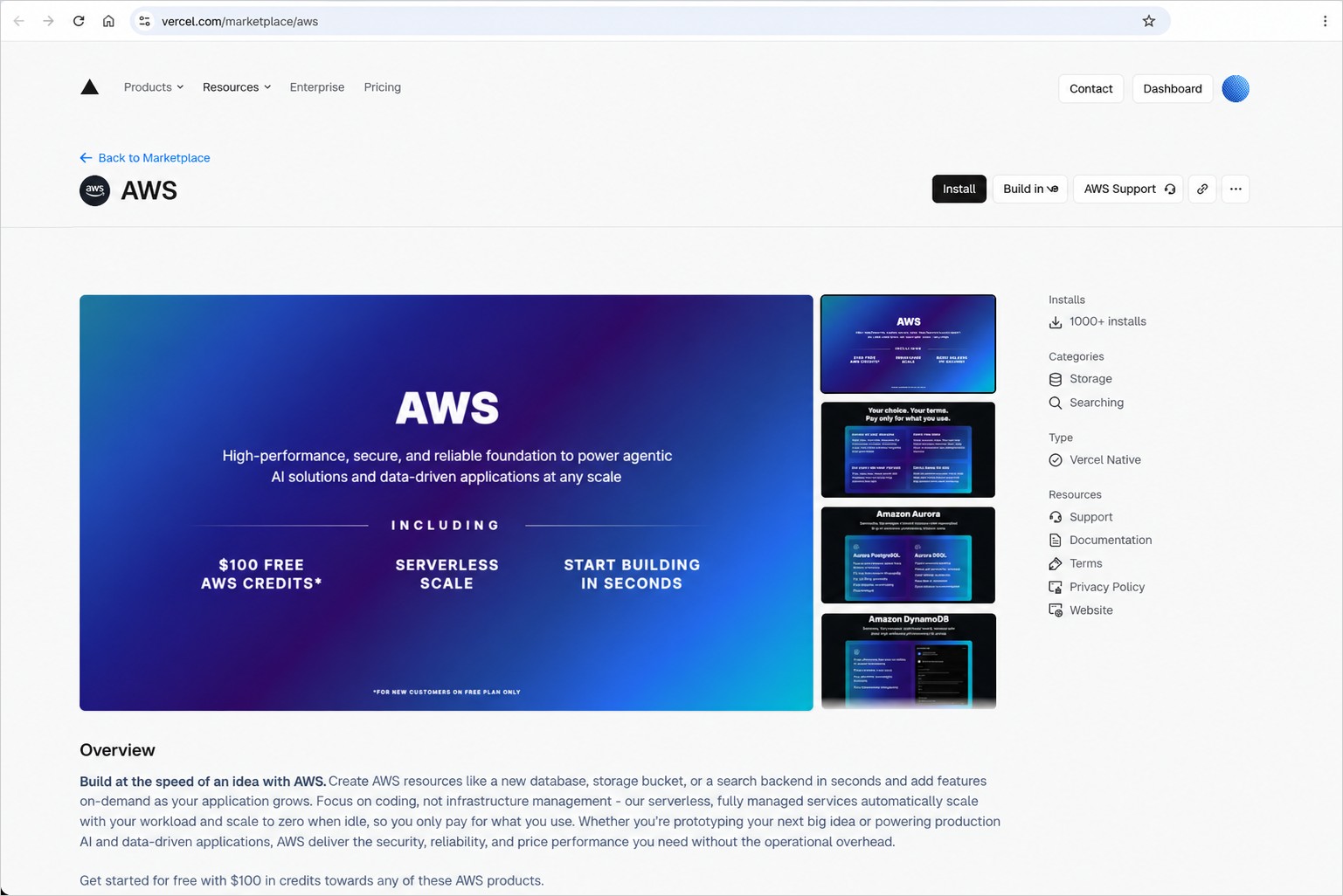
Furthermore, development teams that choose to establish a new AWS account directly through the Vercel integration receive $100 in AWS service credits, valid for the first six months of operation.
The feature is generally available today across all commercial AWS Regions supported by Vercel. Developers can begin provisioning resources immediately by navigating to the Storage tab within the Vercel dashboard, exploring the AWS integration page on the Vercel Marketplace, or leveraging natural language prompts within v0.