By Investigative Desk
Published Special Report
Executive Overview
Live music is a visceral, communal experience—a dynamic exchange of energy between artists and audiences that has defined human culture for generations. From sweeping open-air amphitheaters to pulsing arena floors, the roar of the crowd and the punch of bass frequencies offer a sensory immersion unlike any other. Yet, hidden beneath the euphoria of these sonic landscapes lies a pervasive, entirely preventable public health crisis: noise-induced hearing loss (NIHL).
Despite decades of warnings from audiologists, public health agencies, and medical researchers, concertgoers routinely step into acoustic environments that rival the decibel levels of industrial machinery, often completely unprotected. As the live entertainment industry bounces back with bigger productions, louder speaker arrays, and increasingly dense festival grounds, the physical toll on our auditory systems is escalating.
This investigative report examines the severe risks associated with high-decibel live entertainment, the biological reality of irreversible inner-ear damage, and the complex psychological and social barriers that prevent everyday music lovers from wearing ear protection. By analyzing empirical data from clinical trials, evaluating the limits of human biology, and exploring how cultural paradigms must shift, we look at why safeguarding our hearing is the ultimate prerequisite for a lifetime of musical enjoyment.
Detailed Chronology: Anatomy of a Concert Acoustic Shock
To understand the immediate danger posed by modern concert venues, one only needs to trace the trajectory of a typical evening out. The journey from the quiet murmur of the ticket gates to the heart of the pit is a masterclass in acoustic escalation.
Phase 1: The Approach and the Perimeter
As concertgoers follow the collective surge toward the stadium gates, the acoustic environment is generally benign. Distant sounds filter through the open air, and the opening act can often be heard from afar at a reasonable, conversational volume. For individuals with pre-existing hearing loss, this initial phase offers a false sense of security. Ambient environmental noise masks the impending auditory assault, and casual attendees rarely consider the physics of sound propagation in wide-open spaces.
However, open-air venues present unique acoustic dynamics. Without walls to trap sound, engineers compensate by cranking up line arrays to massive power outputs, ensuring that even those in the lawn seats feel the impact.
Phase 2: The Acoustic Ambush
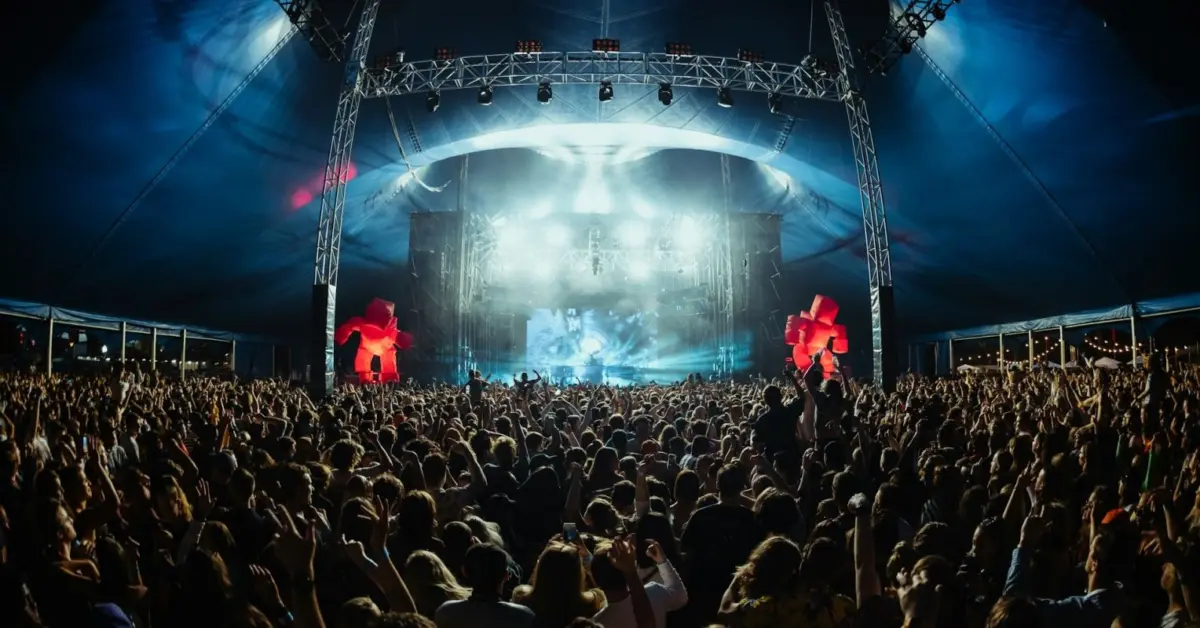
The moment of transition—rounding the concrete corridor or stepping out from the concourse into the main seating bowl—is often jarring. Without warning, attendees are struck by a wall of sound.
“We followed the crowd toward the stadium. It was our first concert at an outdoor venue, and we had no idea how the open air would affect the sound. But we came prepared with ear protection. As someone who lives with hearing loss, I know no concert is worth damaging the hearing I have left… As we circled the perimeter, the opening act was playing in the distance at what seemed to be a reasonable volume. Then we rounded the corner toward our seats. BLAST! We stepped back as if we had been physically struck and ducked behind a wall to put on our headphones.”
This physical reaction—recoiling as if struck by a physical force—highlights a stark reality: modern amplified sound possesses physical mass and kinetic energy capable of triggering a defensive reflex in the human nervous system. Yet, once the initial shock subsides, a startling observation frequently presents itself to those wearing protection: looking around the stadium, an overwhelming majority of the audience stands completely unprotected, exposing their ears to continuous decibel levels that exceed occupational safety limits.
Supporting Context & Metrics: The Hard Science of Sound
To grasp the magnitude of the risk, we must look at the objective metrics governing human hearing and acoustic energy. Sound is measured in decibels (dB), a logarithmic scale where every increase of 10 dB represents a tenfold increase in sound intensity.
Decibel Thresholds and Biological Damage
During a typical live performance, consumer-grade biometric devices, such as smartwatches equipped with real-time decibel monitors, regularly log ambient noise levels hovering between 90 and 100 decibels (dBA). Mainstage festival sets and indoor arena performances frequently peak even higher, pushing past 105 or 110 dBA near the soundboard.
According to authoritative data from the National Institute on Deafness and Other Communication Disorders (NIDCD):
- 85 decibels (dB): The threshold at which prolonged exposure begins to cause damage. This is roughly equivalent to heavy city traffic or a noisy restaurant.
- 90 to 95 decibels (dB): Exposure limits drop dramatically. Damage can occur within hours.
- 100 decibels (dB): Just 14 minutes of unprotected exposure at this level is enough to induce measurable, permanent cellular damage to the inner ear.
The Biological Reality: No Regenerative Cure
The human ear is an architectural marvel of biological engineering, relying on microscopic inner ear hair cells (stereocilia) to convert fluid vibrations into electrical signals that the brain interprets as sound. Unlike skin, bone, or liver tissue, these delicate sensory hair cells do not regenerate in humans.
When subjected to excessive acoustic trauma—such as the sonic blast of a sub-woofer array or sustained high-decibel music—these hair cells are violently bent, sheared, or completely destroyed. Once these cells die off, the hearing loss is permanent. The ringing sensation known as tinnitus that many experience after leaving a loud venue is, in fact, the neurological distress signal of dying hair cells crying out before they expire.
Empirical Evidence: Protection Works
Skeptics often argue that wearing earplugs ruins the fidelity of the music, robbing the listener of the live experience. However, scientific trials have repeatedly dismantled this misconception, proving that modern high-fidelity earplugs reduce volume evenly across frequencies without muddying the sound.
A landmark randomized trial conducted at a major music festival in Amsterdam evaluated festival-goers exposed to an average sound level of 100 dBA. The results were definitive:
- 42% of unprotected ears showed signs of temporary threshold shift (temporary hearing loss) immediately following the festival.
- Only 8% of ears protected by specialized earplugs exhibited similar deficits.
- Furthermore, the incidence of post-concert tinnitus and hyperacusis (sound sensitivity) was drastically lower among the earplug-wearing cohort.
These figures illustrate that the damage is not an abstract theory; it is an immediate, statistically predictable consequence of unprotected exposure.
Official Statements and Industry Perspectives
Public health authorities and audiological associations have long sounded the alarm regarding the normalization of dangerously loud entertainment venues, urging a cultural re-evaluation of how we protect our senses.
Dr. Angela Sterling, a clinical audiologist specializing in acoustic trauma, notes a troubling generational shift:
"We are seeing younger and younger patients presenting with high-frequency hearing loss and chronic, debilitating tinnitus that mirrors the profiles of industrial workers from thirty years ago. The difference is that industrial workers wore OSHA-mandated ear protection. Concertgoers are voluntarily walking into environments that are frequently louder than a factory floor, completely unarmed, purely for recreation."
Public health bodies, including the World Health Organization (WHO), have repeatedly emphasized that over 1 billion young people globally are at risk of hearing loss due to unsafe listening practices in recreational settings, including concerts, nightclubs, and personal listening devices.
Despite these warnings, the live music industry finds itself in a delicate balancing act. High-impact bass and crystal-clear, high-volume mixing are deeply embedded in the artistic vision of modern performers and sound engineers. Yet, a growing cadre of forward-thinking artists—ranging from electronic music producers to legacy rock musicians—have begun distributing free earplugs at merch booths or wearing custom-molded monitors themselves, signaling a slow but crucial shift in industry accountability.
Why We Skip the Earplugs: A Psychological Breakdown
If the math is clear, the biology is unforgiving, and protective devices are widely available and inexpensive, why do millions of concertgoers continue to leave their earplugs at home? The answer lies in a complex interplay of human psychology, social conformity, and environmental design.
1. The Psychology of Denial
Youth and vitality breed a profound sense of invulnerability. When you are in your teens or twenties, the body’s ability to bounce back from minor trauma creates an illusion of permanence. Hearing loss is an insidious, invisible condition that accumulates slowly over decades. Because a single concert does not typically result in total deafness, the brain categorizes the temporary ringing as a harmless byproduct of a fun night out. The true consequence—presbycusis or noise-induced degradation—manifests years or decades later, making it easy to dismiss the risk in the present moment.
2. Social Conformity and the Fear of Stigma
Human beings are inherently social creatures governed by unwritten norms. When an individual steps into a stadium and notices that zero people within their immediate field of vision are wearing ear protection, a powerful psychological barrier erects itself.
- Will I look silly?
- Will people think I’m overly cautious or antisocial?
- Will I look like I don’t belong?
Conformity bias dictates that it is socially safer to blend in with the crowd and suffer potential harm than to stand out and protect oneself. The fear of social awkwardness routinely overrides the instinct for self-preservation.
3. Misconceptions About Acoustic Fidelity
A lingering myth persists that earplugs act like foam blocks, turning the concert experience into a muffled, distant drone. For decades, cheap foam earplugs designed for construction sites did heavily attenuate high frequencies, ruining the acoustic balance of music.
However, acoustic engineering has evolved exponentially. Modern high-fidelity musicians’ earplugs utilize specialized attenuation filters that lower decibel levels uniformly across all frequencies. They do not muffle the music; they simply turn down the volume knob on the universe, allowing the listener to hear every nuance of the performance safely and clearly.
Future Outlook: Shifting the Cultural Paradigm
Transforming hearing protection from an afterthought into an instinctive social norm requires a multi-pronged approach involving venues, artists, public health advocates, and individual concertgoers.
Architectural and Venue-Level Interventions
Concert venues and event promoters hold significant leverage in shaping the acoustic environment. Future-proofing live entertainment will likely require regulatory updates and voluntary industry standards:
- Decibel Caps: Implementing strict maximum decibel limits (such as a hard cap of 95 dBA) across all seating zones, similar to regulations already being tested in parts of Europe.
- Accessible Protection Stations: Installing complimentary or low-cost earplug dispensers at all entry gates, bars, and merchandise stands, normalizing their presence just like hand sanitizer or water stations.
- Acoustic Optimization: Investing in advanced line-array speaker positioning that directs energy toward audience ears rather than bouncing wastefully off concrete stadiums, reducing the need for sheer volume to achieve clarity.
Grassroots Cultural Shifts
Ultimately, the most powerful catalyst for change is peer influence. As the narrative around hearing health shifts from clinical scolding to lifestyle wellness, individuals who choose to wear ear protection must transition from hidden outliers to cultural trendsetters.
“Live music is one of life’s great joys. Protecting your hearing is part of making sure you can keep enjoying it. And if no one else around you is wearing ear protection, consider being the first. You might make it easier for someone else to do the same.”
By openly wearing high-fidelity earplugs, removing the social stigma, and talking candidly about acoustic safety, concertgoers can create a ripple effect. When one person takes the step to protect their auditory health, it grants implicit permission for the friends standing next to them to do the same.
Conclusion
The roar of the crowd, the thumping bassline, and the transcendent euphoria of a live concert are experiences that enrich the human soul. They are worth seeking out, celebrating, and preserving. But we must stop treating our senses as expendable collateral. By respecting the measurable laws of acoustics, acknowledging the permanent fragility of our biology, and breaking the cycle of social denial, we can ensure that the music never has to stop—and that we can hear every single note of it for the rest of our lives.