Executive Overview
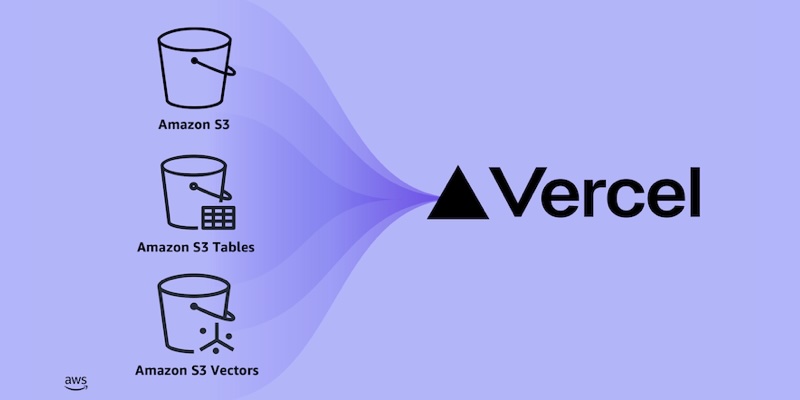
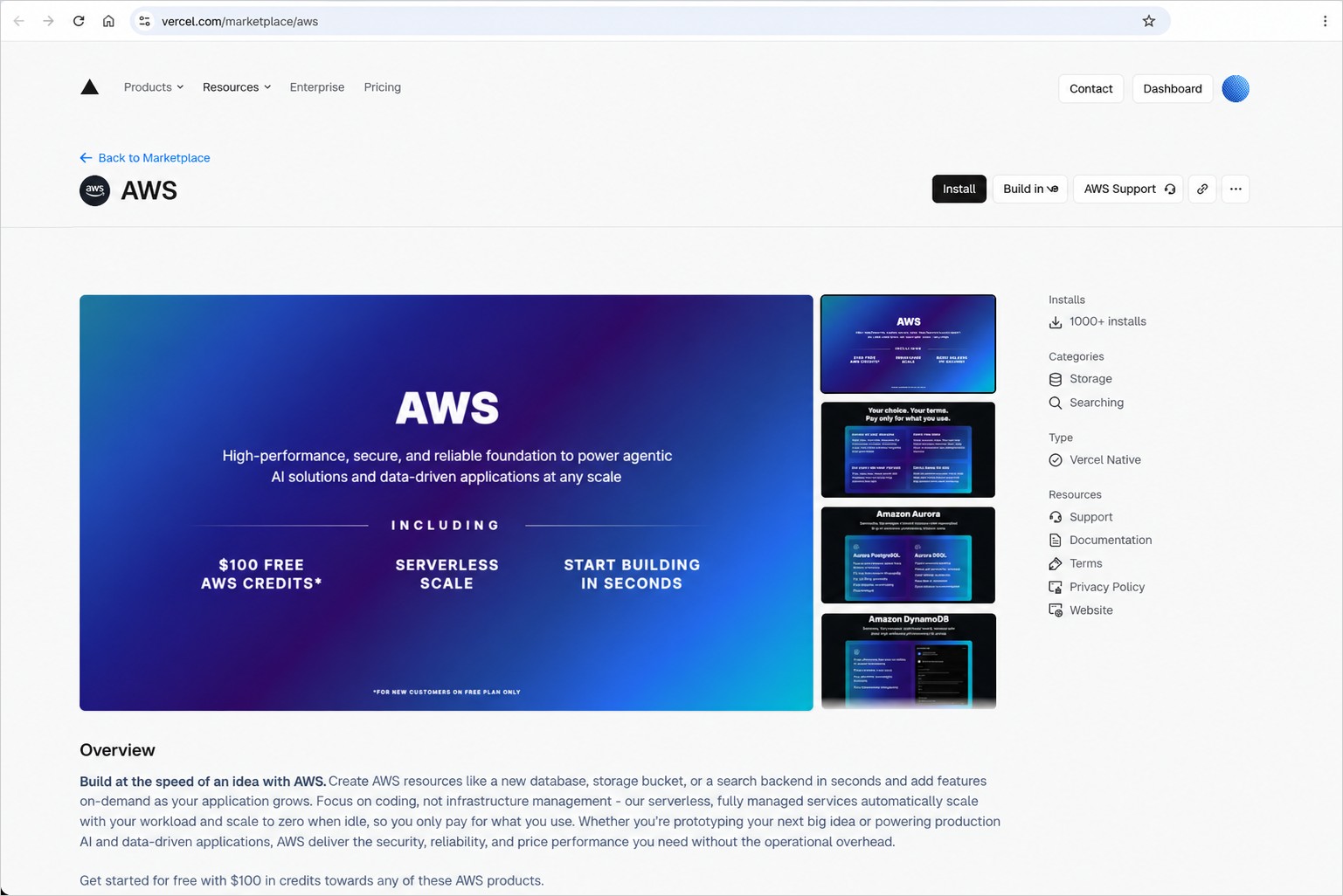
In a significant development for the modern web development and artificial intelligence ecosystems, Vercel and Amazon Web Services (AWS) have announced a deep native integration that brings Amazon Simple Storage Service (Amazon S3)—including advanced features like S3 Tables and S3 Vectors—directly into the Vercel Marketplace and v0 by Vercel.
For millions of developers who rely on Vercel to build, deploy, and scale frontend-driven web applications and AI agents, this integration marks the elimination of one of the cloud’s most enduring friction points: the administrative overhead of cloud infrastructure provisioning. Previously, setting up performant, scalable object storage required developers to context-switch away from their application workflows, manually navigating the AWS Management Console, configuring complex IAM policies, and managing long-lived static security credentials.
Today, that barrier falls. Developers can provision, configure, and connect production-grade AWS storage resources directly from the Vercel dashboard or via natural language prompts in v0. By pairing this with Vercel’s OpenID Connect (OIDC) authentication model—which exchanges short-lived tokens via AWS STS rather than utilizing static keys—the integration bridges the gap between serverless developer velocity and enterprise-grade security.
Furthermore, this release completes a comprehensive full-stack architecture within Vercel. Alongside existing integrations for Amazon Aurora, Amazon DynamoDB, and Amazon OpenSearch Serverless, teams can now orchestrate an entire application stack—relational databases, NoSQL datastores, object storage, open table formats for analytics, and vector storage for AI—all unified under a single AWS account, managed within a single interface, and consolidated onto a single monthly bill.
Detailed Chronology and Technical Architecture
The journey toward a unified serverless and cloud storage experience has evolved over several years, culminating in this milestone release.
The Evolution of Vercel-AWS Interoperability
Historically, Vercel revolutionized how developers ship frontend applications by abstracting infrastructure away entirely, optimizing for zero-config deployments, edge computing, and global content delivery networks (CDNs). However, as web applications evolved into sophisticated, AI-driven platforms, they required heavy computational and storage backends. Developers frequently found themselves splitting their workflows: building the user interface and serverless functions on Vercel while managing persistence, analytics, and vector databases across various cloud provider dashboards.
Recognizing this friction, AWS and Vercel began building direct infrastructural bridges. The introduction of managed integrations for databases like Amazon Aurora and DynamoDB laid the groundwork. However, unstructured data storage, analytical querying over data lakes, and vector embeddings for retrieval-augmented generation (RAG) remained complex to orchestrate.
The launch of the native Amazon S3 integration on the Vercel Marketplace and v0 solves this by abstracting the provisioning layer entirely while retaining the underlying power, durability, and scalability of AWS.
Under the Hood: Provisioning and OIDC Security
The technical implementation of the Vercel-S3 integration prioritizes security by design, completely eradicating the risk of leaked static access keys.
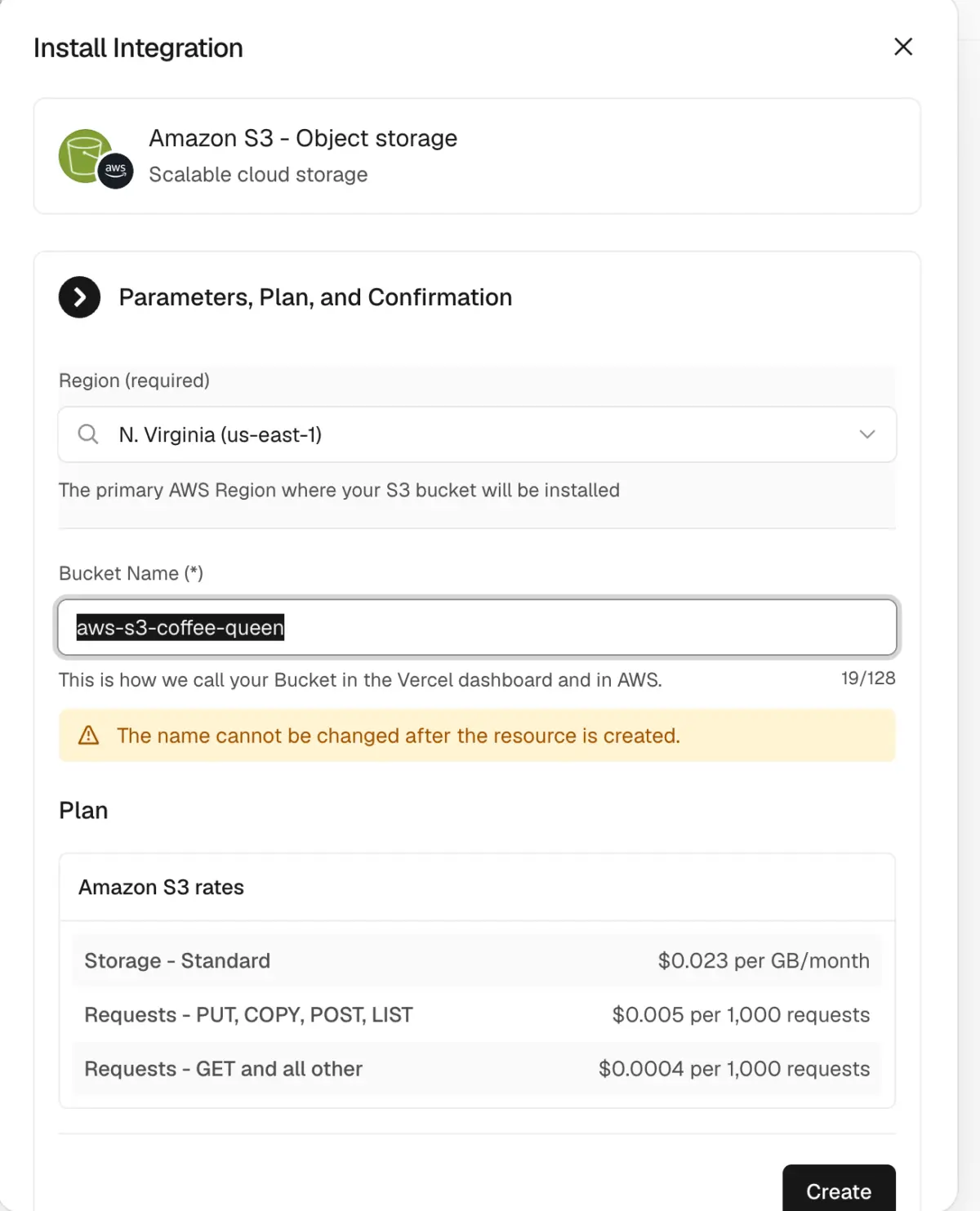
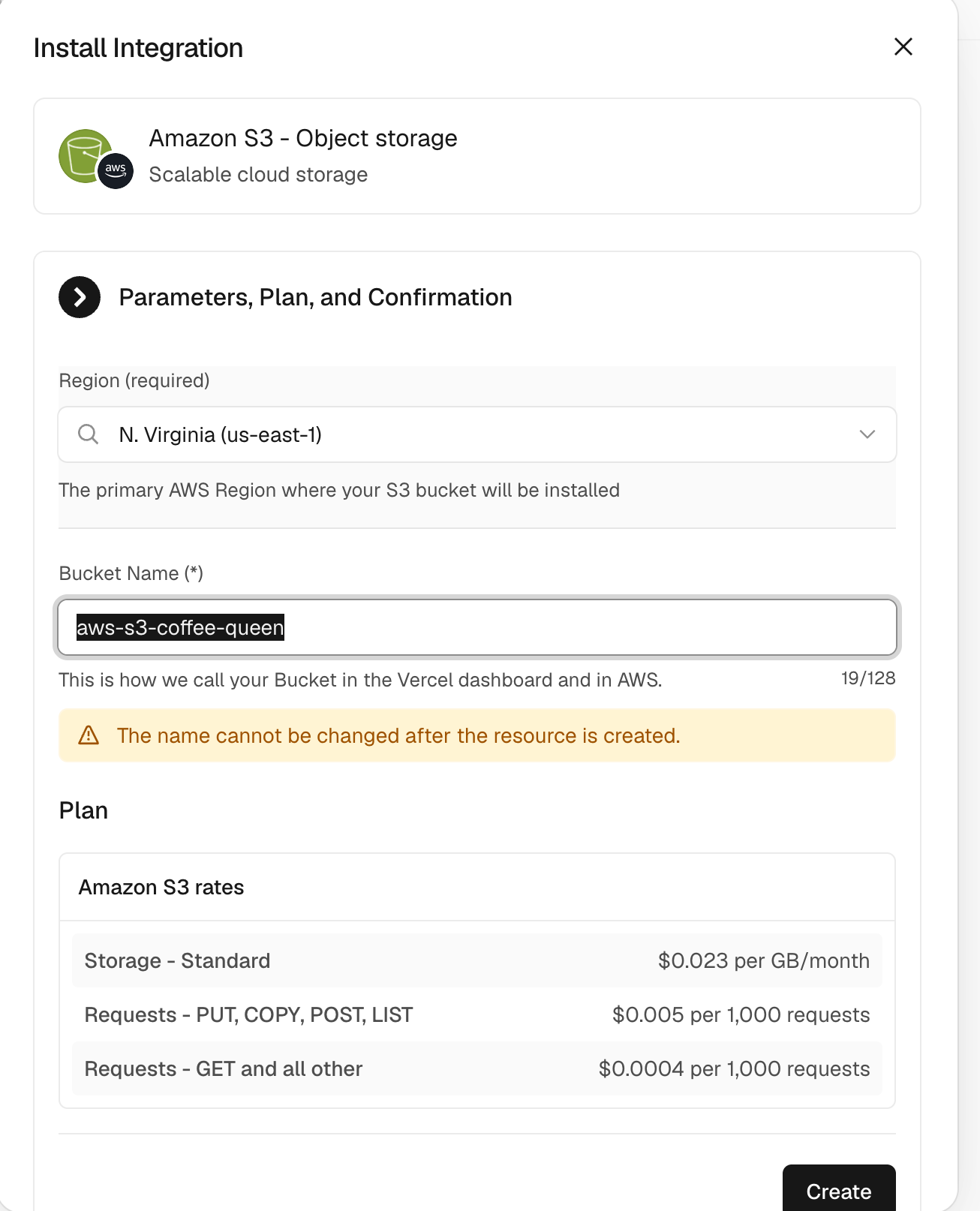
When a developer navigates to the Vercel dashboard, selects the Storage tab, chooses AWS, and picks an S3 bucket type and region, the provisioning process executes behind the scenes in a matter of seconds. Underneath, Vercel interacts with the user’s AWS environment (either a newly generated account or a linked pre-existing enterprise account) to establish the necessary infrastructure.

When the bucket is linked to a project, Vercel injects targeted environment variables—such as AWS_REGION, AWS_ROLE_ARN, AWS_RESOURCE_ARN, and resource-specific identifiers like S3_BUCKET_NAME—into the application context.
At runtime, rather than reading hardcoded credentials from environment files, Vercel functions leverage the awsCredentialsProvider utility from @vercel/functions/oidc. This module exchanges a cryptographically secure, short-lived OIDC token with AWS Security Token Service (AWS STS), generating temporary, highly scoped credentials on-the-fly. This architectural pattern ensures that even if application code is compromised, no master access keys exist to be stolen.
import  S3Client, PutObjectCommand  from "@aws-sdk/client-s3";
import  awsCredentialsProvider  from "@vercel/functions/oidc";

const s3 = new S3Client(
  region: process.env.AWS_REGION,
  credentials: awsCredentialsProvider(
    roleArn: process.env.AWS_ROLE_ARN,
  ),
);

export async function POST(request)
  const formData = await request.formData();
  const file = formData.get("file");

  await s3.send(new PutObjectCommand(
    Bucket: process.env.S3_BUCKET_NAME,
    Key: file.name,
    Body: Buffer.from(await file.arrayBuffer()),
    ContentType: file.type,
  ));

  return Response.json( success: true );
Powering Three Distinct Workloads: General Purpose, Tables, and Vectors
The integration is engineered to support three core operational paradigms that modern applications demand:
- Everyday Object Storage (General Purpose Buckets): Designed for standard use cases like user-generated content, media galleries, document uploads, and asset hosting. Using the AWS SDK for JavaScript, developers can read, write, list, and delete objects with minimal boilerplate code.
- Analytics with S3 Tables: S3 Tables provide cloud object storage purpose-built for analytics, delivering fully managed Apache Iceberg tables with automated table maintenance and compaction. By integrating DuckDB directly into Vercel Functions alongside S3 Tables, developers can execute high-performance aggregate analytical queries over massive data volumes without spinning up expensive, dedicated data warehouse clusters.
- AI and Semantic Search with S3 Vectors: Tailored for AI agents, semantic search engines, and generative AI applications, S3 Vectors provide native, cost-optimized vector storage directly within S3. Developers can store and query vector embeddings without maintaining a separate standalone vector database, seamlessly powering RAG pipelines and intelligent document assistants.
Supporting Context and Metrics: The Developer Experience Revolution
To truly understand the impact of this integration, one must examine the operational metrics of modern software engineering teams. Context-switching between development environments—moving from an Integrated Development Environment (IDE) to a cloud provider’s console—is a well-documented drain on developer productivity and focus.
Quantifying the Reduction in Cognitive Load
Internal studies across enterprise engineering organizations indicate that provisioning a new cloud storage resource, configuring Identity and Access Management (IAM) roles, establishing CORS policies, and wiring up secure environment variables traditionally takes anywhere from 30 minutes to several hours, depending on organizational compliance hurdles.
By streamlining this into a few clicks within the Vercel dashboard or a single conversational prompt in v0, the time-to-provision drops to under 10 seconds.
The Rise of Generative Infrastructure via v0
The inclusion of Amazon S3, S3 Tables, and S3 Vectors inside v0 by Vercel represents a paradigm shift toward generative infrastructure. Developers are no longer restricted to writing code; they can describe complex backend requirements in natural language, and v0 handles both the architectural wiring and code generation:
- "Build a photo gallery where users can upload images using AWS" automatically provisions a general-purpose S3 bucket, configures the necessary API routes, and generates the React frontend.
- "Create a support bot that answers questions from my uploaded PDF manuals" provisions an S3 Vectors bucket, hooks up the semantic search logic, and builds the chat interface.
- "Deploy an analytics dashboard for my application clickstream data" provisions S3 Tables and configures DuckDB query handlers within Vercel Functions.
Unified Billing and Governance
For engineering leaders and FinOps professionals, the architecture offers clean governance. Because the S3 resources reside directly within the customer’s AWS account (whether newly created via Vercel or linked via an existing enterprise account), organizations retain full ownership of their data and governance policies. They continue to utilize AWS-native security tooling, while enjoying consolidated billing and eliminating hidden multi-cloud data egress penalties. New AWS accounts spawned via Vercel even receive a $100 AWS credit valid for six months, lowering the barrier for prototyping and early-stage scaling.
Future Outlook: The Convergence of Serverless Frontend and Deep Cloud Storage
As we look toward the future of software architecture, the boundaries separating frontend deployment platforms, serverless compute layers, and deep cloud storage infrastructure are rapidly dissolving.
The All-in-One Application Stack
The ability to spin up an entire application stack—from global edge routing and React rendering on Vercel, through serverless functions and relational/NoSQL databases (Aurora and DynamoDB), up to object, vector, and open table storage (Amazon S3)—within a single cohesive workflow signals a maturing industry. Developers no longer need to compromise between the extreme developer velocity of modern frontend frameworks and the industrial-grade durability, security, and scalability of hyperscale cloud primitives.
AI Agents and Autonomous Data Pipelines
Looking ahead, the integration of S3 Vectors and S3 Tables within frontend-centric developer platforms paves the way for autonomous AI applications. As developers increasingly build sophisticated AI agents that require persistent memory, large-scale vector search, and real-time analytical processing, having these capabilities natively bound to serverless deployment targets makes deployment frictionless.
Tools like the AWS Model Context Protocol (MCP) server further enhance this ecosystem, allowing developers to query documentation, check regional availability, and troubleshoot infrastructure issues directly through their preferred AI-assisted development tools.
Conclusion
The native integration of Amazon S3, S3 Tables, and S3 Vectors into Vercel and v0 is more than a technical convenience; it is a validation of the serverless philosophy applied to the entire cloud stack. By abstracting infrastructure configuration without sacrificing control, security, or performance, Vercel and AWS have set a new standard for how modern web and AI applications are conceptualized, built, and scaled.