Executive Overview
At this year’s TechBBQ summit in Copenhagen, the prevailing dialogue among European founders, venture capitalists, and policy strategists underwent a fundamental shift. Rather than focusing solely on incremental gains in machine learning capabilities or novel consumer applications, discussions centered on a critical geopolitical question: Who ultimately controls the foundational technology driving the artificial intelligence revolution?
Against the backdrop of the annual Nordic flagship conference—which concluded on August 27 under the theme "Emerging from Agency"—the European tech community actively debated the risks of digital dependency. The urgency of these conversations was intensified by recent operational disruptions, notably an incident earlier this year where access to Anthropic’s advanced AI models, Mythos and Fable, was unexpectedly interrupted for users outside Europe. This service outage served as a wake-up call for European enterprises, exposing the vulnerability of relying on foreign proprietary infrastructure.
As artificial intelligence shifts from standalone applications to autonomous agents embedded directly into software ecosystems and operating systems, the European tech sector faces a strategic crossroads. Industry leaders at TechBBQ signaled that true technological agency requires more than building software on top of American or Chinese APIs; it demands sovereign compute capacity, localized data governance, and capital allocation frameworks capable of supporting homegrown infrastructure.
Detailed Chronology: Catalyst, Panels, and Policy Debates
The Inciting Incident: The Mythos and Fable Outage
The catalyst for much of the week’s urgency stemmed from an event earlier in the year when Anthropic restricted access to its flagship models, Mythos and Fable, for international deployments outside Europe. While the service was eventually restored, the sudden loss of access disrupted workflow pipelines for dozens of European software engineering teams.
At TechBBQ, reactions to the incident highlighted a clear divide in how European tech executives view operational risk:
- The Pragmatist View: Some startup executives downplayed the event, treating temporary service disruptions as routine operational friction within early-stage tech stacks.
- The Strategic View: Others saw the outage as an early warning of a deeper structural vulnerability. Relying on foreign technology providers leaves European companies exposed to abrupt changes in terms of service, foreign regulatory mandates, or geopolitical friction.
+-----------------------------------------------------------------------------------+
|                         CHRONOLOGY OF DIVERGENT STRATEGIES                        |
+-----------------------------------------------------------------------------------+
|  [Q1/Q2 Outage Event]       -->  [TechBBQ Mainstage Debates] -->  [Strategic Imperative]
|  Anthropic restricts model       Panels address AI control,       Shift from basic API
|  access outside Europe,          OS data extraction, and          integration toward
|  disrupting workflows.           national sovereignty.            sovereign compute/models.
+-----------------------------------------------------------------------------------+
Mainstage Keynotes and Debates
The formal agenda at the Bella Center and peripheral venues across Copenhagen provided a platform for rigorous debates on digital control, personal privacy, and economic self-determination.
Privacy vs. AI Coexistence
A heavily attended session featured Meredith Whittaker, President of Signal, in a direct dialogue regarding whether user privacy can survive the current trajectory of AI development. Whittaker offered a sharp critique of major tech platforms integrating AI assistants directly into consumer operating systems—citing examples such as OpenAI’s deep integrations within mobile messaging infrastructure. She argued that these architectures represent an unprecedented data-extraction engine, engineered to normalize pervasive background collection under the guise of user convenience.
Economic Agency and National Power
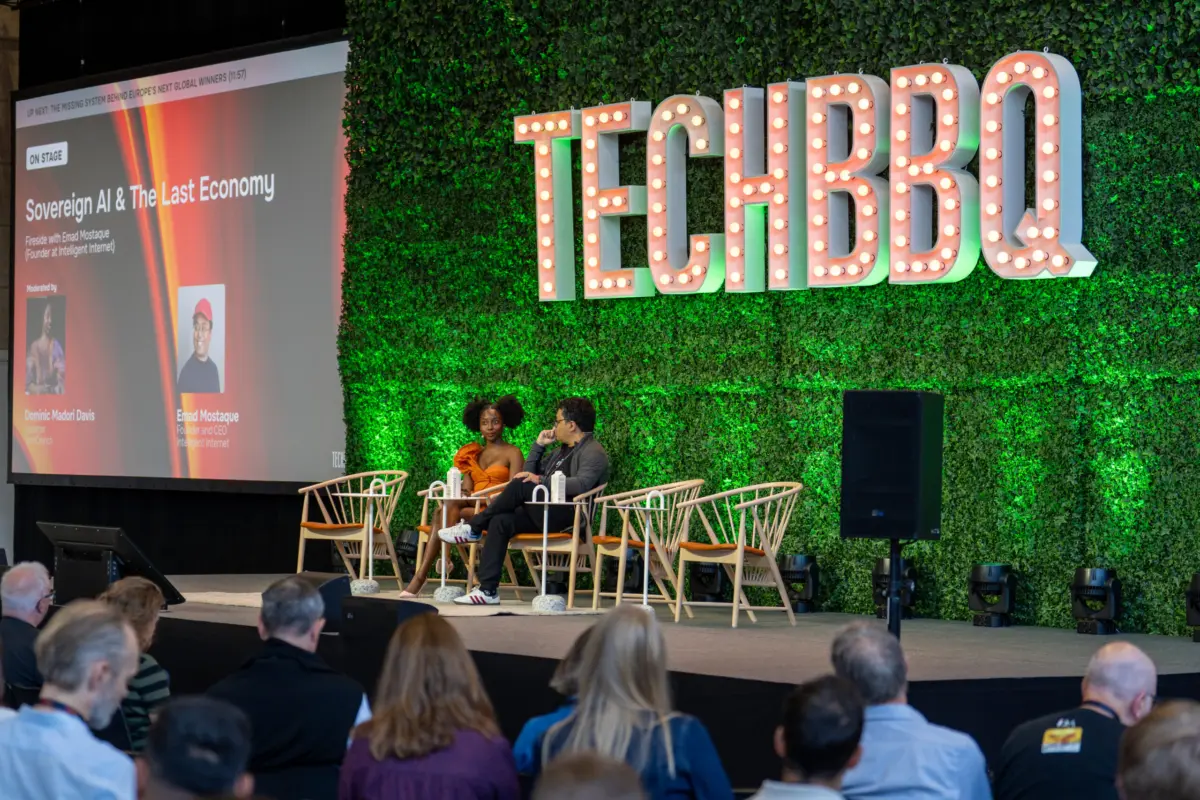
In a parallel mainstage panel on the agentic workforce, Emad Mostaque, co-founder of Stability AI and Intelligent Internet, addressed the macroeconomic and geopolitical implications of autonomous software. Mostaque framed technological sovereignty not merely as an engineering objective, but as an existential requirement for national governance. He argued that as decision-making algorithms become integral to public infrastructure and enterprise operations, control over those underlying models translates directly into political and economic control.
Ecosystem Expansion and Cross-Border Investment
Beyond high-level policy debates, the conference featured sessions aimed at building tangible ecosystem connections:
- Nordic-Africa Startup Summit: A dedicated track explored cross-border venture bridges, focusing on how capital and technical frameworks from the Nordics could interface with fast-growing African innovation hubs.
- Capital Allocation & Growth Funding: Late-stage investors examined strategies to address Europe’s mid-stage funding deficit, aiming to help promising deep-tech startups scale without relying entirely on Silicon Valley venture funds.
- Deep Tech & Health Tech Tracks: Discussions highlighted specialized verticals, including dedicated panels on women’s health technology and emerging research in women’s brain health.
High-Level Networking and Sovereign Dialogues
Off the mainstage, discussions continued at various networking events across Copenhagen. A rooftop gathering hosted by Lovable, Nvidia, OpenAI, AWS Startups, and HSBC brought together international infrastructure providers and local founders to discuss Denmark’s emerging engineering hubs.
Simultaneously, London-based Ada Ventures hosted an intimate ecosystem session at the Bird cocktail bar focused on health tech thesis building. The formal evening proceedings culminated in a speakers’ dinner on an island in central Copenhagen, where policy experts, founders, and international media discussed the future of European tech governance.
Supporting Context & Metrics
The debates at TechBBQ reflect a broader structural shift within the European technology landscape. For over a decade, European software development has relied heavily on hyper-scalable cloud infrastructure and developer tools originating predominantly from the United States.
+----------------------------------------------------------------------------------+
|                   EUROPEAN AI ECOSYSTEM: CHALLENGES & ASSETS                     |
+----------------------------------------------------------------------------------+
|  INFRASTRUCTURE CONSTRAINTS           |  REGULATORY & STRUCTURAL ASSETS          |
|  * ~80% reliance on foreign cloud     |  * Comprehensive frameworks (EU AI Act)   |
|  * Capital gaps in late-stage scale   |  * Strong institutional foundation capital|
|  * High dependency on foreign APIs    |  * World-class regional engineering hubs |
+----------------------------------------------------------------------------------+
Key Ecosystem Metrics & Structural Realities
- Infrastructure Concentration: An estimated 80% of enterprise-grade cloud compute and AI hardware acceleration used by European startups is hosted or controlled by non-European hyperscalers. This creates a supply-chain vulnerability for critical software services.
- The Capital Gap: While European pre-seed and seed-stage funding rounds match global benchmarks, late-stage growth capital (Series C and beyond) remains significantly lower than in the US. As a result, European deep-tech companies often seek US growth capital, which frequently requires relocating primary operations or intellectual property overseas.
- Regulatory Frameworks: The enforcement of the EU AI Act alongside GDPR establishes a strict compliance standard globally. However, industry leaders at TechBBQ noted that compliance mandates must be paired with local compute infrastructure. Without local hosting capacity, strict regulations risk slowing down domestic startups while foreign tech giants easily absorb compliance costs.
Official Statements & Key Perspectives
The discourse at TechBBQ featured commentary from investors, tech executives, and advocacy leaders, illustrating the complex trade-offs facing European tech.
"TechBBQ’s theme of agency felt particularly timely this year as the conversation shifted from what AI can do to what we’re actually willing to let it do. The debates weren’t about smarter machines, but about human judgment and who gets to stay in the driver’s seat. The age of AI agents isn’t really a story about machines gaining agency; it’s a story about humans deciding what to give up."
— Ellen de Brever, Angel Investor & Head of Partnerships at the Novo Nordisk Foundation Cellerator
"There is a massive data collection apparatus being constructed under the banner of AI assistance. Labs are leveraging sophisticated marketing to encourage users to overlook the systemic collateral consequences of pervasive data harvesting. Yet, there remains an overwhelming market demand for genuine privacy—and particularly as sovereign concerns intensify globally, privacy-first architectures will find an expanding enterprise client base."
— Meredith Whittaker, President of Signal
"Sovereignty is, fundamentally, the structural ability to resist power being exerted over you. Given the unprecedented concentration of compute and model development within a handful of corporate entities, we must recognize that inevitably, every state framework will interface with or be run by AI systems. Consequently, the entity that controls the underlying AI models exercises ultimate functional control over the host nation."
— Emad Mostaque, Co-Founder of Stability AI and Intelligent Internet
"If intelligent agents increasingly execute cognitive workflows while robotic platforms automate physical labor, we are moving beyond a conventional industrial update. We are confronting a paradigm shift where society will be forced to redefine ownership structure, economic participation, democratic oversight, and ultimately, the definition of human citizenship."
— Mia Negru, Advocacy and Engagement Director at Life With Artificials
Reflecting on the balance between technical discussion and human collaboration, Ellen de Brever added:
"In a room full of conversations about machines, the most memorable moments still come from the simplest thing: human connection, face-to-face, building relationships, sharing ideas, and reminding each other of what technology can never quite replace."
Strategic Future Outlook
As the European technology ecosystem processes the lessons of TechBBQ 2026, the sector faces several structural imperatives that will dictate its trajectory over the coming decade.
+-----------------------------------------------------------------------------------+
|                        STRATEGIC ROADMAP FOR EUROPEAN TECH                        |
+-----------------------------------------------------------------------------------+
|  1. SOVEREIGN COMPUTE    --> Expand domestic GPU clusters and open-weights LLMs.  |
|  2. CAPITAL RETENTION    --> Mobilize institutional capital for Series B+ rounds. |
|  3. PRIVACY AS EDGE      --> Turn strict regulatory compliance into a USP.        |
+-----------------------------------------------------------------------------------+
1. Scaling Sovereign Compute Infrastructure
To reduce dependency on overseas APIs, European consortiums, public foundations, and private venture funds are directing capital into localized data centers and open-weights model initiatives. Projects designed to train high-parameter models natively on European soil are transitioning from policy discussions to active technical deployment.
2. Capital Retention and Foundation Participation
Bridging the growth-stage funding gap requires institutional capital—such as pension funds and large philanthropic foundations like the Novo Nordisk Foundation—to play a more active role in venture ecosystems. Expanding growth capital within Europe will allow deep-tech enterprises to scale locally without sacrificing operational control to foreign acquirers.
3. Privacy-First Systems as a Global Differentiator
Rather than viewing strict privacy laws as a barrier to innovation, European enterprise leaders are increasingly positioning compliance as a competitive advantage. As corporate espionage, data leaks, and sovereign risk become chief concerns for multinational companies, privacy-preserving AI architectures engineered in Europe could capture significant global market share.
Conclusion
TechBBQ highlighted a decisive shift in Europe’s technology narrative. The conversation has moved past simple technology adoption toward maintaining operational autonomy. As autonomous agents become deeply integrated into software systems and global infrastructure, Europe’s ability to maintain digital sovereignty will depend on turning these discussions into sovereign compute capabilities, resilient growth capital, and privacy-focused technology.