Executive Overview
Are we on the precipice of a white Christian nationalist takeover? For Robert P. Jones, author, religion scholar, and founder of the Public Religion Research Institute (PRRI), the answer is a sobering and urgent yes. In his sweeping and provocative new book, Backslide: Reclaiming a Faith and a Nation After the Christian Turn Against Democracy, Jones draws a stark, unyielding historical parallel: "This is our 1933."
The reference is calculated and deeply unsettling, pointing directly to the year Weimar Germany collapsed under the weight of a Nazi takeover. While comparisons between modern American political movements—particularly under the banner of Donald Trump—and Nazi Germany have become a common, if sometimes hyperbolic, staple of contemporary discourse, Jones brings an insider’s rigor to the table. Having studied religion for decades and grown up Southern Baptist in the Deep South, Jones views these historical echoes not as casual rhetorical flourishes, but as a precise diagnostic tool. He argues that the uncritical, rock-solid support of white Christian evangelicals for an increasingly authoritarian political agenda is actively dismantling American democracy.
Yet, Backslide is not merely an exercise in alarmism. Rather, it serves as an urgent diagnostic text and a call to action. Jones posits that the greatest danger to the nation—and to the integrity of Christianity itself—is not merely the active malice of the radical fringe, but the paralyzing apathy of the moderate majority. Drawing on the historical trajectory of German anti-Nazi resister Martin Niemöller, Jones maps out a roadmap for resistance, urging non-MAGA Christians, mainline Protestants, and progressive people of faith to awaken from their passivity, find their voice, and actively out-organize a movement that has hijacked their religious heritage.
Detailed Chronology: Learning from the Shadow of 1933
To understand the urgency of Jones’s thesis, one must examine the historical precedent he invokes. In his book, Jones centers the life of Martin Niemöller, a German Lutheran pastor whose trajectory from nationalist supporter to concentration camp prisoner serves as an explicit warning for contemporary American believers.
- The 1920s to 1933 (The Era of Acquiescence): Like many conservative German Christians of his era, Niemöller initially viewed the rise of the Nazi movement with favor or, at worst, passive tolerance. He voted for the Nazi party in three separate elections, blinded by a desire for national restoration, traditional moral order, and protection against perceived cultural threats.
- 1933 (The Turning Point): This was the year Weimar Germany officially fell and Adolf Hitler seized absolute power. It was also the year Niemöller began his tentative resistance against Nazi rule, a stance that would slowly evolve into outright theological opposition through the founding of the Confessing Church.
- 1937–1945 (Imprisonment and Reflection): Niemöller’s resistance ultimately cost him his freedom. He was arrested by the Gestapo in 1937 and imprisoned at the Dachau concentration camp, where he remained until his liberation by Allied forces in 1945.
- The Post-War Realization: When Niemöller revisited Dachau after World War II, he did not merely view it as the site of his own suffering or the place where the camp opened. Instead, he viewed 1933 as a bitter marker of time wasted—the years he spent supporting or tolerating a fascist movement before finally finding his moral courage. Every day of his pre-1933 and early Nazi-era support felt like a missed opportunity to avert an unimaginable catastrophe.
Jones applies this chilling historical lens to the contemporary United States. He argues that the second Trump administration, bolstered by the unconditional backing of white Christian evangelicals, has pushed the United States into a state of "democratically back-slidden nationhood, abetted by an apostate white Christianity." By tracing the escalation of religious authoritarianism—from evangelical cheerleading for mass deportations to the explicit Christian nationalist rhetoric embraced by administration figures like Defense Secretary Pete Hegseth—Jones warns that modern American Christians are sleepwalking through their own 1933.
Supporting Context & Metrics: The Sociological Reality
To ground his historical warnings, Jones relies on the rigorous data accumulated by PRRI, the premier research and polling think tank tracking the intersection of religion, politics, and American identity. As a sociologist and public intellectual, Jones bridges the gap between empirical data and theological critique.
The Evangelical Baseline and Immigration Policy
One of the most harrowing aspects of Jones’s research centers on the moral disconnect between professed biblical values and actual political behavior among white evangelicals. PRRI data reveals a chilling uniformity in support for draconian policies. When asked about extreme immigration enforcement measures—such as placing razor wire and dangerous barricades in rivers to deter migrants, or establishing internment-style detention camps—white evangelical support remains astonishingly high.
"In the Trump era, white evangelical attitudes about undocumented immigrants are so extreme that it seems virtually impossible to construct a policy that is too brutal for them to support," Jones notes. This unwavering endorsement stands in stark theological contrast to biblical scriptures that repeatedly command believers to care for widows, orphans, and immigrants, warning them not to oppress the stranger.
Demographics: A Shrinking Supermajority
Despite the dominance of Christian nationalism in the contemporary Republican Party, Jones’s data uncovers an encouraging demographic reality: the movement does not represent the majority of the country.
- White Evangelicals: This group now comprises only 13 percent of the total U.S. population. While approximately 85 percent of white evangelicals are deeply embedded in the MAGA movement, their numerical footprint is shrinking.
- Christian Nationalists as a Whole: Americans who actively subscribe to a Christian nationalist worldview account for roughly three in ten (30 percent) of the population. While this constitutes a majority of Republicans and two-thirds of white evangelicals, it means the broader American public rejects the ideology by a 2-to-1 margin.
- The Mainline and Catholic Divide: Unlike white evangelicals, white mainline Protestants, white Catholics, and Latino evangelicals are far more internally divided. They have not shown the same total acquiescence to a seductive political worldview, providing fertile ground for alternative religious coalitions.
Official Statements and Grassroots Resistance
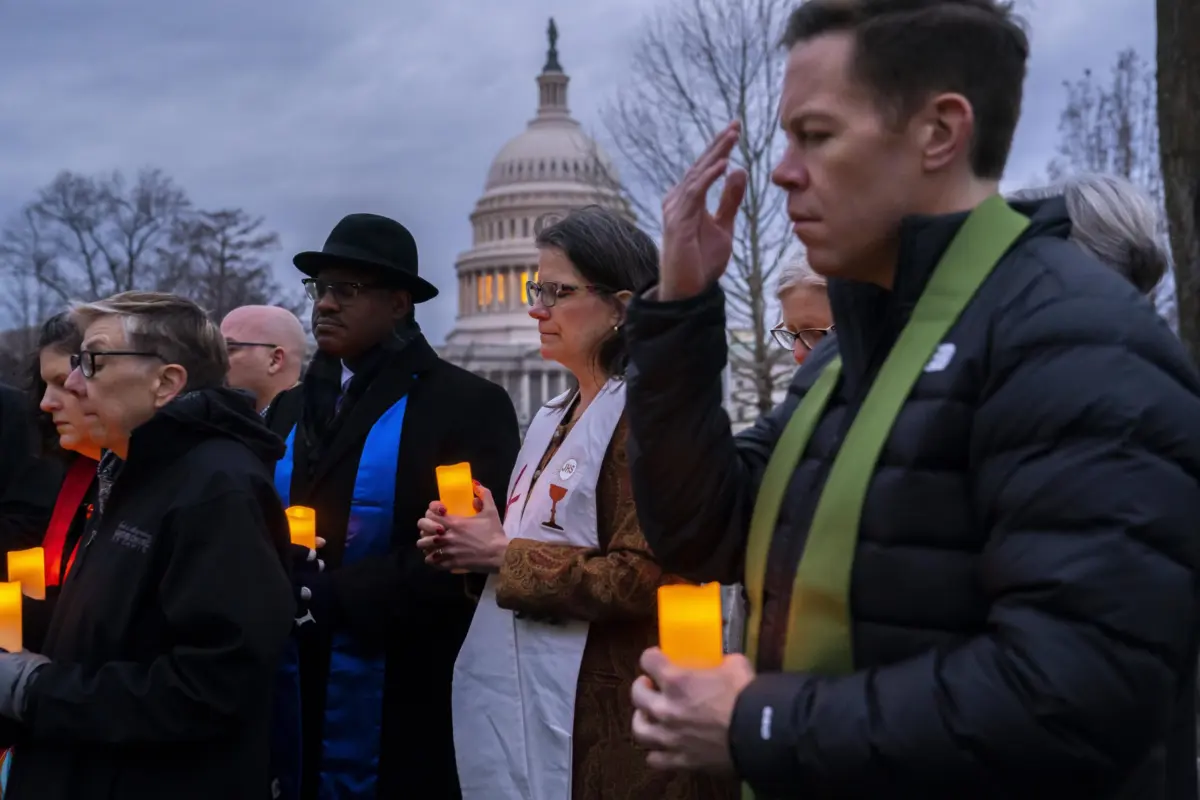
The narrative of Backslide is not purely one of declension; it documents a nascent, growing resistance springing up across American religious communities. While the national spotlight has frequently fixated on the loud, institutional capture of conservative white evangelicalism by right-wing politics, an alternative witness is quietly and persistently organizing.
Denominational Rebukes
At the institutional level, mainline denominations are beginning to draw clear lines in the sand. Five major Christian denominations have either officially adopted or are actively drafting formal statements explicitly condemning Christian nationalism. These declarations serve as vital theological guardrails, empowering local pastors and congregants to push back against extremism within their own communities.
Grassroots Mobilization and Sanctuary Movements
On the ground, resistance is taking practical, localized forms:
- Midwestern Organizing: In upper Midwest states like Iowa, Michigan, and Minnesota—where the demographic weight of white evangelicals is smaller and mainline Protestants hold more influence—churches are actively organizing. In Minneapolis and St. Paul, Lutheran and mainline Protestant communities have mobilized to monitor ICE operations, protest aggressive deportation sweeps, and provide direct aid to immigrant communities.
- Catholic Pushback in the Southwest: Near El Paso, Texas, Catholic bishops and local parishes successfully organized to halt the construction of a massive ICE detention facility in their community. Combined with frequent, pointed critiques of anti-immigrant policies from the broader Catholic hierarchy, these actions signal a vital fracturing of the monolithic religious support previously claimed by nationalist politicians.
- The Rise of Explicitly Faithful Public Figures: Jones points to a shifting political landscape where non-evangelical and mainline Christian politicians are increasingly finding their public voice. While Black religious leaders like the late Rep. John Lewis, Rep. Jim Clyburn, and Senator Raphael Warnock have long articulated a public faith rooted in civil rights and prophetic justice, a new generation of white politicians from mainline traditions—such as Texas state figures and Midwestern candidates—are beginning to speak openly from their faith backgrounds to counter the nationalist narrative.
Future Outlook: A Playbook for Resistance
What does this mean for the average person reading these developments? Jones is pragmatic, drawing a sharp line between those who can be reached and those who cannot.
The Futility of Persuasion vs. the Power of Out-Organizing
"If we’re talking about persuading the folks that have been all in for Trump for a decade now, for three consecutive elections, that’s a fool’s errand," Jones asserts. He argues that a segment of the population is so deeply wedded to political power, hierarchy, and cultural dominance that they are fundamentally beyond persuasion.
The solution, therefore, is not endless debate with the unpersuadable, but rather effective counter-organization. By mobilizing the silent, disturbed majority of Christians who have watched extremism take hold with quiet discomfort, progressives and moderate believers can build a powerful alternative coalition.
Reclaiming the Faith
Crucially, Jones emphasizes that his work is not a traditional apologetic defense of the institutional church. He expresses deep sympathy for the millions of Americans who have deconstructed their faith and left Christianity over the last two decades, citing the toxicity of political evangelicalism as a primary catalyst.
Instead, Backslide is a plea for spiritual and civic integrity. For those who remain connected to the Christian tradition, the current historical moment demands a visible, public reclamation of a faith centered on love, hospitality toward the vulnerable, and full compatibility with a pluralistic, multi-racial democracy.
As Jones concludes, the road ahead requires moral clarity and institutional courage. By breaking the chains of apathy, recognizing the historical echoes of 1933, and standing up a visible alternative to Christian nationalism, American believers still possess the agency to alter the nation’s trajectory before the backslide becomes irreversible.