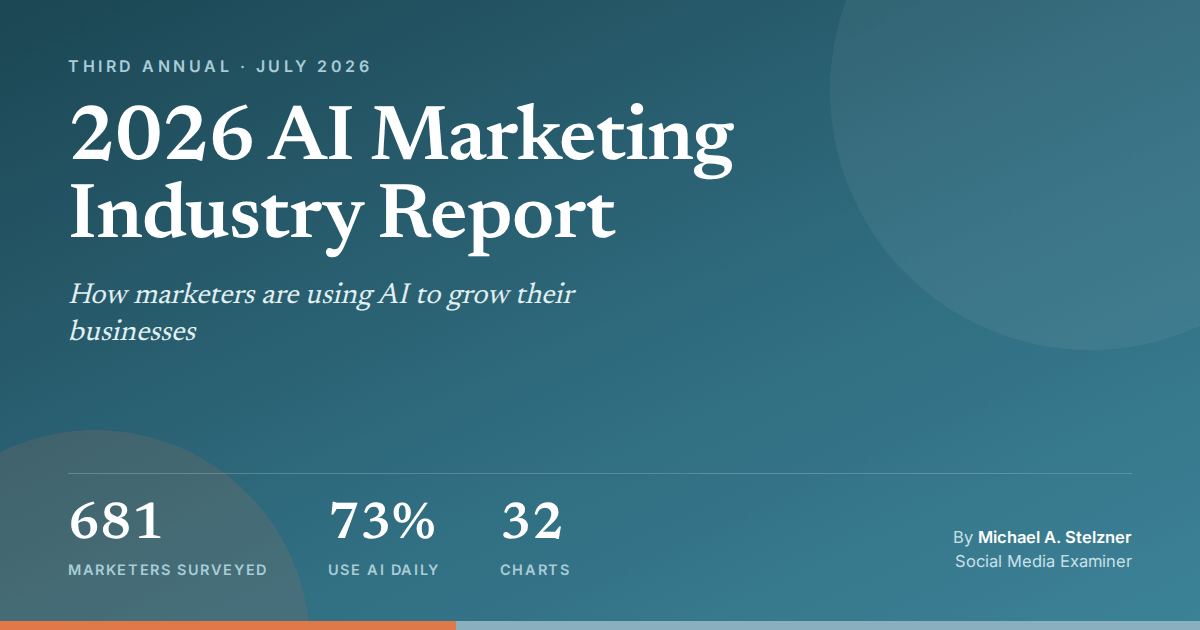
The landscape of modern business operations has crossed a definitive threshold. Data drawn from the recently published 2026 AI Marketing Industry Report—compiled by Social Media Examiner—reveals that artificial intelligence is no longer an experimental auxiliary tool or a passing technological trend. Rather, it has cemented itself as core digital infrastructure, particularly for lean organizations and micro-enterprises.
With 60% of survey respondents operating in teams of 10 or fewer people, this empirical research offers a candid look into the operational realities of small business owners. Gone are the days when AI adoption was spearheaded exclusively by enterprise IT departments with unlimited capital reserves. Today, the modern small business is driving its own technological transformation through grassroots experimentation, bootstrapping, and agile implementation.
This special report synthesizes five eye-opening findings from the 2026 data, examining how daily AI usage has surged to nearly 75%, why traditional corporate training models are completely absent from the movement, how a significant measurement gap persists despite massive productivity gains, and where the next wave of disruption—spanning AI video and autonomous agents—is heading.
1. Executive Overview: The Great Operational Normalization
Two years ago, in the nascent stages of widespread generative AI awareness, roughly a third of marketing professionals (37%) utilized artificial intelligence on a daily basis. That figure was largely comprised of early adopters, tech enthusiasts, and forward-thinking agencies testing the waters of large language models.
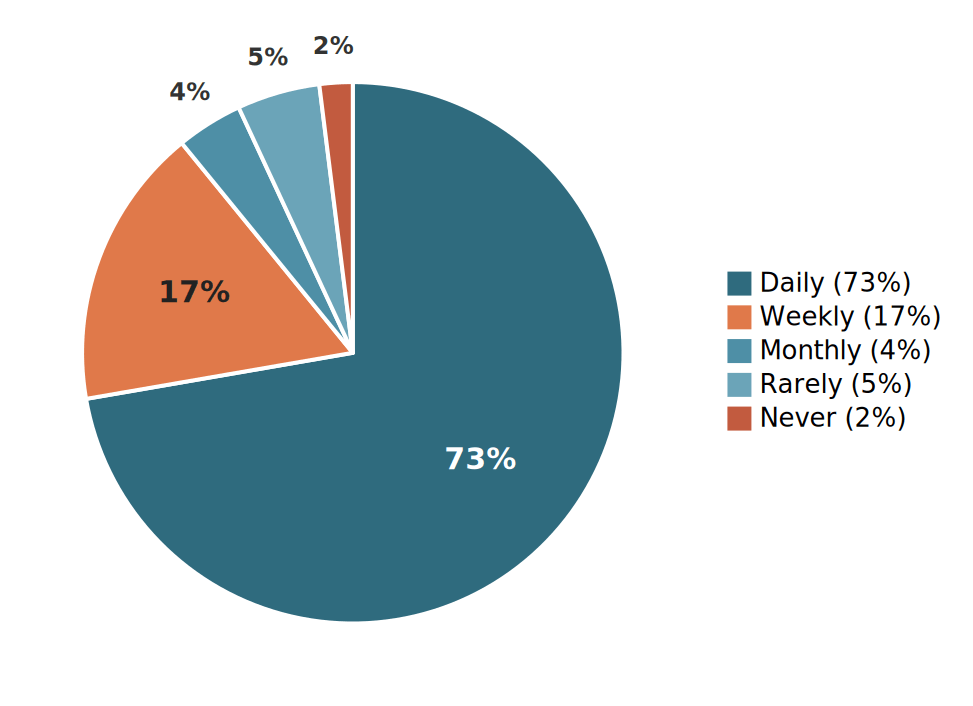
Fast forward to the present day, and that operational profile has inverted dramatically. The 2026 report indicates that 73% of marketers now use AI every day, representing a seismic shift in daily workflow architecture. When expanding the aperture to weekly usage, 90% of professionals interact with AI systems at least once a week, while the cohort of non-users or rare users has plummeted from 23% in 2024 to a mere 7%.
Crucially, this momentum shows no signs of plateauing. Fully 84% of respondents report that their personal AI usage has increased over the past year, and 78% expect continued expansion in their utilization moving forward. For small business owners who have remained on the sidelines, waiting for the technology to stabilize or standardize, the data delivers an unmistakable warning: the window for securing a competitive advantage as an early mover is rapidly narrowing. AI has officially graduated from a "nice-to-have" novelty to the baseline operating system of modern commerce.
2. Detailed Chronology: From Corporate Pilots to Grassroots Bootstrapping
To understand how small businesses have achieved such staggering adoption rates without the benefit of institutional support, one must examine the bottom-up trajectory of AI integration over the past 24 months.
Phase I: The Free-Tier Era and Individual Discovery (2024)
In the immediate aftermath of the generative AI boom, adoption was largely driven by individual curiosity. Employees and solopreneurs experimented with publicly accessible, zero-cost platforms during off-peak hours. Budgets were virtually nonexistent for software licenses, and companies viewed AI as a peripheral novelty rather than a strategic asset.
Phase II: The Shift to Paid Ecosystems and Personal Investment (2025)
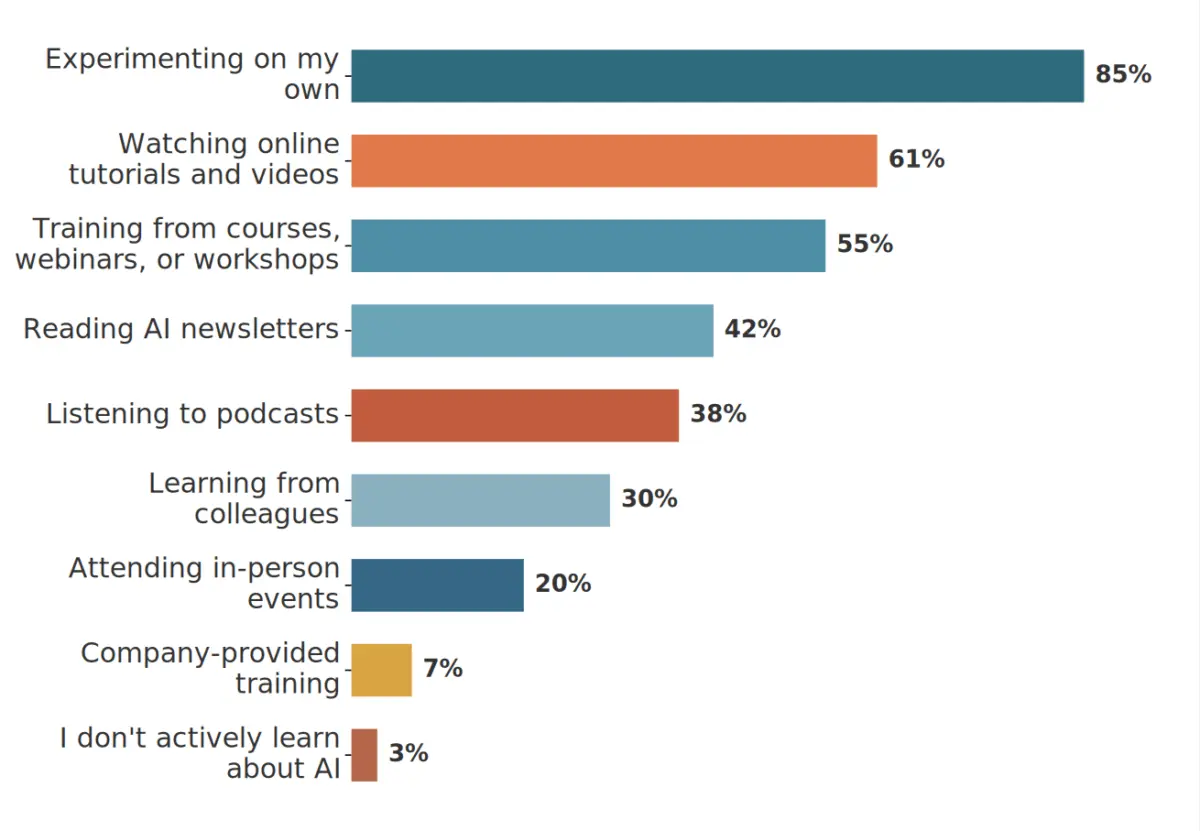
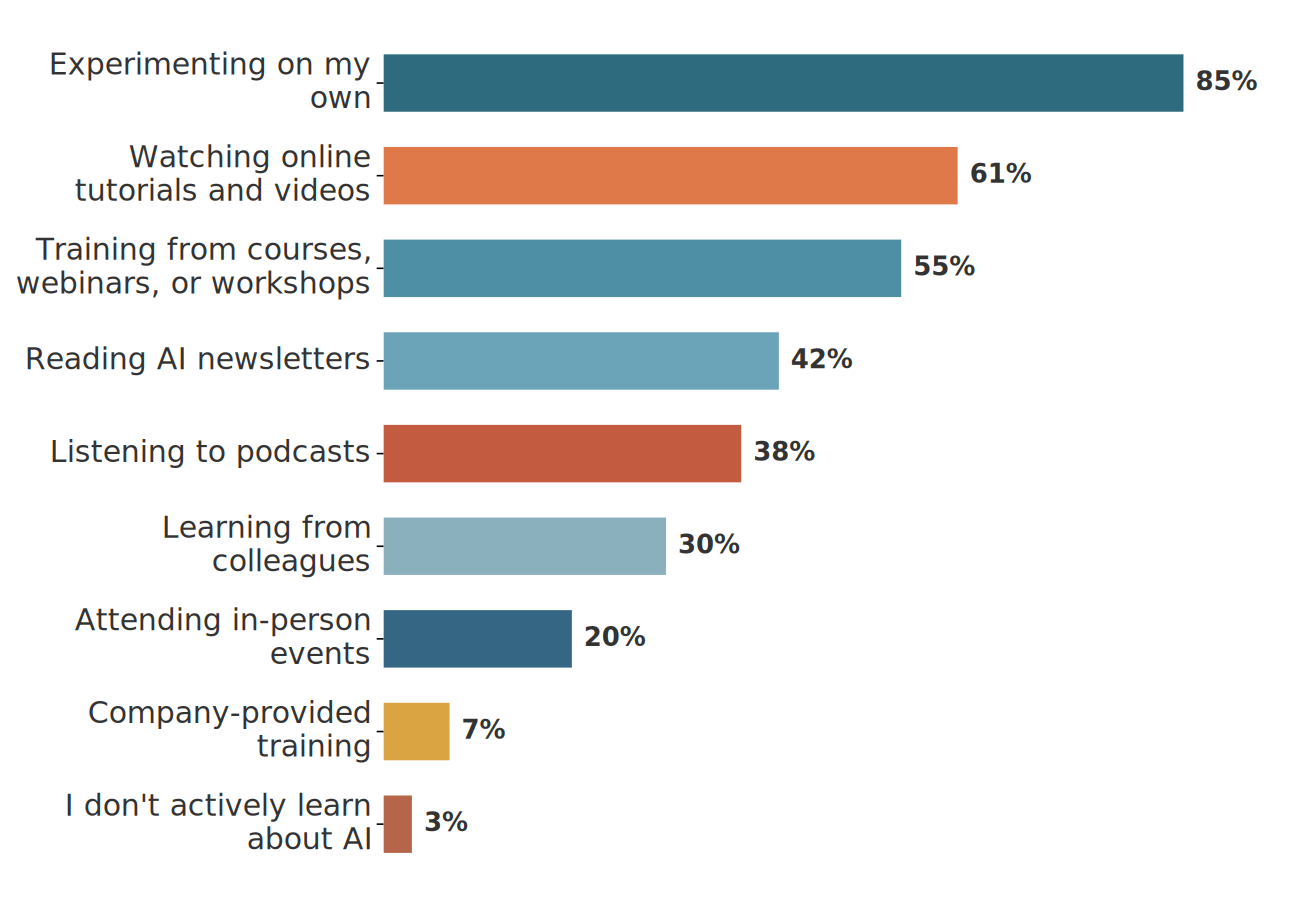
As basic models proved their utility, organizations quickly outgrew free tiers. However, rather than corporate procurement departments stepping in to provision enterprise-wide licenses, the financial burden shifted heavily onto the end-user. According to the 2026 data, 53% of marketers now fund their AI tools out of their own pockets, with 85% paying for software subscriptions in some capacity. Furthermore, corporate training programs remain virtually nonexistent: 85% of professionals learn how to leverage AI entirely through independent experimentation, while a paltry 7% receive formal, company-provided training.
Phase III: The Democratization of Autonomy (2026)
Today, small business owners have bypassed bureaucratic hurdles entirely. When asked who drives AI adoption within their organizational structures, 55% of respondents answered simply: "Me." This DIY ethos has allowed lean teams to outpace traditional corporate bureaucracies constrained by compliance reviews, committee approvals, and lengthy training cycles. Small businesses, by nature of their agility, have found that the chaotic, self-taught world of AI implementation suits their operational DNA perfectly.
3. Supporting Context & Metrics: The Value Paradox and Emerging Frontiers
While the qualitative sentiment surrounding artificial intelligence is overwhelmingly positive, the 2026 metrics reveal fascinating paradoxes, particularly concerning measurable return on investment (ROI) and the uneven adoption of media formats.
The Productivity-Measurement Gap
There is universal agreement regarding AI’s ability to clear administrative bottlenecks. 86% of marketers report that AI saves them significant time, and an identical 86% confirm measurable boosts in daily productivity.
Yet, when asked to provide hard financial proof or concrete metrics justifying these tools, a striking disconnect appears:
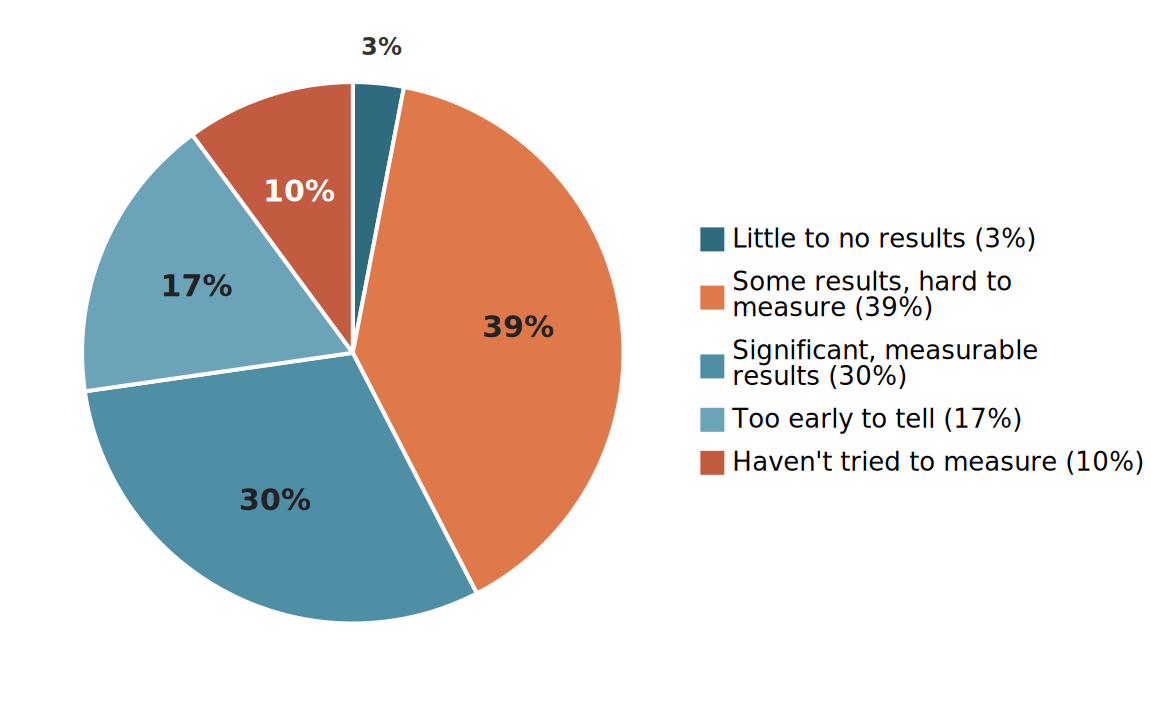
Only 30% of respondents can point to significant, quantified results.
39% experience undeniable qualitative improvements but lack the tracking mechanisms to prove them.
10% have made no attempt whatsoever to measure AI’s impact.
How Marketers Prove AI Value:
Quantifiable Results: [████████████████] 30%
Qualitative (Unmeasured): [██████████████████████] 39%
No Attempt to Measure: [██████] 10%
This measurement gap represents an open playing field for analytical small business owners. Those who establish clear key performance indicators (KPIs)—such as tracking hours saved per week, cost-per-content reductions, or velocity of campaign deployment—will instantly separate themselves from the 70% of competitors operating purely on intuition.
Content Disparities: Text vs. Video
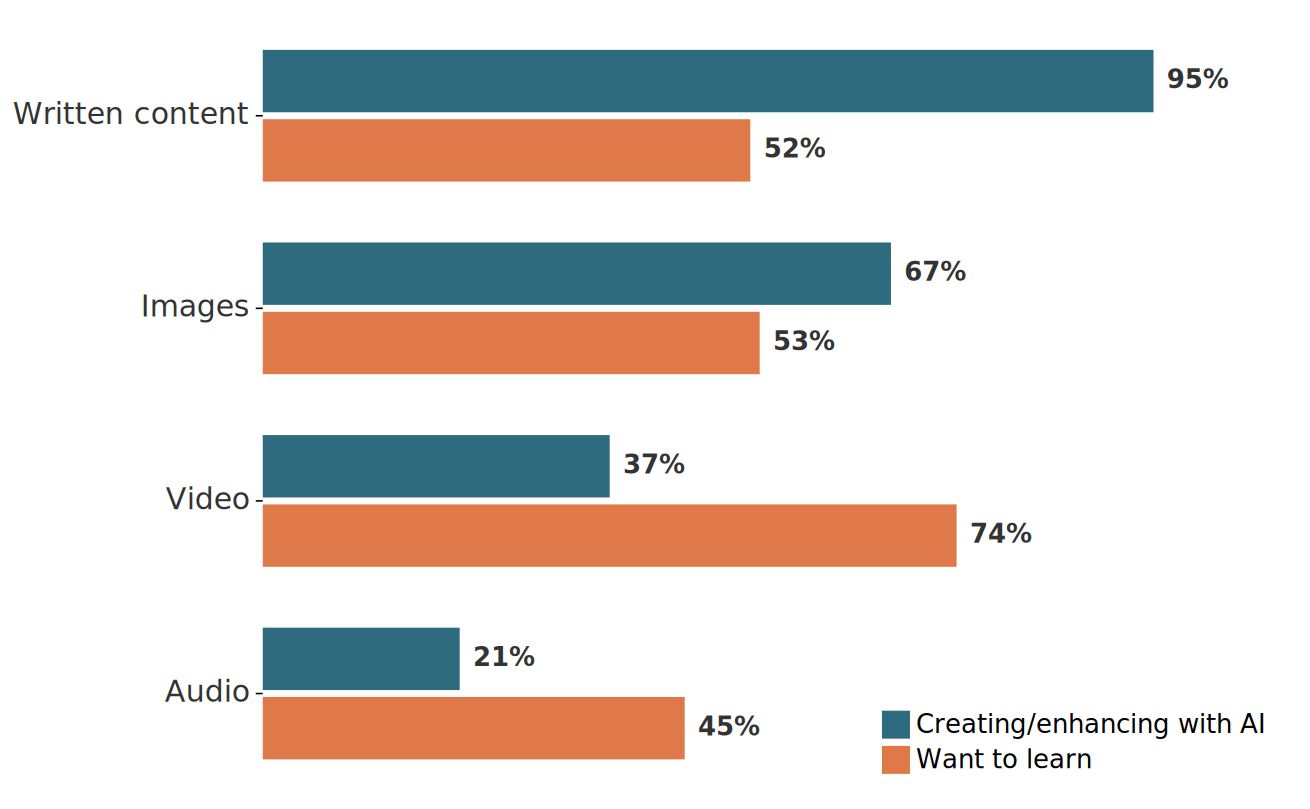
While text-based AI integration is nearly ubiquitous at 95% adoption, multimedia formats reveal massive structural gaps.
Image Creation: Surged dramatically, growing from 39% adoption in 2024 to 67% in 2026.
Video Generation: Lags significantly behind at just 37% adoption.
However, consumer and professional demand for video is reaching a fever pitch. 74% of marketers state that AI video creation is the single top skill they want to learn, creating a massive 37-point deficit between market desire and current operational capability. Small businesses willing to embrace basic AI-driven video tools today will capture disproportionate attention across social media channels long before their competitors catch up.
4. Official Statements and Industry Insights
Reflecting on the overarching implications of the 2026 data, industry leaders emphasize that the narrative surrounding artificial intelligence must shift away from generalized hype and focus strictly on operational leverage.
Michael Stelzner, founder of Social Media Examiner and architect of the annual industry report, noted during the release of the data:
"We surveyed marketers to find out how they’re actually using AI—not the hype, not the headlines, but the real story. Since 60% of our respondents come from businesses with 10 or fewer people, this isn’t enterprise research. This is your world. If you start tracking how AI impacts your output—even something as simple as hours saved per week or pieces of content produced—you’ll be ahead of 70% of marketers who can’t do that yet."
Stelzner further underscored that the democratization of digital tools has leveled the playing field between multi-million-dollar corporations and kitchen-table enterprises. By eliminating the high cost of specialized creative labor through automated workflows, AI grants small teams the operational bandwidth of agencies twice their size.
5. Future Outlook: The Dawn of Autonomous AI Agents
As the business community looks toward the horizon, the conversation is rapidly shifting from generative text assistants to autonomous workflows. A brand-new metric tracked in the 2026 report evaluates the emergence of AI agents—software systems capable of executing complex, multi-step tasks without requiring constant human intervention at every intermediate prompt.
Currently, daily utilization of AI agents remains in its infancy, with only 11% of professionals using them regularly and 24% actively experimenting. However, future intent signals a massive wave of upcoming disruption:
44% of marketers plan to adopt AI agents but have not yet initiated implementation.
Combined, 79% of professionals are either utilizing or actively planning to integrate agents into their tech stacks.
74% rank learning how to manage AI agents as their absolute top educational priority.
What This Means for Lean Teams
For small business owners, the rise of autonomous agents portends a structural transformation in workforce economics. Where scaling a business previously required linear hiring to handle customer inquiries, database maintenance, email sequence management, and analytics tracking, AI agents promise horizontal scalability.
Imagine delegating entire operational workflows—such as monitoring incoming leads, drafting tailored proposals, scheduling follow-ups, and updating CRM dashboards—to background software agents that operate continuously. This is not distant science fiction; it is the immediate trajectory mapped out by the 2026 data.
Conclusion: Actionable Steps for the Small Business Owner
The data from the 2026 AI Marketing Industry Report delivers a clear mandate for small businesses:
Formalize Metrics: Move beyond the "feeling" of productivity and begin tracking hours saved and output volume to justify software expenditures.
Close the Video Gap: Bypass saturated text markets by experimenting with accessible AI video tools to capture untapped audience demand.
Prepare for Agents: Keep a close eye on autonomous agent frameworks that will soon manage routine administrative and marketing tasks, freeing lean teams to focus strictly on high-level strategy and client relationships.
The tools are accessible, the learning curve is entirely self-driven, and the momentum is undeniable. For the agile small business, the AI revolution is no longer coming—it is already here.