Executive Overview
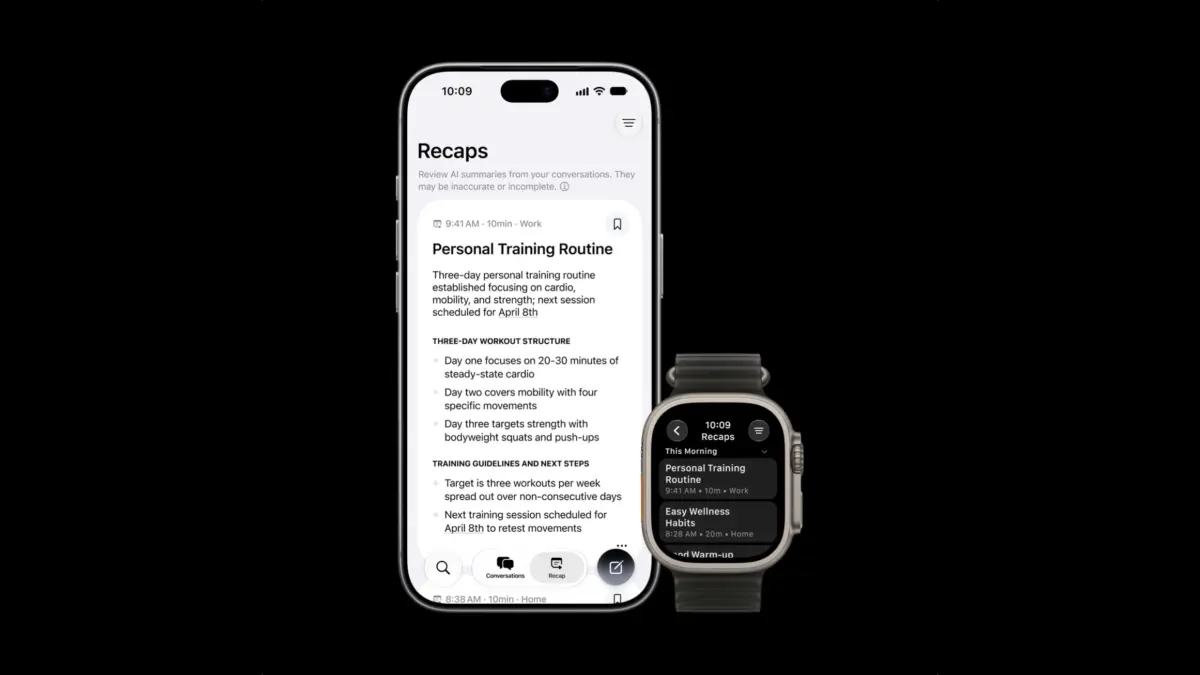
At its latest hardware showcase, Apple unveiled a sweeping suite of audio intelligence features designed for the newly announced Apple Watch Series 12 and Apple Watch Ultra 4. At the center of this update is "Siri Recap," an ambient, always-on meeting notetaker that runs on-device. This feature positions the Apple Watch not just as a health and fitness tracker, but as an active, passive-listening productivity hub.
By leveraging the local processing power of the Series 12 and Ultra 4 hardware, Siri Recap listens to ambient conversations to automatically generate structured titles, summaries, and action items directly within the Siri ecosystem. Alongside this flagship productivity tool, Apple introduced "Live Rewind"—a feature allowing users to instantly retrieve the last 15 seconds of missed conversation—as well as upgraded environmental sound recognition and an instant-identification Shazam engine designed to rival Google’s long-standing "Now Playing" feature.
While these updates mark a significant leap forward in wearable ambient computing, they also push Apple into a complex debate over privacy, surveillance, and consent. Although Apple has built strict privacy guardrails into the architecture—including end-to-end encryption, local processing, and the exclusion of raw audio storage—the introduction of an always-listening, summary-generating device on millions of wrists raises unprecedented ethical and legal questions.
Detailed Chronology of Apple’s Audio Intelligence Suite
The rollout of these audio features marks a deliberate transition for watchOS, moving from user-initiated interactions (such as tapping a button or speaking a direct command) to passive, continuous environmental processing. Below is a detailed breakdown of the capabilities introduced for the Apple Watch Series 12 and Ultra 4.
[Ambient Audio Input] ──► [On-Device Neural Engine] ──► [Feature Processing]
                                                              │
       ┌──────────────────────────────┬───────────────────────┴──────────────────────┐
       ▼                              ▼                                              ▼
[Siri Recap]                  [Live Rewind]                                 [Environmental Awareness]
• Continuous listening        • 15-second buffer                            • Continuous acoustic analysis
• Structured summarization    • Double-press Crown trigger                  • Siren, alarm, baby cry alerts
• On-device local database    • End-to-end encrypted transcript             • Automatic background Shazam
1. Siri Recap: The On-Wrist Meeting Notetaker
Siri Recap is designed to act as a silent, continuous scribe for the user’s daily life. Rather than requiring users to manually open a voice memos app or initiate a recording, the Apple Watch can remain in an active, ambient listening state.
- How it Works: Using the watch’s integrated microphone array, Siri Recap analyzes spoken dialogue within physical proximity. The system filters out background noise and targets human speech.
- The Output: Instead of delivering a raw, word-for-word transcript, the on-device Apple Intelligence model parses the conversation to generate three distinct components: a descriptive title, a high-level narrative summary, and a bulleted list of key points or action items. These are synced to the Siri app on the user’s paired iPhone or iPad.
- User Control: To mitigate privacy concerns, Apple allows users to configure the feature’s operational parameters. Users can choose to keep Siri Recap "always on," establish a customized schedule (e.g., active only during scheduled work hours), or disable the feature entirely.
2. Live Rewind: Instant Conversational Recall
Recognizing that human attention is frequently divided, Apple introduced "Live Rewind." This feature addresses the common scenario of missing a brief instruction, a name, or a critical piece of context during a conversation.
- The Trigger: By double-pressing the Digital Crown, users can instantly summon a transcription of the preceding 15 seconds of audio.
- Under the Hood: The Apple Watch maintains a temporary, rolling 15-second audio buffer in its volatile memory (RAM). This buffer is constantly overwritten. When the Digital Crown is double-pressed, this buffer is processed by the local neural engine, converted to text, and presented as a quick-read notification on the watch face.
3. Environmental Sound Recognition and Ambient Shazam
Apple’s new audio suite also enhances safety and environmental awareness through continuous acoustic analysis:
- Critical Sound Alerts: The Series 12 and Ultra 4 can identify specific, high-priority acoustic signatures—such as screaming, sirens, smoke alarms, doorbells, or a crying baby—and deliver haptic and visual alerts to the user. This is particularly valuable for users with hearing impairments or those wearing noise-canceling headphones.
- Background Shazam: In a direct bid to match a key feature of Google’s Pixel ecosystem, the new Apple Watch models feature background music identification. The watch periodically samples ambient music, matching acoustic fingerprints against an on-device database of popular tracks, allowing users to identify songs without needing to raise their wrist or wake the device.
Supporting Context, Hardware Requirements, and Competitive Metrics
The deployment of continuous, on-device audio processing represents a significant engineering challenge, requiring a delicate balance between computational power and thermal and battery efficiency.
Hardware Dependencies: The S12 and Ultra 4 Advantage
Apple has restricted Siri Recap and Live Rewind to the Apple Watch Series 12 and Ultra 4. According to internal technical briefings, these features rely on the advanced Neural Engine embedded within Apple’s latest system-in-package (SiP) silicon.
Previous generations of the Apple Watch lack the memory bandwidth and specialized tensor processing units required to run large language models (LLMs) locally without draining the battery in a matter of hours. The new S12 chip features an upgraded neural architecture optimized for low-power, continuous inferencing, allowing the watch to maintain a standard 18-hour battery life even with ambient listening enabled.
The Competitive Landscape: Apple vs. Google and Third-Party Startups
With these announcements, Apple is positioning itself to capture market share from both established tech giants and a fast-growing ecosystem of AI hardware and software startups.
| Feature / Metric | Apple Watch (Siri Recap / Live Rewind) | Google Pixel Watch (Now Playing / Recorder) | Third-Party Apps (Granola, Circleback) | Dedicated AI Wearables (Limitless, Humane) |
|---|---|---|---|---|
| Primary Form Factor | Smartwatch (Integrated) | Smartwatch (Integrated) | iOS/watchOS App (Third-Party) | Dedicated Pendant / Pin |
| Processing Location | On-Device (Local) | Cloud / On-Device Hybrid | Cloud-Based | Cloud-Based |
| Subscription Cost | Free (Included with hardware) | Free (Included with hardware) | Subscription-based ($10-$20/mo) | Subscription-based ($19-$30/mo) |
| Always-On Summary | Yes (Siri Recap) | No (Manual recorder only) | No (Requires manual activation) | Yes |
| Privacy Model | End-to-End Encrypted / No Raw Audio Saved | Google Cloud Privacy | Third-Party Cloud Policies | Proprietary Cloud Encryption |
Apple’s entry into this space poses an immediate threat to dedicated AI productivity wearables, such as the Limitless Pendant or the Humane AI Pin. By integrating these capabilities directly into the Apple Watch—a device millions of consumers already wear—Apple eliminates the need for users to carry a secondary, single-purpose device or pay a monthly subscription fee.
Furthermore, while third-party Apple Watch apps like Granola and Circleback have successfully offered meeting summarization, they are constrained by watchOS’s developer API limitations, which restrict deep, continuous system-level background processing. Apple’s native integration bypasses these limitations entirely.
Technical Privacy Safeguards vs. Real-World Privacy Risks
Because always-listening devices are a frequent target for privacy advocates and regulators, Apple dedicated a significant portion of its announcement to detailing the security architecture supporting Siri Recap and Live Rewind.
The Technical Guardrails
Apple’s privacy strategy relies on a combination of hardware-level isolation and cryptographic security:
- No Raw Audio Storage: Apple emphasized that raw audio recordings are never stored on the device’s permanent flash storage, nor are they transmitted to Apple’s servers. The audio buffer used for Live Rewind resides strictly in volatile memory (RAM) and is overwritten every 15 seconds.
- No Speaker Identification: Siri Recap does not attempt to identify or label individual speakers by name. The summaries generated refer to participants generically (e.g., "Speaker 1," "Speaker 2"), preventing the creation of biometric voiceprints.
- End-to-End Encryption: When summaries or Live Rewind transcripts are synced to iCloud to be viewed on other Apple devices, they are protected by end-to-end encryption. Only the user’s authenticated devices hold the keys to decrypt the text summaries.
[Ambient Audio]
       │
       ▼
[Volatile RAM Buffer] ──(No Raw Audio Saved to Disk)──► [On-Device LLM Parser]
       │                                                          │
       ▼                                                          ▼
[Overwritten in 15s]                                      [Generic Text Summary]
                                                            ("Speaker 1", "Speaker 2")
                                                                  │
                                                                  ▼
                                                       [End-to-End Encrypted Sync]
                                                                  │
                                                                  ▼
                                                       [User Devices Only (Decrypted)]
The Legal and Ethical Gray Areas
Despite these robust technical safeguards, the deployment of Siri Recap introduces complex legal and social challenges.
- Two-Party Consent Laws: In many jurisdictions globally (including several U.S. states such as California, Florida, and Massachusetts), it is illegal to record or capture confidential communications without the consent of all parties involved. While Apple’s system does not save the audio recording, the generation of a detailed, written summary of a private conversation may still run afoul of these statutes. Courts have yet to establish a clear precedent on whether an AI-generated text summary constitutes an unauthorized "recording" or "intercept" of an oral communication under wiretapping laws.
- The Illusion of Privacy: Even if raw audio is inaccessible, the text summaries themselves can contain highly sensitive personal, medical, or corporate information. If a user’s Apple account is compromised, or if a device is unlocked by an unauthorized party, these detailed logs of daily conversations could be exposed.
- Social Friction: The presence of an always-listening device on a colleague’s or friend’s wrist could create social discomfort. Unlike a smartphone, which must be actively held or placed on a table to record, a smartwatch is passive and inconspicuous, making it difficult for others to know when their words are being processed and summarized.
Future Outlook: The Dawn of True Ambient Computing
The introduction of Siri Recap and Live Rewind represents a major milestone in Apple’s broader ambient computing strategy. By moving away from a transactional model of technology—where a user must explicitly type, tap, or speak to a device—Apple is preparing consumers for an era of context-aware, invisible computing.
As Apple Intelligence matures, it is highly likely that these audio intelligence features will expand beyond summarization. Future iterations of watchOS could see Siri proactively offering contextual suggestions based on ambient conversations. For example, if the watch detects a user scheduling a lunch meeting during a casual conversation, it could automatically draft a calendar invitation or suggest a restaurant location without any manual input.
However, the success of this transition depends on Apple’s ability to navigate the inevitable regulatory scrutiny and win consumer trust. As international data protection agencies examine the implications of always-listening wearables, Apple’s commitment to on-device processing and strict user control will face its most rigorous test yet. What is certain is that the wrist has officially become the primary battleground for the next generation of personal, artificial intelligence.