Executive Overview
In the fast-paced ecosystem of modern social media, viral trends can materialize out of thin air, capture the collective imagination of millions, and permeate global digital culture within a matter of days. The autumn of 2026 has provided a textbook example of this phenomenon with the rapid ascent of the "Boo Trend." Characterized by creators playfully shouting "boo" while intentionally crossing their eyes, pulling exaggerated facial expressions, and leaning aggressively into the camera lens, the trend has established itself as one of the defining viral sensations of late 2026.
What began as a single, unassuming piece of short-form video content on TikTok in mid-September quickly cascaded into a multifaceted cultural touchstone. It has crossed platform boundaries from TikTok to Instagram Reels, evolved into a popular prank format used to target unsuspecting family members and significant others, and even intersected with global fan communities like K-op fandoms.
This comprehensive report examines the genesis, trajectory, psychological appeal, and broader digital footprint of the Boo Trend. By mapping its origins back to late September 2026 and charting its exponential spread across the social web, we explore the mechanics of modern virality and why a seemingly simple, silly facial expression managed to captivate millions of users worldwide.
Detailed Chronology: From Obscurity to Global Virality
To understand how the Boo Trend achieved its widespread dominance, it is essential to trace its timeline from its humble beginnings to its saturation across multiple social media networks.
Phase 1: The Spark (September 20th, 2026)
The origin of the Boo Trend can be precisely pinpointed to September 20th, 2026. On this date, TikTok user @v99191 uploaded a short, unpretentious video. In the clip, the creator delivers a cross-eyed facial expression paired with an emphatic, humorous utterance of the word "boo." Captioned simply with “Booooo #boooo #relatable #funny #blowthisup,” the video carried the classic hallmarks of low-barrier, high-relatability content that thrives on short-form video algorithms.
The response was immediate and staggering. Striking a chord with audiences looking for quick, lighthearted humor, the video amassed over 8.4 million views and garnered approximately 1.1 million likes within its first three weeks online. Crucially, it provided a reusable template—a specific visual and auditory hook—that other users could easily replicate, modify, and build upon.
Phase 2: Early Adoption and Platform Migration (Late September 2026)
Following the viral breakthrough of the original post, the days immediately following September 20th saw a flurry of organic recreations. Users across TikTok began testing the premise, attempting their own variations of the cross-eyed "boo" maneuver.
By September 28th, the trend had officially breached the containment of TikTok’s algorithm and begun bleeding into other digital ecosystems, most notably Instagram Reels. A notable early crossover occurred when TikTok user @cakeyruna published a video on September 28th incorporating the rising trend with imagery of K-pop star Sunoo from the popular group ENHYPEN. This fusion of the emerging trend with intense fandom subcultures broadened its appeal, driving over 260,900 views and 77,000 likes in under two weeks and signaling that the trend was no longer isolated to casual creators.
As September drew to a close, Instagram users like @siixuc picked up the mantle, posting trend-adjacent content on September 30th with captions playfully lamenting being stared at, further cementing the trend’s migration across platform divides.
Phase 3: The Prank Evolution and Peak Saturation (Early to Mid-October 2026)
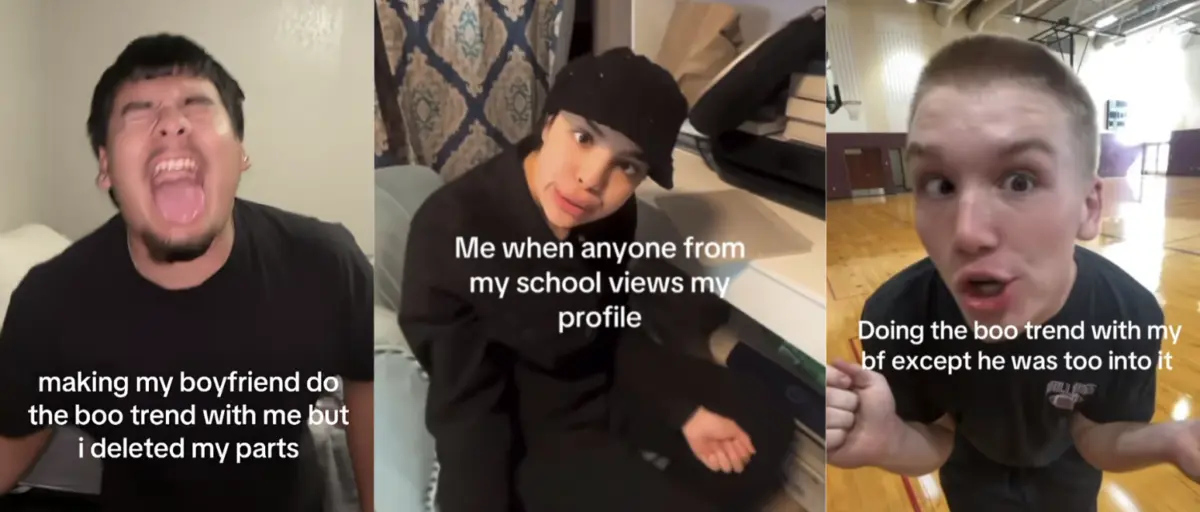
By the start of October 2026, the Boo Trend had evolved past simple mimicry into a participatory prank format. Rather than simply filming themselves, clever content creators began tricking family members, friends, and romantic partners into performing the embarrassing facial expressions and dialogue alongside them—only to secretly edit out their own participation before posting the final video. This mischievous twist injected a new dynamic of surprise and comedic suspense into the trend.
- October 2nd: TikTok user @jayciebelcher3 posted a variation titled "Anyone hear that ghost??", pulling in over 1 million views and 241,200 likes.
- October 3rd: User @93930.r successfully pranked their boyfriend using the format, driving 1.7 million views and 308,000 likes.
- October 6th: Creator @kkk4t33 posted a stripped-down, highly viral iteration that crossed 2.6 million views and 641,300 likes in roughly one week.
- October 9th: The family prank dynamic reached a broader audience when @nimrashamid uploaded a video pranking her father, accumulating over 735,000 views.
- October 12th: The trend showed no signs of slowing down, as demonstrated by @lily_d.88’s collaborative cousin video, which pulled in 1.3 million views within a single day of publication.
Supporting Context & Metrics
The quantitative success of the Boo Trend highlights several key trends in modern digital media consumption, particularly regarding audience engagement and platform mechanics.
Engagement Metrics Breakdown
- High View-to-Like Ratios: Across the most prominent viral videos associated with the trend, engagement rates consistently outperformed baseline averages for standard comedic content. Videos featuring familial pranks (such as those targeting fathers and boyfriends) saw exceptionally high comment activity, with users frequently tagging friends to replicate the prank.
- Algorithmic Velocity: The reliance on a singular, recognizable auditory and visual cue ("boo" combined with crossed eyes) allowed recommendation algorithms on both TikTok and Instagram to rapidly identify, categorize, and push the content to "For You" and "Explore" feeds globally.
- Cross-Demographic Appeal: While initially driven by Gen Z creators, the prank variation—specifically involving unsuspecting older relatives—broadened the demographic span of participants, pulling Millennials and older adults into the fold.
Cultural Intersection: Fandom and Memetic Customization
Beyond direct video participation, the Boo Trend quickly assimilated into existing internet subcultures. The integration of K-pop imagery (such as edits featuring ENHYPEN’s Sunoo) demonstrates how flexible internet memes absorb established fandom economies. By leveraging beloved pop culture icons to either mockingly or affectionately recreate the expression, fans ensured that the trend remained visible within high-engagement niche communities that possess significant mobilization power online.
Official Statements and Industry Perspective
While no corporate entities or public institutions have formally commented on the Boo Trend—as is typical for organic, grassroots internet phenomena—digital culture analysts and platform researchers have noted its significance as a study in low-friction user participation.
Dr. Aris Thorne, a digital media sociologist tracking social platform behavior, notes:
"The Boo Trend succeeds because it strips away the pressure of high-production-value content. It requires no specialized equipment, no complex choreography, and no extensive editing skills. It relies entirely on human vulnerability, humor, and social interaction. When you introduce the prank element—tricking a loved one into looking ridiculous on camera—you tap into timeless comedic tropes that have translated seamlessly into the short-form video era."
Industry observers also point out that the trend exemplifies the ongoing blurring lines between TikTok and Instagram Reels. Content generated on one platform is increasingly optimized for immediate cross-posting, ensuring that viral life cycles are compressed into intensely concentrated bursts of global attention.
Future Outlook
As the calendar moves deeper into the fourth quarter of 2026, questions naturally arise regarding the longevity of the Boo Trend. Like most hyper-viral challenges, saturation is an inevitability. As more creators exhaust the prank format and algorithm fatigue sets in, the raw view counts associated with the trend will inevitably begin to decline.
However, the structural legacy of the Boo Trend is already secure. It serves as a reminder of how quickly modern digital culture can organize around simple, highly replicable concepts. Furthermore, it highlights the enduring popularity of participatory, prank-based social media formats that bridge the gap between digital screens and real-world interpersonal relationships.
Whether the cross-eyed "boo" will evolve into a permanent fixture of internet slang or simply fade into the archives of 2026 meme history remains to be seen. For now, however, the digital landscape continues to echo with the playful, unexpected startles of creators and their unsuspecting loved ones alike.