Executive Overview
In the upper echelons of Silicon Valley, a quiet yet profound psychological shift has taken hold. For decades, the archetype of the tech titan was defined by hyper-minimalism—the uniform of the turtleneck, the tailored hoodie, or the interchangeable gray Brunello Cucinelli t-shirt. These austere aesthetics signaled intellectual superiority, relentless drive, and the cold rationality of enterprise. Today, however, that era of austere tech-bro elitism is giving way to something far more calculated: the deliberate cultivation of harmlessness.
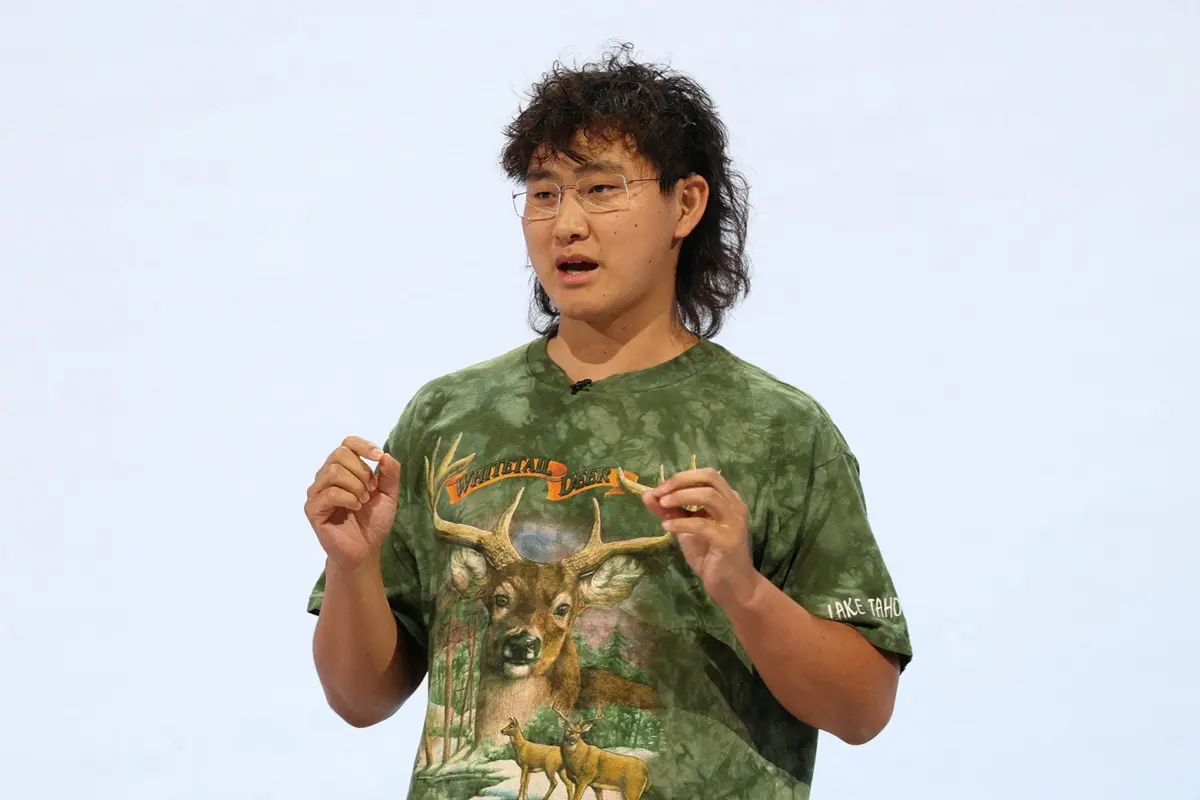
The modern tech executive does not want to look like an untouchable overlord; they want to look like your cousin’s underemployed friend who spends too much time on Reddit, or a high-school dropout who manages a local record store. Nowhere is this bizarre aesthetic pivot more evident than in the recent public rebrand of Alexandr Wang. Once known as the razor-sharp, crisp-collared wunderkind who became a billionaire at 24 via Scale AI, Wang recently took the stage at Meta Connect sporting a thrifted "Lake Tahoe" camo t-shirt, black joggers, Realtree-collaboration Crocs, wire-rimmed glasses, and a shaggy mullet.
This is not a random wardrobe malfunction or an accidental stumble into middle-aged irony. It is a masterclass in countersignalling—a deliberate visual strategy designed to disarm public skepticism at a time when big tech companies are facing unprecedented scrutiny over invasive surveillance, monopolistic overreach, and the militarization of artificial intelligence. When the architects of our digital future dress like indie-rock roadies, it forces an urgent question: Why are some of the wealthiest and most powerful men on the planet suddenly spending so much energy trying to look completely harmless?
Detailed Chronology: The Evolution of the Tech Uniform
To understand the current wave of deliberate dowdiness, one must trace the evolutionary history of Silicon Valley fashion, where every stylistic pivot has mirrored a corresponding shift in regulatory pressure, public trust, and corporate ambition.
Phase I: The Hoodie and the Outsider (Early 2000s–2010s)
In the formative years of the web-two era, Mark Zuckerberg famously wore a fleece hoodie embossed with a binary code logo to investor meetings. This was anti-establishment signaling. It communicated that the wearer did not play by Wall Street rules and prioritized code over convention.
Phase II: The Silicon Valley Corporate Uniform (2010s–2020s)
As startups matured into trillion-dollar monopolies, a sleek corporate minimalism took over. Steve Jobs set the template with his black Issey Miyake mock turtlenecks. Later, Jeff Bezos traded his early-aughts bookish cardigans for tailored vests and custom athletic wear after transforming Amazon into a global logistics behemoth. Mark Zuckerberg locked himself into form-fitting, hyper-expensive neutral t-shirts. During this period, the goal was legitimacy—showing the world that these companies were serious, mature, and safe stewards of global infrastructure.
Phase III: The Era of Counter-Signalling and Aesthetic Chaos (Present)
Today, that veneer of corporate respectability has become a liability. With the public increasingly anxious about the societal tolls of generative AI, labor exploitation, and mass data harvesting, looking too polished is toxic.
Wang’s recent appearance at Meta Connect is the pinnacle of this new era. After Meta sunk $14.3 billion to buy Wang into its ecosystem—tasking him with spearheading its advanced artificial intelligence lab following Scale AI’s massive valuation milestones—Wang stood before an international audience looking less like a chief AI officer and more like a part-time DJ with a nicotine habit.
When online commentators initially dissected his Meta Connect outfit—speculating that his shoes were Balenciaga and his pants were Prada, totaling upwards of $3,500—Wang quickly jumped onto X (formerly Twitter) to set the record straight. He posted an annotated breakdown revealing that his graphic t-shirt was a $30 thrift find, his underwear cost $5 from Calvin Klein, and his footwear consisted of $60 Realtree hunting-collaboration Crocs. By aggressively de-escalating the monetary value of his wardrobe, Wang performed a carefully choreographed populist ritual: he asked the public to look past his immense wealth, his multi-billion-dollar corporate backing, and the profound societal footprint of his technology, and instead focus on the fact that he wears cheap underwear and shops at thrift stores.
Supporting Context & Metrics: The High Stakes of Artificial Intelligence
The aesthetic shift toward down-to-earth casualness does not exist in a vacuum. It coincides with an era where major technology firms are aggressively integrating AI tools into every facet of human life while weathering intense regulatory and ethical storms.
Scale AI and Labor Practices
Wang’s historical foundation, Scale AI, achieved a $7.3 billion valuation when Wang was just 24 years old, making him a poster child for modern tech wealth. However, the company’s meteoric rise was fueled by immense, often invisible human labor. Scale AI has faced intense scrutiny, including investigations into labor practices surrounding its vast workforce of overworked and underpaid contract workers—many located in developing nations—who manually label the hyper-specific data sets required to train large language models.
The Militarization of Silicon Valley
Wang is hardly alone in adopting a counter-signalling wardrobe to mask high-stakes, controversial endeavors. Consider Palmer Luckey, the 34-year-old co-founder of Anduril. Luckey builds autonomous military hardware, surveillance systems, and AI-driven defense infrastructure for the Pentagon. Yet, his signature public uniform consists almost exclusively of tropical Hawaiian shirts and cargo shorts.
Similarly, Palantir—a firm heavily contracted by immigration enforcement agencies like ICE to build surveillance platforms such as "ImmigrationOS"—has begun embedding trendy chore coats into its corporate merchandise lines, even as it publishes aggressive manifestos defending its work in military combat technology.
Meta’s Ecosystem Expansion
At Meta, the stakes are equally existential. The company has poured billions into artificial intelligence, rolling out the Meta Muse personal agent ecosystem, smart glasses embedded with computer-vision capabilities, and open-source coding models. These tools are designed to weave seamlessly—and perhaps invasively—into the daily habits of billions of users.
When Wang took the stage at Meta Connect to present updates to Meta Muse, he casually shared anecdotes about tracking user behavior—such as a user who broke their mother-in-law’s favorite china set or another planning a family vacation. The underlying message of the software is total integration into personal life. To sell that level of intimacy, the messenger cannot look like a cold, calculating technocrat. He has to look approachable, disheveled, and fundamentally non-threatening.
Official Statements & Industry Rhetoric
The ideological packaging of modern tech leadership relies heavily on folksy charm juxtaposed with hard-edged corporate domination.
During the Meta Connect keynote, Mark Zuckerberg shared the stage with Wang, wearing a custom graphic tee bearing the slogan: "Building is my love language." This rhetorical framing—borrowed from the therapeutic lexicon of pop psychology—recasts the aggressive amassing of market share, algorithmic data collection, and corporate consolidation as acts of emotional vulnerability and care.
Industry analysts note that this dual-track strategy is vital for user adoption. As public trust in tech platforms hits historical lows, executives must work overtime to manufacture relatability. By leaning into self-deprecating humor online—such as Wang correcting his followers about the price of his Calvin Klein underwear or reposting memes of cartoon mascots battling for market dominance—these executives create a parasocial bond with the public.
"We’re in an era of mask-off technocratic rule," industry critics observe. "We know that tech industries hold an unprecedented level of influence over our lives, amassing wealth and power never seen before in human history. But they still need us to keep using their products, and it’s easier to swallow those products when they’re handed to you by a guy dressed like an Oberlin theater dropout."
Future Outlook: The Mask-Off Technocracy
As artificial intelligence moves from experimental chat interfaces to fully autonomous personal agents capable of managing emails, finances, travel, and social interactions, the psychological battleground between tech companies and consumers will intensify.
The aesthetic choices of Silicon Valley leaders are early warning indicators of how these companies intend to navigate coming regulatory crackdowns and public pushback. Expect more intentional disheveledness, more thrift-store humblebrags, and more cartoon mascots designed to look friendly while operating complex, data-harvesting ecosystems underneath.
Ultimately, the billionaire in Realtree Crocs wants you to forget that beneath the ironic mullet and the cheap graphic tee lies an engine of unprecedented corporate and computational power. The clothes may change, but the mission remains unchanged: to integrate technology so deeply into human existence that questioning its safety feels like picking a fight with your quirky, harmless cousin.