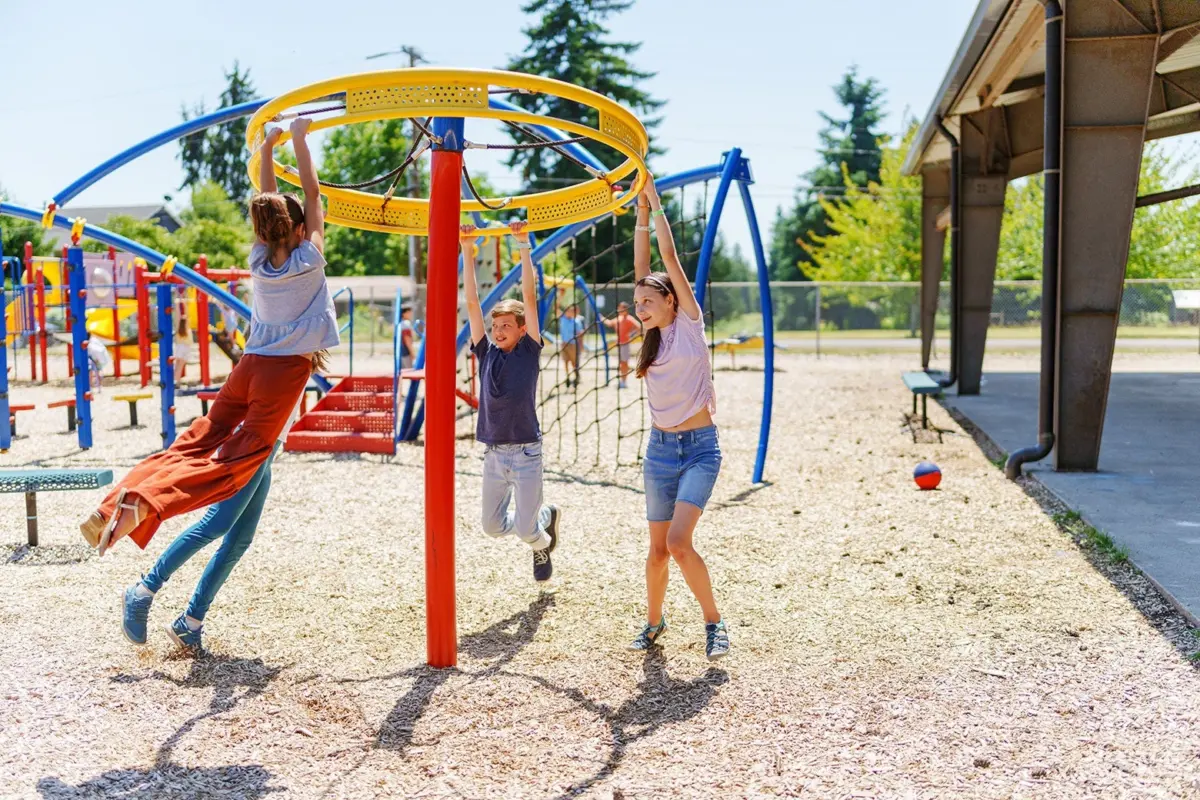
Executive Overview
As millions of students transition from the unstructured, open-ended days of summer to the rigorous demands of the K–12 academic calendar, a quiet crisis is taking shape in schools across the United States. While early childhood education has long recognized the developmental value of play, the standard American school day for adolescents is increasingly defined by sedentary confinement, relentless screen time, and an absence of unscripted physical activity.
For the roughly 54.4 million children enrolled in U.S. public and private schools, time spent socializing freely or moving outdoors has been steadily compressed. Many children are granted a mere 20 minutes of daily recess—if they receive any at all. While elementary schools occasionally protect these brief respites, middle and high schools routinely abandon recess altogether, replacing movement and unstructured play with continuous seat time, digital learning platforms, and high-stakes testing preparation.
This rigid approach to education persists despite a growing mountain of neuroscientific and pediatric evidence indicating that it is counterproductive. Young people and educators are returning to classrooms amid national anxiety over a prolonged learning recession, surging rates of youth mental health challenges, diminished attention spans driven by smartphones, and the encroachment of artificial intelligence into critical thinking.
In response, experts, researchers, and medical authorities are pushing for a paradigm shift. Newly updated guidance from the American Academy of Pediatrics (AAP) asserts that recess is not a frivolous reward or an optional break, but a fundamental biological and psychological necessity that should extend all the way through 12th grade. By examining the cognitive necessity of "wakeful rest," the systemic inequities in how recess is distributed, and real-world successes in reducing absenteeism through movement breaks, a compelling case emerges: letting teenagers goof off is not a distraction from learning—it is the very foundation of it.
Detailed Chronology & Policy Evolution: From the Playground to the High School Classroom
The marginalization of play within the American educational framework is a relatively modern phenomenon, accelerated by decades of policy decisions prioritizing standardized metrics over holistic development.
- 2013: The American Academy of Pediatrics issues its foundational policy statement on school recess, emphasizing its critical role in child development. However, this guidance predates the modern ubiquity of iPads, Chromebooks, and algorithm-driven educational software that now dominate both academic and social spheres.
- 2013–Present: Researchers identify the onset of a persistent "learning recession" affecting student achievement nationwide, coinciding with the rapid proliferation of smartphones, social media, and screen-based curricula.
- 2023: A landmark study of 153 low-income California elementary schools, conducted by researchers Hannah Thompson and Rebecca London, reveals stark disparities in recess allocation. The findings demonstrate that students in larger, lower-income schools receive significantly less recess time than their peers in smaller, wealthier districts—mirroring broader national racial and socioeconomic divides.
- 2024: Faced with soaring rates of chronic absenteeism—reaching 36 percent—Medford High School in Medford, Massachusetts, implements a radical daily intervention: mandatory "movement breaks" for high school students.
- May 2026: The American Academy of Pediatrics publishes updated guidance titled The Crucial Role of Recess in School. For the first time, the policy explicitly recommends that daily recess be integrated into the school day for all students through 12th grade, urging pediatricians to advocate for state-level protections.
- 2026 Legislative Shifts: States adopt patchwork policies regarding physical activity. Oklahoma doubles its elementary recess requirement to 40 minutes per day, while Pennsylvania mandates 30 minutes for full-day kindergarten through fifth grade. Meanwhile, high school students remain largely unprotected by statutory recess mandates.
- End of the 2025–2026 School Year: Medford High School reports a dramatic drop in chronic absenteeism, with rates falling from 36 percent down to 20 percent following the sustained implementation of daily movement breaks.
Supporting Context & Metrics: The Cognitive and Social Cost of Sedentary Schooling
To understand why high schoolers need recess, one must first examine the biological cost of keeping adolescents tethered to desks and screens for seven hours a day.
Modern teenagers navigate an environment saturated with digital stimuli. Yet, cognitive science consistently demonstrates that the human brain requires downtime to process and consolidate information. The AAP’s updated 2026 guidance highlights the concept of "wakeful rest"—a necessary neural state that occurs after the intake of new information. During wakeful rest, the brain steps back from active cognitive demands, allowing memories to stabilize, neural pathways to strengthen, and complex concepts to be fully retained.
When schools eliminate breaks in favor of uninterrupted instructional time, they work against basic human neurology. Research suggests that physical activity and movement directly improve information processing, executive function, attention span, and working memory. According to data from the Centers for Disease Control and Prevention (CDC), students who are physically active consistently exhibit better grades, higher school attendance, improved classroom behavior, and superior cognitive performance.
Furthermore, the denial of recess disproportionately harms vulnerable populations. Recent CDC data reveals that nearly a quarter of U.S. children live in neighborhoods devoid of a local park or playground, with a similar percentage lacking basic infrastructure like sidewalks or walking paths. For these young people, the schoolyard is often the only safe, reliable space available for physical activity and socialization.
When schools restrict recess or use it as a disciplinary tool—withholding outdoor time as punishment for poor classroom behavior—they exacerbate socioeconomic inequalities. Studies show that students of color and those attending underfunded, low-income schools routinely receive less recess time than their wealthier, predominantly white counterparts. This systemic deprivation compromises not only physical health, but also long-term academic achievement, including reading outcomes.
Official Statements & Expert Perspectives
Educational leaders, pediatricians, and youth advocates are increasingly vocal about the urgent need to reintroduce play and unscripted movement into adolescent education.
Denisha Jones, Executive Director of Defending the Early Years:
"We’re told, ‘Oh no, your kid needs an iPad in kindergarten.’ No, they don’t. They do not. To learn, children—and really people of all ages—need opportunities to play, create, and move."
Dr. Rebecca London, Sociology Professor at UC Santa Cruz and author of Rethinking Recess:
"There are no tracking systems [for recess laws]. I think the piece of it that’s really important is it gives parents something to fall back on. They can go back to their classroom teacher or their principal and say, ‘My child’s having recess withheld, and that’s against the law.’"
Jordan Dospil, Senior Content Specialist at the National Center for Families Learning (NCFL):
"We were trying to reach adults who are not comfortable being outside. Because if they’re not comfortable, then they’re not going to want to take their kids out. We really wanted to start with baby steps to get people used to outside and then go into letting your kids take the lead and learn from them."
Aisha Isabel, Program Director at Youth in Action:
"I always need breaks and discussions to be able to absorb material, and the only time I was able to have that was at recess. We would know we had a test after recess, so we’d practice or study together or just talk about it casually, in a way that helped us absorb it—not in a very structured, sit-down way, because that doesn’t help me. I think it’s important for adults who hold the structure to ask: How can joy come back into these systems? Because so much of school is sitting behind one another, standing and walking in lines, and learning in very specific ways. Joy isn’t a reward. Joy can be something we draw on when we’re going through obstacles."
Future Outlook: Reimagining the Secondary School Day
As school districts grapple with chronic absenteeism, declining mental health metrics, and questions surrounding the efficacy of over-digitized classrooms, the model pioneered by institutions like Medford High School offers a clear blueprint for the future. By recognizing that high schoolers—no less than kindergartners—require social connection, physical movement, and unstructured downtime, educators can transform sterile academic environments into vibrant communities.
The transition will not be simple. It requires dismantling entrenched administrative habits, pushing back against the commercialization of educational technology, and enacting rigorous state-level legislation that guarantees protected recess time through the 12th grade. Crucially, it requires enforcement mechanisms to ensure that mandates are honored rather than bypassed.
Ultimately, the argument for letting high schoolers goof off is an argument for humanizing education. When schools carve out space for teenagers to step away from their screens, breathe fresh air, laugh with their peers, and experience unbridled joy, academic performance follows naturally. Joy is not an indulgence to be earned after all work is complete; it is the vital fuel that sustains lifelong learning and resilience.