Executive Overview
In the hyper-accelerated, schedule-crammed ecosystem of New York Fashion Week, the traditional runway presentation has increasingly become a casualty of its own industrial efficiency. Standard-issue industrial warehouses in Manhattan, brutalist Brooklyn shipping yards, and sterile white-box galleries have long served as the default backdrops for seasonal collections—spaces optimized primarily for social media grid aesthetics and rapid-fire press turnarounds rather than conceptual resonance.
Enter Collina Strada. For its Spring/Summer 2027 collection, titled Detour, the New York City-based label under the creative direction of Hillary Taymour executed a definitive physical and ideological departure from the asphalt-bound norms of the contemporary fashion circuit. Trading the urban grid for the bucolic expanse of Upstate New York, the brand staged its latest presentation across the rolling, wind-swept lawns of the Storm King Art Center.
Located 58 miles north of Manhattan, the 500-acre outdoor museum—home to one of the most comprehensive and celebrated collections of large-scale contemporary outdoor sculpture in the United States—provided a living, breathing canvas for a collection intimately concerned with the intersections of environment, human architecture, and sartorial narrative. While the term "whimsy" risks over-saturation in the lexicon of 2026 fashion commentary, it remains the most direct descriptor for the Midsommar-esque, sun-drenched energy that defined the afternoon.
Yet, beneath the dreamlike, pastoral surface lay a rigorous conceptual exercise. Detour was not merely an aesthetic escape from the city; it was a calculated logistical challenge to the industry’s status quo, an interrogation of how clothing interacts with natural typography, and a masterclass in experiential showmanship. Complete with exaggerated silhouettes, cascading ruffles, sun-catching sequins, a surprise live performance by pop icon Carly Rae Jepsen, and an unscripted finale dance party that dissolved the barrier between model and spectator, the event cemented Collina Strada’s status as one of the most intellectually agile and environmentally conscious houses operating today.
This report provides a comprehensive examination of the Detour presentation, detailing the chronological progression of the day, contextualizing the event within the broader metrics of sustainable fashion and geographic decentralization, analyzing official statements from the creative leadership, and projecting the future implications of this pivotal runway moment for the broader fashion industry.
Detailed Chronology: A Day at Storm King Art Center
Phase I: The Great Migration North
The choreography of Detour began long before the first look touched the grass. Breaking convention with the standard urban transit schedule, invited editors, buyers, celebrities, and influencers were asked to relinquish their morning rush across the East River bridges in favor of a synchronized fleet of coaches bound north for Orange County, New York.
As the Manhattan skyline faded in the rearview mirror, replaced by the dense deciduous canopies of the Hudson Valley, the collective mood shifted. The anxieties of the fashion week calendar—late-night parties, overlapping show invites, and the relentless pressure of the digital news cycle—seemed to recede with every mile marker. Upon arrival at Storm King Art Center, attendees were greeted not by screaming paparazzi lining a concrete barricade, but by the quiet majesty of monumental steel and stone sculptures rising organically from manicured fields and native meadows.
The scale of the institution immediately recalibrated the human perspective. Under a brilliant, unyielding midday sun, the 500-acre landscape served as an equalizer. Guests navigated gravel paths and open fields, forced to slow their pace, feel the uneven terrain beneath their footwear, and physically acclimate to the environment. It was an intentional disruption of the passive spectator experience, setting a contemplative tone for what was to follow.
Phase II: The Unfolding of Detour
As the seating arrangements—minimalist, unobtrusive, and scattered organically across a sloping hillside—filled with guests, the show commenced without a traditional elevated runway. Instead, the models’ pathway was defined purely by the natural topography of the land: traversing swaths of waist-high grass, ducking beneath the shadow of massive outdoor art installations, and navigating the vast openness of the sky.
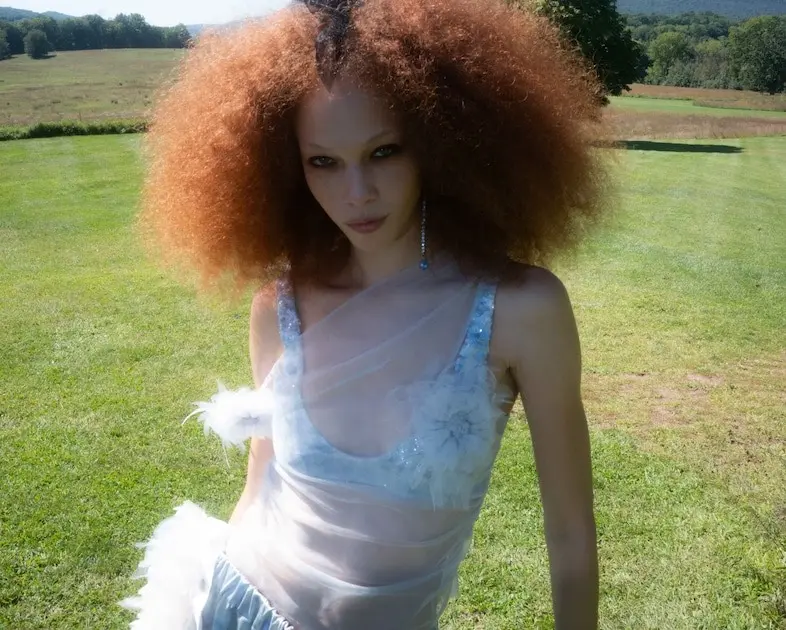
Taymour’s design narrative for Spring/Summer 2027 immediately declared itself through a series of striking sartorial contrasts. The garments were engineered to dialogue with their surroundings rather than fight against them. Exaggerated silhouettes billowed in the upstate breeze, while yards of ethereal ruffles echoed the organic contours of the surrounding flora. Soft, sun-washed pastels offered a muted counterpoint to the vibrant green of the landscape, punctuated by explosive moments of high-shine sequins that caught the fierce afternoon sunlight, casting glittering reflections across the grass and onto the faces of front-row spectators.
The styling championed freedom of movement. Garments were constructed to be lived in, run in, and blown about by the elements. The models did not march with the robotic, dead-eyed cadence typical of traditional urban fashion weeks; instead, they moved with a dynamic, fluid energy, their bodies weaving through steel sculptures and undulating terrain, embodying the very essence of the collection’s title.
Phase III: The Crescendo and the Finale
Just as the audience settled into the hypnotic rhythm of the presentation, the show pivoted into an unforgettable sensory crescendo. A surprise performance by pop luminary Carly Rae Jepsen electrified the clearing. Jepsen, sporting a voluminous, flowing pink Collina cape that caught the wind like a sail, delivered a jubilant vocal performance that bridged the gap between avant-garde presentation and immersive pop spectacle.
The true emotional apex of the day, however, arrived with the grand finale. Eschewing the conventional line-up where models take a polite final bow before retreating backstage, the Detour finale broke all protocol. As the final notes of the music swelled, the entire cast of models broke into an uninhibited sprint down the rolling fields, charging toward the center of the amphitheater to join Jepsen in a sprawling, joyous post-show dance party.
Within moments, the rigid boundary separating the cast from the audience dissolved entirely. Editors, buyers, and guests were swept up in the momentum, joining the dancers on the grass. As laughter echoed across the sculpture park and dust kicked up from the trampled turf, the prevailing sentiment among the damp, sun-kissed crowd was unanimous: the 58-mile journey north had been more than worth it. In an industry perpetually trapped in digital simulation and concrete confinement, Detour proved the ancient adage true—sometimes, you simply need to touch grass.
Supporting Context & Metrics: The Economics and Ecology of Leaving Manhattan
While the visual poetry of Detour captivated the fashion press, the logistical and strategic realities of staging a major runway show 58 miles outside New York City warrant rigorous examination. As sustainability reporting becomes an indispensable metric for modern luxury brands, Collina Strada’s geographical pivot offers a compelling case study in eco-conscious event production.
The Carbon Footprint Paradox
At first glance, transporting hundreds of fashion industry professionals 58 miles north via motorcoach might appear to contradict the tenets of low-emission event planning. However, a comparative analysis of urban versus rural fashion show production reveals a more nuanced picture.
Traditional urban shows require staggering amounts of energy: climate-controlling massive industrial warehouses for mere hours, constructing temporary sets that are routinely dismantled and sent to landfills immediately after the final look, and managing localized traffic congestion that idles thousands of vehicles. By partnering with an outdoor institution like Storm King Art Center, Collina Strada bypassed the need for heavy indoor construction, relying instead on natural architectural assets.
| Production Element | Traditional Urban Show (Manhattan/Brooklyn) | Collina Strada Detour (Storm King Art Center) |
|---|---|---|
| Primary Venue Type | Climate-controlled industrial warehouse / raw space | Open-air outdoor museum and sculpture park |
| Set Construction | High waste; custom temporary walls, lighting rigs, and seating built from scratch | Minimal waste; natural landscape and existing permanent art installations utilized |
| Energy Consumption | Intensive HVAC, heavy grid power draw for theatrical lighting | Natural daylight; minimal localized power requirements |
| Audience Transit | Fragmented rideshares and private cars across city boroughs | Synchronized charter coach transit system |
| Material Lifecycle | Single-use set materials frequently discarded post-show | Zero structural footprint left on protected sculpture grounds |
The Psychological and Economic Impact on Buyers and Press
Beyond environmental metrics, Detour addresses a growing phenomenon within the fashion economy: "show fatigue." By the midpoint of New York Fashion Week, invited guests are routinely subjected to up to five disparate presentations a day, rushing across borough lines in gridlocked traffic, leading to sensory overload and diminished engagement with the garments.
By forcing a collective pause—a literal and figurative detour—Collina Strada achieved what psychologists call "attentional restoration." Removed from the frenetic pace of Manhattan, buyers and editors were placed in a state of relaxed alertness. Industry analysts noted that post-show orders and media engagement metrics for collections presented in immersive, contemplative environments consistently demonstrate higher dwell times on digital platforms. The disruption of routine creates a memorable sticky factor that standard runway shows struggle to replicate in an era of infinite digital scrolling.
Official Statements & Creative Philosophy
To fully understand the impetus behind Detour, one must examine the intellectual framework established by creative director Hillary Taymour and the Collina Strada team. The show notes provided to attendees serve not merely as descriptive program text, but as a manifesto for the brand’s evolving relationship with space, garment, and consumer psychology.
The Creative Director’s Manifesto
In the official show notes, Taymour articulated the conceptual architecture underpinning the Spring/Summer 2027 collection:
"We wanted to make a show that wasn’t just hosted by a museum, but inspired by the way you experience one. Detour is about immersing the clothes into the landscape. Bodies move through grass, steel, sky, sculpture, and each other. It’s about the paths we take, the paths we’re told to take, and what happens when you decide to go somewhere else."
This statement encapsulates the dual rebellion that defines Collina Strada. On one hand, it is a rebellion against the linear, hyper-standardized path of the fashion calendar—the predictable circuit of locations, silhouettes, and consumer expectations. On the other hand, it is a physical embrace of kinetic architecture. By casting the human body as a mobile sculpture moving among stationary monumental art pieces, Taymour invited viewers to re-evaluate clothing not as static objects hanging on a rack or rigid garments locked to a concrete runway, but as dynamic, living entities shaped by wind, gravity, and terrain.
Institutional Collaboration
The partnership with Storm King Art Center also marks a significant evolution in how fashion houses collaborate with cultural institutions. Rather than treating a museum as a passive backdrop or renting a gallery wing for a closed-door cocktail hour, Collina Strada integrated its presentation into the very ethos of the sculpture park.
Storm King, renowned for fostering a profound dialogue between art and the natural world since its founding in 1960, found an ideological ally in Collina Strada’s eco-centric design ethos. The brand’s ongoing commitment to utilizing deadstock materials, locally sourced textiles, and regenerative production methods aligned seamlessly with an institution dedicated to environmental preservation and open-air stewardship. The collaboration signals a growing trend where fashion houses seek out non-traditional cultural partners, moving past commercial art galleries into ecological sanctuaries.
Future Outlook: What Detour Signals for the Industry
As the dust settles on the rolling lawns of Storm King Art Center and the fashion world turns its collective gaze toward subsequent seasons, the reverberations of Collina Strada’s Spring/Summer 2027 presentation are already being felt across the industry. Detour serves as a harbinger of several critical shifts in how runway shows will be conceptualized, produced, and experienced in the latter half of the decade.
1. The Decentralization of Fashion Week
For decades, the geographic centralization of fashion weeks in global capitals—New York, London, Milan, and Paris—has been treated as an immutable law of commerce. However, rising urban real estate costs, tightening municipal regulations, and an increasing desire among independent labels to distinguish themselves from corporate mega-brands are accelerating the decentralization of the runway.
Collina Strada’s successful execution of a major off-site presentation proves that the global press corps and key retail buyers are willing to travel for a genuinely compelling conceptual experience. We can anticipate a rising wave of satellite shows—designer presentations migrating to regional landmarks, ecological preserves, and architectural marvels far beyond city limits—transforming fashion week from a localized urban festival into a series of destination events.
2. Experiential Storytelling Over Algorithmic Optimization
In recent years, runway production has frequently been compromised by the tyranny of the "Instagram/TikTok box"—shows engineered explicitly to provide visually isolated, easily digestible 15-second loops for social media algorithms, often at the expense of the physical audience’s experience.
Detour subverted this dynamic entirely. While the event generated unprecedented digital chatter, its power stemmed from its scale, its unpredictability, and its total immersion in the physical world. The wind in the models’ hair, the tactile sensation of the grass, the unexpected sprint across the field, and the shared joy of the post-show dance party could not be fully captured by a smartphone screen. This points toward a future where progressive brands invest in deep, memory-making experiential design rather than superficial, short-lived visual spectacles.
3. Sustainability as a Spatial Practice
As environmental scrutiny intensifies, sustainable fashion can no longer be confined to material sourcing alone; it must encompass the entire lifecycle of a brand’s operations, including public presentations. Collina Strada has consistently pushed the envelope by proving that ecological responsibility and high-concept creativity are not mutually exclusive.
By utilizing existing natural landscapes and partnering with ecological preservation sites, brands can dramatically reduce the carbon footprint and material waste associated with seasonal presentations. Detour establishes a new operational blueprint—one where fashion honors, rather than dominates, the earth it walks upon.
Conclusion
Collina Strada’s Spring/Summer 2027 outing will be remembered not merely as a collection of garments, but as a cultural turning point. In an era where the fashion industry often feels trapped on a relentless, mechanized treadmill of commercial obligation, Hillary Taymour and her team chose to step off the path, scale a hill, and feel the earth beneath their feet.
Through meticulous planning, radical geographic daring, and an unwavering commitment to joyful, unscripted human connection, Detour reminded the fashion world why it fell in love with creation in the first place. As the models sprinted across the fields of Storm King Art Center under the wide upstate sky, they carried with them more than just the latest designs from a forward-thinking New York label—they carried a vision of what fashion could be when it dares to leave the concrete behind and embrace the wild, unpredictable expanse of the world.