Executive Overview
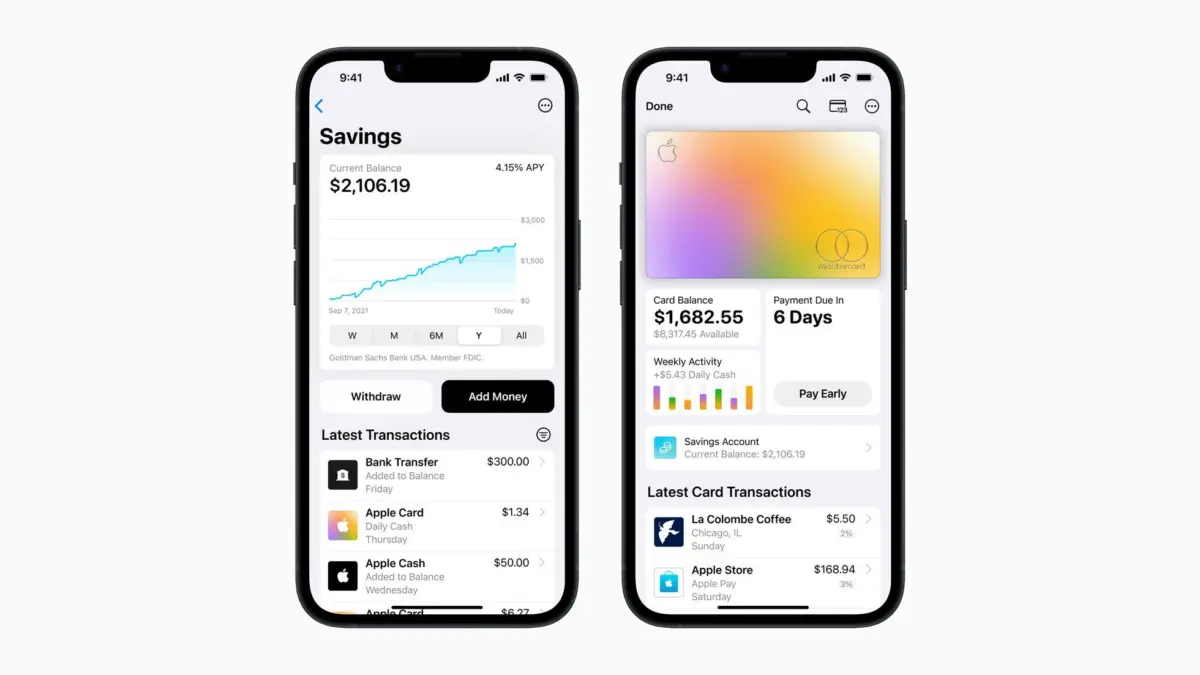
In a strategic escalation of its footprint within the financial technology sector, Apple Inc.—acting in close partnership with Wall Street banking titan Goldman Sachs—officially launched a high-yield savings account tailored specifically for Apple Card holders. Announced on a Monday morning, this new financial instrument allows users to automatically deposit their "Daily Cash" rewards into an account yielding an impressive 4.15% Annual Percentage Yield (APY).
The announcement sent immediate ripples through the traditional banking industry, contrasting sharply with the near-zero yields offered by legacy brick-and-mortar institutions. Beyond the automatic routing of cashback rewards, the service empowers users to deposit personal funds from external bank accounts, up to a maximum balance cap of $250,000, insured by the Federal Deposit Insurance Corporation (FDIC).
This bold move underscores Apple’s broader, calculated evolution from a hardware and software powerhouse into an integrated financial services ecosystem. Coming on the heels of the recent rollout of its "Buy Now, Pay Later" (BNPL) feature, the high-yield savings account represents a direct challenge to both traditional retail banks and burgeoning fintech competitors. By embedding frictionless financial tools directly into the iOS Wallet application, Apple is redefining how consumers manage, save, and grow their wealth in an increasingly digital-first economy.
Detailed Chronology: The Evolution of Apple’s Fintech Ambitions
To fully understand the significance of Apple’s high-yield savings account, it is necessary to examine the systematic and deliberate timeline through which the Cupertino-based tech giant has integrated itself into the global financial architecture.
The Foundation: Apple Pay and the Genesis of Wallet
Apple’s journey into consumer finance began in earnest in October 2014 with the introduction of Apple Pay. Initially met with standard industry skepticism regarding merchant adoption and consumer habits, Apple Pay gradually transformed contactless payments. By digitizing credit and debit cards and embedding them securely within the iPhone’s Secure Element, Apple established the foundational infrastructure required for deeper financial integration. Over the next several years, the Wallet app evolved from a digital passbook for boarding passes and movie tickets into a secure repository for identification cards, transit passes, and payment credentials.
The Apple Card Debut (2019)
In March 2019, Apple announced its first direct credit product: the Apple Card, created in partnership with Goldman Sachs and backed by the Mastercard network. The card was lauded for its minimalist titanium physical design, the complete absence of late fees, annual fees, or foreign transaction fees, and an uncompromising focus on privacy. Crucially, the Apple Card introduced "Daily Cash"—an instant cashback reward system that paid users back up to 3% on purchases, deposited directly onto their Apple Cash card every single day.
While the Apple Card successfully attracted credit-conscious consumers and tech enthusiasts, industry analysts viewed it as an introductory phase. The true architecture for a closed-loop financial ecosystem was still being laid out behind the scenes.
The BNPL Incursion (Early 2023)
Just weeks prior to the high-yield savings account announcement, Apple widened its financial product portfolio by launching "Apple Pay Later." This service allowed eligible users to split purchases into four equal payments spread across six weeks, entirely free of interest and late fees. By stepping into the short-term installment lending space, Apple positioned itself in direct competition with established fintech heavyweights such as Klarna, Affirm, and Afterpay. The move demonstrated Apple’s willingness to absorb calculated credit risks to drive higher transaction volumes through its hardware and payment networks.
The High-Yield Savings Account Launch (April 2023)
The logical next step in this progression materialized when Apple and Goldman Sachs unveiled the high-yield savings account. By linking the account directly to the Apple Card and the Wallet app, Apple closed the loop between spending and saving. Users no longer had to transfer their Daily Cash rewards to an external checking account or spend them immediately; they could now compound their rewards at a rate that outperformed the vast majority of traditional consumer savings products.
Supporting Context & Metrics: Analyzing the Financial Landscape
Apple’s entry into high-yield savings cannot be viewed in a vacuum. It arrives against the backdrop of shifting macroeconomic conditions, aggressive monetary policy, and a stark divide between modern digital platforms and legacy banking infrastructure.
The Macroeconomic Environment and Interest Rates
Following years of historic lows, central banks around the world—led by the U.S. Federal Reserve—rapidly increased benchmark interest rates to combat persistent inflation. While this aggressive monetary tightening increased borrowing costs for mortgages, auto loans, and credit cards, it also created an opportunity for savers. Suddenly, liquidity became valuable again, and financial institutions found themselves competing fiercely for consumer deposits.
Despite these macro shifts, traditional retail banks have been notoriously slow to pass higher yields on to everyday consumers. For instance, legacy giants like Bank of America have historically maintained standard savings account rates at a meager 0.01% APY.
By offering a 4.15% APY, Apple and Goldman Sachs positioned themselves aggressively within the market. While 4.15% is not mathematically the absolute highest yield available—with various online-only neo-banks and specialized financial platforms offering upwards of 4.5% to 5.0% during peak rate cycles—Apple’s offering occupies a unique psychological and functional sweet spot. It leverages unmatched convenience rather than raw rate leadership.
Comparative Analysis: Traditional Banks vs. Apple Savings
| Feature / Metric | Traditional Bank (e.g., Bank of America) | Apple / Goldman Sachs Savings Account |
|---|---|---|
| Average Savings APY | ~0.01% | 4.15% |
| Account Opening Time | Days (requires paperwork or branch visit) | Minutes (fully digital via iPhone) |
| Monthly Maintenance Fees | Often varies; requires minimum balance | $0 |
| Minimum Balance Requirement | Frequently requires $500–$2,500 to waive fees | $0 |
| Maximum Deposit Cap | Varies / High | $250,000 (FDIC Insured) |
| Reward Integration | None or manual redemption | Automated Daily Cash deposits |
The Mechanics of the Goldman Sachs Partnership
It is critical to note that Apple is not a chartered bank. Under U.S. federal law, technology companies cannot directly hold public deposits or issue regulated financial products without a banking license. To circumvent this, Apple partnered with Goldman Sachs—an institution seeking to diversify its revenue streams away from traditional investment banking and into consumer retail banking via its Marcus platform.
Goldman Sachs provides the underlying banking infrastructure, holds the deposits, and ensures compliance with federal banking regulations, including FDIC insurance limits up to the statutory $250,000 threshold per depositor. Apple, meanwhile, provides the user interface, customer experience design, and software integration that makes managing the account feel as effortless as checking the weather.
Official Statements and Industry Perspectives
The announcement generated immediate commentary from corporate leadership and financial analysts alike, highlighting the strategic intent behind the product.
The Apple Perspective
In an official corporate statement detailing the launch, Jennifer Bailey, Apple’s vice president of Apple Pay and Apple Wallet, articulated the company’s long-term vision:
"Our goal is to build tools that help users lead healthier financial lives, and building Savings into Apple Card in Wallet enables them to spend, send, and save Daily Cash directly and seamlessly — all from one place."
This statement underscores Apple’s core philosophy: friction reduction. By keeping the entire financial lifecycle—earning rewards, spending via credit, buying now and paying later, and accumulating interest—within a single, unified application on the iPhone, Apple effectively increases user retention within its hardware ecosystem.
The Financial Sector Reaction
Wall Street analysts and fintech commentators observed that Apple’s approach poses a subtle yet profound threat to traditional retail banking models. For decades, legacy banks relied on customer inertia. Millions of Americans kept their money in low-yield savings accounts simply because switching banks was tedious, required physical documentation, and lacked emotional engagement.
By contrast, an Apple user can open a high-yield savings account in under a minute directly from their iPhone, fund it immediately from an external checking account, and watch their cashback rewards compound automatically.
Furthermore, financial experts have noted that Goldman Sachs benefits immensely from gathering low-cost retail deposits, which serve as a stable source of funding for the bank’s broader lending operations. However, the partnership has also drawn scrutiny from industry watchers regarding customer service scaling and regulatory oversight, given Goldman’s recent scaling back of certain consumer credit ventures.
Future Outlook: Where Goes Apple Finance?
As Apple continues to weave its software and services fabric deeper into the daily lives of billions of global consumers, the high-yield savings account is unlikely to be its final financial frontier.
The Path to Financial Super-App Status
In international markets, particularly across Asia, "super-apps" like WeChat and Alipay have successfully consolidated messaging, social media, shopping, ride-hailing, and comprehensive wealth management into single platforms. While Apple has historically resisted the super-app label, its systematic rollout of Apple Pay, Apple Card, Apple Cash, Installments (BNPL), and now High-Yield Savings points toward an inevitable convergence.
Future iterations of Apple’s financial roadmap could theoretically include:
- Automated Investment Portfolios: Robo-advisory services allowing users to automatically invest savings into equities, exchange-traded funds (ETFs), or cryptocurrencies.
- Peer-to-Peer Lending and Shared Accounts: Expanding Apple Cash and Savings to support joint family accounts, automated bill splitting, and micro-loans among trusted contacts.
- Global Expansion: Scaling the high-yield savings account and Apple Card infrastructure beyond the United States into European, Asian, and Latin American markets, subject to local banking regulations and international partnerships.
Regulatory and Competitive Hurdles
Despite its immense market capitalization and unmatched brand loyalty, Apple faces significant headwinds. Regulatory bodies in the United States, the European Union, and elsewhere are maintaining heightened scrutiny over big tech companies entering financial services. Concerns regarding antitrust practices, data privacy, and systemic financial risk mean that every new financial product Apple launches will be met with rigorous regulatory audits.
Additionally, traditional banks are fighting back. Major financial institutions are upgrading their own mobile applications, boosting their own high-yield offerings, and lobbying regulators to examine the competitive advantages wielded by platform operators who control the underlying operating systems of smartphones.
Conclusion
Apple’s introduction of a 4.15% APY high-yield savings account in partnership with Goldman Sachs is far more than a routine product update. It is a calculated strategic maneuver that bridges consumer technology and institutional banking. By offering superior yields, unmatched user experience, and absolute friction reduction, Apple is teaching a new generation of consumers to expect more from their money—and ensuring that the iPhone remains the undisputed center of their financial lives.