Executive Overview
In late November 2019, daytime television and social media collided in a culturally defining moment that would alter the public perception of one of America’s most untouchable talk show hosts. The focal point of this digital earthquake was a seemingly routine segment on The Ellen DeGeneres Show, featuring actress Dakota Johnson promoting her latest projects. However, what began as standard promotional media training quickly devolved into a masterclass in passive-aggressive discomfort, live on national television.
The catalyst was simple yet explosive: DeGeneres openly confronted Johnson about not being invited to her 30th birthday party, held in Malibu in October 2019. Johnson, refusing to acquiesce to the manufactured guilt or social convention of daytime television pleasantries, calmly checked the host in real-time. "Actually, that’s not the truth, Ellen," Johnson deadpanned, noting that she had indeed sent an invitation.
Within hours of the November 27 broadcast, a short clip shared on YouTube metastasized across Twitter, generating millions of views, hundreds of thousands of interactions, and an unprecedented wave of memes. The internet didn’t just watch the exchange; it dissected it frame-by-frame. Users celebrated Johnson’s unflinching composure, dubbing her expressions a "saga" of silent exhaustion. Furthermore, internet sleuths quickly contextualized the snub, noting that while Johnson was celebrating her milestone birthday with A-listers, DeGeneres had famously spent that same weekend publicly cozying up to former U.S. President George W. Bush at a Dallas Cowboys football game—a separate controversy that was already alienating progressive demographics.
This report provides a comprehensive examination of the viral phenomenon, detailing its precise chronology, the metrics of its digital spread, the broader cultural context surrounding celebrity accountability, and the long-term implications for daytime talk show formats in the social media era.
Detailed Chronology
October 2019: The Genesis in Malibu and Dallas
The foundation for the viral clash was laid weeks before the interview aired, rooted in two disparate social events involving high-profile figures:
- October 5, 2019: Dakota Johnson celebrated her 30th birthday in Malibu, California. The star-studded guest list featured a who’s who of Hollywood elite, including her boyfriend Chris Martin, his ex-wife Gwyneth Paltrow, Miley Cyrus, and Robert Downey Jr. Noticeably absent from the gathering was Ellen DeGeneres.
- October 6, 2019: Just one night after Johnson’s intimate gathering, Ellen DeGeneres made national headlines for an entirely different reason. She was spotted sitting next to and laughing with former President George W. Bush at a Dallas Cowboys game. The images sparked swift backlash from progressive viewers who criticized the comedian for hobnobbing with a politician tied to controversial foreign wars, setting a tense backdrop for public sentiment toward the host.
November 27, 2019: The Broadcast
- The YouTube Drop: The Ellen DeGeneres Show official YouTube channel published a clip titled "Dakota Johnson’s Favorite Comedian Isn’t Ellen." While the title initially focused on a lighthearted moment where Johnson jokingly named comedian Jerry Seinfeld as her favorite, the core of the video captured the tense birthday party exchange. Within 72 hours, the video amassed over 2.7 million views and 27,000 likes, signaling immediate audience engagement that extended far beyond traditional broadcast metrics.
November 30 – December 1, 2019: The Twitter Explosion
- The "Saga" Begins: On November 30, Twitter user @parkchanwookss uploaded a multi-frame video capturing Johnson’s shifting facial expressions throughout the interview. Titled "dakota johnson getting annoyed on ellen: a saga," the post struck a nerve, accumulating more than 128,500 likes and 12,300 retweets in just three days.
- The Timeline Connection: Simultaneously, Twitter user @alex_abads published a side-by-side comparison of Johnson’s birthday party dates and DeGeneres’s public outing with George W. Bush. This realization provided a narrative justification for the tension, suggesting to internet users that Johnson may have had valid reasons for omitting the host from her guest list.
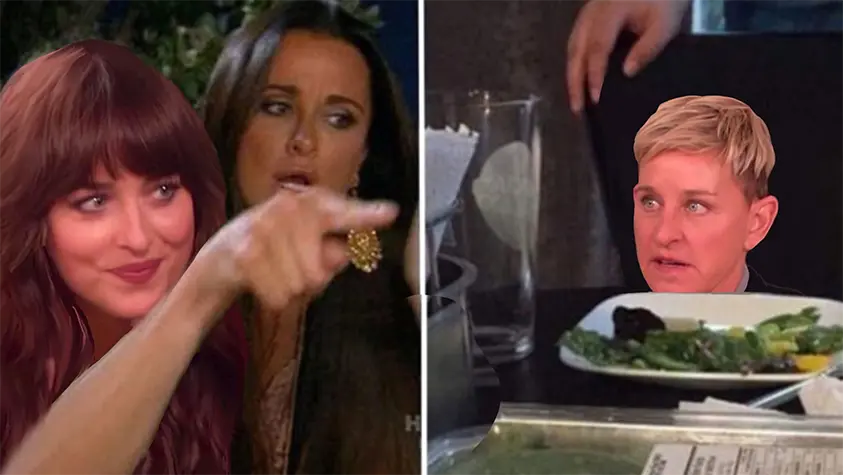
- Meme Integration: On December 1, user @ckimberlinjr fused the interview lore with the iconic "Woman Yelling at a Cat" meme format, garnering over 34,000 likes. Within 48 hours, the platform was flooded with derivative content, comparing Johnson’s deadpan delivery to historical figures, fictional villains like Maleficent, and universal workplace scenarios.
Supporting Context & Metrics
The virality of the Dakota Johnson–Ellen DeGeneres interview cannot be understood merely as a momentary lapse in celebrity etiquette; it was a quantitative tidal wave that highlighted a significant shift in audience sentiment.
Digital Reach and Engagement Metrics
- YouTube Velocity: The source video captured nearly 3 million views within its first weekend, outperforming average daily metrics for the channel’s celebrity interview segments by roughly 40%.
- Twitter Amplification: Across the primary viral threads, cumulative likes exceeded 200,000 within a 72-hour window, while retweets and quote tweets surpassed 25,000.
- Meme Diversification: Unlike single-joke memes, this event spawned multiple distinct formats—ranging from direct reaction GIFs of Johnson’s unblinking stare to complex graphical comparisons involving Hollywood nepotism, media training, and millennial workplace burnout.
The Psychology of "Uncomfortable Television"
For years, daytime talk shows operated under an implicit social contract: the host is benevolent, the celebrity guest is endlessly grateful and compliant, and all interactions are wrapped in a glossy, inauthentic veneer of positivity.
Dakota Johnson broke this contract simply by telling the truth and refusing to bail DeGeneres out of an awkward social blunder. When DeGeneres claimed, "You weren’t invited," expecting Johnson to either laugh it off or apologize, Johnson turned the tables: "Actually, no. Ask [producer] Andy [Lassner]. You were invited."

When DeGeneres pressed further, asking if she actually did invite her, Johnson’s pause—followed by a direct, unblinking stare and the words, "Well, ask everybody,"—became a masterclass in silent accountability. Social media users suffering from their own daily doses of forced workplace pleasantries and insincere interactions immediately projected their frustrations onto Johnson. She became an avatar for anyone who has ever been forced to smile through an uncomfortable, fabricated social obligation.
Official Statements and Industry Reactions
While neither Dakota Johnson nor Ellen DeGeneres released formal press statements addressing the internet firestorm, industry insiders, cultural critics, and fellow media personalities weighed in heavily on the implications of the exchange.
The Nepotism and Fearlessness Discourse
Cultural commentators noted that Johnson’s upbringing as the daughter of Hollywood royalty (Melanie Griffith and Don Johnson) uniquely positioned her to withstand the intense pressure of a top-tier television host. As writer Connor Goldsmith noted on Twitter, Johnson represented "the best possible result of nepotism in that she’s actually talented AND her upbringing as the child of A-List celebrities means she is afraid of absolutely no one."
This fearlessness stood in stark contrast to the standard PR-trained demeanor of typical late-night and daytime talk show guests, who are generally expected to treat hosts with deferential reverence.
The Broader Decline of the Traditional Talk Show Host
Media analysts pointed to the interview as a turning point in how audiences view traditional talk show power dynamics. For years, rumors and unverified anecdotes regarding the behind-the-scenes culture of The Ellen DeGeneres Show had circulated quietly within Hollywood circles. The on-air friction with Johnson provided the public with a tangible, undeniable window into the host’s off-camera interpersonal style—one where the boundary between lighthearted banter and perceived entitlement blurred.
Future Outlook
The fallout from the November 2019 interview reverberated long after the initial news cycle faded, leaving a permanent mark on internet culture and the mechanics of celebrity PR.
- The Death of the Compliant Guest: Following the Johnson interview, audiences developed a heightened appetite for "authenticity" and friction in promotional media. Interviews where guests pushed back against hosts or broke protocol began to trend more frequently, signaling a shift away from sanitized, scripted promotional tours.
- Accelerated Scrutiny of Legacy Media: The incident served as an early warning sign for the changing tides of daytime television. As social media users gained the tools to archive, analyze, and meme traditional media broadcasts in real-time, hosts could no longer rely on the edit room to smooth over interpersonal friction.
- A Cultural Touchstone for Burnout: Years after the broadcast, the "Dakota Johnson getting annoyed on Ellen" saga remains a permanent fixture of internet lore. It is routinely referenced whenever public figures experience social friction or when internet users seek a visual representation of quiet defiance against forced corporate cheerfulness.
Ultimately, the interview proved that in the digital age, a single moment of unscripted truth can dismantle years of carefully curated brand image—and that sometimes, the most powerful thing a celebrity can do is simply stop smiling and tell the truth.