Executive Overview
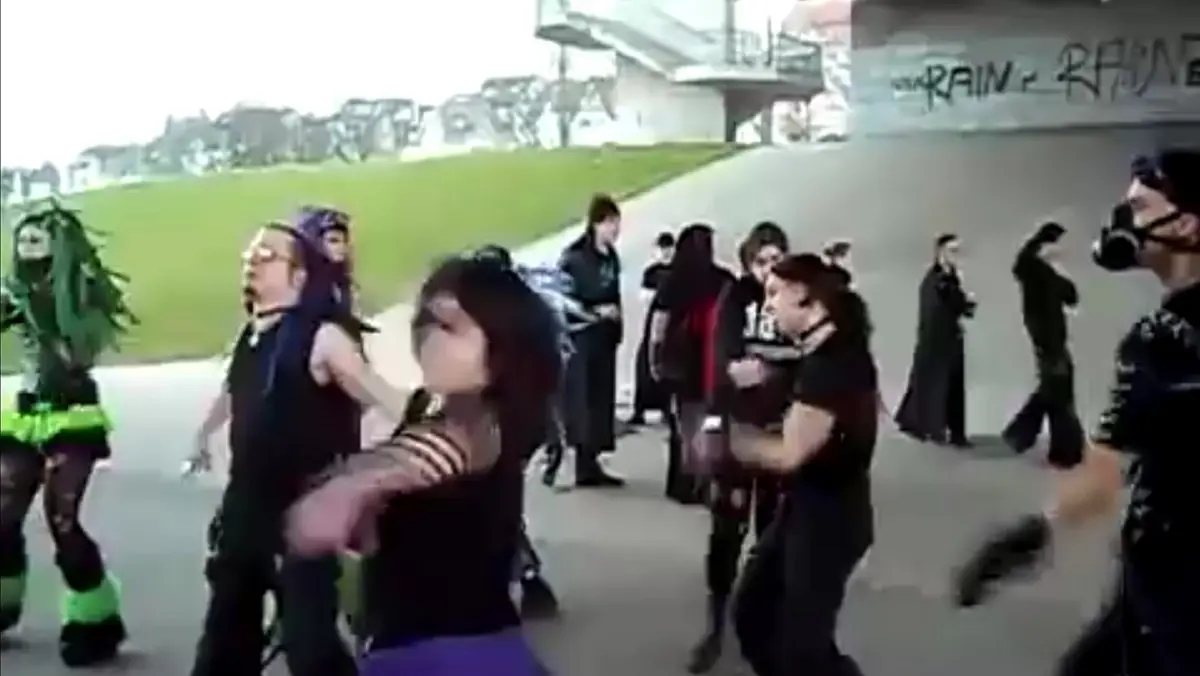
In the sprawling, volatile ecosystem of internet culture, few phenomena capture the absurd juxtaposition of niche subcultures and mainstream derision quite like the "Cybergoth Dance Remixes." Originating from a seemingly innocuous piece of user-generated footage uploaded to YouTube in September 2011, the meme centers on a group of young cybergoths—clad in neon hair extensions, gas masks, platform boots, and goggles—energetically performing industrial dance routines beneath a concrete overpass.
What began as a localized document of a European subcultural gathering rapidly morphed into a canvas for a classic internet trope: the "while I play unfitting music" format. By swapping the original harsh industrial and electronic body music (EBM) tracks with everything from upbeat 1990s movie soundtracks to soft rock and Latin dance anthems, internet creators transformed the earnest expression of a marginalized youth movement into viral comedy.
Over the course of more than a decade, this single piece of digital media has transcended its origins on early-2010s YouTube. It has migrated across Vine, Reddit, TikTok, and X (formerly Twitter), spawning alternate-angle footage discoveries, geographic pilgrimages via Google Earth, and millions of engagements. This retrospective explores the cultural trajectory of the Cybergoth Dance Party, detailing its unexpected viral lifespan, the mechanics of its comedic appeal, and its enduring legacy in the annals of digital folklore.
Detailed Chronology: From Düsseldorf Overpass to Digital Immortality
The Genesis: September 2011
The story of the phenomenon begins on September 7th, 2011, when YouTuber gNarLu cEe uploaded a video titled "Cybergoth Dance Party." The footage captured a group of teenagers and young adults fully immersed in the aesthetic parameters of the cybergoth subculture—a fusion of traditional goth fashion with cyberpunk, rave, and rivethead influences. Dancing with intense, militaristic precision to heavy industrial beats beneath an urban bridge, the participants demonstrated a distinct style of movement characterized by shuffling, waving glowsticks, and robotic gestures.
The video was initially received as a straightforward, if eccentric, window into European subcultural life. However, the sheer visual theatricality of the dancers—combined with the stark, mundane backdrop of a concrete highway overpass—planted the seeds for its comedic reinterpretation. Within five years, the original upload would quietly accumulate over 4.2 million views and nearly 12,000 comments, establishing a baseline audience of curious onlookers and internet historians.
The Remixed Wave and Subcultural Satire
It took merely two days for the internet to pivot from documentation to subversion. On September 9th, 2011, YouTuber griffin goodwin re-uploaded the footage, replacing the abrasive industrial soundtrack with "Cuban Pete," a bouncy, comedic song performed by Jim Carrey in the 1994 film The Mask. The comedic dissonance of solemn, gas-mask-wearing goths moving in strict synchronization to a lighthearted cinematic novelty track struck a chord.
On September 14th, 2012, the video found a new staging ground when Reddit user bodmon submitted it to the notoriously critical forum /r/cringe. This exposure exposed the clip to a broader demographic of internet users primed to mock alternative subcultures.
As the short-form video platform Vine rose to prominence in the mid-2010s, the meme found a natural home. On June 19th, 2014, Viner babyd0ll paired the dancers with Luke’s 1996 hip-hop track "Scarred," followed closely on June 24th by Viner Brisk God, who synced the footage to Rupert Holmes’ 1979 soft rock staple "Escape (The Piña Colada Song)." The trend became so pervasive that digital culture publication UPROXX published a feature on July 7th, 2014, titled "Goths Dance to Anything" is The Best Thing Happening On Vine Right Now.
The momentum continued unabated into the autumn. On September 3rd, 2014, YouTuber Idk Dontcare introduced the chaotic Mexican dance track "El Sonidito" by Hechizeros Band to the visual mix, amplifying the surreal energy of the clip. By June 18th, 2015, the meme crossed paths with another internet staple when YouTuber Nolan Arriaga published a Bill Nye the Science Guy theme song remix, cementing the cybergoth dancers as modular comedic actors capable of inhabiting any musical universe.
Geographic Discovery and Alternate Angles: 2022–Present
More than a decade after its initial upload, the meme experienced a geographic and archival renaissance. On December 6th, 2022, TikTok user @madcow published a viral video utilizing Google Earth to pinpoint the exact physical location of the original dance party. Through digital sleuthing, the user identified the site as Kaiser-Wilhelm-Ring in Düsseldorf, Germany, situated near the Oberkasseler Brücke (bridge). The revelation that this surreal internet touchstone occurred in a mundane European urban corridor resonated deeply with audiences, driving the TikTok video to over 6.6 million views and 1.4 million likes within a single month.
Concurrently, the internet’s insatiable appetite for archival completeness led to the unearthing of lost media associated with the event. On March 14th, 2011—months prior to the viral explosion—YouTuber CybertreffenNRW had uploaded footage depicting the moments immediately preceding the famous dance party, set to "Early Hardstyle" music.
Though it languished with modest view counts for over a decade, this alternate angle was rediscovered and submitted to the niche subreddit /r/DeepIntoYouTube by user Yeleywillonedaywin on December 12th, 2022. The rediscovery culminated on November 4th, when X user @chiweethedog reposted the extended clip with the caption: "Alternative angle of the famous ‘Cybergoth Dance Party’ video, showing more cybergoth dance moves to Early Hardstyle, ending where the famous one begins." The post captured over 60,000 likes, proving that the public’s fascination with the lore of the Cybergoth Dance Party remained potent well into its second decade.
Supporting Context & Metrics: The Anatomy of a Viral Meme
To understand why the Cybergoth Dance Remixes retained relevance for over twelve years, one must analyze the structural mechanics of the meme. It relies heavily on three core internet phenomena:
- Juxtaposition and Cognitive Dissonance: The visual presentation of cybergoth culture is intimidating, aggressive, and intensely serious. By pairing this aesthetic with upbeat, nonsensical, or deeply pedestrian music (such as "Escape (The Piña Colada Song)" or "Cuban Pete"), creators subvert expectations, turning an intimidating display of subcultural performance into harmless slapstick.
- Modular Video Assets: Because the original footage features clear, highly synchronized choreography against a static, non-descript background (the underside of a bridge), it serves as an ideal green-screen-adjacent template. Creators do not need sophisticated editing skills to replace the audio track; the visual clarity carries the joke independently.
- Subcultural Archiving and Digital Archaeology: The meme bridges the gap between passive consumption and active investigation. The transition from editing background tracks to locating the exact GPS coordinates on Google Earth and unearthing pre-event footage reflects a modern internet culture that treats historical memes like archaeological sites.
Quantitatively, the footprint of the phenomenon spans multiple platforms:
- YouTube: The foundational upload by gNarLu cEe sits at over 4.2 million views, while subsequent remixes and archival footage have collectively drawn millions more views across independent channels.
- TikTok: Geographic exploration content surpassed 6.6 million views and 1.4 million likes within weeks of posting in late 2022.
- X (Twitter) & Reddit: Archival rediscovery posts consistently pull thousands of upvotes and tens of thousands of likes, demonstrating multi-generational appeal among digital natives.
Official Statements & Community Perspectives
While the original dancers in the 2011 video largely remained anonymous figures caught in the early crosshairs of viral internet culture, the broader electronic music and industrial subcultures have had a complex relationship with the meme.
In the early 2010s, traditional industrial and goth communities frequently distanced themselves from the cybergoth subculture, viewing its neon aesthetics, gas masks, and hyper-energetic dancing as overly theatrical or derivative of mainstream rave culture. Consequently, the mass mockery facilitated by the "Cybergoth Dance Remixes" was initially viewed by some subcultural purists as an unfair caricature of industrial dance music (EBM).
However, as the years progressed, the sentiment shifted from derision to nostalgic irony. Speaking on internet culture forums and retrospective threads, commentators frequently note that despite the humorous edits, the dancers themselves exhibited genuine dedication, physical stamina, and community engagement. One long-time observer of industrial music culture noted on Reddit:
"Sure, it looked goofy out of context under a bridge in Düsseldorf, but those kids were entirely committed to their scene, their music, and their expression. The internet turned them into a punchline, but looking back a decade later, it’s hard not to respect the sheer unadulterated energy of it all."
Similarly, digital culture analysts have pointed to the phenomenon as an early blueprint for modern audio-swapping trends found on TikTok and Instagram Reels. Long before algorithms dictated which songs were paired with viral dances, community editors on YouTube and Vine were independently pioneering the format of audio-visual dissonance.
Future Outlook
As the Cybergoth Dance Party enters its teens, its trajectory offers valuable insights into the lifecycle of digital artifacts. Far from fading into the digital ether, the meme has successfully transitioned from an active viral trend into an established piece of internet folklore.
Future developments surrounding the meme are likely to follow two distinct paths:
- The Archival and Geographic Tourism Loop: With the precise location in Düsseldorf now mapped on Google Earth and documented by traveling content creators, the site functions as a physical monument to digital history. It is anticipated that internet creators will continue to make pilgrimages to the Kaiser-Wilhelm-Ring underpass, replicating the dances or documenting the location as a rite of passage.
- Generational Reinterpretation: As younger generations of internet users—who were children when the video was first uploaded in 2011—discover the footage through algorithmic resurfacing, new waves of remixes and format adaptations are inevitable. Whether through emerging short-form video platforms, AI-assisted video editing tools, or decentralized meme archiving projects, the cybergoths dancing under the bridge will likely continue to find themselves thrust into unexpected musical scenarios.
Ultimately, the enduring legacy of the Cybergoth Dance Remixes lies in its ability to humanize the bizarre. What started as an isolated moment of youth subculture in western Germany became a shared global joke, demonstrating that regardless of how intense, niche, or esoteric human expression may appear, the internet will inevitably find a way to set it to a catchy pop song.