Executive Overview
In the high-stakes theater of venture-backed technology companies, founders are constantly encouraged to take calculated risks. They take risks on unproven markets, unpolished product-market fits, and stretch candidates who have only operated one tier below the role they are interviewing for. They hire VPs who lack traditional industry backgrounds and C-level executives who have never quite managed a budget of that magnitude.
However, according to industry veterans and veteran investors like SaaStr founder Jason Lemkin, there is one catastrophic risk that startup founders must never take: hiring executives who refuse to—or simply cannot—do the actual work themselves.
"Every time I see a CRO that doesn’t sell themselves, they fail. Every time I see a CTO that doesn’t code themselves, they fail. Every time I see a CMO that doesn’t market themselves, they fail. Every time I see a CCO that isn’t constantly meeting with customers themselves…"
— Jason Lemkin, SaaStr
This uncompromising operational rule holds true for any company striving to scale up to $100 million, $200 million, or even $250 million in Annual Recurring Revenue (ARR). In an era defined by hyper-competition, leaner teams, and the blistering pace of AI-driven tools, the era of the purely administrative, "macro-managing" executive is dead. When founders mistakenly import corporate executives from monolithic enterprises like Salesforce, Oracle, or legacy B2B giants—leaders who haven’t touched a line of code, closed a direct enterprise deal, or written a piece of copy in a decade—the results are almost universally fatal. Innovation stalls, morale plummets, pipelines dry up, and companies quietly bleed out from the inside.
Detailed Chronology: The Evolution of the Corporate "Paper Executive"
To understand how modern startups are crippled by bad executive hires, it is critical to examine how the archetype of the corporate leader evolved and why it has clashed so violently with the realities of the modern tech landscape.
The Legacy Playbook (Pre-2020)
For decades, the traditional growth playbook dictated a predictable trajectory. A startup would reach a certain threshold of traction, often around $10M to $20M ARR, and panicky investors would demand "adult supervision." This meant bringing in seasoned veterans from Fortune 500 companies or mega-unicorns. These incoming executives were heralded for their ability to build organizational structures, establish multi-layered reporting lines, and manage massive budgets.
At companies generating billions in revenue with thousands of employees, this delegation model made sense. A VP of Engineering at a massive tech conglomerate didn’t need to commit code; they managed directors who managed managers. A Chief Revenue Officer didn’t jump on sales calls; they reviewed macro forecasting sheets and managed regional sales VPs.
The Great Compression (2020–2024)
As economic realities shifted, venture capital tightened, and growth-at-all-costs mentalities gave way to efficiency and profitability, the cracks in this playbook began to widen. Startups could no longer afford bloated middle-management layers. Yet, the habit of hiring legacy corporate executives persisted. Founders continued to fall for impressive resumes filled with well-known logos, failing to realize that the candidates had long since divorced themselves from tactical execution.
The AI Inflection Point (2025–2026)
Today, the arrival of advanced artificial intelligence and hyper-lean operational models has completely compressed organizational charts. Modern startups are scaling to incredible heights with a fraction of the headcount. Companies like SaaStr are running significant operations with minuscule human teams augmented by dozens of autonomous AI agents.
In this hyper-accelerated ecosystem, there are simply no layers of management left to hide behind. When a functional department consists of a handful of humans and an array of AI agents, an executive either knows how to dive into the trenches and direct the work directly, or they have no reason to exist in the organization at all. The disconnect between legacy corporate habits and modern startup velocity has turned the "hands-off" executive into an active liability.
Supporting Context & Metrics: Anatomy of Functional Failures
When non-executing executives infiltrate a growth-stage startup, the failure manifests across every core functional department. Here is how it breaks down across the C-suite:
1. The CRO Who Has Never Closed a Deal
You can spot the hollow Chief Revenue Officer early—often during the very first board meeting, or even in the final rounds of interviews if the right probing questions are asked. When presented, this CRO delivers pristine forecasts, generalized pipeline coverage metrics, complex compensation plans, and exhaustive hiring templates.
However, the moment a founder asks about the state of a specific, high-stakes enterprise deal, the red flags fly: "Let me check with the account executive on that."
- The Reality: A functional CRO must still be able to jump onto a Zoom call or walk into a boardroom and help save a floundering enterprise deal. If they only manage, they become a downstream victim of optimism. They rely entirely on the filtered, overly optimistic roll-ups provided by their sales reps.
- The Fallout: Top-performing sales reps realize quickly that their boss cannot help them navigate complex enterprise closes or technical blockers. Respect erodes, top producers head for the exits, sales velocity slows, win rates plummet, and remaining customers face heavy-handed pressure to make up for the revenue shortfalls.
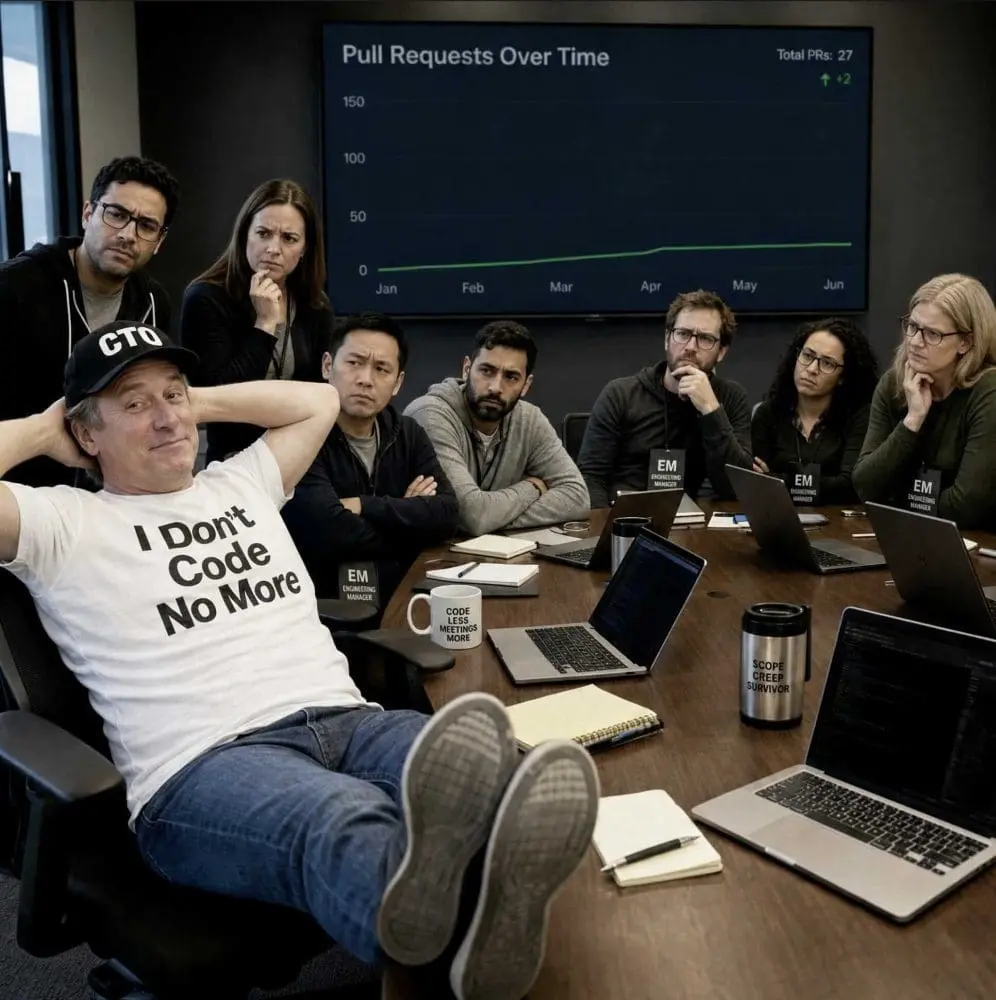
2. The CTO Who Stopped Committing Code
Perhaps the most dangerous impostor in the modern tech stack is the engineering leader imported from a massive B2B giant or stagnant unicorn who hasn’t written a line of production code in years.
- The Reality: Software development has transformed radically. With the maturation of AI-driven coding assistants and automated deployment pipelines, the speed and scale at which a small engineering team can ship code have multiplied exponentially. A CTO who isn’t hands-on with these technologies every single week is flying blind. They cannot accurately estimate team velocity, call out padded development estimates, or discern which engineers have adapted to the AI era.
- The Fallout: Innovation grinds to a halt. If founders are shipping production code and experimenting with cutting-edge tools while their CTO is restricted to high-level architectural meetings and slide decks, the technical leadership is inverted. Innovation dies quietly under a mountain of bureaucratic technical debt.
3. The CMO Who Manages Agencies Instead of Markets
Ask a modern corporate CMO who actually owned the revenue commitment, drafted the core messaging on the homepage, wrote the launch email sequence, or built the webinar deck. If the answers consistently point to an external agency, a product marketing subordinate, or—by default—the CEO acting as the public face of the company, you are looking at a coordinator, not a marketing leader.
- The Reality: Marketing in a competitive landscape requires real-time agility, narrative creation, and hands-on demand generation. When a CMO delegates every creative and tactical output to third-party agencies and junior staff, the department devolves into administrative overhead: managing a content calendar, adjusting a budget spreadsheet, and reviewing dashboards of vanity metrics (Marketing Qualified Leads) that fail to tie back to pipeline conversion.
- The Fallout: True demand generation shrinks. Pipeline metrics flatten, and every quarter ends with lengthy excuses centered around attribution models rather than actual revenue contribution.
4. The CCO Who Relies Solely on Digital Health Scores
Customer Success has evolved from a passive support function into the primary engine of net revenue retention (NRR) and onboarding optimization—especially in an era where AI agent deployments require deep, hands-on technical and operational integration.
- The Reality: A Chief Customer Officer or VP of Customer Success who spends all their time staring at internal dashboard metrics while never boarding a flight to visit enterprise clients in person is missing the forest for the trees. Quarterly Zoom QBRs featuring nine muted participants do not constitute customer engagement.
- The Fallout: Health scores can read "green" right up until the morning a client drops a formal churn notice. If the CCO isn’t rolling up their sleeves to fix onboarding bottlenecks and drive tangible value realization, customer churn spikes, and expansion revenue evaporates.
Official Industry Perspectives & Investment Wisdom
The consensus among seasoned investors and operational founders is clear: the tolerance for administrative executives has dropped to absolute zero.
Venture capitalists who have witnessed the lifecycle of hundreds of early-to-mid-stage startups note that up to 95% of founders make the fatal mistake of hiring legacy corporate leaders during their formative growth phases. These hires are often seduced by impressive resumes from household-name technology brands, assuming that pedigree equates to operational capability.
According to industry leaders:
- The Scale Mismatch: Skills optimized for maintaining a multi-billion-dollar enterprise with established moats, massive brand equity, and thousands of employees are fundamentally misaligned with the speed, grit, and hands-on execution required to scale a company from $10M to $100M ARR.
- The Cultural Rot: When a non-executing leader is introduced into a lean startup environment, it creates immediate friction. Hardworking team members resent leaders who delegate down while adding zero tactical value.
- The Inflexibility Factor: No matter how charismatic a candidate is, or how sophisticated their organizational flowcharts and management methodologies appear, if they cannot perform the core craft of their department, they will fail 100% of the time.
Future Outlook: The Lean, AI-Augmented Executive Paradigm
Looking ahead toward the rest of the decade, the expectations placed on C-suite executives are undergoing a permanent structural shift. As AI agents and automation continue to shrink team sizes while exponentially increasing output expectations, the traditional corporate executive archetype is becoming entirely obsolete.
1. The Death of Pure Management
The notion that a C-level executive’s sole job is "managing managers" will no longer be viable for any company operating below $250M ARR. Because modern teams are leaner, hyper-efficient, and deeply integrated with advanced tooling, executive roles are shifting back to player-coach models. Leaders must be practitioners first and managers second.
2. Rigorous Pre-Hire Interrogations
Founders and boards are waking up to the danger of the "resume hire." Moving forward, rigorous vetting processes will demand practical demonstrations of capability before an offer is ever extended. Founders are increasingly relying on four critical diagnostic questions during interviews:
- When was the last time you personally executed this task?
- Can you demonstrate how you use modern tools (AI agents, code assistants, direct outreach) to accelerate this function today?
- What specific pipeline, code, campaign, or customer onboarding did you personally rescue in your last role?
- If we stripped away your team tomorrow, how would you rebuild the core output yourself?
3. The Rise of the Tactical Generalist
The future belongs to hybrid executives who combine high-level strategic vision with the raw capability to dive into the codebase, write the email, close the enterprise logo, or configure the customer deployment themselves.
For startup founders navigating the perilous journey toward scale, the directive is clear: guard your cap table, protect your culture, and never—under any circumstances—hire an executive who refuses to do the work. No matter how glittering their past resume may be, if they won’t roll up their sleeves, they are simply passengers on a rocket ship they do not know how to fly.