Published: February 7, 2018
Author: Rachel Leah (Enriched & Expanded Edition)
Executive Overview
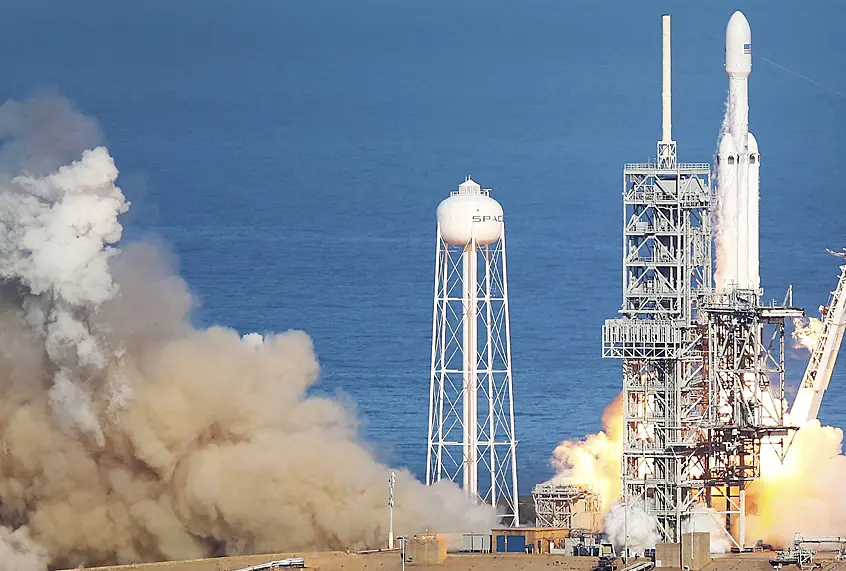
On February 6, 2018, the aerospace industry crossed a monumental threshold. From historic Launch Pad 39A at the Kennedy Space Center in Florida—the very site from which humanity once departed for the Moon—Elon Musk’s private aerospace enterprise, SpaceX, successfully executed the maiden flight of the Falcon Heavy rocket. Billed as the most powerful operational rocket in the world by a factor of two, the mammoth vehicle carried an unconventional, highly publicized payload: a cherry-red Tesla Roadster driven by a spacesuit-clad mannequin affectionately dubbed "Starman."
Beyond the engineering marvels of the launch—including the breathtaking, synchronized vertical landings of two of the rocket’s three reusable first-stage boosters—the event offered something else that immediately captured the global digital consciousness. As the spacecraft coasted into the upper reaches of the atmosphere and entered orbit, high-definition live feeds broadcast stunning, uninterrupted vistas of planet Earth, complete with its unmistakable, brilliant curvature set against the infinite velvet blackness of space.
For the vast majority of observers, scientists, and space enthusiasts, the crisp video streams served as yet another awe-inspiring confirmation of planetary geography. Yet, within moments of the broadcast, social media platforms erupted with a secondary, culturally fascinating conversation: Would these undeniable, high-altitude visuals finally put an end to the resurgent phenomenon of "flat-Earth" conspiracy theories?
As this report explores, while the imagery provided a masterclass in modern aerospace engineering and public-facing science communication, the psychological and sociological underpinnings of pseudoscientific belief systems suggest that even the most conclusive empirical evidence from space will likely fail to convince the most ardent skeptics.
Detailed Chronology: The Road to Pad 39A and the Flight of the Falcon Heavy
The journey to the February 6 launch was fraught with technical delays, developmental hurdles, and escalating expectations. Conceived originally in 2011, the Falcon Heavy was slated by SpaceX leadership to fly as early as 2013 or 2014. However, the complexities of strapping three modified Falcon 9 first-stage cores together—creating a unified structural cluster capable of generating more than 5 million pounds of thrust at liftoff—proved vastly more difficult than anticipated.
Elon Musk himself frequently tempered public expectations leading up to the launch, warning reporters and fans alike that the probability of failure on a maiden flight was exceptionally high. Unlike traditional government-funded rocket programs that carry conservative, risk-averse payloads, SpaceX opted for a dramatic marketing stunt. Rather than risking a high-value commercial satellite or a vital scientific instrument, Musk chose his own personal Tesla Roadster, equipped with cameras designed to capture multi-angle footage of the vehicle journeying into deep space.
T-Minus Zero and Beyond
At precisely 3:45 PM EST on Tuesday, February 6, 2018, the 27 Merlin engines roar to life, generating a deafening shockwave that rippled across Florida’s Space Coast. The Falcon Heavy thundered skyward, slicing through a partly cloudy Florida sky.
The mission milestones unfolded with cinematic precision:
- Max-Q (Maximum Aerodynamic Pressure): The vehicle successfully navigated the point of maximum mechanical stress on the airframe roughly a minute and a little into flight.
- Core Separation: The side boosters cleanly separated from the central core, executing intricate flip maneuvers using cold-gas thrusters.
- The Booster Landings: In what became an iconic visual touchstone for modern aerospace, the two side boosters descended simultaneously back toward Cape Canaveral Air Force Station, touching down on Landing Zones 1 and 2 in tandem. The synchronized landing looked less like real-world engineering and more like a sequence from a science-fiction film.
- Payload Deployment and Orbit Insertion: The second stage coasted before successfully injecting the Tesla Roadster and Starman into an elliptical heliocentric orbit that would stretch out toward the orbit of Mars.
As the second-stage cameras activated, streaming live video back to Earth via multiple vantage points, viewers were treated to a sweeping vista of the planet. The horizon curved gracefully away from the lens, oceans gleamed beneath swirling weather patterns, and the thin, fragile blue halo of the atmosphere stood in stark relief against the void.
Supporting Context & Metrics: The Scale of the Falcon Heavy and the Anatomy of the Debate
To understand why the February 6 launch became such a watershed cultural moment, it is necessary to examine both the technical scale of the achievement and the stubborn resilience of the conspiracy culture it intersected with.
Technical Metrics of the Falcon Heavy
- Thrust at Liftoff: ~5.1 million pounds (roughly equivalent to eighteen 747 aircraft at full power).
- Payload Capacity to Low Earth Orbit (LEO): 63,800 kilograms (140,660 lbs).
- Payload Capacity to Mars: 16,800 kilograms (37,040 lbs).
- Core Architecture: Three modified Falcon 9 nine-engine cores, totaling 27 Merlin 1D engines.
The Rise of Modern Flat-Earth Belief
Despite centuries of established scientific consensus—dating back to ancient Greek measurements of shadows by Eratosthenes, reinforced by circumnavigations of the globe, and validated by decades of crewed and uncrewed spaceflight—the 21st century has witnessed an unexpected resurgence in flat-Earth pseudoscientific beliefs.
Propelled largely by algorithm-driven video platforms like YouTube, online forums, and social media echo chambers, modern flat-Earthers reject the oblate spheroid model of the Earth. Instead, they adhere to variants of a model asserting that:
- The Earth is a flat, disk-shaped plane centered on the North Pole, with Antarctica serving as a massive wall of ice at the perimeter holding the oceans in.
- Gravity is either an illusion caused by the flat Earth accelerating upward through space at a rate of 9.8 meters per second squared, or the result of density and buoyancy alone.
- All photographic and video evidence originating from space agencies (NASA, SpaceX, ESA, etc.) is an elaborate, CGI-generated hoax orchestrated by a global conspiracy designed to hide the "true nature" of creation.
When the live feed from the SpaceX Roadster showed the curvature of the Earth, social media users immediately recognized the irony: here was a private company, broadcasting real-time, unscripted footage from an unprecedented vantage point, directly contradicting the foundational premise of flat-Earth dogma.
Official Statements and Social Media Reactions
The digital reaction was swift, ranging from triumphant scientific vindication to biting satire. Within minutes of the broadcast, internet culture seized upon the moment to mock the logic of conspiracy theorists.
Elon Musk himself tweeted a view from SpaceX Launch Control, noting simply: "Apparently, there is a car in orbit around Earth." The post garnered hundreds of thousands of likes and retweets, cementing the cultural crossover between tech innovation and meme-driven internet commentary.
Public figures and everyday social media users alike weighed in:
- Sebastian Bell (@sepsis13): "Suck it Flat Earthers. #Starman"
- Skyler (@thatguysky13): "Look you can see the curvature of the Earth, I bet the flat Earthers are pissssed."
- Dave Days: "Flat earth officially debunked… with style @SpaceX #FlatEarth"
- Darin (@darink): Sarcastically sharing a stunning, wide-angle orbital view with the caption: "Look at that flat earth."
However, amidst the celebratory digital noise, sociologists and science communicators pointed out a sobering reality: real-world evidence rarely penetrates deeply entrenched belief systems that rely on conspiratorial thinking.
Future Outlook: Pseudoscience in the Age of High-Tech Transparency
The launch of the Falcon Heavy and the successful deployment of Starman marked a massive leap forward for commercial space exploration. In the years following this 2018 milestone, SpaceX has continued to revolutionize the space industry, routinely launching crewed missions to the International Space Station, deploying massive satellite constellations for global internet coverage, and advancing the development of the Starship rocket system designed for lunar and Martian colonization.
Yet, despite reusable rockets landing on autonomous drone ships and civilian passengers routinely gazing out of cupola windows at the curvature of our world, flat-Earth communities have not dissolved.
From a psychological perspective, conspiracy theories rarely persist due to a lack of data; rather, they endure because they fulfill deep-seated psychological needs—such as a sense of belonging to an "enlightened" community, distrust of institutional authorities, and a framework that makes a chaotic world feel controllable and understandable. When presented with definitive proof that contradicts their worldview—such as live footage from a commercial sports car coasting through the cosmos—conspiracists simply expand their narrative to include the new actors. In their view, SpaceX, Elon Musk, and private aerospace are simply the newest layers of the grand deception.
Ultimately, while the Falcon Heavy’s maiden flight failed to convert the stubborn holdouts of flat-Earth belief, it achieved something far more enduring. It galvanized the global imagination, demonstrated the breathtaking potential of private space enterprise, and captured in vivid, undeniable high-definition the fragile, beautiful curve of our home planet spinning quietly in the dark.