Executive Overview
On February 6, 2018, the aerospace industry crossed a monumental threshold. From historic Launch Complex 39A at the Kennedy Space Center in Florida—the very site from which humanity once departed for the Moon—Elon Musk’s private space exploration company, SpaceX, successfully executed the maiden flight of the Falcon Heavy. Billed as the most powerful operational rocket in the world by a factor of two, the massive vehicle roared into the Florida sky, carrying an unconventional, highly publicized payload: a midnight-cherry Tesla Roadster belonging to Musk himself, complete with a spacesuit-clad dummy affectionately dubbed "Starman" behind the wheel.
While the engineering marvels of the launch—including the simultaneous, synchronized propulsive landings of two of the rocket’s three reusable first-stage boosters—captivated the global imagination and fundamentally altered the economics of heavy-lift rocketry, the mission inadvertently triggered a fierce cultural and digital debate. As crystal-clear, high-definition live feeds streamed from the edge of the atmosphere, broadcasting the unmistakable, glorious curvature of our home planet against the velvet void of space, social media erupted.
Millions of spectators watched in awe, but a vocal segment of the online community immediately pivoted to a different question: Would this finally be the definitive proof that breaks the resolve of the flat-Earth movement?
The footage was staggering, comprehensive, and broadcast live across multiple platforms without the traditional filters of institutional media or pre-packaged documentary editing. Yet, history and psychological research suggest a sobering reality: overwhelming visual evidence rarely penetrates deeply entrenched conspiracy theories. This article examines the technological triumph of the Falcon Heavy launch, the physics of observing planetary curvature from space, the mechanics of modern digital discourse, and the psychological fortress that allows the flat-Earth belief system to endure in the face of insurmountable scientific reality.
Detailed Chronology of the Falcon Heavy Inaugural Flight
The road to the launch pad for the Falcon Heavy was fraught with technical delays, engineering hurdles, and repeated warnings from Elon Musk himself regarding the high probability of failure. Designing a heavy-lift vehicle by strapping three Falcon 9 first-stage boosters together introduced unprecedented structural and aerodynamic complexities, particularly regarding the intense stress experienced during Max-Q (maximum aerodynamic pressure) and the subsequent staging events.
T-Minus Hours: The Build-Up at Kennedy Space Center
By the early morning hours of February 6, 2018, anticipation had reached a fever pitch. Hundreds of media outlets and tens of thousands of space enthusiasts had converged on the Space Coast, filling local beaches, highways, and viewing parks. Unlike traditional NASA payloads—which typically consist of multi-billion-dollar scientific instruments, classified reconnaissance satellites, or critical resupply modules for the International Space Station—SpaceX’s payload was intentionally playful, yet deeply symbolic. Mounted securely inside the custom payload fairing was Musk’s personal Tesla Roadster, playing David Bowie’s "Space Oddity" on an infinite loop, with the glove compartment housing a copy of Douglas Adams’ The Hitchhiker’s Guide to the Galaxy, a towel, and a plaque bearing the words: “Made on Earth by humans.”
Liftoff and Max-Q
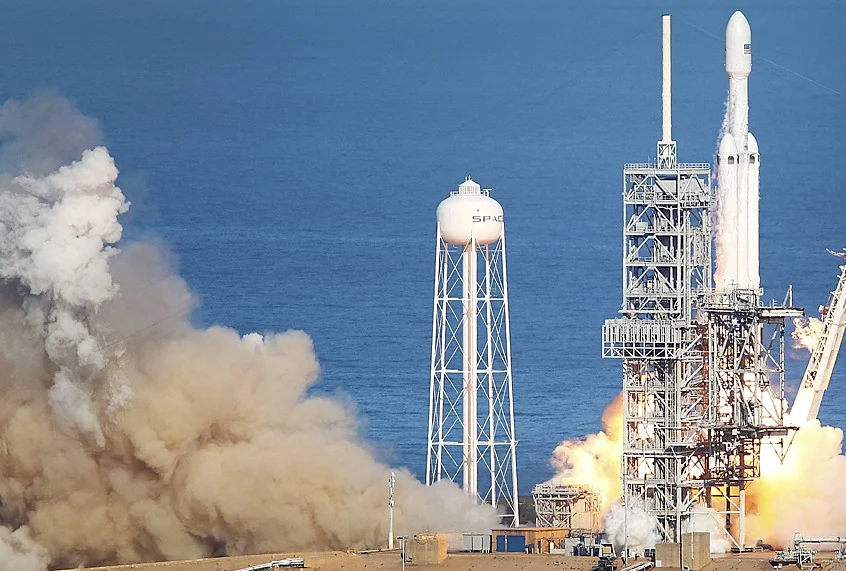
At exactly 3:45 PM EST, the nine Merlin engines on each of the three core boosters—totaling 27 engines in all—ignited in a thunderous symphony of controlled combustion. Generating more than 5 million pounds of thrust at liftoff, the Falcon Heavy slowly cleared the tower, pitching eastward over the Atlantic Ocean.
Approximately two minutes and thirty-three seconds into the flight, the side boosters successfully separated from the central core in a flawless staging maneuver. While the central core continued pushing the second stage and the Tesla Roadster deeper into the upper atmosphere, the two side boosters executed their flip maneuvers, fired their entry burns, and guided themselves back toward Cape Canaveral Air Force Station.
The Dual Landing Sensation
For the first time in history, spectators witnessed the simultaneous return of two orbital-class rocket boosters. Landing in tandem at Landing Zones 1 and 2, the twin boosters touched down vertically amidst roaring sonic booms and thunderous applause from SpaceX mission control. It was a watershed moment that visually redefined what reusable rocket technology could achieve, signaling the dawn of a new, highly cost-effective era in space logistics.
Deployment and the View from Space
Meanwhile, the second stage continued its ascent, coasting toward a trans-Mars injection orbit. Hours after launch, as the vehicle coasted through the vacuum of space, cameras mounted to the chassis of the Roadster beamed back continuous, high-definition footage of the cherry-red sports car floating against the backdrop of the cosmos. Below the vehicle, the blue oceans, swirling cloud patterns, and distinct, unmistakable curvature of the Earth were displayed in stunning clarity for millions of viewers across the globe. It was this live video feed that immediately galvanized internet commentators, setting off a digital storm regarding scientific literacy and modern conspiracy theories.
Supporting Context & Metrics: Engineering Marvels vs. Pseudoscience
To understand why the Falcon Heavy’s footage became an immediate cultural touchstone in the battle against misinformation, one must examine both the immense scale of the engineering achievement and the stubborn mechanics of the counter-movement it sought to challenge.
The Scale of the Falcon Heavy
- Total Thrust at Liftoff: ~5.1 million pounds (roughly equivalent to eighteen 747 aircraft at full power).
- Payload Capacity to Low Earth Orbit (LEO): 63,800 kilograms (140,660 lbs).
- Payload Capacity to Mars: 16,800 kilograms (37,000 lbs).
- First-Stage Engines: 27 Merlin 1D engines operating in concert.
- Cost Efficiency: Designed to drastically reduce the cost per pound to orbit, opening commercial markets previously restricted by exorbitant legacy launch expenses.
The Flat-Earth Phenomenon in the Digital Age
In stark contrast to the empirical precision required to calculate orbital mechanics, trajectory vectors, and gravitational assist maneuvers, the flat-Earth movement has experienced a resurgence in the 21st century, largely fueled by algorithmic social media platforms, recommendation engines, and online echo chambers.
Adherents of the flat-Earth theory claim that the planet is not an oblate spheroid, but rather a disc-shaped landmass centered around the North Pole, bounded by an impassable wall of ice (Antarctica) that purportedly holds the oceans in place. Within this framework, gravity is often explained away as either upward acceleration of the disc through space (driven by universal acceleration) or through density and buoyancy differentials.
Crucially, flat-Earth epistemology relies on a foundational conspiracy theory: that every space agency on Earth (including NASA, ESA, Roscosmos, and private entities like SpaceX), every commercial airline pilot, every satellite communications provider, and virtually the entire global scientific community are engaged in a massive, coordinated global deception. According to this worldview, all imagery of a spherical Earth—dating back to the iconic "Blue Marble" photograph taken by the Apollo 17 crew in 1972—is meticulously fabricated using computer-generated imagery (CGI), fish-eye lenses, or staged studio environments.
When the SpaceX live stream began broadcasting unbroken, unedited, multi-angle footage of the Roadster ascending through the stratosphere and into orbit, mainstream internet users assumed the ultimate trump card had finally been played. Sarcastic hashtags like #Starman, #FlatEarth, and direct taunts flooded Twitter (now X), YouTube, and Reddit, with users declaring the conspiracy officially and definitively debunked.
Official Statements and Global Reactions
The cultural shockwaves of the Falcon Heavy launch extended far beyond the aerospace community, prompting reactions from industry leaders, cultural commentators, and science communicators alike.
Following the successful deployment of the payload, Elon Musk addressed the media during a post-launch press conference, highlighting the philosophical and inspirational value of the mission:
"Life cannot just be about solving one miserable problem after another. There need to be things that inspire you, that make you glad to wake up in the morning and be part of humanity. That is why we did it. We wanted to get people excited about the future."
When questioned about the unorthodox payload and whether it was intended to provoke critics of mainstream science, Musk maintained a lighthearted demeanor, noting that the absurdity of the stunt was part of its charm:
"I love the thought of a car driving aimlessly through spacepans—maybe discovered by millions of years from now by some alien civilization that will wonder what kind of strange creatures built such a device and put a mannequin in a tuxedo inside it."
Science communicators and educators were quick to praise the educational windfall provided by the high-definition footage. Dr. Neil deGrasse Tyson and various independent physics educators pointed out that the continuous nature of the video—spanning hours from liftoff to deep-space coasting—made it mathematically and optically impossible to dismiss as a studio trick or a fisheye distortion effect, as the gradual transition from troposphere to exosphere provided a continuous visual proof of planetary geometry.
However, spokespersons and prominent figures within the flat-Earth community were predictably unmoved. In subsequent online forums, digital video breakdowns, and alternative podcasts, flat-Earth influencers dismissed the SpaceX footage using established defensive tropes:
- The Fisheye Lens Argument: Claiming that camera lenses with wide fields of view artificially curve straight horizons.
- The CGI Allegation: Asserting that the live stream suffered from digital artifacts or pre-rendered transitions during the ascent phase.
- The "Hollywood" Production Narrative: Drawing absurd parallels between commercial rocket launches and cinematic special effects, effectively insulating their belief system from any form of empirical falsification.
Future Outlook: The Intersection of Space Exploration and Scientific Literacy
The 2018 Falcon Heavy launch served as a powerful reminder that technological progress does not automatically cure societal skepticism. As humanity pushes deeper into the cosmos—with ambitions set on lunar return missions via NASA’s Artemis program, commercial space stations, and eventual crewed expeditions to Mars—the democratization of space imagery will only accelerate.
The Role of Private Spaceflight
Private companies like SpaceX, Blue Origin, and Rocket Lab are effectively democratizing access to Earth orbit. As commercial space tourism expands and more civilian passengers travel to the edge of space, direct, personal observation of the Earth’s curvature will become increasingly accessible to private citizens, further eroding the foundation of geographically isolated conspiracy theories.
The Ongoing Battle for Scientific Literacy
Yet, the persistence of flat-Earth belief highlights a deeper, more systemic challenge for modern society: the crisis of trust in institutional science and empirical methodology. Psychologists studying belief systems note that conspiracy theories often serve psychological functions—providing adherents with a sense of community, special knowledge, and agency in an increasingly complex and overwhelming world. Consequently, facts and visual proofs alone are rarely sufficient to change a believer’s mind; true shifts require addressing the underlying social and psychological drivers of alienation and institutional distrust.
As the Tesla Roadster—bearing its silent occupant, Starman—continues its elliptical orbit around the sun, drifting through the silent vacuum of interplanetary space, it stands as a dual monument. On one hand, it is a shining testament to human ingenuity, engineering excellence, and the relentless drive to explore the unknown. On the other hand, it remains a fascinating cultural artifact of our digital age—a high-definition mirror reflecting humanity’s ongoing struggle between empirical reality and the enduring allure of myth.