Executive Overview
For well over a decade, the consumer data broker Radaris.com operated with near-total impunity. Despite countless requests from individuals demanding the removal of their personal information from its sprawling network of people-search engines, the company maintained a rigid reputation for stonewalling, evasion, and procedural warfare. That era of unchecked dominance has officially come to an end.
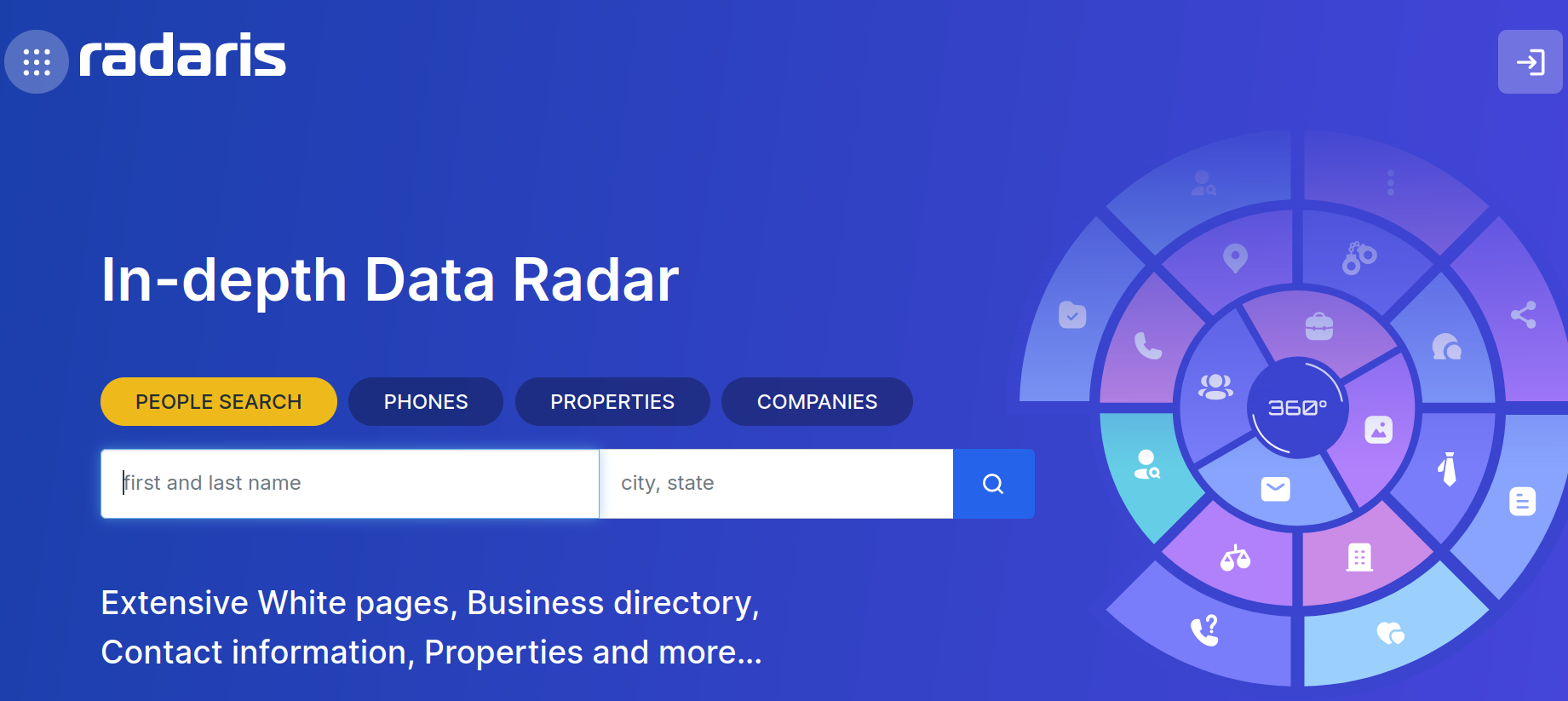
In a landmark legal victory, a federal and state showdown culminating in New Jersey has stripped Radaris of its crown jewel. Following a pattern of calculated delays, false fronts, and aggressive legal posturing, a judge ordered that radaris.com—along with more than a dozen associated domains—be transferred directly to the plaintiffs. Rather than functioning as a searchable index of millions of American citizens, the flagship radaris.com domain now redirects to an official legal notice regarding the court-ordered forfeiture.
The lawsuit, spearheaded by data privacy enforcement firm Atlas Data Privacy Corp, targeted Radaris for brazen violations of New Jersey’s Daniel’s Law. Named in honor of a slain family member of a state judge, the statute empowers law enforcement personnel, judges, and government officials to scrub their data entirely from commercial people-search sites, levying fines of up to $1,000 per violation for non-compliance.
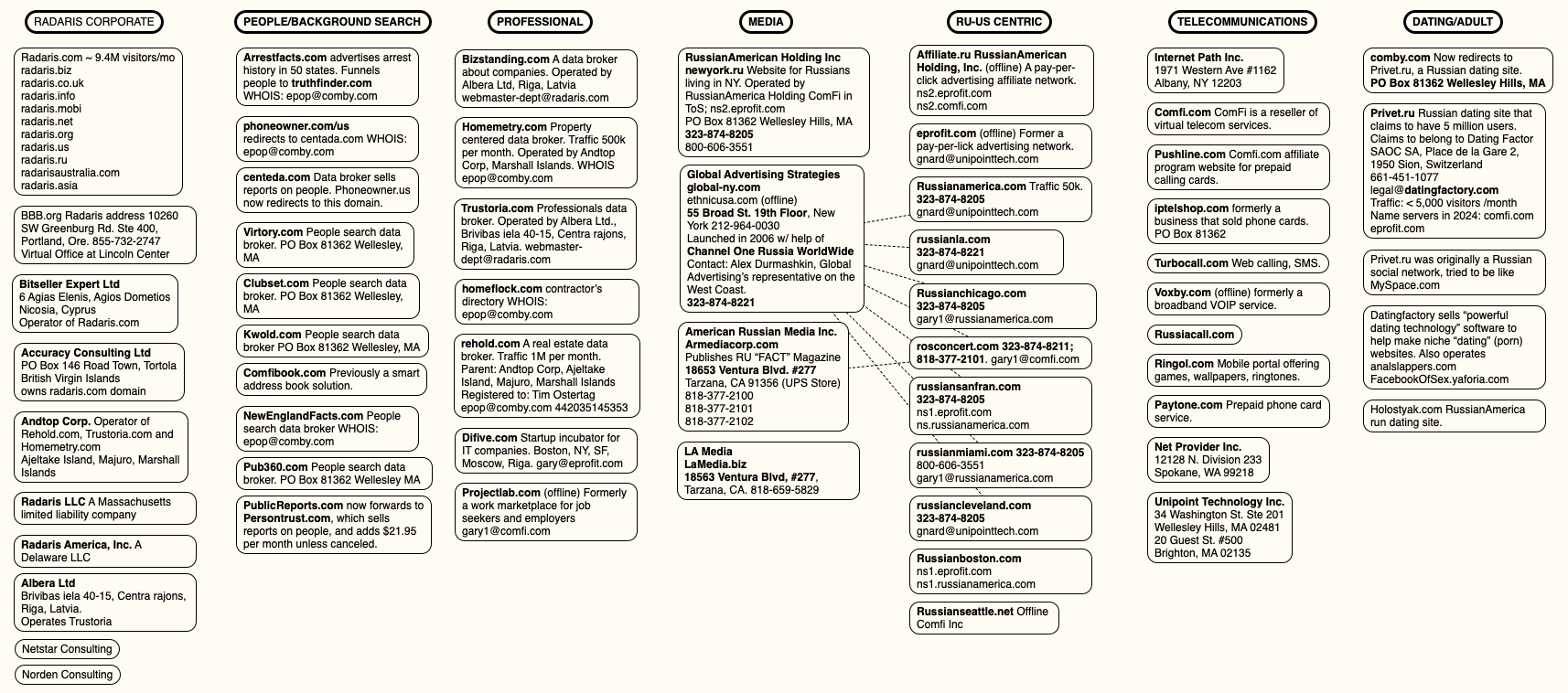
The enforcement action did more than extract a symbolic penalty; it cracked open a secretive corporate labyrinth. Court documents, internal emails, and independent investigative reporting have revealed that Radaris is not an isolated entity, but rather the beating heart of an interconnected empire of over 25 people-search sites. Operated by a tight-knit group based in the Boston area—led by Russian-born brothers Igor and Dmitry Lubarsky—the network managed to rake in millions of dollars annually while hiding behind a shifting facade of offshore shell companies.
As Daniel’s Law faces a massive constitutional battle in federal appellate courts, the fall of Radaris serves as a watershed moment for the global data broker industry. It exposes the fragile house of cards underpinning modern data scraping, while underscoring the desperate need for comprehensive, federal digital privacy reform.
Detailed Chronology: The Anatomy of an Investigation and Legal War
The Spark: Atlas Sues Under Daniel’s Law
The legal onslaught began in February 2024, when Atlas Data Privacy Corp filed suit against Radaris. Atlas had positioned itself as a primary corporate enforcer of Daniel’s Law, a New Jersey statute designed to protect public safety officials by forcing commercial data brokers to purge their records. The law carries real teeth: statutory damages of $1,000 for every individual violation where a covered official’s data remains published after a removal request.
Almost immediately, Radaris fell back on its historical playbook: delay, obfuscation, and jurisdictional shell games. Attorneys for the company dragged their feet, waiting until the absolute final legal window to contest proceedings, while asserting that Atlas had failed to serve the "real" owners of the platform.
Unmasking the Operators: The Lubarsky Brothers and "Gary Norden"
Only a month after the lawsuit was filed, investigative reporting by KrebsOnSecurity blew the lid off the actual masterminds behind the platform. The deep dive exposed Igor and Dmitry Lubarsky (also known as Gary Lybarsky), two Russian-born brothers residing in Massachusetts. The brothers were operating a sprawling conglomerate of people-search directories alongside various Russian-language dating services and affiliate programs.
The response from the brothers’ legal counsel was swift and aggressive. Attorneys representing the Lubarskys threatened a defamation lawsuit unless the expose was scrubbed and a formal public apology issued. The defense insisted that the reporting was fundamentally flawed and that Radaris was actually owned by Ukrainian nationals living in Ukraine.
However, subsequent investigative reporting systematically dismantled that narrative. Journalists proved that the Lubarsky brothers had engineered Radaris and its sister platforms using a completely fictitious CEO named “Gary Norden.” Radaris’s own attorney, Val Gurvits of the Boston Law Group, ultimately admitted in legal settings that his clients had fabricated the "Gary Norden" persona. The fake executive’s name had even been deployed across multiple corporate press releases designed to lure outside investors.
The "Island-Hopping" Corporate Shell Game
When the original legal strategies failed to deflect scrutiny, Radaris dramatically expanded its defensive maneuvers. In June 2025, Atlas re-filed its lawsuit, exponentially expanding the number of corporate entities tied to the Radaris umbrella.
According to Matt Adkisson, President and CEO of Atlas, the defense team engaged in a calculated corporate shell game.
"We refer to this period as their island-hopping phase," Adkisson noted. "Privacy policies changed constantly, and new entities kept appearing from places like the Marshall Islands, the British Virgin Islands, and Seychelles."
Behind the scenes, the mechanics of evasion were staggering. Defense attorneys would designate a specific corporate entity as the sole operator of a domain, framing it as the only valid target for litigation. Yet, precisely as a judgment approached, that entity would be quietly dissolved or discarded, replaced by a fresh, unserved corporation registered in a distant offshore tax haven. When Radaris updated its terms of service to claim management by a Marshall Islands entity called Andtop Company, Atlas dispatched an investigator to the islands, only to discover that the designated management company did not even legally exist.
This strategy of attrition had served the founders well for nearly a decade. Plaintiffs’ attorneys, exhausted by procedural road-blocks and the steep costs of chasing foreign-shielded corporate entities, had historically given up. But Atlas committed the necessary time, capital, and legal resources to pierce the corporate veil.
The Judgment and Domain Seizure
The turning point arrived on August 26, when the New Jersey court ruled decisively against the defendants, finding that they had squandered numerous opportunities to mount a legitimate defense.
Because Radaris’s legal representatives continuously stonewalled and failed to answer the merits of the claims, the court ordered Verisign—the registry for top-level domains—to transfer radaris.com and 13 sister domains directly to Atlas.
Unsurprisingly, the legal counter-offensive was swift. Mr. Gurvits stepped aside, and attorney Victor Worms took the reins, filing a motion to vacate the default judgment. Worms argued that the default judgment was void because "Radaris.com" is technically a domain name, not a formal legal entity with the capacity to sue or be sued. Furthermore, Worms claimed the domain transfer amounted to an unconstitutional forfeiture.
Despite these legal maneuvers, the reality on the ground has shifted permanently: radaris.com no longer generates revenue or distributes personal dossiers, instead greeting visitors with a notice of transfer from Atlas.
Supporting Context & Metrics: Inside the Data Broker Financial Machine
The scale of the Radaris enterprise was long obscured by its web of foreign registries. However, documents obtained during the litigation—encompassing over 10,000 emails, bank statements, and vendor agreements—shattered the illusion that Radaris was a decentralized collection of independent businesses.
The Corporate Web
Atlas’s legal discovery revealed that nominal legal entities including Radaris America, Inc., Bitseller Expert Limited, Digital Orbit Corp, Core Solutions Group Inc, Lucky Solutions Inc, Virtura Corp, Veripages Inc., Nuform Solutions Inc., Growth Data Advisors Inc., and Property Experts, Inc. were nothing more than paper dolls.
In reality, all of these corporate vehicles were administered by the exact same group of three or four individuals, operating out of identical email infrastructures, drawing from a centralized financial pool, and managed through a single virtual office address. Technical analysis of the corporate corpus revealed that the entire administrative and financial apparatus for more than 25 distinct people-search sites was anchored to the difive.com mail domain and its evolutionary successors (centerex.com, scienteco.com, eprofit.com, realmo.com, and pub360.com).
Revenue Streams and Industry Partnerships
The internal documents exposed lucrative revenue streams that highlight how data brokers mutually sustain one another:
- Radaris.com pulled in an estimated $42,000 per month in direct traffic and consumer search monetization.
- Veripages.com, another asset within the network, generated roughly $45,000 monthly through lucrative data-sharing and advertising partnerships with the Lifetime Value Company—the parent organization behind well-known consumer brands like PeopleLooker, PeopleSmart, NumberGuru, and the automotive history platform Bumper.
- The network generated up to $25,000 monthly through commercial partnerships with Onerep, a privacy-washing service that purports to help consumers remove their digital footprints from people-search directories.
This last partnership underscores a deeply cynical dynamic within the data privacy sector: investigative reports have previously demonstrated that the founders of major removal services frequently launch or operate people-search sites themselves, effectively monetizing both the exposure of personal data and the desperate consumer’s desire to delete it.
Official Statements and Industry Perspectives
The fallout from the Radaris case has drawn sharp commentary from legal experts and privacy advocates who have monitored the data brokerage ecosystem for years.
Raj Parikh, a partner at PEM Law in New Jersey who has spearheaded the core Daniel’s Law litigation for Atlas, emphasized the psychological and financial toll the defendants inflicted on the legal system.
"In the past, they won by attrition," Parikh explained. "Plaintiffs’ attorneys tired of the procedural games and just gave up. That strategy worked for a decade, and it probably would have worked in this case too, given how difficult financial recovery from foreign actors is. But we were acutely aware of the threat this website posed to law enforcement officers and other public officials in New Jersey, and decided early on to commit whatever time and resources were necessary to remove that threat."
On the defense side, attorney Victor Worms maintained that the judicial process had overstepped constitutional boundaries. In a statement addressing the domain seizure, Worms argued:
"We have made a motion to vacate that default judgment on the grounds that it is void since a non-entity has no legal capacity to sue or be sued. We also intend to pursue all appropriate appeals because we believe the transfer of Radaris.com amounts to a forfeiture in violation of various constitutional principles."
Future Outlook: The Battle for Privacy Legislation
While the fall of Radaris marks a massive tactical victory for Atlas and the defenders of Daniel’s Law, the broader war over commercial data brokering is entering an uncertain and highly contentious phase.
The Constitutional Test in Federal Courts
Daniel’s Law itself is currently facing an existential threat. Roughly 150 consumer data broker firms have banded together to mount a fierce constitutional challenge against the statute. At least 70 of these lawsuits have been successfully pushed into federal court, where the data broker lobby argues that Daniel’s Law is unconstitutionally broad and an infringement upon First Amendment protections regarding the distribution of public records.
While the U.S. Court of Appeals for the Third Circuit has yet to rule on the core New Jersey dispute, legal scholars anticipate that the litigation will inevitably scale the steps of the U.S. Supreme Court. The legislative landscape at the state level is similarly fractured: while at least 14 other states have introduced or passed bills modeled after Daniel’s Law, federal district courts have demonstrated a willingness to strike them down. Notably, in August 2025, a federal district court ruled West Virginia’s version of Daniel’s Law facially unconstitutional under the First Amendment.
The Structural Flaw: "Public Records" Exemptions
Justin Sherman, a prominent privacy expert and author of the forthcoming book The Middlemen, which dissects the data broker industry’s role in modern surveillance, notes that targeted state laws are ultimately insufficient without broader structural reform.
Sherman points out that people-search engines will continue to proliferate so long as federal and state legislators refuse to tackle the foundational loophole: public record exemptions. Virtually all existing state privacy legislation explicitly exempts records deemed "public" or "government-generated"—including voting registries, property deeds, marriage licenses, motor vehicle records, criminal histories, court files, and professional licenses.
"The average person can look at Daniel’s Law and have a perfectly normal reaction, which is that everyone should be covered, not just police and judges," Sherman said. "Pero we don’t need more wake-up calls. We’ve had eight million wake-up calls already on the need for better privacy laws. The lack of comprehensive federal privacy law is not for a lack of knowledge, and anyone claiming otherwise is either not reading the news or kidding themselves."
Big Tech and Industry Lobbying
At the federal level, comprehensive consumer privacy legislation remains deadlocked. Sherman attributes this stagnation to an intense, multi-front lobbying campaign waged not just by boutique data brokers, but by a coalition of social media giants, cryptocurrency firms, and artificial intelligence proponents. These powerful industry groups routinely pressure lawmakers by arguing that restricting data scraping and collection will cripple American technological competitiveness.
The consequences of this legislative vacuum extend far beyond people-search sites. As states increasingly mandate age-verification measures for online services—requiring citizens to upload government-issued identification cards—the absence of federal restrictions on how those documents are stored, shared, and managed creates catastrophic systemic risk. A prime example is the recent breach at IDScan.net, which exposed the driver’s license records of over 153 million Americans, instantly transforming sensitive state identity documents into a point-and-click identity theft inventory on the dark web.
Conclusion
The court-ordered forfeiture of Radaris.com is undeniably a watershed moment, proving that even the most deeply entrenched, offshore-shielded data brokers can be held accountable when plaintiffs possess the resources and determination to pierce their corporate camouflage. However, as the legal battle shifts to federal appellate courts and data brokers rally behind First Amendment defenses, the case of Radaris serves as a stark reminder: picking off individual bad actors will never be enough. Until governments enact robust, federal data protection laws that rein in the commercial exploitation of public and private records alike, the multi-billion-dollar data surveillance machine will simply adapt, morph, and find new domains to inhabit.