Executive Overview
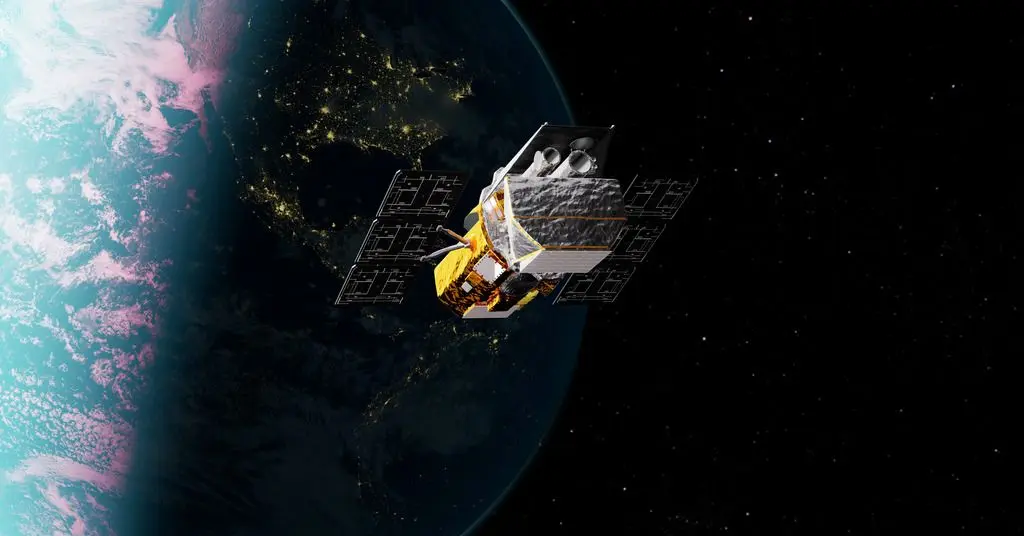
For over two decades, the Neil Gehrels Swift Observatory has served as one of humanity’s most watchful sentinels, peering deep into the cosmos to capture the raw, violent power of gamma-ray bursts (GRBs)—the most energetic electromagnetic explosions in the universe. Launched in 2004 with a modest, two-year primary mandate, this pioneering spacecraft far exceeded expectations, operating as a critical pillar of multi-messenger and time-domain astronomy well into its third decade. However, the remarkable run of the Swift observatory is now drawing to a premature and dramatic close.
Facing an accelerating orbital decay driven by an unexpected surge in solar activity, NASA recently attempted a high-stakes, cinematic salvage operation. Teaming up with commercial aerospace innovator Katalyst Space Technologies, the space agency sought to rendezvous with the ageing observatory using a robotic servicing vehicle equipped with mechanical capture arms. The goal was nothing short of unprecedented: to grapple an unserviceable, legacy spacecraft never designed for docking, lift it to a safe orbital altitude, and extend its scientific lifespan for years to come.
Alas, reality proved far less forgiving than science fiction. Following the July 3, 2026, launch of the Katalyst LINK spacecraft, critical attitude control failures crippled the chaser vehicle’s ability to maintain stable orientation. Despite weeks of frantic troubleshooting by ground engineering teams, the obstacles proved insurmountable. On Wednesday, NASA formally announced the cancellation of the primary rescue mission, abandoning the effort to boost Swift’s orbit.
While the historic telescope is now destined to plunge back into Earth’s atmosphere and disintegrate before the end of the year, the mission is far from a total loss. NASA has pivoted the stranded LINK spacecraft toward secondary objectives, transforming a failed salvage operation into an invaluable technological proving ground for proximity operations and autonomous rendezvous. This comprehensive retrospective examines the twilight of the Swift observatory, the intricate mechanics of its attempted rescue, the solar forces that sealed its fate, and what this watershed moment means for the booming frontier of in-space satellite servicing.
Detailed Chronology: From Launch to the Failed Intercept
To understand the dramatic final chapters of the Swift observatory, one must trace a timeline defined by decades of scientific triumph, sudden environmental threats, and a breathtakingly fast commercial space race against the clock.
The Golden Years (2004–2023)
- November 20, 2004: Swift blasts off aboard a Delta II rocket from Cape Canaveral Air Force Station. Equipped with three primary instruments—the Burst Alert Telescope (BAT), the X-Ray Telescope (XRT), and the Ultraviolet/Optical Telescope (UVOT)—its core mission is to autonomously detect, locate, and study gamma-ray bursts within seconds of their occurrence.
- 2006–2023: Having successfully completed its primary two-year mission, Swift enters an extended operational phase. It becomes a workhorse of modern astrophysics, shifting its gaze not only to GRBs but also to tidal disruption events, comets, supernovae, and active galactic nuclei. It routinely alerts ground-based and space-based telescopes worldwide to transient cosmic phenomena.
The Solar Threat Amplifies (2023–2025)
- Early 2024: As the Sun approaches the peak of its roughly 11-year activity cycle (Solar Cycle 25), space weather intensifies dramatically. Increased solar flares and coronal mass ejections pump unprecedented amounts of extreme ultraviolet radiation into Earth’s upper atmosphere.
- Mid-to-Late 2024: The thermosphere heats up, swelling outward like a warming balloon. At altitudes of several hundred kilometers, where Swift orbits without an active propulsion system, the density of residual atmospheric gas molecules increases significantly.
- Late 2025: Orbital tracking data reveals that Swift’s orbital decay has accelerated exponentially. While prior models predicted the satellite could safely remain aloft until the 2030s, revised trajectories indicate that atmospheric drag is pulling the observatory down toward an inevitable atmospheric reentry much sooner than anticipated—likely by late 2026.
The Scramble for a Commercial Fix (Early 2026)
- January–March 2026: Recognizing the impending loss of a major astrophysical asset, NASA explores unconventional solutions. Because Swift lacks an onboard propulsion system and a standard grappling fixture, traditional orbital rescue is impossible. The agency turns to the agile commercial sector, partnering with Katalyst Space Technologies.
- April–June 2026: Katalyst fast-tracks the development of the LINK spacecraft—an innovative robotic chaser designed to close the orbital distance, utilize advanced machine vision, capture the tumbling observatory via robotic arms, and fire its own thrusters to push Swift into a higher, protected orbit. The engineering timeline is astonishingly compressed, reflecting the urgency of Swift’s descent.
- July 3, 2026: The LINK spacecraft launches into low-Earth orbit, kicking off a high-risk, high-reward mission widely billed as a turning point for commercial orbital logistics.
The Crisis and Pivot (July–August 2026)
- Mid-July 2026: Shortly after achieving orbit, LINK encounters critical technical hurdles. The spacecraft experiences severe anomalies within its attitude control system—the vital mechanical and software array responsible for maintaining proper orientation, stability, and pointing accuracy in the harsh vacuum of space.
- Late July to Early August 2026: Engineers across NASA and Katalyst work around the clock, attempting software patches and workaround maneuvers to stabilize the crippled chaser.
- Wednesday, August 2026: NASA officially pulls the plug. Agency leadership announces the cancellation of the Swift boost maneuver, confirming that LINK will no longer attempt to capture or elevate the telescope. Instead, the mission parameters are adjusted to utilize LINK’s remaining capabilities for proximity navigation demonstrations before Swift’s final descent.
Supporting Context & Metrics: The Physics of Orbital Decay and Solar Forcing
To appreciate why Swift could not save itself—and why rescuing it required an orbital ballet of astronomical precision—one must examine the unforgiving physics of low-Earth orbit (LEO).
The Invisible Brake: Atmospheric Drag
Orbiting hundreds of kilometers above the terrestrial surface, spacecraft like Swift appear to reside in the pristine vacuum of space. However, the boundary where Earth’s atmosphere ends and interplanetary space begins is not a hard wall; it is a gradual fade. At Swift’s operational altitude, trace quantities of molecular nitrogen, oxygen, and hydrogen persist.
As a satellite barrels through these sparse gas particles at speeds exceeding 27,000 kilometers per hour, microscopic collisions occur. Each collision strips an infinitesimal fraction of kinetic energy from the spacecraft. This continuous deceleration is known as atmospheric drag.
Without an onboard propulsion system to periodically perform station-keeping burns—propulsive maneuvers that inject energy back into the orbit—a satellite will inevitably lose altitude. As it drops lower, the atmospheric density increases, compounding the drag force, accelerating the descent, and creating a terminal feedback loop that ends in atmospheric reentry.
Solar Cycle 25: The Catalyst of Destruction
The rate of orbital decay is not constant; it is profoundly influenced by space weather driven by our Sun. During periods of low solar activity (solar minimum), the sun emits relatively stable radiation, and Earth’s upper atmosphere remains cool and compact.
During solar maximum, however, the dynamic is entirely different. Solar flares and intense ultraviolet (UV) radiation heat the thermosphere, causing gases to expand upward. This expansion elevates the dense layers of the atmosphere to higher altitudes.
For Swift, the heightened solar activity of Solar Cycle 25 during 2024 served as an invisible guillotine. The expanded atmosphere reached higher into space, dramatically increasing the drag cross-section of the telescope. Projections that once gave the observatory another decade of life were slashed overnight, compressing its remaining lifespan down to mere months and forcing NASA’s hand into an emergency rescue attempt.
Official Statements and Leadership Perspectives
The decision to cancel the mission and let a beloved telescope fall to Earth was not made lightly. Agency leadership has been remarkably transparent about the calculated risks involved and the long-term strategic vision guiding these pioneering commercial partnerships.
NASA Administrator Jared Isaacman addressed the media and the scientific community in an official press release, emphasizing that while the immediate outcome is disappointing, the broader mission parameters remain a resounding success for the future of space exploration.
"This is not the outcome we were working toward, but it does not change why this mission was worth attempting," Isaacman stated. "The team moved with extraordinary speed to give Swift a chance to carry out more science while advancing capabilities America will need for satellite servicing in the future. We are going to learn everything we can from LINK’s rendezvous attempt and put those lessons to work on the missions that follow."
Isaacman also defended the agency’s willingness to embrace high-risk, high-reward ventures, particularly when partnering with nimble private aerospace startups:
"NASA should be willing to move quickly and take smart risks when the potential return is worth it, and that is exactly what we did with this mission."
Industry experts note that traditional NASA programs often require years of risk mitigation and redundant testing—a luxury that Swift simply did not possess once its orbital decay timeline accelerated. Katalyst Space Technologies designed and deployed the LINK spacecraft under immense time pressure, a testament to the new paradigm of commercial agility. While attitude control failures ultimately grounded the capture phase, the engineering data harvested during the crisis will provide an invaluable masterclass for future orbital maintenance missions.
Future Outlook: The Dawn of Orbital Servicing and the Legacy of Swift
As the Swift observatory prepares for its fiery atmospheric swan song later this year, the astrophysics community is mourning the loss of a prolific instrument. During its tenure, Swift revolutionized our understanding of gamma-ray bursts, proving that short bursts are often produced by the collision of neutron stars—a discovery that paved the way for modern gravitational-wave astronomy. When it finally reenters the atmosphere, much of the spacecraft will incinerate under extreme aerodynamic heating and frictional forces, leaving no hazardous debris behind.
Yet, the true legacy of the Swift crisis extends far beyond the data it beamed back to Earth. It has served as a baptism by fire for the nascent orbital servicing industry.
The Growing Need for In-Space Logistics
As Earth’s orbit becomes increasingly congested with functional satellites, defunct hardware, and dangerous space debris, the ability to service, refuel, repair, and relocate spacecraft has transitioned from science fiction to an economic and environmental necessity.
- Space Sustainability: Traditional satellite operations operate on a "launch, use, and abandon" model. In-space servicing promises a circular space economy, where aging assets can have their lifespans artificially extended via external propulsion modules.
- Commercialization of LEO: Companies like Katalyst Space Technologies, Northrop Grumman (via its Mission Extension Vehicles), and Astroscale are pioneering technologies that will allow operators to manage orbital real estate proactively rather than reactively.
Lessons Learned from the LINK Mission
Though the LINK spacecraft was unable to execute its primary grappling maneuver, its ongoing proximity operations and navigation demonstrations are yielding critical empirical data. By testing autonomous rendezvous algorithms and close-range sensors in real-world orbital environments, engineers are identifying the precise failure modes that plague complex autonomous systems in space.
The lessons forged in the crucible of the Swift rescue mission will directly inform the next generation of robotic servicing vehicles. Future missions will feature more resilient attitude control architectures, standardized grappling fixtures mandated for all future spacecraft, and more robust fault-tolerance protocols.
Ultimately, Swift’s final act was not merely a tragic descent, but a catalyst. It forced space agencies and commercial pioneers to stare down the logistical nightmares of orbital decay and test the boundaries of what is technologically possible. When the Swift observatory lights up the upper atmosphere in its final moments later this year, it will do so having expanded human knowledge across two decades of cosmic discovery—and having laid the very foundation for the tools that will manage humanity’s future among the stars.