Executive Overview
In the autumn of 2012, the intersection of corporate marketing, video game culture, and digital journalism produced one of the most enduring memes and ethical debates in modern media history: the "Dorito Pope." This moniker, bestowed upon prominent Canadian video game journalist Geoff Keighley, emerged directly from a seemingly innocuous promotional interview conducted on October 18, 2012. Framed by an overwhelming visual display of junk food branding—specifically Mountain Dew and Doritos—Keighley discussed upcoming titles like Halo 4 while physically boxed in by PepsiCo promotional merchandise.
What followed was a swift and severe public backlash that crystallized long-simmering anxieties regarding the cozy, often transactional relationship between major gaming outlets, corporate publishers, and fast-food giants. The incident served as a primary catalyst for "Doritosgate," a broader conversation concerning journalistic integrity, editorial independence, and conflict of interest within the games media ecosystem. This report provides an exhaustive investigation into the origins, evolution, and cultural legacy of the "Dorito Pope" phenomenon, analyzing its impact on digital media ethics, internet subculture, and the personal branding of one of the industry’s most visible figures.
Detailed Chronology
October 18, 2012: The Interview That Sparked a Movement
The saga began when LevelSave.com, a video game culture and news website, published an interview featuring Geoff Keighley. At the time, Keighley was a revered, veteran fixture of mainstream gaming journalism, known for his deep industry connections, hosting duties, and rigorous reporting. The interview was ostensibly meant to cover his experiences at San Diego Comic-Con, his early impressions of Microsoft’s highly anticipated Halo 4, and various industry trends.
However, the content of the interview was immediately overshadowed by its bizarre mise-en-scène. Keighley was seated directly in front of and surrounded by a dense fortification of Mountain Dew and Doritos products. The visual setup was designed to promote "Mtn Dew and Doritos XP," a massive cross-promotional campaign between PepsiCo and Microsoft. This marketing blitz allowed players to secure double experience points (XP) in Halo 4 by inputting unique codes printed under the caps and packaging of participating snacks and beverages.
Rather than maintaining an objective distance from promotional material, Keighley sat at the epicenter of a corporate sales pitch. Within hours of its publication, the video drew intense scrutiny across gaming forums, social media platforms, and enthusiast sites. Viewers recoiled at the blatant commercialization of a journalistic interview, noting the cognitive dissonance of a reporter discussing creative art forms while framed by neon-green soda bottles and nacho cheese chip bags. The video’s reception on platforms like YouTube quickly plummeted; within a relatively short window, it accumulated nearly 50,000 views alongside an overwhelmingly negative ratio of roughly 1,200 downvotes to a mere 125 upvotes.
October 24, 2012: "Lost Humanity 18" and the Birth of Doritosgate
The internet backlash transitioned from internet mockery to institutional critique six days later, on October 24, 2012. Rab Florence, a prominent writer for Eurogamer.net, published a scathing opinion piece titled "Lost Humanity 18: A Table of Doritos."
Florence used Keighley’s interview as a striking symptom of a larger, systemic malaise infecting gaming journalism. In the opening paragraphs, Florence targeted Keighley directly, painting a vivid picture of a critic compromised by corporate proximity. The article argued that games journalism had grown too close to the multi-billion-dollar entities it was supposed to scrutinize, trading critical distance for exclusive access, swag, and advertising dollars.
Florence’s critique struck a nerve, acting as the match that lit "Doritosgate"—a watershed moment for media ethics discussions online. The term merged the pervasive corporate synergy of snack foods with the suffix "-gate," echoing historic political scandals and signaling a permanent shift in how consumers viewed the independence of game critics.
October 26, 2012: Satire and Remix Culture Take Hold
As editorial discussions raged in professional columns, internet creators weaponized the incident through the medium of remix culture and parody. On October 26, 2012, a YouTube creator operating under the handle PewpewVIDEOGAMES uploaded a video titled "Double your Gaming Journalism with Geoff Keighley™."
The video expertly satirized the absurdity of the original interview by lifting the segment where Keighley discussed the Halo 4 XP promotion and seamlessly splicing it with frantic multiplayer footage from Halo 3. To compound the mockery, the gameplay footage featured a player repeatedly performing a "teabagging" animation over a defeated opponent—a classic, crude multiplayer ritual. This juxtaposition of high-profile corporate journalism with juvenile gaming culture cemented the surreal nature of the scandal, giving internet meme creators a potent template for future satire.
January 1, 2013: Institutionalizing the Meme in Year-End Retrospectives
The resonance of the "Dorito Pope" nickname and the accompanying controversy remained potent as the year drew to a close. On January 1, 2013, popular YouTube content creator AngryJoeShow released a comprehensive countdown of the top 10 gaming controversies of 2012.
In his video breakdown, the Doritosgate scandal and Keighley’s corporate positioning were ranked near the very top of the industry’s most egregious missteps, trailing only massive historical grievances like the fan backlash over Mass Effect 3‘s controversial endings and the real-world geopolitical espionage arrests of Arma III developers in Greece. By cementing the incident in a widely viewed year-end retrospective, the controversy transitioned from a fleeting forum joke into an official milestone in gaming history.

Supporting Context & Metrics
To fully understand the cultural footprint of the "Dorito Pope" phenomenon, one must examine the socio-technical environment of the internet in 2012. The early 2010s represented a transitional era for digital media: legacy print gaming magazines were rapidly folding or moving exclusively online, independent blogs were fighting for survival, and YouTube was evolving into a dominant platform for cultural commentary.
Quantitative Breakdown of the Original Artifact
- Date of Publication: October 18, 2012
- Original Platform: LevelSave.com
- Primary Subject: Geoff Keighley, discussing Halo 4 and San Diego Comic-Con
- Promotional Partner: PepsiCo (Mountain Dew) and Microsoft (Xbox)
- Metrics (as of May 2014):
- Total Views: ~50,000
- Upvotes: 125
- Downvotes: ~1,200
- Dislike Ratio: ~90.5% negative engagement, highlighting a severe disconnect between audience expectations and journalistic execution.
The Evolution of Image Macros and Derivative Media
The meme quickly broke containment from video platforms, saturating image-sharing boards, Reddit, and Twitter. Graphic designers and forum dwellers produced dozens of image macros that satirized the aesthetic of the interview.
Common motifs included:
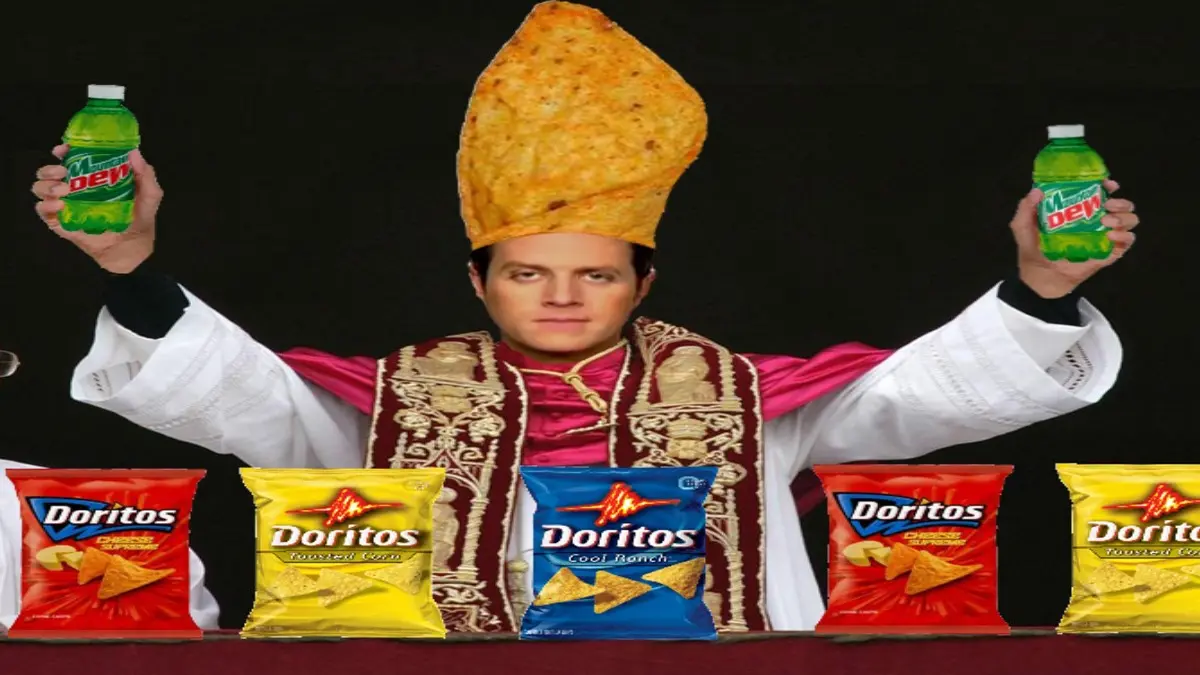
- Photoshopping papal vestments, tiaras, and religious iconography onto Geoff Keighley’s likeness, explicitly tying the "Pope" title to the worship of corporate consumer goods.
- Layering fictional video game UI elements, promotional codes, and PC hardware requirements over the original interview background to mock the invasive nature of corporate advertisements.
- Creating fictional product lines, such as "Doritos Praxis Rating" or "Mountain Dew Evolution," merging cyberpunk aesthetics with junk food branding.
These artifacts demonstrated a sophisticated literacy among internet users, who utilized irony and pastiche to critique the commodification of their hobby.
Official Statements and Industry Reactions
In the immediate wake of the interview and Florence’s subsequent column, the industry experienced a defensive posture from mainstream outlets, contrasted with intense demands for transparency from independent commentators.
Geoff Keighley initially attempted to navigate the storm by focusing on his ongoing work, though the sheer ubiquity of the nickname made avoidance impossible. Over subsequent years, Keighley distanced himself from the traditional editorial structures that birthed such compromises. By launching independent, digitally native showcases—most notably The Game Awards in 2014 and Summer Game Fest—Keighley consciously pivoted toward a model where he acts explicitly as a producer, host, and marketer of video game announcements, rather than a traditional journalist bound by strict objectivity norms. Ironically, while The Game Awards has often faced its own modern criticisms regarding heavy corporate sponsorships and commercial integration, Keighley successfully transformed his public persona from a compromised traditional reporter into a master showman of digital industry spectacles.
Rab Florence’s article for Eurogamer also prompted internal reckonings across various gaming publications. Editors began drafting stricter guidelines regarding gifts, travel accommodations, review copies, and promotional partnerships. While the line between enthusiast press and corporate PR departments remained porous, the public scrutiny demanded a higher baseline of disclosure regarding sponsored content.
Future Outlook
More than a decade after the birth of the "Dorito Pope," the legacy of the 2012 interview continues to cast a long shadow over digital media, influencer culture, and game journalism.
The Shift from Traditional Journalism to Creator-Led Marketing
The core tension exposed by Doritosgate—the conflict between independent critical analysis and commercial promotion—has not disappeared; rather, it has radically mutated. In the contemporary media landscape, traditional written gaming journalism has shrunk dramatically due to economic pressures, layoffs, and shifting platform algorithms. In its place, independent content creators, Twitch streamers, and YouTube personalities dominate the promotional pipeline.
Today, major publishers routinely bypass traditional journalists entirely, funneling marketing budgets directly to high-profile influencers. These creators are frequently flown out to exclusive preview events, gifted elaborate PR packages, and paid to stream sponsored gameplay. While these sponsorships are legally required to be disclosed, the modern creator economy often operates in a gray area that makes the corporate positioning of Geoff Keighley in 2012 look quaint by comparison.
The Permanent Lexicon of Internet Satire
Despite the evolution of media monetization, the "Dorito Pope" remains a foundational meme of the digital age. It serves as a permanent linguistic and visual shorthand for institutional sellouts, corporate heavy-handedness, and the absurdities inherent in marketing pop culture to digital natives. Whenever modern media events feature heavy-handed brand integration—such as corporate executives awkwardly holding energy drinks on stage or streaming setups cluttered with unnecessary consumer goods—the ghost of the 2012 LevelSave interview is invariably invoked by internet users.
Ultimately, what began as a poorly staged promotional video transformed into an invaluable cultural checkpoint. It empowered consumers to critically evaluate the media they consume, permanently altered the discourse surrounding journalistic ethics, and inadvertently helped shape the career trajectory of one of modern gaming’s most recognizable impresarios.